
Ezrachapter 9
15 verses · Ezra, by tradition · 5th century BC · History
But now, for a brief moment, grace has come from the LORD our God to preserve for us a remnant and to give us a stake in His holy place. Even in our bondage, our God has given us new life and light to our eyes.
Introduction
Ezra, by tradition, History, Ezra Overview.
This chapter was written for a small community in danger of losing itself among its neighbours. It is told in Ezra's own voice and centres on one of the great prayers of confession in the Old Testament. Its first hearers knew the history of Israel's drift into the religions of the land and what it had cost them. The chapter shows a leader who grieves before he acts. Listen for the pronouns in the prayer, and notice whom Ezra counts among the guilty. Listen too for how he sets the sin against the mercy just received. Read it as confession made on behalf of others.
Context
- Who
- A tiny community that had been quietly dissolving into its neighbors
- What
- An account of the report of mixed marriages among the people and their leaders, Ezra's public grief and his prayer of confession.
- Where
- Jerusalem, before the house of God, at the time of the evening sacrifice.
- When
- Some four months after Ezra's arrival, in 458 BC, before the ninth month in which chapter 10 is dated.
- Why
- To show the community that returning home had not cured the old sin, and to model a leader who confesses with his people rather than against them.
Historical context
The officials come to Ezra with a report he did not expect: the people, the priests, and the Levites have intermarried with the surrounding peoples, "and the hand of the princes and rulers hath been chief in this trespass." The leadership was leading it.
Show the rest of the historical context, 5 more paragraphs
The concern was not ethnic. The list of peoples named is a list of religious traditions, the cults of the land that had pulled Israel apart for centuries and had, in the end, cost them the country. Malachi describes the same crisis as marrying "the daughter of a strange god."
Scale is what made it urgent. The whole province of Judah in this period was small, a district perhaps twenty-five miles across, with a population in the tens of thousands at most, surrounded by larger groups. A generation or two of intermarriage without conversion would have ended the community as a distinct people, and with it the line the promises ran through.
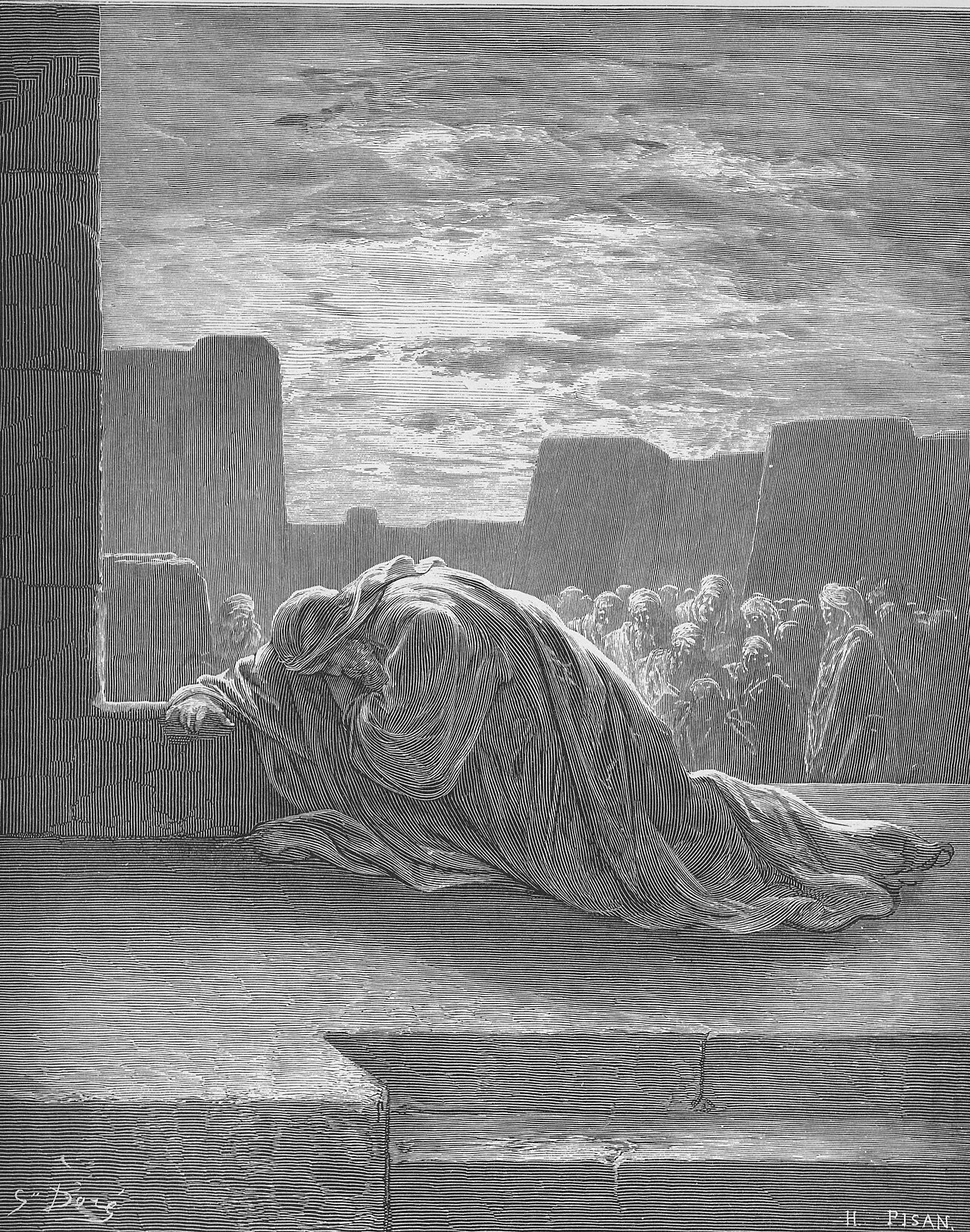
Ezra's reaction is physical and public: he tears his clothes and his robe, pulls hair from his head and beard, and sits stunned until the evening sacrifice. Then he kneels with his hands spread out and prays.
The prayer never says "they." It says "our iniquities are increased over our head," and "we are before thee in our trespasses." Ezra had been in the country four months and had nothing to do with it.
He also names what makes it worse: God had just given them "a nail in his holy place", a peg, a foothold, a little reviving in their bondage. This was happening after the mercy, not before it.
Significance
For the community this chapter said the exile had not actually cured them. They had come home, rebuilt the house, and reproduced the old problem inside two generations.
Show the rest of the significance, 1 more paragraph
It also gave them a leader who grieved rather than lectured. The people gathered around Ezra while he wept, and that is how the next chapter starts, a crowd assembled by somebody else's sorrow.
This chapter in Jewish lifeWhat this chapter is in Jewish life and reading.
What is done
Ezra's prayer of confession has no place in the synagogue year. The site's own table in src/lib/hebraic/readings.ts printed parashot total 0 and haftarah uses total 0 for Ezra, and no festival reading.
The chapter records Ezra's fast, and Rashi reads the rising from it plainly: "for I had not eaten on that day" (Rashi on Ezra 9:5:1). Under the fourth verse the corpus carries Megillah 30b:8 and Taanit 13a:1.
How it is read
Rashi is the one commentator on this chapter whose English the corpus carries, quoted here from The Judaica Press complete Tanach with Rashi, translated by A. J. Rosenberg, which Sefaria reports as CC-BY. He reads the report to Ezra as a report of treachery. The leaders "commenced to deal treacherously by intermarrying with the peoples of the lands" (Rashi on Ezra 9:2:1). Ezra's state he glosses as "miserable and bewildered", comparing Ezekiel sitting bewildered for seven days (Rashi on Ezra 9:3:1).
In the prayer Rashi reads the present condition of the people. The phrase "as of this day" he explains, "for the Ten Tribes have already been exiled, and many of the exiles still remain in Babylon" (Rashi on Ezra 9:7:2). The short moment of grace is "temporarily" (Rashi on Ezra 9:8:1). The slavery is service "to Darius, king of Persia" (Rashi on Ezra 9:9:1). The land is to be left to the children "as an inheritance to eternity" (Rashi on Ezra 9:12:1).
At the last verse Rashi reads the reason the people cannot stand. "we do not have the power of good deeds to stand and exist before You, because of this transgression" (Rashi on Ezra 9:15:1). Several of his notes are grammar alone, on the doubled letters of the verbs (Rashi on Ezra 9:7:1 and 9:9:2).
The corpus carries eight further notes on this chapter without an English text, each marked linked because Sefaria holds no English version of the ref. Three stand cited and unquoted at Rashi on Ezra 9:2:2, 9:4:1 and 9:6:1, and five at Metzudat David on Ezra 9:3:1, 9:4:1, 9:5:1, 9:6:1 and 9:10:1.
What the rabbis say
The corpus carries twenty-four rabbinic locators on this chapter and the text of none, so each is cited here rather than quoted. On the second verse, the intermarriage, it holds Bava Metzia 108a:2, Ein Yaakov, Bava Metzia 9:7 and Ein Yaakov (Glick Edition), Bava Metzia 9:4. With them stand Jerusalem Talmud Sotah 1:8:4 and a passage of Otzar Midrashim on missing and extra letters, at 2:5. On the fourth it holds Megillah 30b:8, Taanit 13a:1, Jerusalem Talmud Sotah 1:1:5 and Midrash Tehillim 141:1. On the sixth it holds Midrash Tehillim 38:1 and Pesikta Rabbati 44:1.
The ninth verse, the slavery to Darius, draws the heaviest run. The corpus holds Megillah 10b:30 and 11a:1, Shabbat 11a:2, Ein Yaakov, Megillah 1:18 and Shabbat 1:8, Ein Yaakov (Glick Edition), Megillah 1:12, and Midrash Lekach Tov, Deuteronomy 31:6:1.
On the twelfth verse the corpus holds Midrash Sekhel Tov, Bereshit 34:9:2. On the thirteenth it holds Midrash Tehillim 30:4, 62:4 and 62:5. On the fourteenth it holds Sifra, Acharei Mot, Chapter 13 23 and Yalkut Shimoni on Torah 599:2. What each of them teaches is a saying of the rabbis, and is reported as theirs wherever this site quotes one. The quotations wait on a fetch that carries the text.
Sources: Rashi, Rashi on Ezra 9:1:1 to 9:15:1, The Judaica Press complete Tanach with Rashi, translated by A. J. Rosenberg, reported CC-BY; Rashi on Ezra 9:2:2, 9:4:1 and 9:6:1 cited by ref because the corpus carries no English text; Metzudat David, Metzudat David on Ezra 9:3:1, 9:4:1, 9:5:1, 9:6:1 and 9:10:1, cited by ref because the corpus carries no English text; The Sefaria corpus, scripts/data/sources/sefaria/ezra/9.json, the 24 Talmud and Midrash locators of this chapter; The site's own files, src/lib/hebraic/readings.ts, probed for this book and printing parashot total 0, haftarah uses total 0 and festivalReadingForBook null.
The heads below are this chapter's scenes. The numbered points under each are its verses.
Ezra hears of mixed marriages and sits down astonished
Ezra 9:1-2
have not kept themselves separate: The leaders report that the people, priests and Levites included, have not kept themselves separate from the surrounding peoples. The roll of eight nations echoes the conquest list of Deuteronomy 7:1. Verse 2 names the offense: the holy seed has been mixed with the people of the land.
Ezra 9:1
“Abominations - The mixed marriages had prevented that complete separation of the people of God from the idolatrous rites, or “abominations,” which the Law required, and which was necessary for purity of religion. See 1Ki 11:2 note.”
the holy seed has been mixed: Henry, following Bishop Patrick, reads the charge as marriage with the peoples of the land that would lead by degrees to idolatry. The list at 10:18 opens with sons of Jeshua son of Jozadak, of the high priest's family. Barnes counts four of that family among the guilty.
Ezra 9:2
“We are willing to hope that they did not worship their gods, but that their captivity had cured them of their idolatry: it is said indeed that they did according to their abominations; but that (says bishop Patrick) signifies here only the imitation of the heathen in promiscuous marriages with any nation whatsoever, which by degrees would lead them to idolatry.”
Matthew Henry · Commentary on the Whole Bible (1707-1721)puritan
Ezra 9:3-4
I tore my tunic and cloak: Ezra tears his tunic and cloak, pulls out hair from his head and beard, and sits down in horror. Everyone who trembled at the words of the God of Israel gathers around him. No blame is spoken yet, and the chapter's first response to the report is open mourning.
Ezra 9:3
“Plucking out the hair with the hands, so common among the Classical nations, is, comparatively speaking, rarely mentioned as practiced by Asiatics.”
everyone who trembled at the words: The same group returns at 10:3, where Shecaniah proposes a covenant by the counsel of those who tremble at the command of God. Adam Clarke places the evening offering between sunset and the end of twilight, and John Gill has the report reach Ezra early in the morning.
Ezra 9:4
“Those that had been carried away - Those that had returned long before with Zerubbabel; see Ezr 9:1. Until the evening sacrifice - The morning sacrifice was the first of all the offerings of the day, the evening sacrifice the last. As the latter was offered between the two evenings, i.e., between sunset and the end of twilight, so the former was offered between break of day and sunrise. Ezra sat astonied - confounded in his mind, distressed in his soul, and scarcely knowing what to do.”
Adam Clarke · Commentary on the Bible (1810-1826)evangelical
1 more voice on this verse
Ezra 9:4
“Those that tremble at the word of God cannot but tremble at the sins of men, by which the law of God is broken and his wrath and curse are incurred. The pious zeal of one against sin may perhaps provoke very many to the like, as the apostle speaks in another case, 2 Cor. ix.”
Matthew Henry · Commentary on the Whole Bible (1707-1721)puritan
A prayer at the evening sacrifice: our iniquities are grown over our head
Ezra 9:5-6
I fell on my knees: Ezra confesses with no petition: "I am ashamed and embarrassed to lift up my face to You, my God". Our iniquities, he says, are higher than our heads. Ezra was not among the intermarried, yet he prays in the first person plural, owning the nation's sin as his own.
Ezra 9:5
“And at the evening sacrifice I rose up from my heaviness,.... The signs and tokens of it, particularly sitting on the ground; or "from my fasting" (n), having eaten nothing that day, it being early in the morning when he was told the above case: and having rent my garment and my mantle; which he had done before, and still kept them on him in the same case: fell upon my knees, and spread out my hands unto the Lord my God; in the posture and with the gesture of an humble supplicant. (n) מתעניתי "jejunio meo", Michaelis; so Jarchi.”
2 more voices on this verse
Ezra 9:5
“In this he had an eye to God as the Lord, and as his God, a God of power, but a God of grace. It is not properly to be called a prayer, for there is not a word of petition in it; but, if we give prayer its full latitude, it is the offering up of pious and devout affections to God, and very devout, very pious, are the affections which Ezra here expresses.”
Matthew Henry · Commentary on the Whole Bible (1707-1721)puritan
Ezra 9:5
“He did this at the time of the evening sacrifice, because then devout people used to come into the courts of the temple, that hearing his confession, they likewise might be made sensible of the sins of the people. And he had an eye to that great propitiation, of which that sacrifice was a peculiar type.”
John Wesley · Explanatory Notes upon the Old Testament (1765)evangelical
I am ashamed and embarrassed: Ezra's shame comes after much grace. Clarke reads it as the shame of one who must lift his face again to ask mercy for a people God had often pardoned. Ezra calls God his own, and Henry finds a ground of hope in that covenant name.
Ezra 9:6
"Iniquity has grown up to such a height among us that it reaches to the heavens, so very impudent that it dares heaven, so very provoking that, like the sin of Sodom, it cries to heaven for vengeance." But let this be the comfort of true penitents that though their sins reach to the heavens God's mercy is in the heavens, Ps. xxxvi. Where sin abounds grace will much more abound.
Matthew Henry · Commentary on the Whole Bible (1707-1721)puritan
2 more voices on this verse
Ezra 9:6
“I am ashamed and blush - God had been so often provoked, and had so often pardoned them, and they had continued to transgress, that he was ashamed to go back again to the throne of grace to ask for mercy in their behalf. This is the genuine feeling of every reawakened backslider.”
Adam Clarke · Commentary on the Bible (1810-1826)evangelical
Ezra 9:6
“Our - He includes himself in the number of the transgressors, because he himself was guilty of many sins; and because the princes and priests, and so many of the people having done this, the guilt was now become national.”
John Wesley · Explanatory Notes upon the Old Testament (1765)evangelical
Ezra 9:7-9
From the days of our fathers: The guilt runs from the days of the fathers to the exile. Against that he sets present grace, come "for a brief moment" with a remnant and a stake in His holy place. Clarke takes the stake as ground enough for a tent peg.
Ezra 9:7
“Have we been - We are not purged from the guilt of our fathers sins, but we are still feeling the sad effects of them; yea, and are repeating the same sins.”
John Wesley · Explanatory Notes upon the Old Testament (1765)evangelical
1 more voice on this verse
Ezra 9:7
“Very similar in tone to this are the confessions of Nehemiah Neh 9:29-35 and of Daniel (see the marginal references). The captivity had done its work by deeply convincing of sin the Jewish nation that had previously been so proud and self-righteous.”
for a brief moment: Henry reads for a brief moment as a warning: the grace was recent and might soon end. That made the new guilt worse. Clarke explains the remnant: the ten tribes were gone into captivity, and much of Judah and Benjamin still lived beyond the Euphrates.
Ezra 9:8
“And now for a little space - This interval in which they were returning from servitude to their own land. Grace hath been showed - God has disposed the hearts of the Persian kings to publish edicts in our favor. To leave us a remnant to escape - The ten tribes are gone irrecoverably into captivity; a great part even of Judah and Benjamin had continued beyond the Euphrates: so that Ezra might well say, there was but a remnant which had escaped. A nail in his holy place - Even so much ground as to fix our tent-poles in.”
Adam Clarke · Commentary on the Bible (1810-1826)evangelical
1 more voice on this verse
Ezra 9:8
“Observe, [1.] The time of mercy: Now for a little space, that is, "It is but a little while since we had our liberty, and it is not likely to continue long." This greatly aggravated their sin, that they were so lately in the furnace and that they knew not how soon they might return to it again; and could they yet be secure? [2.] The fountain of mercy: Grace has been shown us from the Lord.”
Matthew Henry · Commentary on the Whole Bible (1707-1721)puritan
Though we are slaves: Albert Barnes stresses the present tense of the confession. The exiles had come home, and the Persian king was still their absolute lord and master. Ezra sets that bondage beside the grace shown through the kings of Persia, the same crown that holds them.
Ezra 9:9
“We are to reckon it a great comfort and advantage to have stated opportunities of worshipping God. Blessed are those that dwell in God's house, like Anna that departed not from the temple. This is my rest for ever, says the gracious soul. [4.] The effects of all this.”
Matthew Henry · Commentary on the Whole Bible (1707-1721)puritan
1 more voice on this verse
Ezra 9:9
“We were bondmen - Rather, “we are bondmen” (compare the marginal reference). The Israelites, though returned from the captivity, were still “bondmen.” The Persian monarch was their absolute lord and master.”
Ezra 9:10-12
what can we say after this?: The confession turns to helplessness, asking "what can we say after this". He then states the law almost word for word from Deuteronomy 7:3. The stated ground is strength and the land as an inheritance, and Nehemiah 10:28 later receives those who separate themselves to the Law.
Ezra 9:10
“And now, O our God, what shall we say after this?.... What apology or excuse can be made for such ingratitude? what can be said in favour of such a people? what kindness can be expected to be shown to a people who had behaved in so base a manner? for we have forsaken thy commandments: particularly those which related to marriages with people of other nations.”
polluted by the impurity of its peoples: Henry notes that sin appears exceedingly sinful when set beside the law it breaks, and Ezra sets the commandments of the prophets before God. The abominations here are those of verse 1, likened there to those of the Canaanites. Barnes reads them as idolatrous rites.
Ezra 9:11
“Saying - The words which follow in this verse are not quoted from any previous book of Scripture, but merely give the general sense of numerous passages. Compare the marginal references.”
1 more voice on this verse
Ezra 9:11
“For sin appears sin, appears exceedingly sinful, when we compare it with the law which is broken by it. Nothing could be more express: Give not your daughters to their sons, nor take their daughters to your sons. The reason given is because, if they mingled with those nations, they would pollute themselves.”
Matthew Henry · Commentary on the Whole Bible (1707-1721)puritan
Never seek their peace or prosperity: Gill finds the command against seeking their peace at Deuteronomy 23:6, and limits it to the time the peoples kept their idolatries and impurity. He takes forever to run at least until the Messiah came.
Ezra 9:12
“Now therefore give not your daughters unto their sons, nor take their daughters unto your sons,.... That is, in marriage, see Deu 7:3, where the prohibition is expressed in the same language: nor seek their peace or their wealth for ever; that is, as long as they continue in their idolatries and impurities, see Deu 23:6, that ye may be strong, and eat the good of the land, and leave it for an inheritance to your children for ever; that they might be strengthened and established in the land into which they were brought, and enjoy all the good things…”
Ezra 9:13-15
punished us less than our iniquities deserve: The confession says that God has "punished us less than our iniquities deserve" and left a remnant. Ezra asks whether they will again break His commandments and intermarry with these peoples, since God's anger would leave no remnant or survivor. The prayer ends without petition: "You are righteous!"
Ezra 9:13
“Hast punished us less than our iniquities - Great, numerous, and oppressive as our calamities have been, yet merely as temporal punishments, they have been much less than our provocations have deserved.”
Adam Clarke · Commentary on the Bible (1810-1826)evangelical
shall we again break Your commandments: The word again reaches back to verse 7, where the guilt runs from the days of the fathers to this day. John Wesley reads the exiles there as repeating the fathers' sins while still feeling their effects. Shecaniah answers the question at 10:2 with hope for Israel.
Ezra 9:14
“Should we again break thy commandments, and join in affinity with the people of these abominations?.... That are guilty of abominable idolatries, and of all uncleanness: wouldest thou not be angry with us till thou hadst consumed us; it might be justly expected: so that there should be no remnant nor escaping? any left or suffered to escape the wrath of but all consumed by it.”
You are righteous!: Albert Barnes reports two readings of righteous: some take it as kind, and others as just, God having punished Israel for the forbidden marriages. John Wesley reads the confession as the people arraigning themselves before God's tribunal. They grant He would be just to destroy them.
Ezra 9:15
Some take “righteous” to mean here “kind” or “merciful.” Others give it the more usual sense of “just,” and understand the full meaning of the passage to be, “Thou art righteous, and hast punished us, because of our sin, the contraction of forbidden marriages, so that we are a mere remnant of what was once a great people.”
1 more voice on this verse
Ezra 9:15
“We are - We are here in thy presence, and so are all our sins; we are arraigning ourselves before thy tribunal, acknowledging thee to be just, if thou destroy us. Before thee - In judgment, as that word is often used, we must needs fall and perish at thy presence.”
John Wesley · Explanatory Notes upon the Old Testament (1765)evangelical
Keep studying
Sources for this chapter
The summary
Jamieson, Fausset & Brown, Commentary Critical and Explanatory; John Wesley, Notes on the Old Testament and Matthew Henry, Complete Commentary.
The exposition
Adam Clarke, Commentary on the Bible; Albert Barnes, Notes, Explanatory and Practical, on the Old and New Testaments (1832-1869); Berean Standard Bible, Ezra 10; Jamieson Fausset and Brown, Commentary Critical and Explanatory on the Whole Bible; John Gill; John Wesley, Explanatory Notes upon the Old Testament and Matthew Henry, Commentary on the Whole Bible.