
Ezra 9:10
in Ezra 9And now, our God, what can we say after this? For we have forsaken the commandments
BSB
The same verse in ASV and KJV ▾
ASV
And now, O our God, what shall we say after this? for we have forsaken thy commandments,
KJV
And now, O our God, what shall we say after this? for we have forsaken thy commandments,
⋯
This verse in Ezra 9
Commentary
6 notes on this verseAnd now, O our God, what shall we say after this?.... What apology or excuse can be made for such ingratitude? what can be said in favour of such a people? what kindness can be expected to be shown to a people who had behaved in so base a manner? for we have forsaken thy commandments: particularly those which related to marriages with people of other nations.
This site's exposition
what can we say after this
on Ezra 9:10-12
The confession turns to helplessness, asking "what can we say after this". He then states the law almost word for word from Deuteronomy 7:3. The stated ground is strength and the land as an inheritance, and Nehemiah 10:28 later receives those who separate themselves to the Law.
The record, by era
The Puritans and the Awakening2 voices
Shall we say, There is no hope, and let come on us what will? That is but to make bad worse. [2.] True penitents will consider what to say, and should, as Ezra, beg of God to teach them. God be merciful to me a sinner;" and the like.
quarantine:debris (2026-07-29) — odd-straight-quotes
Ezra, like Barnabas when he came to Jerusalem and saw the grace of God to his brethren there, no doubt was glad, and exhorted them all that with purpose of heart they would cleave to the Lord, Acts xi.
The Nineteenth Century2 voices
A commentator
Jamieson, Fausset & Brown1802–1910
Commentary Critical and Explanatory on the Whole Bible (1871)
proposed
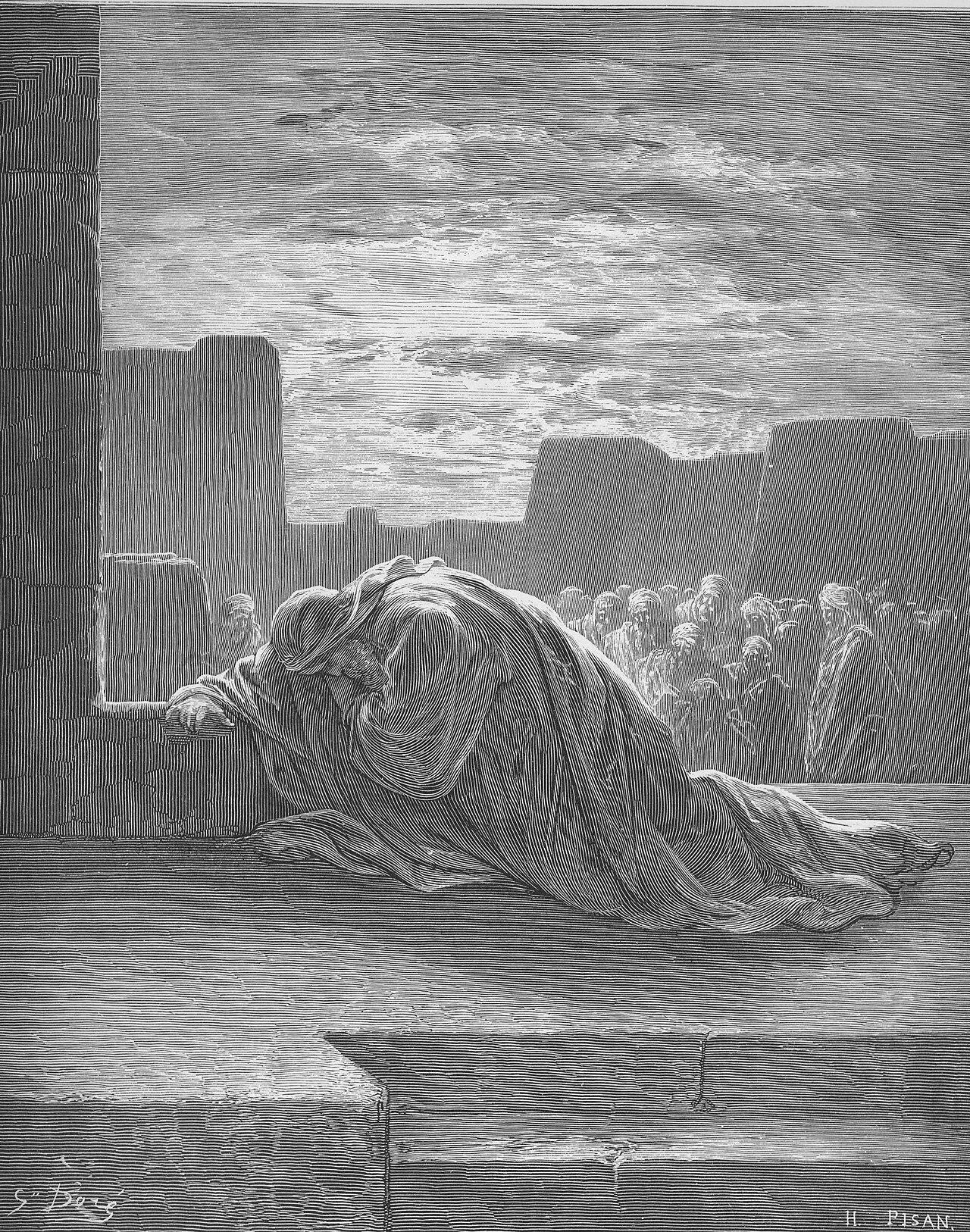
I fell upon my knees, and spread out my hands unto the Lord my God--The burden of his prayer, which was dictated by a deep sense of the emergency, was that he was overwhelmed at the flagrant enormity of this sin, and the bold impiety of continuing in it after having, as a people, so recently experienced the heavy marks of the divine displeasure.
What shall we say after this? - Even in the midst of these beginnings of respite and mercy we have begun to provoke thee anew!
The words behind it
9 Hebrew wordsEvery Hebrew word of this verse in the order it stands, with what it means and the door to its own study. The last column counts the times a word stands in the whole Bible: the rarer the word, the more the places it appears belong together.
| Hebrew | Sound | Meaning | Word study | In the Bible |
|---|---|---|---|---|
| וְעַתָּ֛ה | veatah | and therefore | H6258 → | 433 times |
| מַה־ | mah- | what? | H4100 → | |
| נֹּאמַ֥ר | nomar | will we say | H559 → | 5305 times |
| אֱלֹהֵ֖ינוּ | ʾeloheinu | O God our | H430 → | 2601 times |
| אַֽחֲרֵי־ | ʾacharei- | after | H310 → | 715 times |
| זֹ֑את | zot | this | H2063 → | 603 times |
| כִּ֥י | ki | for | H3588 → | 4482 times |
| עָזַ֖בְנוּ | ʾazavnu | we have forsaken | H5800 → | 215 times |
| מִצְוֹתֶֽיךָ׃ | mitzvoteikha | commandments your | H4687 → | 181 times |
וְעַתָּ֛הand therefore
veatahH6258 →433 times
מַה־what?
mah-H4100 →
נֹּאמַ֥רwill we say
nomarH559 →5305 times
אֱלֹהֵ֖ינוּO God our
ʾeloheinuH430 →2601 times
אַֽחֲרֵי־after
ʾacharei-H310 →715 times
זֹ֑אתthis
zotH2063 →603 times
כִּ֥יfor
kiH3588 →4482 times
עָזַ֖בְנוּwe have forsaken
ʾazavnuH5800 →215 times
מִצְוֹתֶֽיךָ׃commandments your
mitzvoteikhaH4687 →181 times
A shaded row is a word that stands 400 times or fewer in the Bible.
The walk
8 stopsEach card is a verse this one points to, and under it the verses that one points to in turn. Where several paths arrive at the same place, that place is listed first: the text keeps returning to it.
Through
Lamentations 3:22Because of the loving devotion of the LORD we are not consumed, for His mercies never fail.
it leads to
- Psalms 86:15
But You, O Lord, are a compassionate and gracious God, slow to anger, abounding in loving devotion and faithfulness.
- Luke 1:50
His mercy extends to those who fear Him, from generation to generation.
- Nehemiah 9:31
But in Your great compassion, You did not put an end to them; nor did You forsake them, for You are a gracious and compassionate God.
- Micah 7:18–19
Who is a God like You, who pardons iniquity and passes over the transgression of the remnant of His inheritance—who does not retain His anger forever, because He delights in loving devotion?
- Malachi 3:6
“Because I, the LORD, do not change, you descendants of Jacob have not been destroyed.
- Psalms 86:15
Through
Romans 3:19Now we know that whatever the law says, it says to those who are under the law, so that every mouth may be silenced and the whole world held accountable to God.
it leads to
- Galatians 3:10
All who rely on works of the law are under a curse. For it is written: “Cursed is everyone who does not continue to do everything written in the Book of the Law.”
- Galatians 3:22–23
But the Scripture pronounces all things confined by sin, so that by faith in Jesus Christ the promise might be given to those who believe.
- Romans 3:9
What then? Are we any better? Not at all. For we have already made the charge that Jews and Greeks alike are all under sin.
- Galatians 3:10
Where this verse is studied
On this page
Studies1
About Ezra
This page draws on Adam Clarke, Commentary on the Bible; Jamieson, Fausset & Brown, Commentary Critical and Explanatory on the Whole Bible; John Gill, Exposition of the Old Testament (1748-1763); John Gill, Exposition of the Old Testament and Matthew Henry, Commentary on the Whole Bible.