
Ezra 9:6
in Ezra 9and said: “O my God, I am ashamed and embarrassed to lift up my face to You, my God, because our iniquities are higher than our heads, and our guilt has reached the heavens.
BSB
The same verse in ASV and KJV ▾
ASV
and I said, O my God, I am ashamed and blush to lift up my face to thee, my God; for our iniquities are increased over our head, and our guiltiness is grown up unto the heavens.
KJV
And said, O my God, I am ashamed and blush to lift up my face to thee, my God: for our iniquities are increased over our head, and our trespass is grown up unto the heavens.
⋯
This verse in Ezra 9
Commentary
10 notes on this verseI am ashamed and blush - God had been so often provoked, and had so often pardoned them, and they had continued to transgress, that he was ashamed to go back again to the throne of grace to ask for mercy in their behalf. This is the genuine feeling of every reawakened backslider.
This site's exposition
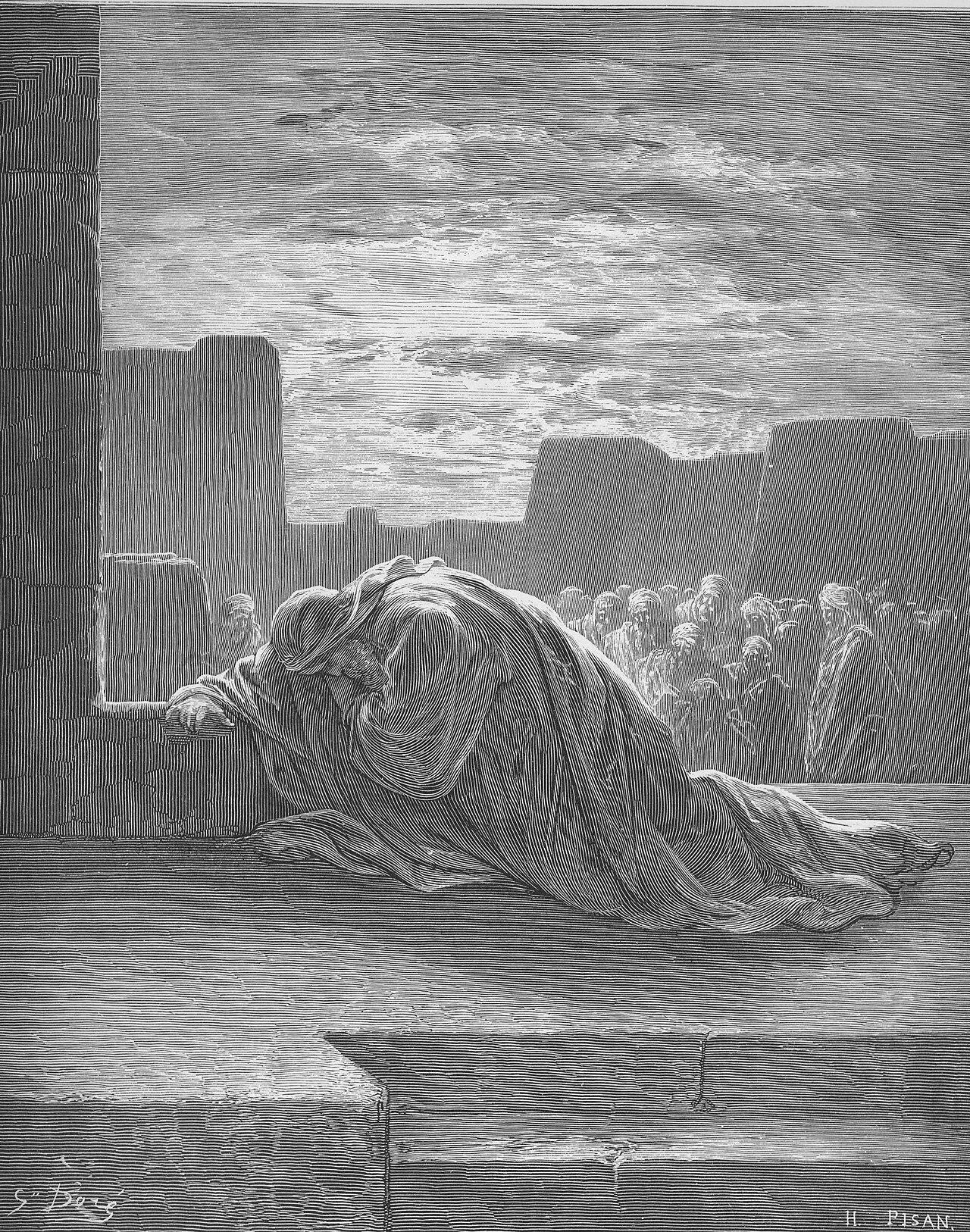
I fell on my knees
on Ezra 9:5-6
Ezra confesses with no petition: "I am ashamed and embarrassed to lift up my face to You, my God". Our iniquities, he says, are higher than our heads. Ezra was not among the intermarried, yet he prays in the first person plural, owning the nation's sin as his own.
This site's exposition
I am ashamed and embarrassed
Ezra's shame comes after much grace. Clarke reads it as the shame of one who must lift his face again to ask mercy for a people God had often pardoned. Ezra calls God his own, and Henry finds a ground of hope in that covenant name.
The record, by era
The Medieval Church1 voice
My God, I am confounded and ashamed, etc. It befits the humility of our Redeemer, who appeared in the likeness of sinful flesh to take away the sins of the world. Hence, even in the Psalms, which according to the testimony of the Gospel, are …
The Puritans and the Awakening4 voices
Our - He includes himself in the number of the transgressors, because he himself was guilty of many sins; and because the princes and priests, and so many of the people having done this, the guilt was now become national.
"Iniquity has grown up to such a height among us that it reaches to the heavens, so very impudent that it dares heaven, so very provoking that, like the sin of Sodom, it cries to heaven for vengeance." But let this be the comfort of true penitents that though their sins reach to the heavens God's mercy is in the heavens, Ps. xxxvi. Where sin abounds grace will much more abound.
The consideration of our covenant-relation to God as ours will help to humble us, and break our hearts for sin, that we should violate both his precepts to us and our promises to him; it will also encourage us to hope for pardon upon repentance. "He is my God, notwithstanding this;" and every transgression in the covenant does not throw us out of covenant.
And said, O my God,....
2 more voices on this verse
The Puritans and the Awakening1 voice
Ezra, like Barnabas when he came to Jerusalem and saw the grace of God to his brethren there, no doubt was glad, and exhorted them all that with purpose of heart they would cleave to the Lord, Acts xi.
The Nineteenth Century1 voice
A commentator
Jamieson, Fausset & Brown1802–1910
Commentary Critical and Explanatory on the Whole Bible (1871)
proposed
I fell upon my knees, and spread out my hands unto the Lord my God--The burden of his prayer, which was dictated by a deep sense of the emergency, was that he was overwhelmed at the flagrant enormity of this sin, and the bold impiety of continuing in it after having, as a people, so recently experienced the heavy marks of the divine displeasure.
The words behind it
17 Hebrew wordsEvery Hebrew word of this verse in the order it stands, with what it means and the door to its own study. The last column counts the times a word stands in the whole Bible: the rarer the word, the more the places it appears belong together.
| Hebrew | Sound | Meaning | Word study | In the Bible |
|---|---|---|---|---|
| וָאֹמְרָ֗ה | vaomerah | and I said ! | H559 → | 5305 times |
| אֱלֹהַי֙ | ʾelohai | O God my | H430 → | 2601 times |
| בֹּ֣שְׁתִּי | bosheti | I am ashamed | H954 → | |
| וְנִכְלַ֔מְתִּי | venikhlamti | and I am humiliated | H3637 → | |
| לְהָרִ֧ים | leharim | to lift up | H7311 → | 190 times |
| אֱלֹהַ֛י | ʾelohai | O God my | H430 → | 2601 times |
| פָּנַ֖י | panai | face my | H6440 → | 2123 times |
| אֵלֶ֑יךָ | ʾeleikha | to you | H413 → | 5510 times |
| כִּ֣י | ki | for | H3588 → | 4482 times |
| עֲוֹנֹתֵ֤ינוּ | ʾavonoteinu | iniquities our | H5771 → | 233 times |
| רָבוּ֙ | ravu | they have increased | H7235 → | 227 times |
| לְמַ֣עְלָה | lema'lah | <to> upwards <towards> | H4605 → | |
| רֹּ֔אשׁ | rosh | a head | H7218 → | 599 times |
| וְאַשְׁמָתֵ֥נוּ | veashmatenu | and guilt our | H819 → | 19 times |
| גָדְלָ֖ה | gadelah | it is great | H1431 → | |
| עַ֥ד | ʾad | to | H5704 → | 1261 times |
| לַשָּׁמָֽיִם׃ | lashamayim | <to> the heavens | H8064 → |
וָאֹמְרָ֗הand I said !
vaomerahH559 →5305 times
אֱלֹהַי֙O God my
ʾelohaiH430 →2601 times
בֹּ֣שְׁתִּיI am ashamed
boshetiH954 →
וְנִכְלַ֔מְתִּיand I am humiliated
venikhlamtiH3637 →
לְהָרִ֧יםto lift up
leharimH7311 →190 times
אֱלֹהַ֛יO God my
ʾelohaiH430 →2601 times
פָּנַ֖יface my
panaiH6440 →2123 times
אֵלֶ֑יךָto you
ʾeleikhaH413 →5510 times
כִּ֣יfor
kiH3588 →4482 times
עֲוֹנֹתֵ֤ינוּiniquities our
ʾavonoteinuH5771 →233 times
רָבוּ֙they have increased
ravuH7235 →227 times
לְמַ֣עְלָה<to> upwards <towards>
lema'lahH4605 →
רֹּ֔אשׁa head
roshH7218 →599 times
וְאַשְׁמָתֵ֥נוּand guilt our
veashmatenuH819 →19 times
גָדְלָ֖הit is great
gadelahH1431 →
עַ֥דto
ʾadH5704 →1261 times
לַשָּׁמָֽיִם׃<to> the heavens
lashamayimH8064 →
A shaded row is a word that stands 400 times or fewer in the Bible.
The walk
8 stopsEach card is a verse this one points to, and under it the verses that one points to in turn. Where several paths arrive at the same place, that place is listed first: the text keeps returning to it.
Through
Psalms 38:4For my iniquities have overwhelmed me; they are a burden too heavy to bear.
it leads to
- Psalms 40:12
For evils without number surround me; my sins have overtaken me, so that I cannot see. They are more than the hairs of my head, and my heart has failed within me.
- Matthew 11:28
Come to Me, all you who are weary and burdened, and I will give you rest.
- Psalms 40:12
Through
Luke 15:21The son declared, ‘Father, I have sinned against heaven and against you. I am no longer worthy to be called your son.’
it leads to
- Psalms 51:4
Against You, You only, have I sinned and done what is evil in Your sight, so that You may be proved right when You speak and blameless when You judge.
- Luke 15:18–19
I will get up and go back to my father and say to him, “Father, I have sinned against heaven and against you.
- Psalms 51:4
Through
Revelation 18:5For her sins are piled up to heaven, and God has remembered her iniquities.
it leads to
- Genesis 18:20–21
Then the LORD said, “The outcry against Sodom and Gomorrah is great. Because their sin is so grievous,
- Revelation 16:19
The great city was split into three parts, and the cities of the nations collapsed. And God remembered Babylon the great and gave her the cup of the wine of the fury of His…
- Jeremiah 51:9
“We tried to heal Babylon, but she could not be healed. Abandon her! Let each of us go to his own land, for her judgment extends to the sky and reaches to the clouds.”
- Genesis 18:20–21
Through
Ezra 9:15O LORD, God of Israel, You are righteous! For we remain this day as a remnant. Here we are before You in our guilt, though because of it no one can stand before You.”
it leads to
- Psalms 130:3
If You, O LORD, kept track of iniquities, then who, O Lord, could stand?
- Psalms 130:3
Where this verse is studied
On this page
Studies1
About Ezra
This page draws on Adam Clarke, Commentary on the Bible; Bede, Commentary on Ezra and Nehemiah; Jamieson, Fausset & Brown, Commentary Critical and Explanatory on the Whole Bible; John Gill, Exposition of the Old Testament; John Gill, Exposition of the Old Testament (1748-1763); John Wesley, Explanatory Notes upon the Old Testament and Matthew Henry, Commentary on the Whole Bible.