
Ezra 9:5
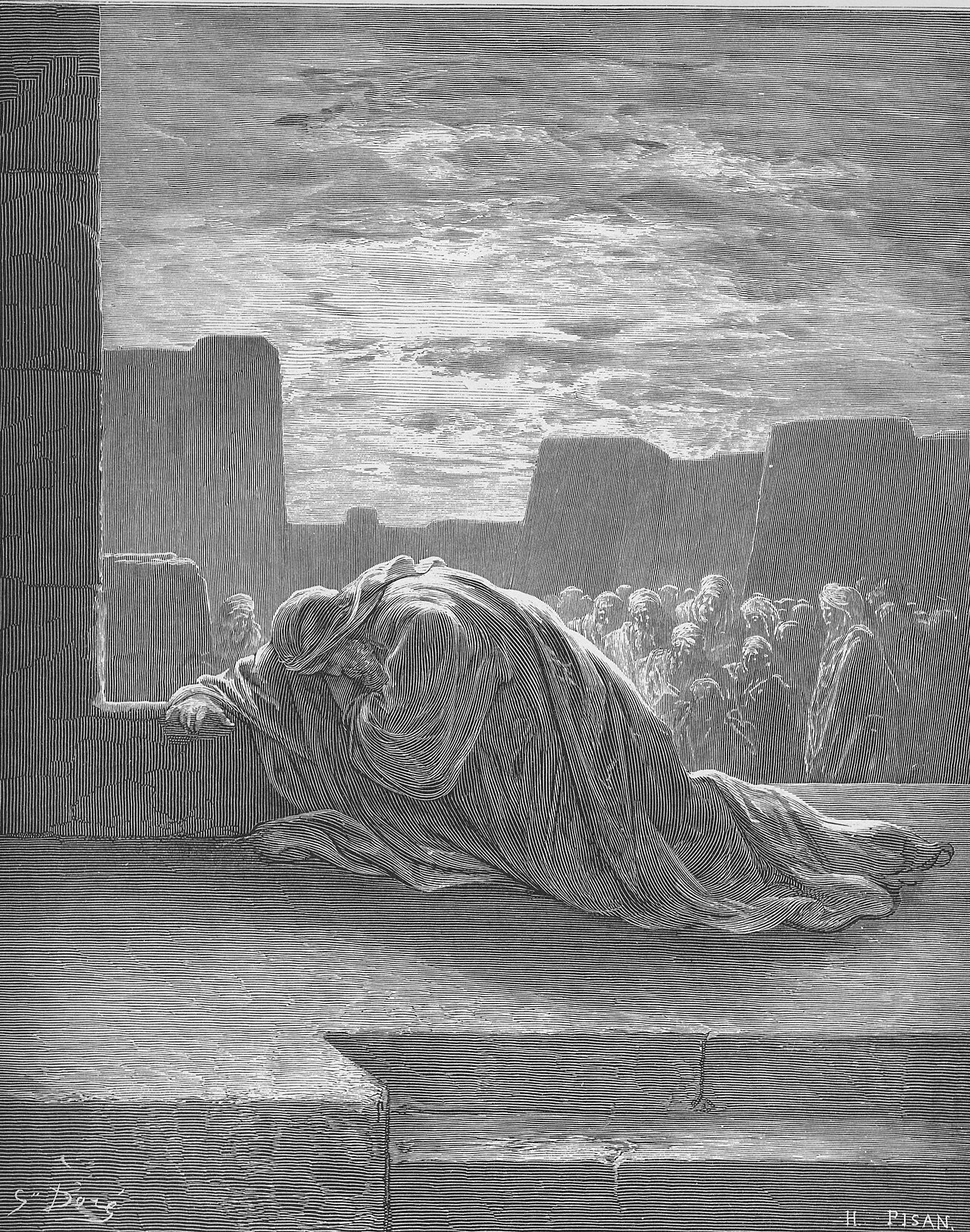
in Ezra 9At the evening offering, I got up from my humiliation with my tunic and cloak torn, and I fell on my knees, spread out my hands to the LORD my God,
BSB
The same verse in ASV and KJV ▾
ASV
And at the evening oblation I arose up from my humiliation, even with my garment and my robe rent; and I fell upon my knees, and spread out my hands unto Jehovah my God;
KJV
And at the evening sacrifice I arose up from my heaviness; and having rent my garment and my mantle, I fell upon my knees, and spread out my hands unto the Lord my God,
⋯
This verse in Ezra 9
Commentary
4 notes on this verseAnd at the evening sacrifice I rose up from my heaviness,.... The signs and tokens of it, particularly sitting on the ground; or "from my fasting" (n), having eaten nothing that day, it being early in the morning when he was told the above case: and having rent my garment and my mantle; which he had done before, and still kept them on him in the same case: fell upon my knees, and spread out my hands unto the Lord my God; in the posture and with the gesture of an humble supplicant. (n) מתעניתי "jejunio meo", Michaelis; so Jarchi.
This site's exposition
fell upon my knees
on Ezra 9:5-6
At the hour of the evening sacrifice Ezra rises from his heaviness and falls upon his knees, spreading out his hands unto the Lord his God, the posture of a supplicant rather than a mediator with standing to demand. What follows is confession without a single word of petition: I am ashamed and blush to lift up my face to thee, my God, for our iniquities are increased over our head and our trespass is grown up unto the heavens. Ezra was not himself among the intermarried, yet he prays in the first person plural throughout, owning a national sin as his own.
The record, by era
The Puritans and the Awakening2 voices
He did this at the time of the evening sacrifice, because then devout people used to come into the courts of the temple, that hearing his confession, they likewise might be made sensible of the sins of the people. And he had an eye to that great propitiation, of which that sacrifice was a peculiar type.
In this he had an eye to God as the Lord, and as his God, a God of power, but a God of grace. It is not properly to be called a prayer, for there is not a word of petition in it; but, if we give prayer its full latitude, it is the offering up of pious and devout affections to God, and very devout, very pious, are the affections which Ezra here expresses.
The words behind it
15 Hebrew wordsEvery Hebrew word of this verse in the order it stands, with what it means and the door to its own study. The last column counts the times a word stands in the whole Bible: the rarer the word, the more the places it appears belong together.
| Hebrew | Sound | Meaning | Word study | In the Bible |
|---|---|---|---|---|
| וּבְמִנְחַ֣ת | uveminchat | and at [the] offering of | H4503 → | |
| הָעֶ֗רֶב | haerev | the evening | H6153 → | 134 times |
| קַ֚מְתִּי | kamti | I arose | H6965 → | 628 times |
| מִתַּֽעֲנִיתִ֔י | mitaaniti | from humiliation my | H8589 → | |
| וּבְקָרְעִ֥י | uvekarei | and in tearing of my | H7167 → | |
| בִגְדִ֖י | vigdi | garment my | H899 → | |
| וּמְעִילִ֑י | umeili | and robe my | H4598 → | |
| וָֽאֶכְרְעָה֙ | vaekhreah | and I bowed down ! | H3766 → | |
| עַל־ | ʾal- | on | H5921 → | 5755 times |
| בִּרְכַּ֔י | birkai | knees my | H1290 → | |
| וָאֶפְרְשָׂ֥ה | vaefresah | and I spread out ! | H6566 → | |
| כַפַּ֖י | khapai | palms my | H3709 → | |
| אֶל־ | ʾel- | to | H413 → | 5510 times |
| יְהוָ֥ה | yahweh | Yahweh | H3068 → | 6520 times |
| אֱלֹהָֽי׃ | ʾelohai | God my | H430 → | 2601 times |
וּבְמִנְחַ֣תand at [the] offering of
uveminchatH4503 →
הָעֶ֗רֶבthe evening
haerevH6153 →134 times
קַ֚מְתִּיI arose
kamtiH6965 →628 times
מִתַּֽעֲנִיתִ֔יfrom humiliation my
mitaanitiH8589 →
וּבְקָרְעִ֥יand in tearing of my
uvekareiH7167 →
בִגְדִ֖יgarment my
vigdiH899 →
וּמְעִילִ֑יand robe my
umeiliH4598 →
וָֽאֶכְרְעָה֙and I bowed down !
vaekhreahH3766 →
עַל־on
ʾal-H5921 →5755 times
בִּרְכַּ֔יknees my
birkaiH1290 →
וָאֶפְרְשָׂ֥הand I spread out !
vaefresahH6566 →
כַפַּ֖יpalms my
khapaiH3709 →
אֶל־to
ʾel-H413 →5510 times
יְהוָ֥הYahweh
yahwehH3068 →6520 times
אֱלֹהָֽי׃God my
ʾelohaiH430 →2601 times
A shaded row is a word that stands 400 times or fewer in the Bible.
The walk
8 stopsEach card is a verse this one points to, and under it the verses that one points to in turn. Where several paths arrive at the same place, that place is listed first: the text keeps returning to it.
Through
Exodus 9:29Moses said to him, “When I have left the city, I will spread out my hands to the LORD. The thunder will cease, and there will be no more hail, so that you may…
it leads to
- Isaiah 1:15
When you spread out your hands in prayer, I will hide My eyes from you; even though you multiply your prayers, I will not listen. Your hands are covered with blood.
Reached by 2 separate paths from here.
- 1 Kings 8:22
Then Solomon stood before the altar of the LORD in front of the whole assembly of Israel, spread out his hands toward heaven,
Reached by 2 separate paths from here.
- 1 Kings 8:38
then may whatever prayer or petition Your people Israel make—each knowing his own afflictions and spreading out his hands toward this temple—
- Psalms 143:6
I stretch out my hands to You; my soul thirsts for You like a parched land. Selah
- 1 Corinthians 10:26
for, “The earth is the Lord’s, and the fullness thereof.”
- Isaiah 1:15
Through
Exodus 9:33Then Moses departed from Pharaoh, went out of the city, and spread out his hands to the LORD. The thunder and hail ceased, and the rain no longer poured down on the land.
it leads to
- Exodus 9:29
Moses said to him, “When I have left the city, I will spread out my hands to the LORD. The thunder will cease, and there will be no more hail, so that you may…
Reached by 2 separate paths from here.
- Exodus 9:29
Through
1 Kings 8:54Now when Solomon had finished praying this entire prayer and petition to the LORD, he got up before the altar of the LORD, where he had been kneeling with his hands spread out toward…
it leads to
- 2 Chronicles 6:12–13
Then Solomon stood before the altar of the LORD in front of the whole assembly of Israel and spread out his hands.
- 2 Chronicles 7:1
When Solomon had finished praying, fire came down from heaven and consumed the burnt offering and the sacrifices, and the glory of the LORD filled the temple.
- 2 Chronicles 6:12–13
Where this verse is studied
On this page
Studies1
About Ezra
This page draws on John Gill, Exposition of the Old Testament (1748-1763); John Gill, Exposition of the Old Testament; John Wesley, Explanatory Notes upon the Old Testament and Matthew Henry, Commentary on the Whole Bible.