
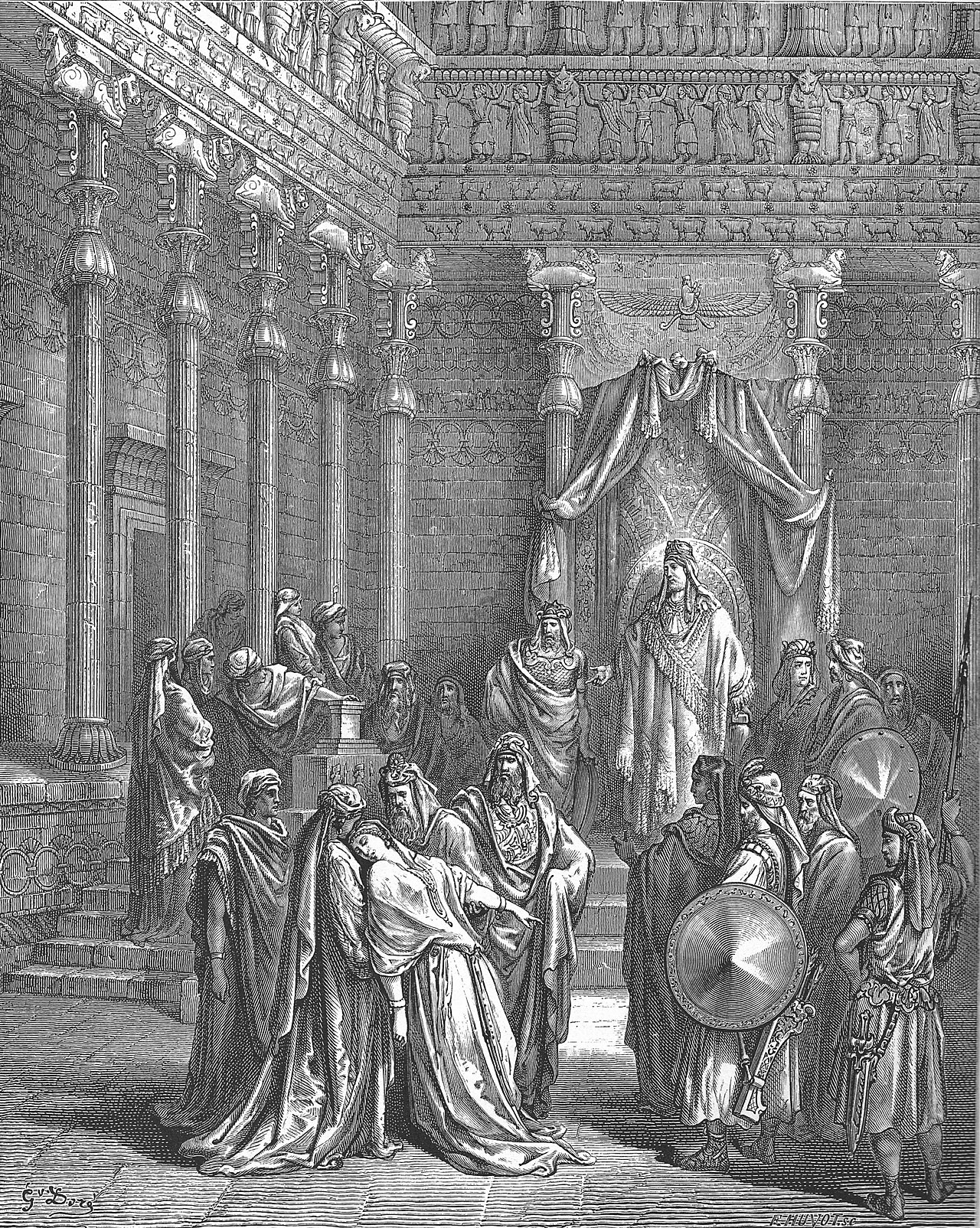
Estherchapter 2
23 verses · unknown · 5th century BC · History
and let the king appoint commissioners in each province of his kingdom to assemble all the beautiful young women into the harem at the citadel of Susa. Let them be placed under the care of Hegai, the king’s eunuch in charge of the women, and let them be given beauty treatments.
Introduction
unknown, History, Esther Overview.
This chapter was written for Jews who lived as a minority in a foreign empire and had to decide, day by day, how much of themselves to show. It brings onto the stage the two people the book is built around. Four years have passed since the feast, years the book leaves out. The chapter moves quietly and passes no judgment on what it reports. Listen for what Esther is told to keep hidden, and for a deed done at the king's gate that nobody repays. Both will matter far more later than they seem to here.
Context
- Who
- Jews who knew what it cost to keep or hide their identity in a foreign court
- What
- The search for a new queen, in which a Jewish orphan named Esther is taken into the palace and crowned, and her cousin Mordecai uncovers a plot against the king.
- Where
- The women's quarters of the palace at Susa, and the king's gate, where the officials of the court sat.
- When
- The seventh year of Ahasuerus, about 479 BC, after his campaign against Greece.
- Why
- To place a hidden Jewish queen and an unrewarded service in the record before the danger they will answer.
Historical context
The four-year gap between chapter 1 and chapter 2 is filled by history the book does not narrate. Xerxes marched on Greece, lost his fleet at Salamis and his army at Plataea, and came home beaten. Herodotus says that after the defeat the king turned his attention to the women of his household. The book's timing matches the outside record exactly, and its silence about the war is the silence of a Jewish writer who did not care about Greek battles.
Show the rest of the historical context, 3 more paragraphs
The harem was a department of state, not a romance. It was staffed and guarded by eunuchs, castrated men, often taken as boys from conquered peoples, trusted precisely because they could father no rival line. Hegai's twelve months of oil of myrrh and spices was standard treatment for palace women: half a year of one preparation, half a year of another, in a dry, hot climate where skin and hair took a beating.
Mordecai's family line is given as Benjamite, back to a man named Kish, and the text says that ancestor was carried off with King Jehoiachin in 597 BC. Readers sometimes take the verse to mean Mordecai himself was deported, which would make him well over a century old; the sentence more naturally attaches to the great-grandfather named at the head of the list. The name itself is at home in that world, a Persian administrative tablet from Susa names an official called Marduka serving in these very years.
Sitting 'in the king's gate' was a job, not a habit. The gate complex of a Persian citadel was where officials worked, records were kept, and business was transacted; a gate building of exactly this kind has been excavated at Susa. That is how a minor official overhears a plot, and why the plot, once verified, gets written into the daily court record. Persian kings kept careful lists of men who had done them a service, and rewarded them later.
Significance
The chapter is uncomfortable on purpose. A Jewish girl is taken into a pagan king's bed, hides who she is on her cousin's instruction, and wins a beauty contest. Nobody in the story prays, and the book does not pause to approve or condemn.
Show the rest of the significance, 1 more paragraph
For scattered Jews the discomfort was the recognition. This was their life, compromise they did not choose, in a system they did not control. And the chapter quietly plants two things that will save a nation years later: a queen nobody knows is Jewish, and an unpaid favour written down in a book.
This chapter in Jewish lifeWhat this chapter is in Jewish life and reading.
What is done
This chapter is heard once a year, inside the whole scroll at Purim. The site's own table in src/lib/hebraic/readings.ts records that the scroll is read twice, in the evening and again the next morning, from a handwritten roll. The congregation is expected to hear every word of it. It records too that four verses of the book are called out by the congregation first and then repeated by the reader. The table cites Mishnah Megillah 2 and Babylonian Talmud Megillah 18a. The book has no weekly portion and no Haftarah in the same table.
How it is read
Rashi carries most of the English the corpus holds on this chapter, quoted here from The Metsudah Five Megillot, Lakewood, N.J., 2001, which Sefaria reports as CC-BY. The edition prints its own numbered notes inside his words, and a note is named here as the edition's. The chapter opens on the king's regret. He remembered Vashti's beauty and became sad (Rashi on Esther 2:1:1). The edition's note gives the reason her death was still ordained: she had persuaded the king to stop the rebuilding of the Temple.
Mordechai is introduced as a Judean and as a Benjamite, and Rashi reconciles the two. "All those who were exiled with the kings of Yehudah were called יְהוּדִים [Yehudites] among the nations, even if they were from another tribe" (Rashi on Esther 2:5:1). The edition's note sets two more readings beside it. The Targum reads the word as a pious Jew. Another reading, from Esther Rabbah 6:2, takes it as one who proclaimed the unity of God's Name by refusing to bow to Haman.
Esther's place in Mordechai's house is read by the Rabbis in a way a Christian reader will not expect. Rashi reports that they read "as a daughter" as "for a house", that is, as a wife (Rashi on Esther 2:7:1). The edition's note names Maseches Megillah 13a. Her silence about her people Rashi explains as a plan. If the court thought her of a low family they would dismiss her, while if they knew she was of the house of King Shaul they would keep her (Rashi on Esther 2:10:1). She kept the silence because Mordechai was at the king's gate encouraging her (Rashi on Esther 2:20:1).
The longest note in the chapter reads Mordechai's daily walk past the court as faith at work. He was one of two righteous men given a hint of salvation, David and Mordechai. David took his victories over the lion and the bear as a sign for the fight with Goliath. Mordechai reasoned in the same way about Esther. "It did not happen to this righteous woman that she should be taken to a gentile’s bed only that she is destined to rise to save Yisroel" (Rashi on Esther 2:11:1). The edition's note names Esther Rabbah 6:6.
The plot at the gate is read through Mordechai's learning. The two men spoke in the Tarsian language, not knowing that Mordechai knew seventy languages, since he was one of the Sanhedrin who sat in the Chamber of Hewn Stone (Rashi on Esther 2:22:1). They meant to poison the king (Rashi on Esther 2:21:1). The favour went into the book of the archives (Rashi on Esther 2:23:1).
Malbim's one note on this chapter whose English the corpus keeps is the Sefaria Community Translation, which Sefaria reports as CC0. It weighs how Mordechai's standing looked under Persian law. "It makes Mordecai’s sin even worse to resist handing Esther in because he is a captive and that means he needs to obey the law" (Malbim on Esther 2:6:2).
The corpus carries seven further notes on this chapter without an English text. Six are marked linked because Sefaria holds no English version of the ref, at Ibn Ezra on Esther 2:1:1, 2:2:1, 2:15:1 and 2:19:1, and at Malbim on Esther 2:4:1 and 2:8:1. The seventh, Rashi on Esther 2:9:1, is marked linked because the text fetch returned nothing.
What the rabbis say
The corpus carries forty rabbinic locators on this chapter and the text of none, so each is cited and linked here rather than quoted. Thirty-six are Midrash and four are Talmud. On the first verse it holds Esther Rabbah 3:15 and 5:1. On the second it holds Bereshit Rabbah 57:4 and Jerusalem Talmud Sotah 5:6:2. On the third it holds Megillah 12b:14 and Midrash Lekach Tov on Esther 2:3:1, and on the fourth Esther Rabbah 5:4 with Midrash Shmuel 13:6.
Mordechai and Esther draw the next run. On the fifth verse the corpus holds Bamidbar Rabbah 10:5 and Bereshit Rabbah 30:8. On the sixth it holds Bereshit Rabbah 49:1 and Esther Rabbah 6:4, and on the seventh Bereshit Rabbah 1:1 and 39:13. On the eighth it holds Bereshit Rabbah 99:3 and Midrash Lekach Tov on Esther 2:8:1. On the ninth it holds Megillah 13a:15 and Midrash Lekach Tov on Esther 2:9:2, and on the tenth Bamidbar Rabbah 9:10 with Midrash Lekach Tov on Esther 2:10:1. On the eleventh it holds Esther Rabbah 6:6 and 6:8.
The year in the harem and the plot carry the rest. On the twelfth verse the corpus holds Ein Yaakov, Shabbat 8:3 and Megillah 13a:18. On the thirteenth it holds Midrash Lekach Tov on Esther 2:13:1 and 2:13:2, and on the fourteenth Bereshit Rabbah 64:5 with Esther Rabbah 5:3. On the fifteenth it holds Bamidbar Rabbah 11:6 and Bereshit Rabbah 29:4, and on the sixteenth Bamidbar Rabbah 1:5 with Esther Rabbah 6:10. On the seventeenth it holds Bereshit Rabbah 58:3 and Bereshit Rabbati, Parashat Vayeshev 33. Bereshit Rabbah 53:10 stands on the eighteenth, Kohelet Rabbah 10:4:1 on the nineteenth, and Bereshit Rabbah at 71:5, 88:3 and 39:12 on the twentieth to the twenty-second. Esther Rabbah 6:14 stands on the twenty-third. What each of them teaches is a saying of the rabbis, and is reported as theirs wherever this site quotes one.
Sources: Rashi, Rashi on Esther 2:1:1 to 2:23:1, The Metsudah Five Megillot, Lakewood, N.J., 2001, reported CC-BY; Rashi on Esther 2:9:1, cited by ref because the text fetch returned nothing; Malbim, Malbim on Esther 2:6:2, Sefaria Community Translation, reported CC0; Malbim on Esther 2:4:1 and 2:8:1, cited by ref because the corpus carries no English text; Ibn Ezra, Ibn Ezra on Esther 2:1:1, 2:2:1, 2:15:1 and 2:19:1, cited by ref because the corpus carries no English text; The Sefaria corpus, scripts/data/sources/sefaria/esther/2.json, the 40 Talmud and Midrash locators of this chapter; The site's own files, src/lib/hebraic/readings.ts, the FESTIVAL_READINGS entry for esther at Purim citing Mishnah Megillah 2, Babylonian Talmud Megillah 18a and the Rema's gloss to Shulchan Aruch, Orach Chayim 690:17, and no portion or Haftarah for this book.
The heads below are this chapter's scenes. The numbered points under each are its verses.
Let fair young virgins be sought for the king
Esther 2:1-4
he remembered Vashti: When the king's anger subsides, "he remembered Vashti and what she had done, and what had been decreed against her". His attendants answer with a policy: commissioners gather "all the beautiful young women into the harem" under Hegai. The one test for the new queen is whoever "pleases the king".
Esther 2:1
“These events must belong to the time between the great assembly held at Susa in Xerxes’ third year (483 B.C.), and the departure of the monarch on his expedition against Greece in his fifth year, 481 B.C.”
2 more voices on this verseWhat preachers and commentators have said about this verse, in their own words.
Esther 2:1
The worldly philosophers drive out an old passion by instilling a new one; they hammer out one nail by hammering in another. It was on this principle that the seven princes of Persia acted toward Ahasuerus, for they subdued his regret for Vashti by inducing him to love other maidens. But whereas they cured one fault by another fault and one sin by another sin, we must overcome our faults by learning to love the opposite virtues. "Depart from evil," says the psalmist, "and do good; seek peace and pursue it."
Jerome · written before 420 · LETTER 125.14patristic
Esther 2:1
“The damsels, on arrival at the palace, were placed under the custody of "Hege, the king's chamberlain, keeper of the women," that is, the chief eunuch, usually a repulsive old man, on whom the court ladies are very dependent, and whose favor they are always desirous to secure.”
Jamieson, Fausset & Brown · Commentary Critical and Explanatory on the Whole Bible (1871)reformed
Then the king’s attendants proposed: Gill reads fear in the proposal of the king's attendants, who would face vengeance if Vashti were restored. Jerome saw the cure of driving out one nail with another, a new love for young virgins to drive out regret for Vashti. Clarke notes all became concubines and one became queen.
Esther 2:2
“Then said the king's servants that ministered unto him,.... Fearing that, if Vashti should be restored, vengeance would be taken on them; or however to remove the grief and melancholy of the king, they gave the following advice: let there be fair young virgins sought for the king; that he might enjoy them, and choose one of them, the most agreeable to him, and put her in the room of Vashti.”
1 more voice on this verse
Esther 2:2
“Let there be fair young virgins sought for the king - This was the usual way in which the harem or seraglio was furnished: the finest women in the land, whether of high or low birth, were sought out, and brought to the harem. They all became the king’s concubines: but one was raised, as chief wife or sultana, to the throne; and her issue was specially entitled to inherit.”
Adam Clarke · Commentary on the Bible (1810-1826)evangelical
and let the king appoint commissioners: Barnes notes that the kings of Persia kept three or four hundred concubines besides their lawful wives, so the harem was large. Wesley explains the beauty treatments as cleansing, perfume and adornment to prepare each young woman for the king. In the East, Clarke notes, women were entrusted to eunuchs.
Esther 2:3
“The house of the women - i. e. the “gynaeceon,” or “haram” - always an essential part of an Oriental palace (Compare 1Ki 7:8). In the Persian palaces it was very extensive, since the monarchs maintained, besides their legitimate wives, as many as 300 or 400 concubines (compare Est 2:14).”
1 more voice on this verse
Esther 2:3
“Purification - That is, to cleanse them from all impurities, to perfume, and adorn, and every way prepare them for the king: for the legal purification of the Jews he never regarded.”
John Wesley · Explanatory Notes upon the Old Testament (1765)evangelical
Then let the young woman who: The one standard for the new queen is the king's pleasure. Rabanus Maurus read the search as an allegory. Judea, expelled from the royal marriage, gives way to peoples of every nation, led in by the preachers of the gospel.
Mordecai's cousin taken into the king's house
Esther 2:5-7
named Mordecai son of Jair: Mordecai's line runs to Kish, of "the tribe of Benjamin," the house that gave Israel its first king, Saul son of Kish. Keil and others trace the line to Saul, whose war with Agag at 1 Samuel 15:8 returns when Haman the Agagite appears at 3:1.
Esther 2:5
“Mordecai, the eunuch Est 2:7, Est 2:11, has been conjectured to be the same as Matacas, who, according to Ctesias, was the most powerful of the eunuchs during the latter portion of the reign of Xerxes. Mordecai’s line of descent is traced from a certain Kish, carried off by Nebuchadnezzar in 598 B.C. - the year of Jeconiah’s captivity - who was his great-grandfather.”
2 more voices on this verse
Esther 2:5
“Now in Shushan the palace was a certain Jew,.... Not one of the tribe of Judah, for he was afterwards called a Benjaminite; but was so called, because he was of the kingdom of Judah, which consisted of both tribes.”
Esther 2:5
“Her sweet and amiable appearance made her a favorite with all who looked upon her (Es 2:15, last clause). Her Hebrew name (Es 2:7) was Hadassah, that is, "myrtle," which, on her introduction into the royal harem, was changed to Esther, that is, the star Venus, indicating beauty and good fortune [GESENIUS].”
Jamieson, Fausset & Brown · Commentary Critical and Explanatory on the Whole Bible (1871)reformed
He had been carried into exile: Barnes takes the man carried into exile to be Kish, Mordecai's great-grandfather, and dates the deportation with Jeconiah to 598 BC. His tribe was Benjamin, and his kingdom was Judah. Gill notes the kingdom held both tribes, so a Benjamite carried off with its king was called a Jew.
And Mordecai had brought up Hadassah: Hadassah is the Hebrew name for myrtle, and Esther is her Persian name, which Clarke takes to mean a star. Barnes finds no sure trace of that name in Old Persian. Clarke also notes that the Vulgate and Josephus make Esther the niece of Mordecai.
Esther 2:7
“Her wisdom and virtue were her greatest beauty, but it is an advantage to be a diamond to be well set. (4.) Mordecai, her cousin-german, was her guardian, brought her up, and took her for his own daughter. The LXX. says that he designed to make her his wife; if that were so, he was to be praised that he opposed not her better preferment.”
Matthew Henry · Commentary on the Whole Bible (1707-1721)puritan
1 more voice on this verse
Esther 2:7
“Hadassah, הדסה hădassâh from הדס hădas (“myrtle”) would seem to have been the Hebrew, and Esther the Persian, name of the damsel. Esther is thought to be connected through the Zend with ἀστήρ astēr, “star.” But there is not at present any positive evidence of the existence in Old Persian of a kindred word.”
Esther 2:8-9
When the king’s command and edict: Esther is taken to the palace among "many young women" and placed "under the care of Hegai, the custodian of the women". She pleases Hegai before the king has seen her. He gives her beauty treatments, "the special diet," "seven select maidservants" and "the best place in the harem".
Esther 2:8
“So it came to pass, when the king's commandment and decree was heard,.... In the several provinces of his kingdom: and when many maidens were gathered unto Shushan the palace, to the custody of Hegai; Josephus (o) says, there were gathered to the number of four hundred: that Esther was brought also unto the king's house, to the custody of Hegai, the keeper of the women: by force, as Aben Ezra and the former Targum, and so the word is sometimes used. (o) Ibid. (Antiqu. l. 11. c. 6. sect. 2.)”
And the young woman pleased him: Clarke credits the favor Hegai showed to her modest and engaging manner, and Wesley adds her beauty and a divine hand. Clarke describes the seven maidservants as her attendants at the bath, where they anointed and adorned her. Henry drew the lesson that wisdom and virtue gain respect.
Esther 2:9
“The maiden pleased him - He conceived a partiality for her above the rest, probably because of the propriety of her deportment, and her engaging though unassuming manners. Seven maidens - These were to attend her to the bath, to anoint and adorn her, and be her servants in general.”
Adam Clarke · Commentary on the Bible (1810-1826)evangelical
1 more voice on this verse
Esther 2:9
“Pleased - Because she was very beautiful, therefore he supposed she would be acceptable to the king; and by the Divine power, which moveth the hearts of men which way he pleaseth.”
John Wesley · Explanatory Notes upon the Old Testament (1765)evangelical
Esther 2:10-11
Esther did not reveal her people: Esther keeps "her people or her lineage" hidden "because Mordecai had instructed her not to do so". At 4:8 Mordecai urges her to plead for her people. Every day Mordecai walks "in front of the court of the harem" to learn of "Esther’s welfare".
Esther 2:10
“Esther had not showed her people - This might have prejudiced her with the king; for it was certainly no credit at the Persian court to be a Jew; and we shall find from the sequel that those who were in the Persian dominions were far from being reputable, or in a safe state. Besides, had her lineage been known, envy might have prevented her from ever having access to the king.”
Adam Clarke · Commentary on the Bible (1810-1826)evangelical
2 more voices on this verse
Esther 2:10
“Shew it - Lest the knowledge hereof should either make her contemptible, or bring some inconvenience to the whole nation; but there was also an hand of God in causing this to be concealed, for the better accomplishment of that which he designed, though Mordecai was ignorant of it.”
John Wesley · Explanatory Notes upon the Old Testament (1765)evangelical
Esther 2:10
“But he only told her not to proclaim her country. All truths are not to be spoken at all times, though an untruth is not to be spoken at any time. She being born in Shushan, and her parents being dead, all took her to be of Persian extraction, and she was not bound to undeceive them.”
Matthew Henry · Commentary on the Whole Bible (1707-1721)puritan
And every day Mordecai would walk: Jamieson, Fausset and Brown describe the harem as an inviolable sanctuary, whose business was secret to those outside. Mordecai still came to its court every day. Aben Ezra, as Gill reports, gave him a high post at court, and Barnes made him a doorkeeper at the palace entrance.
Esther 2:11
“And Mordecai walked every day before the court of the women's house,.... Being one of the court, and in an high post, as Aben Ezra thinks, he might walk there without being examined, and called to an account for it: to know how Esther did; to inquire of her health and prosperity, or peace, the word here used signifies, even all sorts of it: and what should become of her; or was done to her, whether she was well used, or as yet introduced to the king, how it fared with her, and what befell her.”
2 more voices on this verse
Esther 2:11
“Mordecai walked every day before the court of the women's house--The harem is an inviolable sanctuary, and what is transacted within its walls is as much a secret to those without as if they were thousands of miles away.”
Jamieson, Fausset & Brown · Commentary Critical and Explanatory on the Whole Bible (1871)reformed
Esther 2:11
“Mordecai occupied, apparently, a humble place in the royal household. He was probably one of the porters or doorkeepers at the main entrance to the palace Est 2:21.”
Twelve months of purifying, and a crown set on Esther's head
Esther 2:12-14
In the twelve months: The text sets out the harem's process: twelve months of treatments, then one night with the king. In the morning each woman went "to a second harem under the care of Shaashgaz". She would not return to the king "unless he delighted in her and summoned her by name".
Esther 2:12
“Six months with oil of myrrh - See on Est 2:3 (note). The reason of this purification seems not to be apprehended by any writer I have seen. The most beautiful of all the young virgins of all the provinces of Babylon were to be selected; and these were taken out of all classes of the people, indiscriminately; consequently there must have been many who were brought up in low life.”
Adam Clarke · Commentary on the Bible (1810-1826)evangelical
1 more voice on this verse
Esther 2:12
“Now when every maid's turn was come to go in to king Ahasuerus--A whole year was spent in preparation for the intended honor. Considering that this took place in a palace, the long period prescribed, together with the profusion of costly and fragrant cosmetics employed, was probably required by state etiquette.”
Jamieson, Fausset & Brown · Commentary Critical and Explanatory on the Whole Bible (1871)reformed
When the young woman would go: Clarke explains the rule: each woman could take whatever dress, colors or jewels she thought would set her off best. Wesley holds that every woman the king took became a wife of lower rank, as Hagar was to Abraham. On that reading Esther's night with the king carried no dishonour.
Esther 2:13
“Whatsoever she desired - When any of the young women were called to go to the king, it appears that it was an ordinance that whatever kind of dress stuff, color, jewels, etc., they thought best to set off their persons, and render them more engaging, should be given them.”
Adam Clarke · Commentary on the Bible (1810-1826)evangelical
1 more voice on this verse
Esther 2:13
“Desired - For ornament, or by way of attendance. And it should be observed, that every one whom the king took to his bed, was his wife of a lower rank, as Hagar was Abraham's, so that it would have been no sin or dishonour to Esther, though she had not been made queen.”
John Wesley · Explanatory Notes upon the Old Testament (1765)evangelical
She would go there in the: Clarke notes a woman sent to the second harem never left it and was never given in marriage to any man. Henry judged the custom of concubines a breach of the law founded on God's making one man and one woman. One night decided the rest of her life.
Esther 2:14
“She returned into the second house - This was the place where the king’s concubines were kept. They went out no more, and were never given in marriage to any man, and saw the king’s face no more unless specially called. Custody of Shaashgaz - This is probably another Persian name; sheshkhunj, beardless, a proper epithet of a eunuch; or sestgunj, weak loins, for the same reason. Names of this kind at once show the reason of their imposition, by describing the state of the person.”
Adam Clarke · Commentary on the Bible (1810-1826)evangelical
1 more voice on this verse
Esther 2:14
“Having broken through that law of creation which resulted from God's making man, they broke through another law, which was founded upon his making one man and one woman. See what need there was of the gospel of Christ to purify men from the lusts of the flesh and to reduce them to the original institution.”
Matthew Henry · Commentary on the Whole Bible (1707-1721)puritan
Esther 2:15-18
Esther was the daughter of Abihail: Esther asks for nothing "except what Hegai, the king’s trusted official in charge of the harem, had advised". In the tenth month of the seventh year the king "loved Esther more than all the other women" and crowned her. No one at court knows she is a Jew.
Esther 2:15
“She required nothing - The other virgins perhaps loaded themselves with precious ornaments of various kinds, necklaces, bracelets, earrings, anklets, and the like. Esther let Hegai dress her as he would.”
She was taken to King Xerxes: Adam Clarke places Tebeth in December and January, and Albert Barnes dates the seventh year of Xerxes to the turn of 479 and 478 BC. Vashti's place had stood empty four years. Barnes answers that delay with the Grecian expedition, which took up two of those years.
Esther 2:16
“Tebeth (compare the corresponding Egyptian month, “Tobi” or “Tubi”), corresponded nearly to our January. In the seventh year of his reign - In December, 479 B.C., or January, 478 B.C. Xerxes quitted Sardis for Susa in, or soon after, September, 479 B.C. It has been regarded as a “difficulty” that Vashti’s place, declared vacant in 483 B.C., was not supplied until the end of 479 B.C., four years afterward. But since two years out of the four had been occupied by the Grecian expedition, the objection cannot be considered very weighty.”
And the king loved Esther more: Henry notes that the king needed no further trials and made Esther queen at once. Clarke explains the royal crown as rank over all the other women of the harem, who owed the queen the deepest respect. Bonaventure applied the verse to the Virgin Mary, crowned and reigning.
Esther 2:17
“Set the royal crown upon her head - Made her what is now called in the East the Sultana, the queen. She was the mistress of all the rest of the wives, all of whom were obliged to pay her the most profound respect.”
Adam Clarke · Commentary on the Bible (1810-1826)evangelical
Then the king held a great: Barnes reads the tax holiday the king proclaimed in the provinces as a remission of taxes, of military service or of both. Henry and Clarke add a pardon for prisoners. Jamieson, Fausset and Brown add that the king gave his queen the revenue of certain cities for her household.
Esther 2:18
“The nuptials were celebrated by a magnificent entertainment, and, in honor of the auspicious occasion, "he made a release to the provinces, and gave gifts, according to the state of the king." The dotation of Persian queens consisted in consigning to them the revenue of certain cities, in various parts of the kingdom, for defraying their personal and domestic expenditure.”
Jamieson, Fausset & Brown · Commentary Critical and Explanatory on the Whole Bible (1871)reformed
Two doorkeepers' plot written down in the book of the chronicles
Esther 2:19-20
When the virgins were assembled: The virgins are assembled "a second time," and "Mordecai was sitting at the king’s gate," where officials of the court sat. Esther still keeps "her lineage or her people" hidden. The narrator repeats her obedience so the reader knows the crown has left it unchanged.
Esther 2:19
“When the virgins ... - Rather, “when virgins” etc. The words begin a new paragraph. There was a second collection of virgins (after that of Est 2:8), and it was at the time of this second collection that Mordecai had the good fortune to save the king’s life.”
1 more voice on this verse
Esther 2:19
“Mordecai say in the king's gate; that was the height of his preferment: he was one of the porters or door-keepers of the court. Whether he had this place before, or whether Esther obtained it for him, we are not told; but there he sat contentedly, and aimed no higher; and yet Esther who was advanced to the throne was observant of him.”
Matthew Henry · Commentary on the Whole Bible (1707-1721)puritan
Esther still had not revealed her: The Septuagint adds that Mordecai had charged Esther to fear God and keep his commandments. Clarke notes that the Hebrew text of Esther never names God, and he saw the Greek addition as an answer to that reproach. Henry made Esther's obedience to Mordecai an example to orphans.
Esther 2:20
“This is an example to orphans; if they fall into the hands of those who love them and take care of them, let them make suitable returns of duty and affection. The less obliged their guardians were in duty to provide for them the more obliged they are in gratitude to honour and obey their guardians.”
Matthew Henry · Commentary on the Whole Bible (1707-1721)puritan
Esther 2:21-23
In those days, while Mordecai: Bigthan and Teresh, "two of the king’s eunuchs who guarded the entrance," conspire "to assassinate King Xerxes". Mordecai reports the plot to Esther, and she informs the king "on Mordecai’s behalf". The matter is "recorded in the Book of the Chronicles in the presence of the king".
Esther 2:21
“Conspiracies inside the palace were ordinary occurrences in Persia. Xerxes was ultimately murdered by Artabanus, the captain of the guard, and Aspamitras, a chamberlain and eunuch.”
1 more voice on this verse
Esther 2:21
“Mordecai got notice of their treason, and, by Esther's means, discovered it to the king, hereby confirming her in and recommending himself to the king's favour. How he came to the knowledge of it does not appear. Whether he overheard their discourse, or whether they offered to draw him in with them, so it was that the thing was known to him.”
Matthew Henry · Commentary on the Whole Bible (1707-1721)puritan
When Mordecai learned of the plot: The text leaves the source of Mordecai's knowledge of the plot unstated. Henry weighed two ways, that Mordecai overheard the plot or that the eunuchs tried to draw him in. Josephus, as Clarke reports, names a Jew called Barnabasus who overheard it and told Mordecai.
Esther 2:22
“Was known to Mordecai - Josephus says that a Jew, named Barnabasus, overheard the plot, told it to Mordecai, Mordecai to Esther, and Esther to the king, in Mordecai’s name; and he was registered as the discoverer.”
Adam Clarke · Commentary on the Bible (1810-1826)evangelical
After the report had been investigated: Barnes reads the hanging on the gallows as crucifixion or impaling, the ordinary punishment of rebels and traitors. Ctesias, he adds, drew on these chronicles. Henry notes the service of Mordecai was left unrewarded for a time, as the reward of those who serve Christ waits for the resurrection.
Esther 2:23
“Both hanged on a tree - i. e. “crucified” or “impaled” the ordinary punishment of rebels and traitors in Persia. The book of the chronicles - Ctesias drew his Persian history from them, and they are often glanced at by Herodotus.”
1 more voice on this verse
Esther 2:23
“He was not rewarded presently, but a book of remembrance was written. Thus with respect to those who serve Christ, though their recompence is adjourned till the resurrection of the just, yet an account is kept of their work of faith and labour of love, which God is not unrighteous to forget, Heb. vi.”
Matthew Henry · Commentary on the Whole Bible (1707-1721)puritan
Keep studying
Sources for this chapter
The summary
Jamieson, Fausset & Brown, Commentary Critical and Explanatory; John Wesley, Notes on the Old Testament and Matthew Henry, Complete Commentary.
The exposition
Adam Clarke, Commentary on the Bible; Albert Barnes, Notes, Explanatory and Practical, on the Old and New Testaments (1832-1869); Bonaventure, Collationes de Septem Donis, Collation 6; Jamieson Fausset and Brown, Commentary Critical and Explanatory on the Whole Bible; Jamieson, Fausset & Brown, Commentary Critical and Explanatory on the Whole Bible; Jerome, LETTER 125.14; John Gill; John Wesley, Explanatory Notes upon the Old Testament; Keil, The Books of Ezra, Nehemiah, and Esther; Matthew Henry, Commentary on the Whole Bible; Rabanus Maurus, EXPLANATION ON THE BOOK OF ESTHER 3 and W. F. Adeney, Ezra, Nehemiah and Esther (Expositor's Bible).