
2 Kingschapter 11
21 verses · Jeremiah, by tradition · 6th century BC · History
Key verse
And when Athaliah the mother of Ahaziah saw that her son was dead, she arose and destroyed all the seed royal.
It stands in A baby hidden six years in the house of Jehovah, verses 1 to 3.
The chapter
Chapter summary
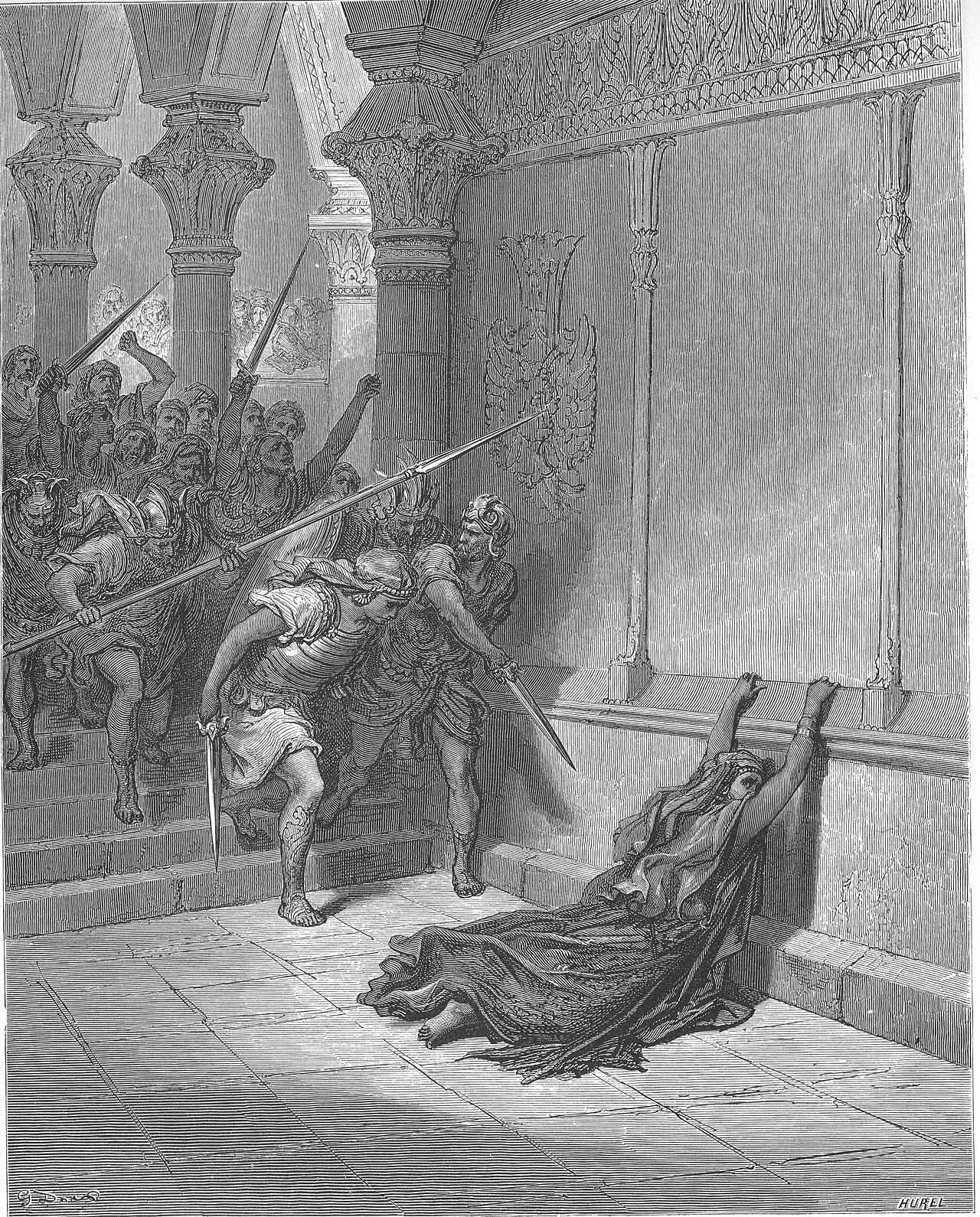
Athaliah sees her son dead and destroys all the seed royal. The one moment when the promise to David hangs by a single thread. That thread is Joash, an infant stolen away by Jehosheba and hidden with his nurse in the house of Jehovah six years while Athaliah reigns. In the seventh year Jehoiada the priest takes the captains into covenant and arms them with king David's spears and shields from the temple. The boy is brought out, given the crown and the testimony, anointed and clapped to: 'Long live the king.' Athaliah tears her clothes and cries 'Treason! treason!' and is put to death outside the house. Then a covenant, and Baal's house torn down.
Context
History · Jeremiah · 2 Kings overview
The world of this chapter
Athaliah's usurpation and the coronation of Joash in Judah · 841 to 835 BC · The temple precinct in Jerusalem, where a hidden child grew up for six years · Judeans who nearly lost the line of David altogether
Historical context
The chapter belongs to Athaliah, the queen mother of Judah and a daughter of Ahab, and to Jehoiada the high priest and his wife Jehosheba. The years are 841 to 835 BC, the six years of Athaliah's rule and the seventh in which it ended.
The place is the temple precinct in Jerusalem and the palace beside it. The occasion is the death of Athaliah's son Ahaziah in Jehu's purge, which left her without any other route to power.
A first hearer knew the precinct as a working compound. It held storerooms and priests' chambers with people living in them, and Athaliah had no reason to enter a temple she did not use, which is how a child stayed hidden for six years.
The coup is timed to the guard rotation. Temple security worked in shifts that changed on the sabbath, so at the changeover both the outgoing and the incoming companies were present, twice the men, armed and assembled for a legitimate reason.
The Carites named in the chapter were the foreign professional bodyguard, the same kind of unit David had used. The spears and shields Jehoiada hands out had been kept in the temple since David's day.
Every element of the coronation is traditional and public. The boy stands by the pillar, which was the king's designated standing place. He receives the crown and the testimony, most likely the copy of the covenant document a king was required to keep and read. Then comes the anointing, the clapping and the trumpets.
Significance
The first hearers knew how close it came. For six years the promise of a lasting house of David rested on one child in a temple storeroom, and a handful of people knew he existed.
The chapter also shows the priesthood doing what the monarchy could not. A high priest hid the heir, armed the guard, crowned the boy, and bound king and people to God by covenant in one afternoon.
Where the chapter sits
2 Kings 11 falls in Elijah's ascension; Elisha's ministry (chapters 1–13). Elijah taken up by whirlwind; double portion; widow's oil; the Shunammite's son raised; Naaman healed; siege of Samaria broken; Elisha dies and his bones raise a man.
After it: Northern kingdom's fall, chapters 14–17.
The whole shape of 2 Kings→The structure of this chapter
People1
The heads below are this chapter's scenes. The numbered points under each are its verses.
A. A baby hidden six years in the house of Jehovah
1. (v. 1)
destroyed all the seed royal: Athaliah's massacre reduces thread one, the covenant tested king by king, to its thinnest point in either book. The promise of 2 Samuel 7:12-15, a house and a throne established forever, now hangs on whichever child of David's line has not yet been found. She is Ahab's daughter and Jezebel's, and the narrator lets her turn royal power on her own family to secure it, without a word of comment yet.
2 Kings 11:1
“Athaliah, as wife of Joram and mother of Ahaziah, had guided both the internal and the external policy of the Jewish kingdom; she had procured the establishmeut of the worship of Baal in Judaea 2Ki 8:18, 2Ki 8:27, and had maintained a close alliance with the sister kingdom 2Ki 8:29; 2Ki 10:13. The revolution effected by Jehu touched her nearly.”
2 more voices on this verseWhat preachers and commentators have said about this verse, in their own words.
2 Kings 11:1
“She destroyed - This was the fruit of Jehoshaphat's marrying his son to a daughter of that idolatrous house of Ahab. And this dreadful judgment God permitted upon him and his, to shew how much he abhors all such affinities.”
John Wesley· Explanatory Notes upon the Old Testament (1765)evangelical
2 Kings 11:1
“This massacre she was incited to perpetrate--partly from a determination not to let David's family outlive hers; partly as a measure of self-defense to secure herself against the violence of Jehu, who was bent on destroying the whole of Ahab's posterity to which she belonged (2Ki 8:18-26); but chiefly from personal ambition to rule, and a desire to establish the worship of Baal.”
Jamieson, Fausset & Brown· Commentary Critical and Explanatory on the Whole Bible (1871)reformed
2. (vv. 2-3)
stole him from among the king’s sons: Jehosheba, a daughter of the royal house and by 2 Chronicles 22:11 the wife of Jehoiada the priest, hides the one surviving infant and his nurse inside the temple's own chambers for six years while Athaliah reigns undisturbed over the land. The whole covenant promised to David narrows to a nurse, a closet, and a silence the text keeps for six years running, told in a single verse. Wesley notes the chamber's place among the rooms used only by priests and Levites is what makes the hiding place work.
2 Kings 11:2
“Daughter of - Joram, sister of Ahaziah - It is not likely that Jehosheba was the daughter of Athaliah; she was sister, we find, to Ahaziah the son of Athaliah, but probably by a different mother. The mother of Jehoash was Zibiah of Beer-sheba; see 2Ki 12:1.”
Adam Clarke· Commentary on the Bible (1810-1826)evangelical
3 more voices on this verse
2 Kings 11:2
“Bed-chamber - Which was in the house of the Lord. So that it was one of those chambers adjoining to the temple, that were for the uses of the priests and Levites only: which made it more proper for this purpose. Now was the promise made to David bound up in one life.”
John Wesley· Explanatory Notes upon the Old Testament (1765)evangelical
2 Kings 11:2
“What is called, however, the bedchamber in the East is not the kind of apartment that we understand by the name, but a small closet, into which are flung during the day the mattresses and other bedding materials spread on the floors or divans of the sitting-rooms by day.”
Jamieson, Fausset & Brown· Commentary Critical and Explanatory on the Whole Bible (1871)reformed
2 Kings 11:2
“While Jehu was extirpating the worship of Baal in Israel, she was establishing it in Judah, as appears, 2 Chron. xxiv. The court and kingdom of Judah had been debauched by their alliance with the house of Ahab, and now one of that house is a curse and a plague to both: sinful friendships speed no better.”
Matthew Henry· Commentary on the Whole Bible (1707-1721)puritan
2 Kings 11:3
“And Athaliah did reign over the land - In these words the writer dismisses the entire reign of Athaliah, whereof he scorns to speak. We gather incidentally from 2Ki 12:5-12, compared with 2Ch 24:7, that Athaliah used her power to establish the exclusive worship of BaaI through the kingdom of Judah, and to crush that of Yahweh.”
B. Jehoiada arms the guard and crowns a seven-year-old
1. (vv. 4-6)
made a covenant with them: In the seventh year Jehoiada strikes at the one hour when the temple guard is doubled without raising suspicion, the sabbath change of watch, when the outgoing and the incoming courses are both present at once. He binds the captains by oath and shows them the hidden king's son before dividing the loyal guard three ways, a third at the king's house, a third at the gate of Sur, a third at the gate behind the guard, sealing every entrance before a sword is drawn. Barnes reads the sabbath doubling as ordinary priestly rotation turned to a plotter's use.
2 Kings 11:4
“And the seventh year Jehoiada sent - He had certainly sounded them all, and brought them into the interests of the young king, before this time; the plot having been laid, and now ripe for execution, he brings the chief officers of the army and those of the body guard into the temple, and there binds them by an oath of secrecy, and shows them the king’s son, in whose behalf they are to rise.”
Adam Clarke· Commentary on the Bible (1810-1826)evangelical
1 more voice on this verse
2 Kings 11:4
“Moreover, Jehoiada was most probably the high priest, whose official duty it was to watch over the due execution of God's laws, and who in his present movement, was encouraged and aided by the countenance and support of the chief authorities, both civil and ecclesiastical, in the country.”
Jamieson, Fausset & Brown· Commentary Critical and Explanatory on the Whole Bible (1871)reformed
2 Kings 11:5
“Five divisions of the guard under their five captains are distinguished here. Three of the five divisions “enter in” on the Sabbath; the other two “go forth” on the Sabbath 2Ki 11:7. By the former phrase seems to be meant the mounting guard at the royal palace (the “king’s house,” where Athaliah then was); by the latter the serving of escort to the sovereign beyond the palace bounds.”
2 Kings 11:6
“The guard - Either, 1. the king's guard. Or, 2. the guard of the temple; this gate was in the south-side. So, &c. - So you shall guard all the gates or entrances into the temple that neither Athaliah nor any of her soldiers may break in.”
John Wesley· Explanatory Notes upon the Old Testament (1765)evangelical
2. (vv. 7-9)
keep the watch of the house: The other two-thirds, who would ordinarily go off duty, stay instead to ring the king himself, a wall of armed men across the width of the temple court with orders to kill anyone who breaks the ranks. Every captain does exactly as Jehoiada commanded, and the narrator gives the plot's execution in one sentence of compliance, no hesitation recorded on either side. The coup's success rests on discipline kept inside a priesthood, not on a battle fought in the open.
2 Kings 11:9
“David had divided the priests into courses, which waited by turns. Every sabbath-day morning a new company came into waiting, but the company of the foregoing week did not go out of waiting till the sabbath evening, so that on the sabbath day, when double service was to be done, there was a double number to do it, both those that were to come in and those that were to go out.”
Matthew Henry· Commentary on the Whole Bible (1707-1721)puritan
3. (vv. 10-11)
king David’s spears and shields: Jehoiada arms the guard with spears and shields that had belonged to David himself and were kept in the temple as dedicated trophies of his old wars. The weapons defending the young king had once flown in David's own hand, so the coup that restores his throne is fought with David's own arms; Spurgeon preached this detail as old trophies put to new use in the covenant's defense. The guard forms corner to corner across the temple, along the altar, closing the last open ground around the boy.
2 Kings 11:10
“And to the captains over hundreds did the priest give King David's spears and shields, that were in the temple of the Lord. Such as he had taken in war from his enemies, and had dedicated for the service of the temple, to defend it on occasion, and laid up there; those the priests gave to the captains, to arm their men with, who came unarmed, and so unsuspected, and in this way might be armed without being seen and known.”
3 more voices on this verse
2 Kings 11:10
“King David’s spears and shields - Josephus expressly says that David had provided an arsenal for the temple, out of which Jehoiada took those arms.”
Adam Clarke· Commentary on the Bible (1810-1826)evangelical
2 Kings 11:10
“WHEN DAVID HAD FOUGHT with an adversary, and overcome him, he took away his armor and his weapons, and as other victorious heroes were wont to do, he bore them home as mementoes of his prowess, the trophies of the battle. These were placed in the house of the Lord. Perhaps David at the same time dedicated in like manner the shield and the sword which he had himself used in battle. After Solomon had built the temple, these trophies, which seem to have been very numerous, were hung up there. So they adorned the walls.”
2 Kings 11:10
“If they were old and unfashionable, yet those that used them might, by their being David's, be reminded of God's covenant with him, which they were now acting in the defence of.”
Matthew Henry· Commentary on the Whole Bible (1707-1721)puritan
2 Kings 11:11
“From the right corner ... - Rather, “from the right side of the temple buildings to the left side” - i. e., right across the temple court from the one side to the other, by the altar of burnt offerings, etc. This altar stood exactly in front of the temple-porch. Here the king was stationed; and before him and behind him, (“round about” him) stood the soldiers, drawn up several ranks deep across the entire court, just in front of the sacred building.”
4. (v. 12)
gave him the testimony: The crown and the testimony, the book of the law, are given together, so Judah's kingship begins bound to a written standard rather than to naked power, the same requirement Deuteronomy 17:18 laid on every king. Clarke calls the people's clapping of hands the first instance on record of that gesture used as an expression of joy in Scripture. Six years of silence break into one shout, God save the king.
2 Kings 11:12
“Put the crown upon him - This was a diadem or golden band that went round the head. And - the testimony - Probably the book of the law, written on a roll of vellum. This was his scepter. Some think that it was placed upon his head, as well as the diadem. The diadem, the testimony, and the anointing oil, were essential to his consecration. They clapped their hands - This I believe is the first instance on record of clapping the hands as a testimony of joy.”
Adam Clarke· Commentary on the Bible (1810-1826)evangelical
1 more voice on this verse
2 Kings 11:12
“Testimony - The book of the law, which he put into the king's hand, to mind him of his duty at his entrance upon his kingdom, which was to read and write out that holy book, Deut. xvii, 18, and to govern himself and his kingdom by it: the law of God being frequently and most properly called a testimony, because it is a witness of God's will, and man's duty.”
John Wesley· Explanatory Notes upon the Old Testament (1765)evangelical
C. Treason! Treason!: Athaliah taken out by the horse gate
1. (vv. 13-14)
she came to the people: Six years of hiddenness end the moment Athaliah hears the noise and comes into her own temple court to find the throne she thought empty occupied by the boy she meant to kill. She sees the king standing by the pillar, the customary coronation station, and rends her clothes with the cry Treason, Treason, the Hebrew word for conspiracy turned back on the one whose own reign began in exactly that conspiracy. Clarke names the Hebrew as kesher, the same root behind the charge.
2 Kings 11:13
“It seems, Athaliah was little regarded, else she would have had intelligence brought her of this daring attempt before with her own ears she heard the noise; had the design been discovered before it was perfected, it might have been quashed, but now it was too late.”
Matthew Henry· Commentary on the Whole Bible (1707-1721)puritan
2 Kings 11:14
“The king stood by a pillar - Stood On a pillar or tribunal; the place or throne on which they were accustomed to put the kings when they proclaimed them. Treason, Treason - קשר קשר kesher, kasher; A conspiracy, A conspiracy! from kashar, to bind, unite together.”
Adam Clarke· Commentary on the Bible (1810-1826)evangelical
1 more voice on this verse
2 Kings 11:14
“Jehoiada gave orders to put her to death as an idolater, a usurper, and an enemy to the public peace. Care was taken, (1.) That she should not be killed in the temple, or any of the courts of it, in reverence to that holy place, which must not be stained with the blood of any human sacrifice, though ever so justly offered.”
Matthew Henry· Commentary on the Whole Bible (1707-1721)puritan
2. (vv. 15-16)
Let her not be slain: Jehoiada orders her taken out between the ranks rather than struck down inside the temple, guarding the sanctuary's own holiness even while executing a usurper he has every cause to kill on sight. She is led out by the way the horses came into the king's house and slain there, at the palace gate rather than at the altar the seed royal never reached. The order for her removal and the order against her blood in the house of the Lord stand in the same sentence.
2 Kings 11:15
“Have her forth without the ranges - Rather, “Conduct her out between your ranks.” Guard her, i. e., on all sides, that the people may not fall upon her and kill her as she passes through the court, thereby polluting the temple.”
2 Kings 11:16
“By the way - which the horses came - They probably brought her out near the king’s stables. It has been supposed, from Eze 46:1, Eze 46:2, that the east gate of the inner court was that by which the king entered on the Sabbath day, whereas on all other days he entered by the south gate. And there was another gate, called the horse gate, in the wall of the city, (Jer 31:40), for the king’s horses to go out at from the stables at Millo, which is therefore called, 2Ch 23:15, the horse gate toward the king’s house.”
Adam Clarke· Commentary on the Bible (1810-1826)evangelical
D. A covenant made, and the house of Baal broken down
1. (v. 17)
made a covenant between the Lord: Jehoiada makes two covenants in one verse, first between the Lord and the king and the people that they be the Lord's people, then a second between king and people themselves, keeping covenant loyalty to God distinct from ordinary political obligation. It is the chapter's second binding oath, after the captains' oath at verse four, and the same shape of national renewal Josiah's reform will repeat at 2 Kings 23:3. Henry reads the king as standing on the same level as his own subjects under this covenant, bound as much as any of them to serve the Lord.
2 Kings 11:17
“God had already, on his part, promised to be their God (Jehoiada could show them that in the book of the testimony); now the king and people on their part must covenant and agree that they will be the Lord's people: in this covenant, the king stands upon the same level with his subjects and is as much bound as any of them to serve the Lord.”
Matthew Henry· Commentary on the Whole Bible (1707-1721)puritan
1 more voice on this verse
2 Kings 11:17
“A covenant - Rather, “the covenant,” which either was already an established part of a coronation (marginal reference “k”), or at least became such afterward.”
2. (vv. 18-20)
went into the house of Baal: Reform follows the coronation without a pause, the house of Baal torn down, its altars and images broken in pieces, and Mattan its priest killed at his own altar, the very worship Athaliah and her mother Jezebel had planted in two kingdoms uprooted in Judah in a single afternoon. The king is brought down to the palace and set on the throne, and the narrator repeats that Athaliah was slain, a second notice after verse sixteen's, closing the episode before the boy king's minority opens the next chapter. All the people of the land rejoice, and the city is in quiet.
2 Kings 11:18
“His altars and images brake they in pieces - It is probable that Athaliah had set up the worship of Baal in Judah, as Jezebel had done in Israel; or probably it had never been removed since the days of Solomon. It was no wonder that Jehoiada began his reform with this act, when we learn from 2Ch 24:7, that the sons of Athaliah, that wicked woman, had broken up the house of God; and also all the dedicated things of the house of the Lord did they bestow upon Baalim.”
Adam Clarke· Commentary on the Bible (1810-1826)evangelical
1 more voice on this verse
2 Kings 11:18
“All his worshippers, it should seem, deserted him; only his priest Mattan stuck to his altar. Though all men forsook Baal, he would not, and there he was slain, the best sacrifice that ever was offered upon that altar.”
Matthew Henry· Commentary on the Whole Bible (1707-1721)puritan
2 Kings 11:19
“They conducted the king down from the temple hill, across the valley of the Tyropoeum, and up the opposite hill to the royal palace, entering it not by the “horse-gate” 2Ki 11:16, where Athaliah had just been slain, but by the “gate of the guard” 2Ki 11:6, which was probably the main gate of the palace on the eastern side (see 2Ch 23:20).”
2 Kings 11:20
“The people - rejoiced - They were glad to get rid of the tyranny of Athaliah. And the city was in quiet - She had no partisans to rise up and disturb the king’s reign.”
Adam Clarke· Commentary on the Bible (1810-1826)evangelical
3. (v. 21)
Seven years old was Jehoash: The chapter's last half sentence opens the regnal formula that 2 Kings 12:1 completes, and it marks thread one's turn from near extinction to survival, the boy hidden at verse two now seated on David's throne. The lamp promised at 2 Samuel 7 and repeated at 1 Kings 11:36 and 15:4 still burns in Jerusalem, carried through six hidden years by a nurse and a priest's wife rather than by any king's strength. Gill notes the boy was a year old when his father was killed and had spent six of his seven years hidden in the temple.
2 Kings 11:21
“Seven years old was Jehoash when he began to reign. Being a year old when his father was killed and having been hid six years in the temple.”
1 more voice on this verse
2 Kings 11:21
“Seven years old was Jehoash - The first instance on record of making a child seven years old the king of any nation, and especially of such a nation as the Jews, who were at all times very difficult to be governed.”
Adam Clarke· Commentary on the Bible (1810-1826)evangelical
Keep studying
On this page
Studies1
People1
Sources for this chapter
The summary
Jamieson, Fausset & Brown, Commentary Critical and Explanatory; John Wesley, Notes on the Old Testament and Matthew Henry, Complete Commentary.
The exposition
Adam Clarke, Commentary on the Bible; Albert Barnes, Notes on the Old Testament; Charles Spurgeon, The Metropolitan Tabernacle Pulpit, Sermon No. 972, New Uses for Old Trophies; Jamieson Fausset and Brown, Commentary Critical and Explanatory on the Whole Bible; John Gill, Exposition of the Old Testament; John Wesley, Explanatory Notes upon the Old Testament and Matthew Henry, Commentary on the Whole Bible.