
2 Kings 11:14
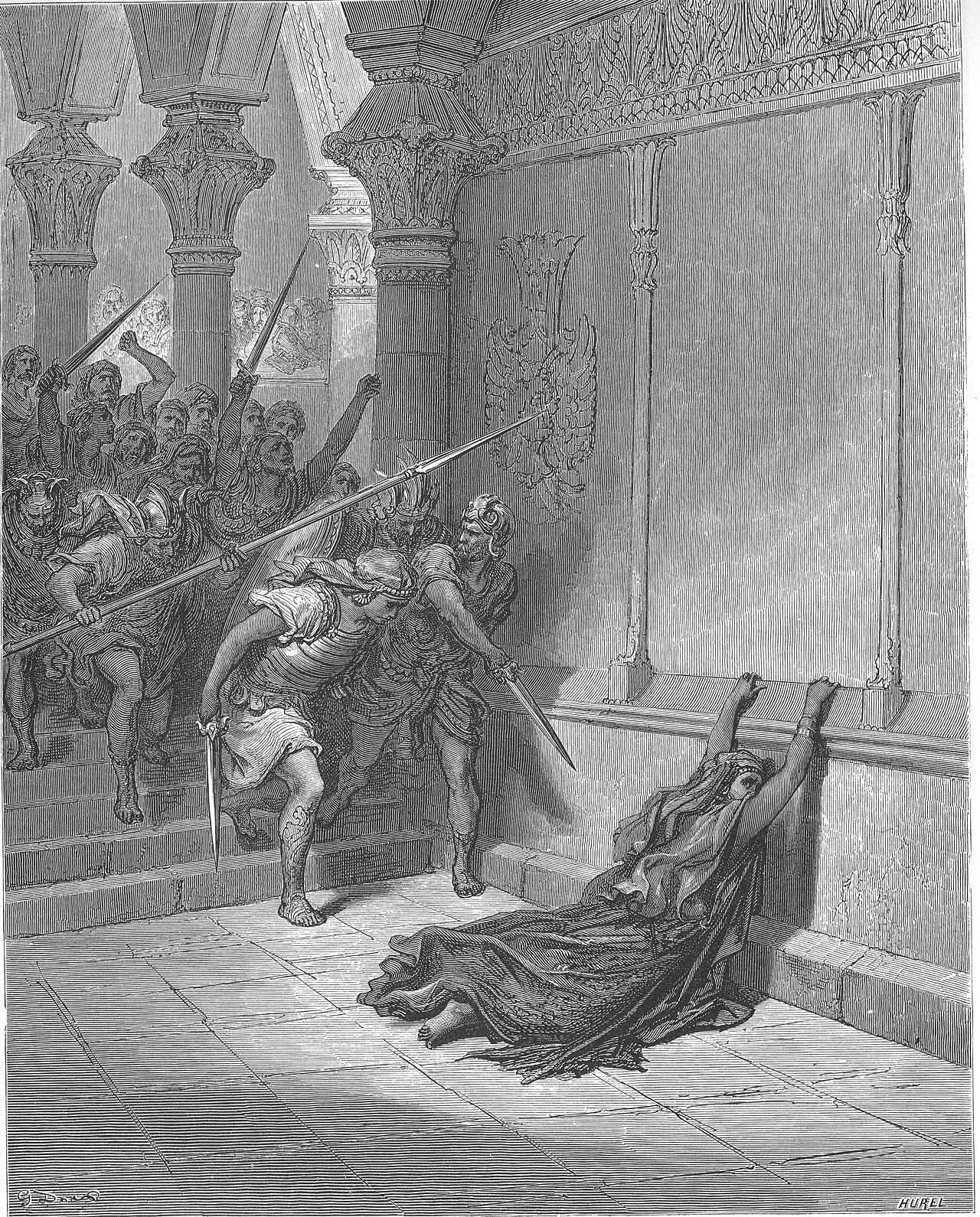
in 2 Kings 11And she looked out and saw the king standing by the pillar, according to the custom. The officers and trumpeters were beside the king, and all the people of the land were rejoicing and blowing trumpets. Then Athaliah tore her clothes and screamed, “Treason! Treason!”
BSB
The same verse in ASV and KJV ▾
ASV
and she looked, and, behold, the king stood by the pillar, as the manner was, and the captains and the trumpets by the king; and all the people of the land rejoiced, and blew trumpets. Then Athaliah rent her clothes, and cried, Treason! treason!
KJV
And when she looked, behold, the king stood by a pillar, as the manner was, and the princes and the trumpeters by the king, and all the people of the land rejoiced, and blew with trumpets: and Athaliah rent her clothes, and cried, Treason, Treason.
⋯
This verse in 2 Kings 11
Commentary
6 notes on this verseThe king stood by a pillar - Stood On a pillar or tribunal; the place or throne on which they were accustomed to put the kings when they proclaimed them. Treason, Treason - קשר קשר kesher, kasher; A conspiracy, A conspiracy! from kashar, to bind, unite together.
This site's exposition
she came to the people
on 2 Kings 11:13-14
Six years of hiddenness end the moment Athaliah hears the noise and comes into her own temple court to find the throne she thought empty occupied by the boy she meant to kill. She sees the king standing by the pillar, the customary coronation station, and rends her clothes with the cry Treason, Treason, the Hebrew word for conspiracy turned back on the one whose own reign began in exactly that conspiracy. Clarke names the Hebrew as kesher, the same root behind the charge.
The record, by era
The Church Fathers1 voice
While these things were happening in the temple, Athaliah, being alarmed by the shouts of the gathering people and by the noise of the crowds, ran to the temple. But while she was trying to restrain the riot with her presence and voice, she was …
The Puritans and the Awakening2 voices
Jehoiada gave orders to put her to death as an idolater, a usurper, and an enemy to the public peace. Care was taken, (1.) That she should not be killed in the temple, or any of the courts of it, in reverence to that holy place, which must not be stained with the blood of any human sacrifice, though ever so justly offered.
And when she looked, behold, the king stood by a pillar, as the manner was,....
The Nineteenth Century1 voice
A commentator
Albert Barnes1798–1870
Notes, Explanatory and Practical, on the Old and New Testaments (1832-1869)
proposed
By a pillar - Rather, “upon the pillar” probably a sort of stand, or pulpit, raised on a pillar. Under the later monarchy the Jewish king seems to have had a special place assigned him in the temple-court, from which on occasions he addressed the people (marginal references).
How the passage was read
What the Jewish commentators add
On the pedestal. That is the king’s platform in the Beis [Hamikdosh] of Adonoy. 20 Alternatively, עַמּוּד merely refers to a location in that area that was set aside for the king.
This section is reception history: how the passage was read and kept in the Jewish tradition. Where a reading parts from an essential of the Christian faith, the section says so at that point.
Texts and citation data: Sefaria; each excerpt follows its version’s licence. 6 further sources are cited on this chapter that carry no English text this site may quote or only restate the verse.
The words behind it
24 Hebrew wordsEvery Hebrew word of this verse in the order it stands, with what it means and the door to its own study. The last column counts the times a word stands in the whole Bible: the rarer the word, the more the places it appears belong together.
| Hebrew | Sound | Meaning | Word study | In the Bible |
|---|---|---|---|---|
| וַתֵּ֡רֶא | vatere' | and she saw | H7200 → | 1300 times |
| וְהִנֵּ֣ה | vehineh | and there! | H2009 → | 843 times |
| הַמֶּלֶךְ֩ | hamelekh | the king | H4428 → | 2525 times |
| עֹמֵ֨ד | ʾomed | [was] standing | H5975 → | 521 times |
| עַֽל־ | ʾal- | at | H5921 → | 5755 times |
| הָעַמּ֜וּד | haamud | the pillar | H5982 → | 111 times |
| כַּמִּשְׁפָּ֗ט | kamishpat | according to the custom | H4941 → | 422 times |
| וְהַשָּׂרִ֤ים | vehasarim | and the commanders | H8269 → | 421 times |
| וְהַחֲצֹֽצְרוֹת֙ | vehachatzotzerot | and the trumpets | H2689 → | 29 times |
| אֶל־ | ʾel- | [were] with | H413 → | 5510 times |
| הַמֶּ֔לֶךְ | hamelekh | the king | H4428 → | 2525 times |
| וְכָל־ | vekhol | and all | H3605 → | 5413 times |
| עַ֤ם | ʾam | [the] people of | H5971 → | 1873 times |
| הָאָ֙רֶץ֙ | haaretz | the land | H776 → | 2504 times |
| שָׂמֵ֔חַ | sameach | [was] joyful | H8056 → | |
| וְתֹקֵ֖עַ | vetokea' | and [was] giving a blast | H8628 → | |
| בַּחֲצֹֽצְר֑וֹת | bachatzotzerot | on trumpets | H2689 → | 29 times |
| וַתִּקְרַ֤ע | vatikra' | and she tore | H7167 → | 63 times |
| עֲתַלְיָה֙ | ʾatalyah | Athaliah | H6271 → | 17 times |
| אֶת־ | ʾet- | <obj.> | H853 → | 10935 times |
| בְּגָדֶ֔יהָ | begadeiha | clothes her | H899 → | 217 times |
| וַתִּקְרָ֖א | vatikra' | and she called out | H7121 → | 733 times |
| קֶ֥שֶׁר | kesher | treason | H7195 → | 16 times |
| קָֽשֶׁר׃ ס | kasher | treason | H7195 → | 16 times |
וַתֵּ֡רֶאand she saw
vatere'H7200 →1300 times
וְהִנֵּ֣הand there!
vehinehH2009 →843 times
הַמֶּלֶךְ֩the king
hamelekhH4428 →2525 times
עֹמֵ֨ד[was] standing
ʾomedH5975 →521 times
עַֽל־at
ʾal-H5921 →5755 times
הָעַמּ֜וּדthe pillar
haamudH5982 →111 times
כַּמִּשְׁפָּ֗טaccording to the custom
kamishpatH4941 →422 times
וְהַשָּׂרִ֤יםand the commanders
vehasarimH8269 →421 times
וְהַחֲצֹֽצְרוֹת֙and the trumpets
vehachatzotzerotH2689 →29 times
אֶל־[were] with
ʾel-H413 →5510 times
הַמֶּ֔לֶךְthe king
hamelekhH4428 →2525 times
וְכָל־and all
vekholH3605 →5413 times
עַ֤ם[the] people of
ʾamH5971 →1873 times
הָאָ֙רֶץ֙the land
haaretzH776 →2504 times
שָׂמֵ֔חַ[was] joyful
sameachH8056 →
וְתֹקֵ֖עַand [was] giving a blast
vetokea'H8628 →
בַּחֲצֹֽצְר֑וֹתon trumpets
bachatzotzerotH2689 →29 times
וַתִּקְרַ֤עand she tore
vatikra'H7167 →63 times
עֲתַלְיָה֙Athaliah
ʾatalyahH6271 →17 times
אֶת־<obj.>
ʾet-H853 →10935 times
בְּגָדֶ֔יהָclothes her
begadeihaH899 →217 times
וַתִּקְרָ֖אand she called out
vatikra'H7121 →733 times
קֶ֥שֶׁרtreason
kesherH7195 →16 times
קָֽשֶׁר׃ סtreason
kasherH7195 →16 times
A shaded row is a word that stands 400 times or fewer in the Bible.
The walk
8 stopsEach card is a verse this one points to, and under it the verses that one points to in turn. Where several paths arrive at the same place, that place is listed first: the text keeps returning to it.
Through
2 Kings 23:3So the king stood by the pillar and made a covenant before the LORD to follow the LORD and to keep His commandments, decrees, and statutes with all his heart and all his soul,…
it leads to
- 2 Kings 11:17
Then Jehoiada made a covenant between the LORD and the king and the people that they would be the LORD’s people. He also made a covenant between the king and the people.
- Deuteronomy 13:4
You are to follow the LORD your God and fear Him. Keep His commandments and listen to His voice; serve Him and hold fast to Him.
- 2 Kings 11:17
Through
2 Chronicles 34:31So the king stood by the pillar and made a covenant before the LORD to follow the LORD and to keep His commandments, decrees, and statutes with all his heart and all his soul,…
it leads to
- 2 Chronicles 23:16
Then Jehoiada made a covenant between himself and the king and the people that they would be the LORD’s people.
- 2 Kings 23:3
So the king stood by the pillar and made a covenant before the LORD to follow the LORD and to keep His commandments, decrees, and statutes with all his heart and all his soul,…
- 2 Chronicles 6:13
Now Solomon had made a bronze platform five cubits long, five cubits wide, and three cubits high, and had placed it in the middle of the courtyard. He stood on it, knelt down before…
- 2 Chronicles 23:16
Through
Luke 19:37And as He approached the descent from the Mount of Olives, the whole multitude of disciples began to praise God joyfully in a loud voice for all the miracles they had seen:
it leads to
- John 12:12–13
The next day the great crowd that had come to the feast heard that Jesus was coming to Jerusalem.
- Ezra 3:10–13
When the builders had laid the foundation of the temple of the LORD, the priests in their apparel with trumpets, and the Levites (the sons of Asaph) with cymbals, took their positions to praise…
- Matthew 21:1
As they approached Jerusalem and came to Bethphage on the Mount of Olives, Jesus sent out two disciples,
- John 12:12–13
About 2 Kings
Who and where
1 name in this verse with a page on the site.
This page draws on Adam Clarke, Commentary on the Bible; Albert Barnes, Notes, Explanatory and Practical, on the Old and New Testaments (1832-1869); Ephrem the Syrian, ON THE SECOND BOOK OF KINGS 11:13; John Gill, Exposition of the Old Testament (1748-1763) and Matthew Henry, Commentary on the Whole Bible.