
2 Kings 11:10
in 2 Kings 11Then the priest gave to the commanders of hundreds the spears and shields of King David from the house of the LORD.
BSB
The same verse in ASV and KJV ▾
ASV
And the priest delivered to the captains over hundreds the spears and shields that had been king David’s, which were in the house of Jehovah.
KJV
And to the captains over hundreds did the priest give king David’s spears and shields, that were in the temple of the Lord.
⋯
This verse in 2 Kings 11
Commentary
6 notes on this verseAnd to the captains over hundreds did the priest give King David's spears and shields, that were in the temple of the Lord. Such as he had taken in war from his enemies, and had dedicated for the service of the temple, to defend it on occasion, and laid up there; those the priests gave to the captains, to arm their men with, who came unarmed, and so unsuspected, and in this way might be armed without being seen and known.
This site's exposition
the spears and shields of King David
on 2 Kings 11:10-11
Jehoiada arms the guard with the spears and shields of King David, kept in the house of the LORD as trophies of David's wars. The coup that restores David's throne is fought with David's own arms, a detail Spurgeon preached in a sermon titled New Uses for Old Trophies.
The record, by era
The Puritans and the Awakening1 voice
If they were old and unfashionable, yet those that used them might, by their being David's, be reminded of God's covenant with him, which they were now acting in the defence of.
The Nineteenth Century3 voices
King David’s spears and shields - Josephus expressly says that David had provided an arsenal for the temple, out of which Jehoiada took those arms.
WHEN DAVID HAD FOUGHT with an adversary, and overcome him, he took away his armor and his weapons, and as other victorious heroes were wont to do, he bore them home as mementoes of his prowess, the trophies of the battle. These were placed in the house of the Lord. Perhaps David at the same time dedicated in like manner the shield and the sword which he had himself used in battle. After Solomon had built the temple, these trophies, which seem to have been very numerous, were hung up there. So they adorned the walls.
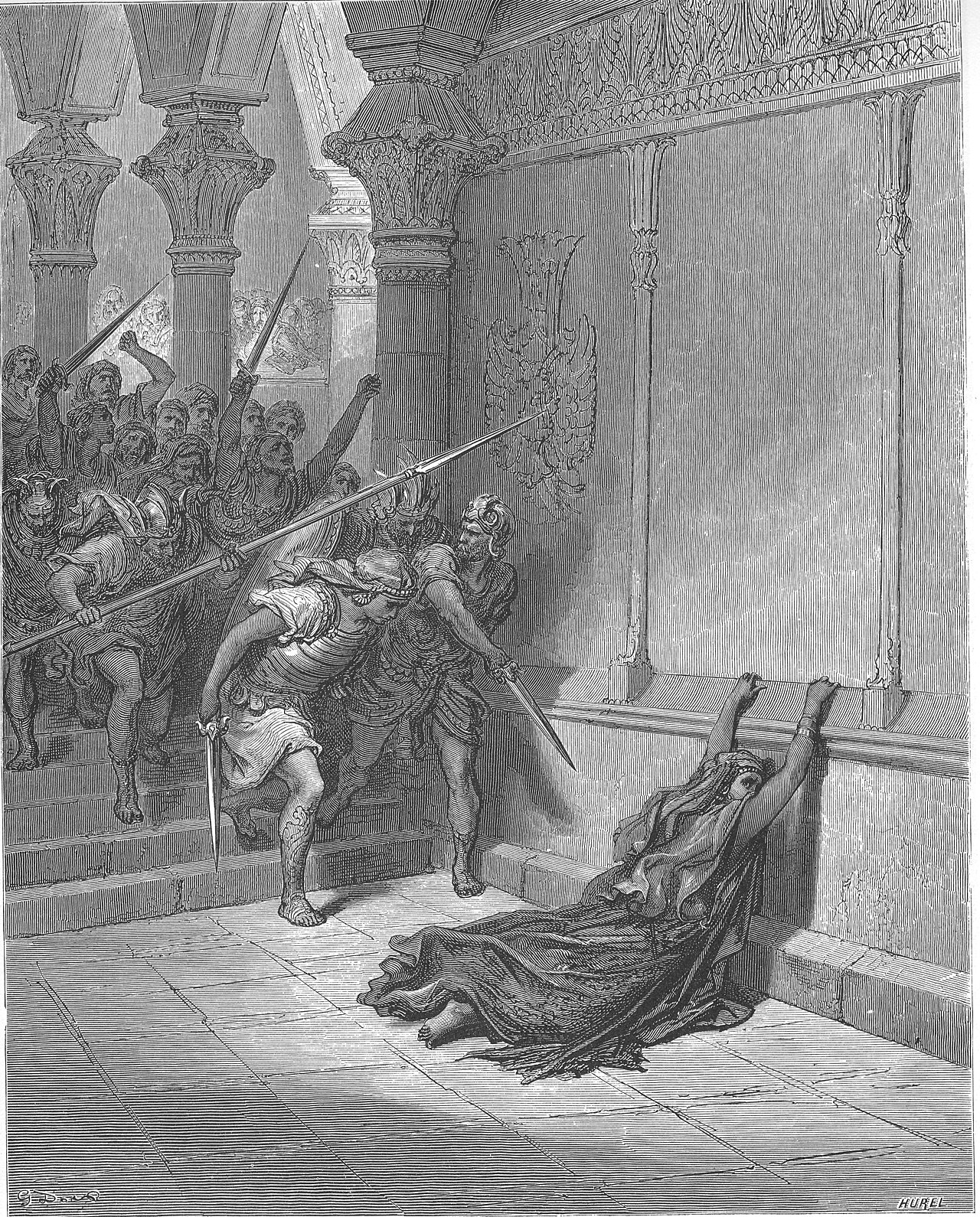
WHEN DAVID HAD FOUGHT with an adversary, and overcome him, he took away his armor and his weapons, and as other victorious heroes were wont to do, he bore them home as mementoes of his prowess, the trophies of the battle. These were placed in the house of the Lord. Perhaps David at the same time dedicated in like manner the shield and the sword which he had himself used in battle. After Solomon had built the temple, these trophies, which seem to have been very numerous, were hung up there. So they adorned the walls. So they illustrated the velour of noble sires. So they served to kindle emulation, I doubt not, in the breasts of true-hearted sons. Thus it was while generations sprung up and passed away; till at length other days dawned, darker scenes transpired, and sadder things filled up the chronicles of the nation. You will all of you remember the crisis to which my text refers. Athaliah, daughter of Ahab, wife of Jehoram, king of Judah, the usurping queen of Judah, had played the tyrant for well-nigh seven years. The endurance of the people had been tried to the uttermost; a just recompense was in store, and a well-concerted plan ready for execution. The time had come when she should be put to death, and the young prince who had been hidden away should be proclaimed king. It was arranged that he should be proclaimed in the temple court, yet the men that were to be the body-guard were not armed with weapons, for fear an alarm might be given, and the matter discovered too soon. But these weapons that were hung up of old in the temple were taken down, and the Levites and other friends were armed with them.
The words behind it
14 Hebrew wordsEvery Hebrew word of this verse in the order it stands, with what it means and the door to its own study. The last column counts the times a word stands in the whole Bible: the rarer the word, the more the places it appears belong together.
| Hebrew | Sound | Meaning | Word study | In the Bible |
|---|---|---|---|---|
| וַיִּתֵּ֨ן | vaiyiten | and he gave | H5414 → | 2011 times |
| הַכֹּהֵ֜ן | hakohen | the priest | H3548 → | 750 times |
| לְשָׂרֵ֣י | lesarei | to [the] commanders of | H8269 → | 421 times |
| הַמֵּא֗וֹת | hameyot | the hundreds | H3967 → | 581 times |
| אֶֽת־ | ʾet- | <obj.> | H853 → | 10935 times |
| הַחֲנִית֙ | hachanit | the spear | H2595 → | |
| וְאֶת־ | veet | and <obj.> | H853 → | 10935 times |
| הַשְּׁלָטִ֔ים | hashelatim | the shields | H7982 → | |
| אֲשֶׁ֖ר | ʾasher | which | H834 → | 5497 times |
| לַמֶּ֣לֶךְ | lamelekh | [had belonged] to the king | H4428 → | 2525 times |
| דָּוִ֑ד | david | David | H1732 → | 999 times |
| אֲשֶׁ֖ר | ʾasher | which | H834 → | 5497 times |
| בְּבֵ֥ית | beveit | [were] in [the] house of | H1004 → | 2046 times |
| יְהוָֽה׃ | yahweh | Yahweh | H3068 → | 6520 times |
וַיִּתֵּ֨ןand he gave
vaiyitenH5414 →2011 times
הַכֹּהֵ֜ןthe priest
hakohenH3548 →750 times
לְשָׂרֵ֣יto [the] commanders of
lesareiH8269 →421 times
הַמֵּא֗וֹתthe hundreds
hameyotH3967 →581 times
אֶֽת־<obj.>
ʾet-H853 →10935 times
הַחֲנִית֙the spear
hachanitH2595 →
וְאֶת־and <obj.>
veetH853 →10935 times
הַשְּׁלָטִ֔יםthe shields
hashelatimH7982 →
אֲשֶׁ֖רwhich
ʾasherH834 →5497 times
לַמֶּ֣לֶךְ[had belonged] to the king
lamelekhH4428 →2525 times
דָּוִ֑דDavid
davidH1732 →999 times
אֲשֶׁ֖רwhich
ʾasherH834 →5497 times
בְּבֵ֥ית[were] in [the] house of
beveitH1004 →2046 times
יְהוָֽה׃Yahweh
yahwehH3068 →6520 times
A shaded row is a word that stands 400 times or fewer in the Bible.
The walk
8 stopsEach card is a verse this one points to, and under it the verses that one points to in turn. Where several paths arrive at the same place, that place is listed first: the text keeps returning to it.
Through
1 Samuel 21:9The priest replied, “The sword of Goliath the Philistine, whom you killed in the Valley of Elah, is here; it is wrapped in a cloth behind the ephod. If you want, you may take…
it leads to
- 1 Samuel 17:2
Saul and the men of Israel assembled and camped in the Valley of Elah, arraying themselves for battle against the Philistines.
- 1 Samuel 31:10
They put his armor in the temple of the Ashtoreths and hung his body on the wall of Beth-shan.
- 1 Samuel 17:50–54
Thus David prevailed over the Philistine with a sling and a stone; without a sword in his hand he struck down the Philistine and killed him.
- Exodus 28:6–14
They are to make the ephod of finely spun linen embroidered with gold, and with blue, purple, and scarlet yarn.
- 1 Samuel 17:2
Through
1 Chronicles 18:7And David took the gold shields that belonged to the officers of Hadadezer and brought them to Jerusalem.
it leads to
- 2 Chronicles 9:15–16
King Solomon made two hundred large shields of hammered gold; six hundred shekels of hammered gold went into each shield.
Reached by 2 separate paths from here.
- 2 Chronicles 12:9–10
So King Shishak of Egypt attacked Jerusalem and seized the treasures of the house of the LORD and of the royal palace. He took everything, including the gold shields that Solomon had made.
- 1 Kings 14:26–28
He seized the treasures of the house of the LORD and of the royal palace. He took everything, including all the gold shields that Solomon had made.
- 2 Chronicles 9:15–16
Through
2 Samuel 8:7And David took the gold shields that belonged to the officers of Hadadezer and brought them to Jerusalem.
it leads to
- 1 Kings 10:16–17
King Solomon made two hundred large shields of hammered gold; six hundred shekels of gold went into each shield.
Reached by 2 separate paths from here.
- 1 Kings 10:16–17
About 2 Kings
Who and where
1 name in this verse with a page on the site.
This page draws on Adam Clarke, Commentary on the Bible; Charles Spurgeon, The Metropolitan Tabernacle Pulpit, Sermon No. 972, New Uses for Old Trophies; Charles Spurgeon, The Metropolitan Tabernacle Pulpit, Sermon No. 972: “New Uses for Old Trophies” (lightly modernized text, CCEL edition); John Gill, Exposition of the Old Testament (1748-1763) and Matthew Henry, Commentary on the Whole Bible.