
2 Kings 11:1
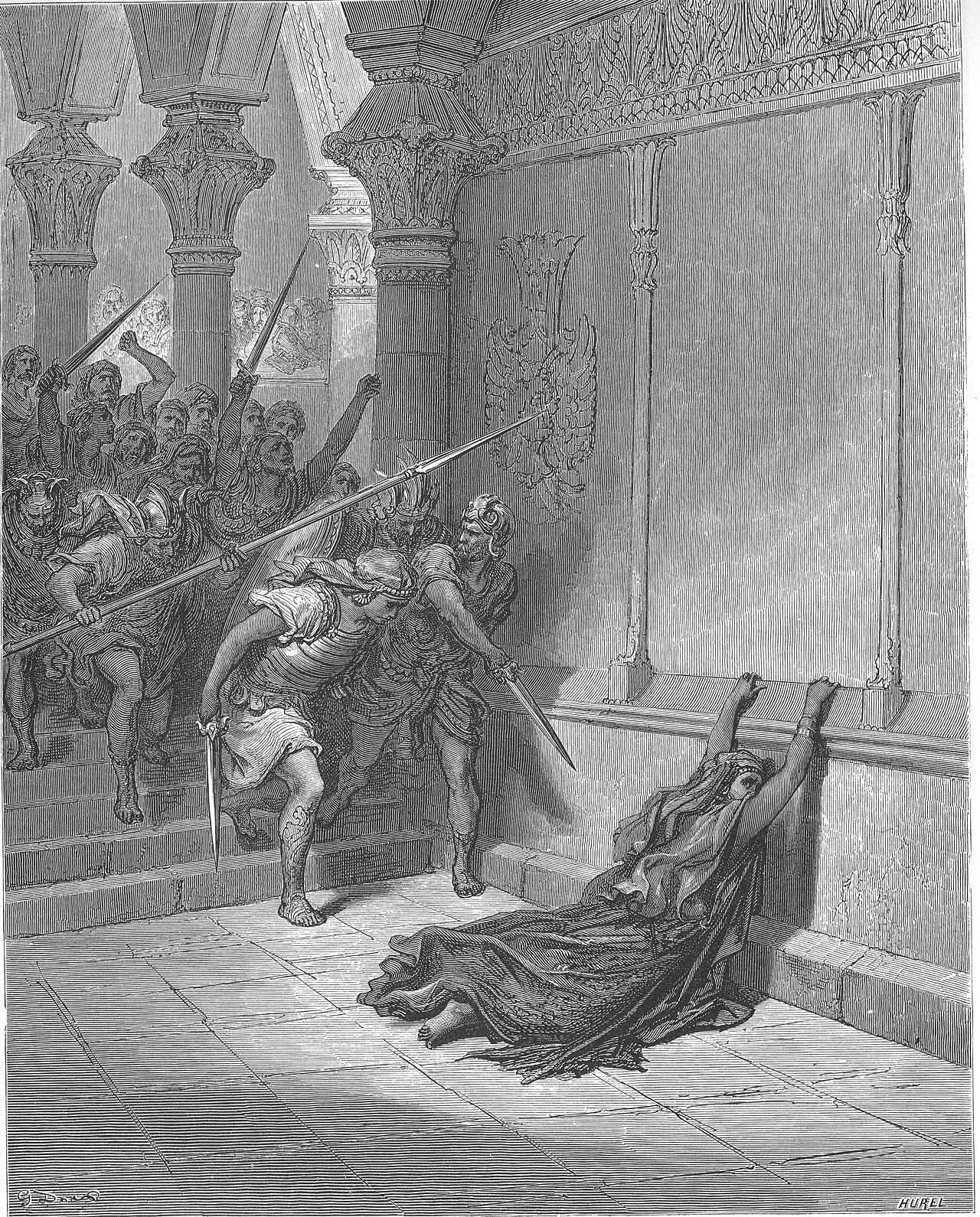
in 2 Kings 11When Athaliah the mother of Ahaziah saw that her son was dead, she proceeded to annihilate all the royal heirs.
BSB
The same verse in ASV and KJV ▾
ASV
Now when Athaliah the mother of Ahaziah saw that her son was dead, she arose and destroyed all the seed royal.
KJV
And when Athaliah the mother of Ahaziah saw that her son was dead, she arose and destroyed all the seed royal.
⋯
This verse in 2 Kings 11
Commentary
8 notes on this verseAthaliah exterminated all the royal children. In fact, after her son had been killed by Jehu, she had conceived an extremely perfidious and vicious scheme, saying to herself with anger, "I will reign just the same against the will of God by fighting God's promises, …
This site's exposition
destroyed all the seed royal
Athaliah's massacre reduces thread one, the covenant tested king by king, to its thinnest point in either book. The promise of 2 Samuel 7:12-15, a house and a throne established forever, now hangs on whichever child of David's line has not yet been found. She is Ahab's daughter and Jezebel's, and the narrator lets her turn royal power on her own family to secure it, without a word of comment yet.
The record, by era
The Puritans and the Awakening3 voices
She destroyed - This was the fruit of Jehoshaphat's marrying his son to a daughter of that idolatrous house of Ahab. And this dreadful judgment God permitted upon him and his, to shew how much he abhors all such affinities.
7 ), Jezebel's own daughter; yet herein God was righteous, and visited the iniquity of Joram and Ahaziah, those degenerate branches of David's house, upon their children. It was wonderfully preserved by the pious care of one of Joram's daughters (who was wife to Jehoiada the priest), who stole away one of the king's sons, Joash by name, and hid him,
quarantine:debris (2026-07-29) — leading-citation-number+unbalanced-parens
And when Athaliah the mother of Ahaziah saw that her son was dead,....
The Nineteenth Century2 voices
A commentator
Albert Barnes1798–1870
Notes, Explanatory and Practical, on the Old and New Testaments (1832-1869)
Athaliah, as wife of Joram and mother of Ahaziah, had guided both the internal and the external policy of the Jewish kingdom; she had procured the establishmeut of the worship of Baal in Judaea 2Ki 8:18, 2Ki 8:27, and had maintained a close alliance with the sister kingdom 2Ki 8:29; 2Ki 10:13. The revolution effected by Jehu touched her nearly.
A commentator
Jamieson, Fausset & Brown1802–1910
Commentary Critical and Explanatory on the Whole Bible (1871)
This massacre she was incited to perpetrate--partly from a determination not to let David's family outlive hers; partly as a measure of self-defense to secure herself against the violence of Jehu, who was bent on destroying the whole of Ahab's posterity to which she belonged (2Ki 8:18-26); but chiefly from personal ambition to rule, and a desire to establish the worship of Baal.
1 more voice on this verse
The Nineteenth Century1 voice
Athaliah - This woman was the daughter of Ahab, and grand-daughter of Omri, and wife of Joram king of Judah, and mother of Ahaziah. Destroyed all the seed royal - All that she could lay her hands on whom Jehu had left; in order that she might get undisturbed possession of the kingdom. How dreadful is the lust of reigning! it destroys all the charities of life; and turns fathers, mothers, brothers, and children, into the most ferocious savages! Who, that has it in his power, makes any conscience “To swim to sovereign rule through seas of blood?” In what a dreadful state is that land that is exposed to political revolutions, and where the succession to the throne is not most positively settled by the clearest and most decisive law! Reader, beware of revolutions; there have been some useful ones, but they are in general the heaviest curse of God.
The words behind it
13 Hebrew wordsEvery Hebrew word of this verse in the order it stands, with what it means and the door to its own study. The last column counts the times a word stands in the whole Bible: the rarer the word, the more the places it appears belong together.
| Hebrew | Sound | Meaning | Word study | In the Bible |
|---|---|---|---|---|
| וַֽעֲתַלְיָה֙ | vaatalyah | and Athaliah | H6271 → | 17 times |
| אֵ֣ם | ʾem | [the] mother of | H517 → | 220 times |
| אֲחַזְיָ֔הוּ | ʾachazyahu | Ahaziah | H274 → | 37 times |
| רָאֲתָ֖ה | raatah | she saw | H7200 → | 1300 times |
| כִּ֣י | ki | that | H3588 → | 4482 times |
| מֵ֣ת | met | he was dead | H4191 → | 839 times |
| בְּנָ֑הּ | benah | son her | H1121 → | 4930 times |
| וַתָּ֙קָם֙ | vatakom | and she arose | H6965 → | 628 times |
| וַתְּאַבֵּ֔ד | vateabed | and she destroyed | H6 → | 184 times |
| אֵ֖ת | ʾet | <obj.> | H853 → | 10935 times |
| כָּל־ | kol- | all | H3605 → | 5413 times |
| זֶ֥רַע | zera' | [the] offspring of | H2233 → | 229 times |
| הַמַּמְלָכָֽה׃ | hamamlakhah | <the> royalty | H4467 → | 117 times |
וַֽעֲתַלְיָה֙and Athaliah
vaatalyahH6271 →17 times
אֵ֣ם[the] mother of
ʾemH517 →220 times
אֲחַזְיָ֔הוּAhaziah
ʾachazyahuH274 →37 times
רָאֲתָ֖הshe saw
raatahH7200 →1300 times
כִּ֣יthat
kiH3588 →4482 times
מֵ֣תhe was dead
metH4191 →839 times
בְּנָ֑הּson her
benahH1121 →4930 times
וַתָּ֙קָם֙and she arose
vatakomH6965 →628 times
וַתְּאַבֵּ֔דand she destroyed
vateabedH6 →184 times
אֵ֖ת<obj.>
ʾetH853 →10935 times
כָּל־all
kol-H3605 →5413 times
זֶ֥רַע[the] offspring of
zera'H2233 →229 times
הַמַּמְלָכָֽה׃<the> royalty
hamamlakhahH4467 →117 times
A shaded row is a word that stands 400 times or fewer in the Bible.
The walk
8 stopsEach card is a verse this one points to, and under it the verses that one points to in turn. Where several paths arrive at the same place, that place is listed first: the text keeps returning to it.
Through
Matthew 2:16When Herod saw that he had been outwitted by the Magi, he was filled with rage. Sending orders, he put to death all the boys in Bethlehem and its vicinity who were two years…
it leads to
- Isaiah 59:7
Their feet run to evil; they are swift to shed innocent blood. Their thoughts are sinful thoughts; ruin and destruction lie in their wake.
- Proverbs 28:15
Like a roaring lion or a charging bear is a wicked ruler over a helpless people.
- Revelation 17:6
I could see that the woman was drunk with the blood of the saints and witnesses for Jesus. And I was utterly amazed at the sight of her.
- Isaiah 59:7
Through
Jeremiah 41:1In the seventh month, Ishmael son of Nethaniah, the son of Elishama, who was a member of the royal family and one of the king’s chief officers, came with ten men to Gedaliah son…
it leads to
- Jeremiah 40:8
they came to Gedaliah at Mizpah—Ishmael son of Nethaniah, Johanan and Jonathan the sons of Kareah, Seraiah son of Tanhumeth, the sons of Ephai the Netophathite, and Jezaniah son of the Maacathite—they and their…
- Jeremiah 40:6
So Jeremiah went to Gedaliah son of Ahikam at Mizpah and stayed with him among the people who were left in the land.
- Psalms 41:9
Even my close friend whom I trusted, the one who shared my bread, has lifted up his heel against me.
- Jeremiah 40:8
Through
2 Kings 25:25In the seventh month, however, Ishmael son of Nethaniah, the son of Elishama, who was a member of the royal family, came with ten men and struck down and killed Gedaliah, along with the…
it leads to
- Zechariah 8:19
“This is what the LORD of Hosts says: The fasts of the fourth, the fifth, the seventh, and the tenth months will become times of joy and gladness, cheerful feasts for the house of…
- Zechariah 7:5
“Ask all the people of the land and the priests, ‘When you fasted and mourned in the fifth and seventh months for these seventy years, was it really for Me that you fasted?
- Zechariah 8:19
About 2 Kings
Who and where
1 name in this verse with a page on the site.
This page draws on Adam Clarke, Commentary on the Bible; Albert Barnes, Notes, Explanatory and Practical, on the Old and New Testaments (1832-1869); Ishodad of Merv, BOOKS OF SESSIONS 2 KINGS 11:1; Jamieson Fausset and Brown, Commentary Critical and Explanatory on the Whole Bible; Jamieson, Fausset & Brown, Commentary Critical and Explanatory on the Whole Bible; John Gill, Exposition of the Old Testament (1748-1763); John Wesley, Explanatory Notes upon the Old Testament and Matthew Henry, Commentary on the Whole Bible.