
2 Kings 11:15
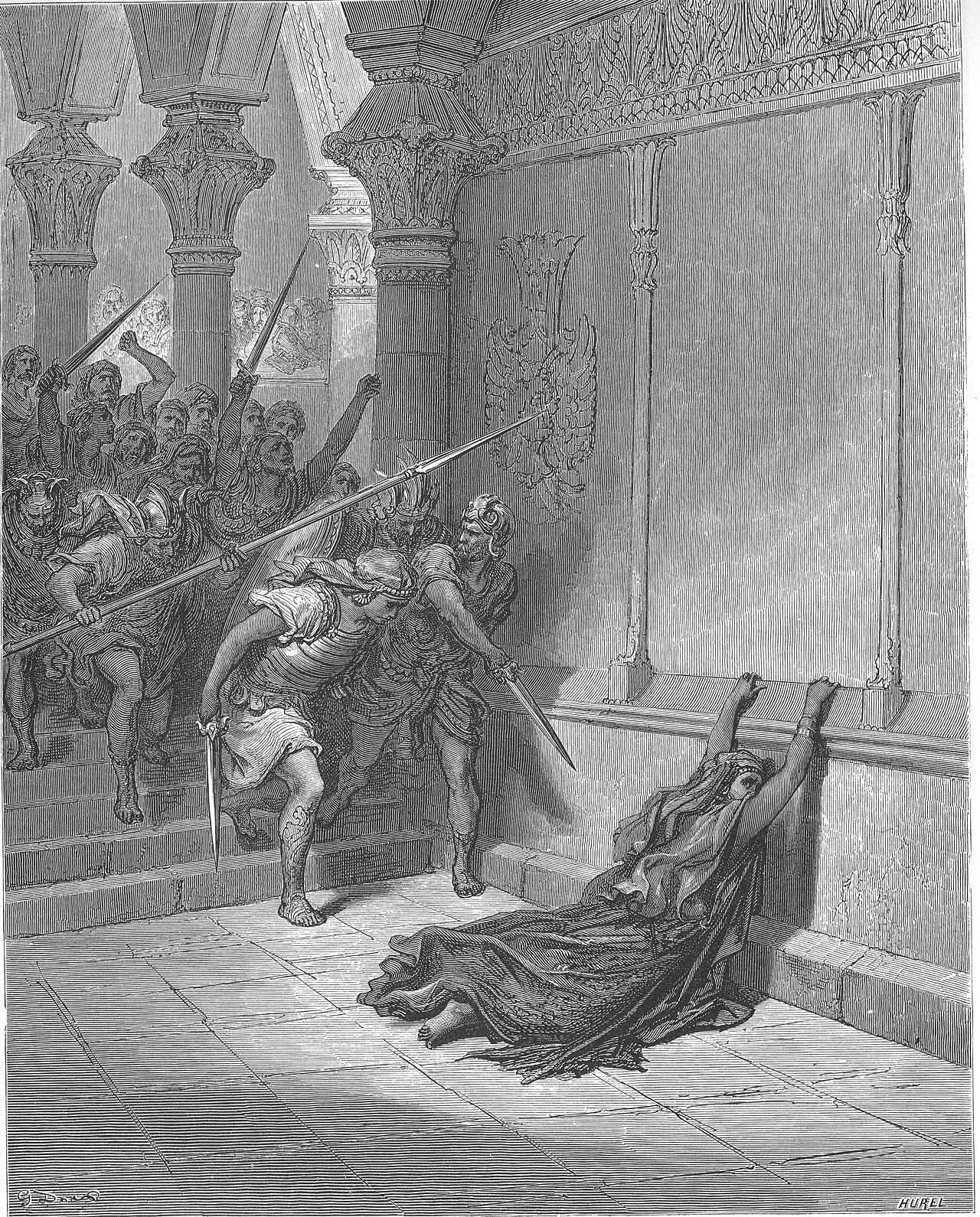
in 2 Kings 11And Jehoiada the priest ordered the commanders of hundreds in charge of the army, “Bring her out between the ranks, and put to the sword anyone who follows her.” For the priest had said, “She must not be put to death in the house of the LORD.”
BSB
The same verse in ASV and KJV ▾
ASV
And Jehoiada the priest commanded the captains of hundreds that were set over the host, and said unto them, Have her forth between the ranks; and him that followeth her slay with the sword. For the priest said, Let her not be slain in the house of Jehovah.
KJV
But Jehoiada the priest commanded the captains of the hundreds, the officers of the host, and said unto them, Have her forth without the ranges: and him that followeth her kill with the sword. For the priest had said, Let her not be slain in the house of the Lord.
⋯
This verse in 2 Kings 11
Commentary
6 notes on this verseA commentator
Albert Barnes1798–1870
Notes, Explanatory and Practical, on the Old and New Testaments (1832-1869)
Have her forth without the ranges - Rather, “Conduct her out between your ranks.” Guard her, i. e., on all sides, that the people may not fall upon her and kill her as she passes through the court, thereby polluting the temple.
This site's exposition
Let her not be slain
on 2 Kings 11:15-16
Jehoiada orders her taken out between the ranks rather than struck down inside the temple, guarding the sanctuary's own holiness even while executing a usurper he has every cause to kill on sight. She is led out by the way the horses came into the king's house and slain there, at the palace gate rather than at the altar the seed royal never reached. The order for her removal and the order against her blood in the house of the Lord stand in the same sentence.
The record, by era
The Church Fathers1 voice
While these things were happening in the temple, Athaliah, being alarmed by the shouts of the gathering people and by the noise of the crowds, ran to the temple. But while she was trying to restrain the riot with her presence and voice, she was …
The Puritans and the Awakening1 voice
But Jehoiada the priest commanded the captains of the hundreds, the officers of the host,....
The Nineteenth Century2 voices
A commentator
Jamieson, Fausset & Brown1802–1910
Commentary Critical and Explanatory on the Whole Bible (1871)
proposed
without the ranges--that is, fences, that the sacred place might not be stained with human blood. JEHOIADA RESTORES GOD'S WORSHIP. 17, 18. a covenant between the Lord and the king and the people--The covenant with the Lord was a renewal of the national covenant with Israel (Ex 19:1-24:18; "to be unto him a people of inheritance," De 4:6;
quarantine:debris (2026-07-29) — starts-lowercase+unbalanced-parens
Have her forth - She had pressed in among the guards into the temple. And him that followeth - The person who takes her part, let him instantly be slain.
How the passage was read
What the Jewish commentators add
On the verses either side of this one
On the pedestal. That is the king’s platform in the Beis [Hamikdosh] of Adonoy. 20 Alternatively, עַמּוּד merely refers to a location in that area that was set aside for the king.
This section is reception history: how the passage was read and kept in the Jewish tradition. Where a reading parts from an essential of the Christian faith, the section says so at that point.
Texts and citation data: Sefaria; each excerpt follows its version’s licence. 6 further sources are cited on this chapter that carry no English text this site may quote or only restate the verse.
The words behind it
26 Hebrew wordsEvery Hebrew word of this verse in the order it stands, with what it means and the door to its own study. The last column counts the times a word stands in the whole Bible: the rarer the word, the more the places it appears belong together.
| Hebrew | Sound | Meaning | Word study | In the Bible |
|---|---|---|---|---|
| וַיְצַו֩ | vaytzav | and he commanded | H6680 → | 494 times |
| יְהוֹיָדָ֨ע | yehoyada' | Jehoiada | H3077 → | 51 times |
| הַכֹּהֵ֜ן | hakohen | the priest | H3548 → | 750 times |
| אֶת־ | ʾet- | <obj.> | H853 → | 10935 times |
| שָׂרֵ֥י | sarei | [the] commanders of | H8269 → | 421 times |
| הַמֵּא֣וֹת | hameiot | the hundreds | H3967 → | 581 times |
| פְּקֻדֵ֣י | pekudei | [the] officers of | H6485 → | 303 times |
| הַחַ֗יִל | hachayil | the army | H2428 → | 246 times |
| וַיֹּ֤אמֶר | vaiyomer | and he said | H559 → | 5305 times |
| אֲלֵיהֶם֙ | ʾaleihem | to them | H413 → | 5510 times |
| הוֹצִ֤יאוּ | hotziu | bring out | H3318 → | 1067 times |
| אֹתָהּ֙ | ʾotah | <obj.> her | H853 → | 10935 times |
| אֶל־ | ʾel- | to | H413 → | 5510 times |
| מִבֵּ֣ית | mibeit | from between | H1004 → | 2046 times |
| לַשְּׂדֵרֹ֔ת | lasederot | to the ranks | H7713 → | |
| וְהַבָּ֥א | vehaba' | and the [one who] comes | H935 → | 2568 times |
| אַחֲרֶ֖יהָ | ʾachareiha | behind her | H310 → | 715 times |
| הָמֵ֣ת | hamet | put to death | H4191 → | 839 times |
| בֶּחָ֑רֶב | becharev | with the sword | H2719 → | 413 times |
| כִּ֚י | ki | for | H3588 → | 4482 times |
| אָמַ֣ר | ʾamar | he had said | H559 → | 5305 times |
| הַכֹּהֵ֔ן | hakohen | the priest | H3548 → | 750 times |
| אַל־ | ʾal- | may not | H408 → | 724 times |
| תּוּמַ֖ת | tumat | she be put to death | H4191 → | 839 times |
| בֵּ֥ית | beit | [the] house of | H1004 → | 2046 times |
| יְהוָֽה׃ | yahweh | Yahweh | H3068 → | 6520 times |
וַיְצַו֩and he commanded
vaytzavH6680 →494 times
יְהוֹיָדָ֨עJehoiada
yehoyada'H3077 →51 times
הַכֹּהֵ֜ןthe priest
hakohenH3548 →750 times
אֶת־<obj.>
ʾet-H853 →10935 times
שָׂרֵ֥י[the] commanders of
sareiH8269 →421 times
הַמֵּא֣וֹתthe hundreds
hameiotH3967 →581 times
פְּקֻדֵ֣י[the] officers of
pekudeiH6485 →303 times
הַחַ֗יִלthe army
hachayilH2428 →246 times
וַיֹּ֤אמֶרand he said
vaiyomerH559 →5305 times
אֲלֵיהֶם֙to them
ʾaleihemH413 →5510 times
הוֹצִ֤יאוּbring out
hotziuH3318 →1067 times
אֹתָהּ֙<obj.> her
ʾotahH853 →10935 times
אֶל־to
ʾel-H413 →5510 times
מִבֵּ֣יתfrom between
mibeitH1004 →2046 times
לַשְּׂדֵרֹ֔תto the ranks
lasederotH7713 →
וְהַבָּ֥אand the [one who] comes
vehaba'H935 →2568 times
אַחֲרֶ֖יהָbehind her
ʾachareihaH310 →715 times
הָמֵ֣תput to death
hametH4191 →839 times
בֶּחָ֑רֶבwith the sword
becharevH2719 →413 times
כִּ֚יfor
kiH3588 →4482 times
אָמַ֣רhe had said
ʾamarH559 →5305 times
הַכֹּהֵ֔ןthe priest
hakohenH3548 →750 times
אַל־may not
ʾal-H408 →724 times
תּוּמַ֖תshe be put to death
tumatH4191 →839 times
בֵּ֥ית[the] house of
beitH1004 →2046 times
יְהוָֽה׃Yahweh
yahwehH3068 →6520 times
A shaded row is a word that stands 400 times or fewer in the Bible.
The walk
8 stopsEach card is a verse this one points to, and under it the verses that one points to in turn. Where several paths arrive at the same place, that place is listed first: the text keeps returning to it.
Through
2 Kings 11:4Then in the seventh year, Jehoiada sent for the commanders of hundreds, the Carites, and the guards, and had them brought into the house of the LORD. There he made a covenant with them…
it leads to
- 2 Kings 11:9
So the commanders of hundreds did everything that Jehoiada the priest had ordered. Each of them took his men—those coming on duty on the Sabbath and those going off duty—and came to Jehoiada the…
- 2 Kings 11:19
He took with him the commanders of hundreds, the Carites, the guards, and all the people of the land, and they brought the king down from the house of the LORD and entered the…
- 2 Kings 11:17
Then Jehoiada made a covenant between the LORD and the king and the people that they would be the LORD’s people. He also made a covenant between the king and the people.
- 2 Chronicles 15:12
Then they entered into a covenant to seek the LORD, the God of their fathers, with all their heart and soul.
- 2 Chronicles 23:1–21
Then in the seventh year, Jehoiada strengthened himself and made a covenant with the commanders of hundreds—with Azariah son of Jeroham, Ishmael son of Jehohanan, Azariah son of Obed, Maaseiah son of Adaiah, and…
- 2 Kings 11:9
Through
Ezekiel 9:7Then He told them, “Defile the temple and fill the courts with the slain. Go forth!” So they went out and began killing throughout the city.
it leads to
- Ezekiel 7:20–22
His beautiful ornaments they transformed into pride and used them to fashion their vile images and detestable idols. Therefore I will make these into something unclean for them.
- 2 Chronicles 36:17
So He brought up against them the king of the Chaldeans, who put their young men to the sword in the sanctuary, sparing neither young men nor young women, neither elderly nor infirm. God…
- Ezekiel 7:20–22
Through
2 Chronicles 23:9Then Jehoiada the priest gave to the commanders of hundreds the spears and the large and small shields of King David that were in the house of God.
it leads to
- 1 Samuel 21:9
The priest replied, “The sword of Goliath the Philistine, whom you killed in the Valley of Elah, is here; it is wrapped in a cloth behind the ephod. If you want, you may take…
- 1 Samuel 21:9
About 2 Kings
This page draws on Adam Clarke, Commentary on the Bible; Albert Barnes, Notes, Explanatory and Practical, on the Old and New Testaments (1832-1869); Albert Barnes, Notes on the Old Testament; Ephrem the Syrian, ON THE SECOND BOOK OF KINGS 11:13; Jamieson, Fausset & Brown, Commentary Critical and Explanatory on the Whole Bible and John Gill, Exposition of the Old Testament (1748-1763).