
2 Kings 11:20
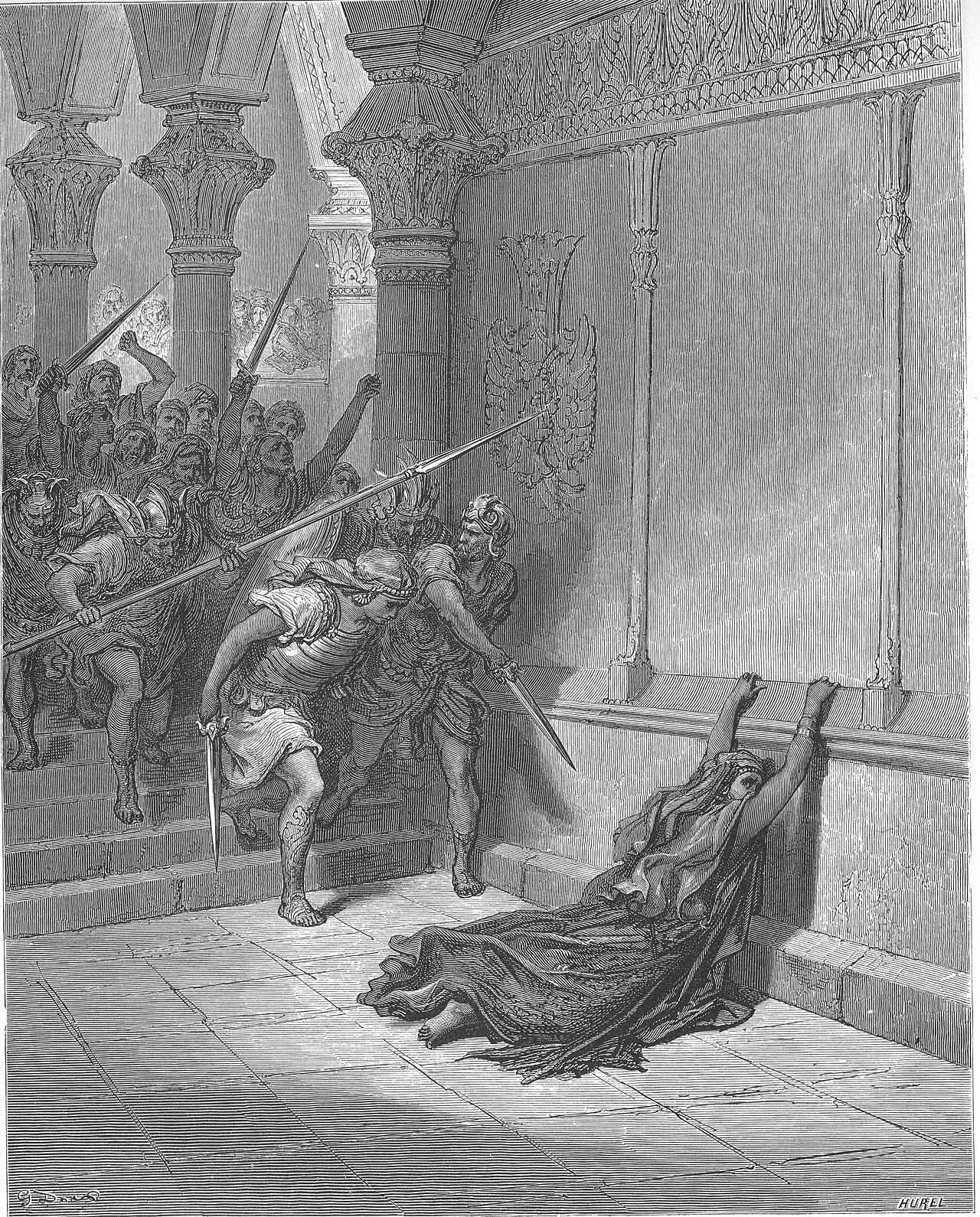
in 2 Kings 11and all the people of the land rejoiced. And the city was quiet, because Athaliah had been put to the sword at the royal palace.
BSB
The same verse in ASV and KJV ▾
ASV
So all the people of the land rejoiced, and the city was quiet. And Athaliah they had slain with the sword at the king’s house.
KJV
And all the people of the land rejoiced, and the city was in quiet: and they slew Athaliah with the sword beside the king’s house.
⋯
This verse in 2 Kings 11
Commentary
6 notes on this verseThe people - rejoiced - They were glad to get rid of the tyranny of Athaliah. And the city was in quiet - She had no partisans to rise up and disturb the king’s reign.
This site's exposition
went into the house of Baal
on 2 Kings 11:18-20
Reform follows the coronation without a pause, the house of Baal torn down, its altars and images broken in pieces, and Mattan its priest killed at his own altar, the very worship Athaliah and her mother Jezebel had planted in two kingdoms uprooted in Judah in a single afternoon. The king is brought down to the palace and set on the throne, and the narrator repeats that Athaliah was slain, a second notice after verse sixteen's, closing the episode before the boy king's minority opens the next chapter. All the people of the land rejoice, and the city is in quiet.
The record, by era
The Puritans and the Awakening3 voices
Now here we have David's promised lamp almost extinguished and yet wonderfully preserved. It was almost extinguished by the barbarous malice of Athaliah, the queen-mother, who, when she heard that her son Ahaziah was slain by Jehu, arose and destroyed all the seed-royal (
quarantine:debris (2026-07-29) — unbalanced-parens
), and Josephus says they kept a feast of joy many days, making good Solomon's observation ( Prov. xi. 10 ), When it goes well with the righteous the city rejoices, and when the wicked perish there is shouting.
quarantine:debris (2026-07-29) — leading-punctuation+unbalanced-parens
And all the people of the land rejoiced,....
The Nineteenth Century1 voice
A commentator
Albert Barnes1798–1870
Notes, Explanatory and Practical, on the Old and New Testaments (1832-1869)
proposed
They slew Athaliah with the sword - This is one of the many little repetitions which mark the manner of the writer, and which generally contain some little point which has not been mentioned before (compare 2Ki 11:16).
The words behind it
12 Hebrew wordsEvery Hebrew word of this verse in the order it stands, with what it means and the door to its own study. The last column counts the times a word stands in the whole Bible: the rarer the word, the more the places it appears belong together.
| Hebrew | Sound | Meaning | Word study | In the Bible |
|---|---|---|---|---|
| וַיִּשְׂמַ֥ח | vaiyismach | and it rejoiced | H8055 → | |
| כָּל־ | kol- | all | H3605 → | 5413 times |
| עַם־ | ʾam- | [the] people of | H5971 → | 1873 times |
| הָאָ֖רֶץ | haaretz | the land | H776 → | 2504 times |
| וְהָעִ֣יר | vehair | and the city | H5892 → | 1090 times |
| שָׁקָ֑טָה | shakatah | it was at peace | H8252 → | |
| וְאֶת־ | veet | and <obj.> | H853 → | 10935 times |
| עֲתַלְיָ֛הוּ | ʾatalyahu | Athaliah | H6271 → | 17 times |
| הֵמִ֥יתוּ | hemitu | they had put to death | H4191 → | 839 times |
| בַחֶ֖רֶב | vacherev | with the sword | H2719 → | 413 times |
| בֵּ֥ית | beit | [the] house of | H1004 → | 2046 times |
| הַמֶּֽלֶךְ׃ ס | hamelekh | the king | H4428 → | 2525 times |
וַיִּשְׂמַ֥חand it rejoiced
vaiyismachH8055 →
כָּל־all
kol-H3605 →5413 times
עַם־[the] people of
ʾam-H5971 →1873 times
הָאָ֖רֶץthe land
haaretzH776 →2504 times
וְהָעִ֣ירand the city
vehairH5892 →1090 times
שָׁקָ֑טָהit was at peace
shakatahH8252 →
וְאֶת־and <obj.>
veetH853 →10935 times
עֲתַלְיָ֛הוּAthaliah
ʾatalyahuH6271 →17 times
הֵמִ֥יתוּthey had put to death
hemituH4191 →839 times
בַחֶ֖רֶבwith the sword
vacherevH2719 →413 times
בֵּ֥ית[the] house of
beitH1004 →2046 times
הַמֶּֽלֶךְ׃ סthe king
hamelekhH4428 →2525 times
A shaded row is a word that stands 400 times or fewer in the Bible.
The walk
8 stopsEach card is a verse this one points to, and under it the verses that one points to in turn. Where several paths arrive at the same place, that place is listed first: the text keeps returning to it.
Through
Proverbs 29:2When the righteous flourish, the people rejoice, but when the wicked rule, the people groan.
it leads to
- Proverbs 28:12
When the righteous triumph, there is great glory, but when the wicked rise, men hide themselves.
Reached by 2 separate paths from here.
- Proverbs 11:10
When the righteous thrive, the city rejoices, and when the wicked perish, there are shouts of joy.
Reached by 2 separate paths from here.
- Proverbs 28:28
When the wicked come to power, people hide themselves; but when they perish, the righteous flourish.
Reached by 2 separate paths from here.
- Esther 8:15
Mordecai went out from the presence of the king in royal garments of blue and white, with a large gold crown and a purple robe of fine linen. And the city of Susa shouted…
- Ecclesiastes 10:5
There is an evil I have seen under the sun—an error that proceeds from the ruler:
- Proverbs 28:12
Through
Proverbs 11:10When the righteous thrive, the city rejoices, and when the wicked perish, there are shouts of joy.
it leads to
- Psalms 58:10–11
The righteous will rejoice when they see they are avenged; they will wash their feet in the blood of the wicked.
Reached by 2 separate paths from here.
- Psalms 58:10–11
Through
2 Kings 11:14And she looked out and saw the king standing by the pillar, according to the custom. The officers and trumpeters were beside the king, and all the people of the land were rejoicing and…
it leads to
- 2 Chronicles 34:31
So the king stood by the pillar and made a covenant before the LORD to follow the LORD and to keep His commandments, decrees, and statutes with all his heart and all his soul,…
- 2 Kings 23:3
So the king stood by the pillar and made a covenant before the LORD to follow the LORD and to keep His commandments, decrees, and statutes with all his heart and all his soul,…
- 2 Chronicles 34:31
About 2 Kings
Who and where
1 name in this verse with a page on the site.
This page draws on Adam Clarke, Commentary on the Bible; Albert Barnes, Notes, Explanatory and Practical, on the Old and New Testaments (1832-1869); John Gill, Exposition of the Old Testament; John Gill, Exposition of the Old Testament (1748-1763) and Matthew Henry, Commentary on the Whole Bible.