
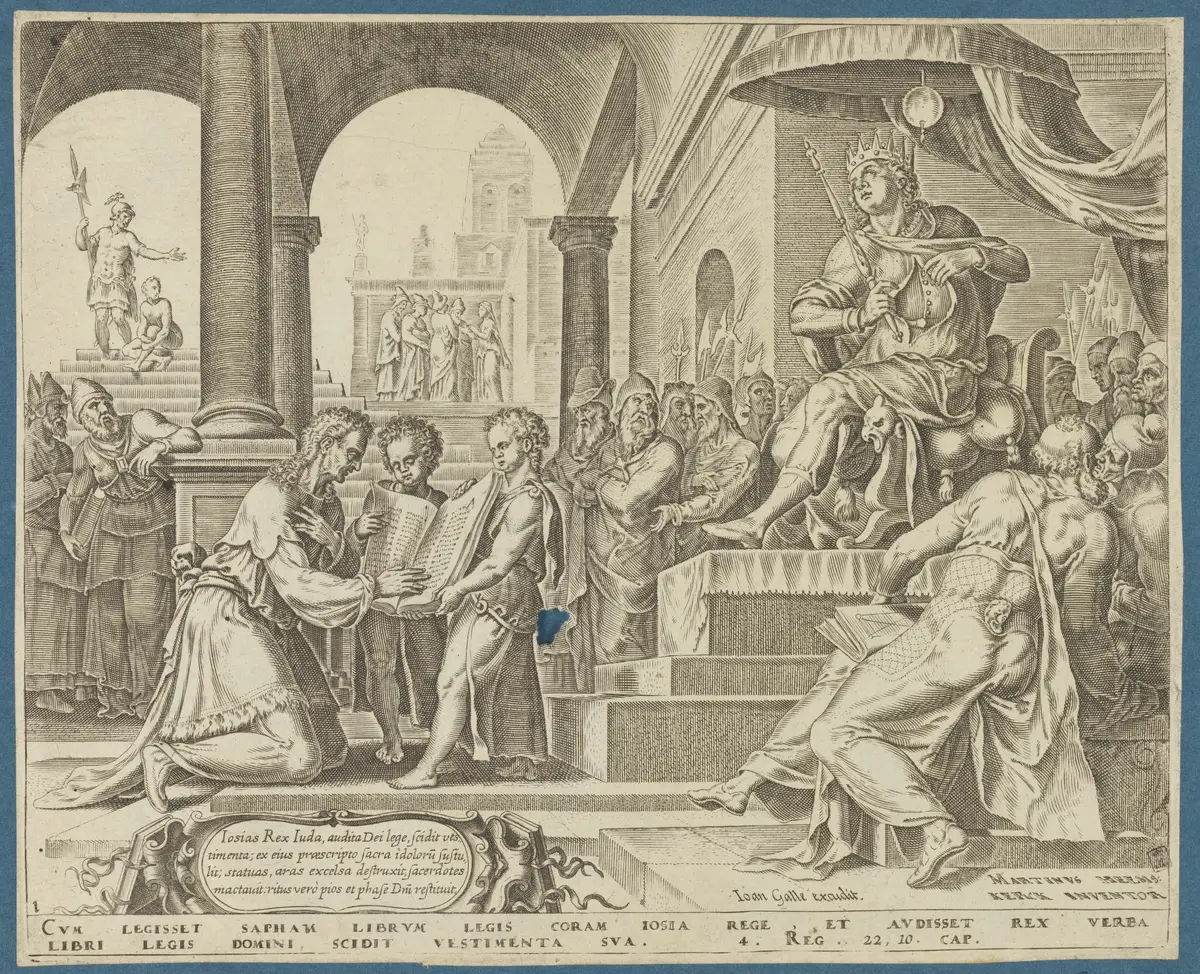
2 Chronicleschapter 35
27 verses · Ezra, by tradition · 450 to 400 BC · History
To the Levites who taught all Israel and were holy to the LORD, Josiah said: “Put the holy ark in the temple built by Solomon son of David king of Israel. It is not to be carried around on your shoulders. Now serve the LORD your God and His people Israel.
Introduction
Ezra, by tradition, History, 2 Chronicles Overview.
This chapter was written for a people who kept a mourning custom for a king long after his death. It sets two scenes thirteen years apart. The first is a feast carried out with more care for the written order than any since the days of Samuel. The second is a battle the king did not need to fight. Listen for how many people give and serve, and how each group has its place. Then listen to the warning the king refuses, and to the lament that follows him.
Context
- Who
- A people who kept a mourning ordinance for this king long after he died
- What
- Josiah's great Passover kept according to the law, and his death in battle against Pharaoh Neco at Megiddo.
- Where
- The temple in Jerusalem for the feast, and the plain of Megiddo for the battle.
- When
- 622 BC for the Passover, in Josiah's eighteenth year, and 609 BC for his death.
- Why
- To show that worship done as God commanded was possible, and to warn that even a faithful king falls when he will not listen.
Historical context
The chapter is Josiah's, and it names more of his officers than most chapters of the book, with three chiefs of the priests and six chiefs of the Levites listed as givers. Necho of Egypt is the other king in it, and Jeremiah closes it.
Show the rest of the historical context, 4 more paragraphs
The time is two fixed points thirteen years apart. The Passover falls in the eighteenth year, 622 BC, the same year as the temple repair and the discovery of the book. The death at Megiddo falls in 609 BC.
The place is the temple for the first nineteen verses and the plain at Megiddo for the last eight. Megiddo guarded the pass an army had to take going north along the coast road.
The occasion of the battle is a campaign that had nothing to do with Judah. Necho was marching for Carchemish on the Euphrates, and Josiah went out to stop him.
A first hearer knew what the courses of verse 4 were, since the writing of David and of Solomon named an order of service their own priests still worked by. A hearer also knew Megiddo as the place armies met. A king who went into battle in disguise was doing what Ahab had done at Ramoth-gilead, in a story this same book tells.
Significance
For Judah this chapter said that worship done exactly as it was written was possible, and it dated the result past every reign back to Samuel.
Show the rest of the significance, 2 more paragraphs
It also left them with a death they could not explain away. The king was warned by a foreign ruler claiming a word from God, and the text says he did not listen and went out anyway.
The lament of verse 25 became a fixed observance. Singing men and singing women kept it at the time this book was written, which is the only mourning ordinance Scripture records for a king of Judah.
This chapter in Jewish lifeWhat this chapter is in Jewish life and reading.
What is done
Chronicles stands among the Writings in the Hebrew canon, and the annual cycle of Torah portions and their Haftarot draws on other books. A Jewish reader meets this chapter in study rather than in a reading appointed for a Sabbath or a feast, and the site's own reading data records the same for every chapter.
The Passover of this chapter is kept by the book, and Rashi marks the parts that make it lawful. The lambs were roasted with fire as the law of Exodus requires (Rashi on II Chronicles 35:13:1). The priests and Levites stood in their courses so that the rite was done according to its law (Rashi on II Chronicles 35:5:1). Rashi opens the chapter by saying that none of the wicked kings of Judah had kept the Passover according to its law (Rashi on II Chronicles 35:1:1).
The order about the Ark is read two ways in the one comment. On the plain sense, the Ark was being put back because it had been displaced for an image in the previous reign (Rashi on II Chronicles 35:3:1). Rashi then gives the reading of the Rabbis, that the king was telling the Levites to hide it there (Rashi on II Chronicles 35:3:1, citing Yoma 42b).
The mourning for the king becomes a practice of its own. Rashi says that singers are named because song and lamentation are carried by the same voice (Rashi on II Chronicles 35:25:1). He reads the prophecy of the sun setting at midday as the day of this king, who died at thirty-nine, in the middle of his days.
How it is read
The claim that no Passover like it had been kept is the chapter's difficulty, and Rashi works it twice. He first sets out a reading built on the two kingdoms and the return of the ten tribes, and then rejects it in his own words. "This interpretation, however, misleads me very much, and does not appear correct to me" (Rashi on II Chronicles 35:18:1). His objection is plain. The days of the judges, of Samuel, of David and of Solomon were days of one king and a willing people, so the claim cannot rest on unity alone.
He then gives the reading he was taught by Rabbi Eliezer son of Rabbi Meshullam. What had never happened before was the provision itself (Rashi on II Chronicles 35:18:1). The king and the officers supplied the animals, and the Levites prepared them and sent each man as much as he could eat.
The death at Megiddo is read as a loss the book laments. Rashi says the account decries and laments this king, because no miracle was done for him as one had been done for Hezekiah (Rashi on II Chronicles 35:20:1). The warning from the Egyptian king he treats as a word from God, and quotes a poem of the Kallir on the king who would not turn back (Rashi on II Chronicles 35:22:1). The two chariots he explains from the custom of kings, the second kept ready if the first should fail (Rashi on II Chronicles 35:24:1).
Metzudat David comments at 35:2:1, 35:4:1, 35:8:1, 35:10:1, 35:11:1, 35:12:1, 35:14:1, 35:16:1, 35:17:1 and 35:23:1, and Radak at 35:21:1. A further comment of Rashi at 35:6:1 is held by Sefaria in Hebrew alone. The corpus holds no English text for any of these, so they stand cited and unquoted.
What the rabbis say
The corpus carries forty locators on this chapter and holds the locator alone for each. The Babylonian Talmud carries it at Yoma 49a:2, Zevachim 14a:20, Horayot 12a:2, Taanit 22b:1 and Moed Katan 25b:10. Ein Yaakov (Glick Edition) carries it at Yoma 5:3, Taanit 3:14 and Moed Katan 3:18, and the plain edition at Yoma 5:4 and Taanit 3:15. The Jerusalem Talmud carries it at Makkot 2:6:12, Shekalim 6:1:6, Sotah 8:3:4, Pesachim 5:6:2, Eruvin 3:1:7, Nazir 6:9:2, Nedarim 6:1:2 and Kiddushin 1:7:3. The Rabbah collections carry it at Kohelet Rabbah 9:1:1, Vayikra Rabbah 20:1, Eikhah Rabbah 1:53 and 4:1 and Bamidbar Rabbah 23:13. Midrash Lekach Tov carries it at Deuteronomy 16:7:1, Exodus 12:9:5 and on Lamentations 1:18:1, and Midrash Aggadah at Deuteronomy 16:7:1. The Tanchuma carries it at Masei 12:1, and Midrash Tanchuma Buber at Masei 9:1 and Vaetchanan 1:1. The halakhic midrashim carry it at Mekhilta DeRabbi Yishmael Tractate Pischa 6:19 and Sifra Bechukotai chapter 2 section 3. The scribal tractates carry it at Tractate Sefer Torah 4:8 and Tractate Soferim 4:9. The rest are Pirkei DeRabbi Eliezer 17:14, Otzar Midrashim Baraita of Rabbi Pinchas Ben Yair 1:30, Seder Olam Rabbah 24:2 and Yalkut Shimoni on Torah 724:1. Last are Introductions to Tanaitic Literature, Introductions to Tractates of the Mishnah, Pesachim 59 and 61.
Sources: Rashi, Rashi on II Chronicles, the Judaica Press complete Tanach with Rashi, translated by A. J. Rosenberg (Sefaria, CC-BY); Metzudat David, Metzudat David on II Chronicles 35, cited by ref from the Sefaria corpus, which holds no English version of it; Radak, Radak on II Chronicles 35, cited by ref from the Sefaria corpus, which holds no English version of it; The Sefaria corpus on disk, scripts/data/sources/sefaria/2-chronicles/35.json, fetched 2026-09-19; The reading data of this site, src/lib/hebraic/readings.ts, probed in this lane: 2-chronicles parashot 0, haftarah uses 0, hasSynagogueReading true for 0 of 36 chapters.
The heads below are this chapter's scenes. The numbered points under each are its verses.
Put the ark in the house; princes give lambs by the thousands
2 Chronicles 35:1-3
Josiah celebrated the Passover to the LORD: Kings gives this Passover three verses, 2 Kings 23:21-23, and Chronicles gives it nineteen, the same expansion the book gave Hezekiah's Passover in chapter 30. From here the Levites' charge is teaching and service, the order David set right at 1 Chronicles 15:2.
2 Chronicles 35:1
“The Levites, the ministers or instructors of the people in all matters pertaining to the divine worship, were commanded (2Ch 35:3) to "put the holy ark in the house which Solomon did build." Their duty was to transport the ark from place to place according to circumstances.”
Jamieson, Fausset & Brown · Commentary Critical and Explanatory on the Whole Bible (1871)reformed
encouraged them in the service of the house of the LORD: Josiah set the priests in their appointed courses and encouraged them in the work. Hezekiah had done the same, speaking encouragement to the Levites in 30:22. Charles Spurgeon, preaching on this verse, traced the order of Josiah's reform: the idols removed, the temple repaired, then the feasts and services restored.
2 Chronicles 35:2
“‘And Josiah set the priests in their charges, and encouraged them to the service of the house of the Lord’2 Chronicles 35:2. JOSIAH, as you remember, in the early part of his reign set his face against the idolatries that prevailed, to root them out of the land. He then bent his thoughts upon repairing and beautifying the temple.”
2 more voices on this verse
2 Chronicles 35:2
“And he set the priests in their charges,.... In their offices, and in their proper places, to execute them: and encouraged them to the service of the house of the Lord; to attend it with cheerfulness and constancy, and do it according to the will of God, promising his favour and protection.”
2 Chronicles 35:2
“The ceremonial services were expensive, which perhaps was one reason why they had been neglected. People had not zeal enough to be at the charge of them; nor were they now very fond of them, for that reason, and therefore, 1. Josiah, at his own proper cost, furnished the congregation with paschal lambs, and other sacrifices, to be offered during the seven days of the feast.”
Matthew Henry · Commentary on the Whole Bible (1707-1721)puritan
It is not to be carried around on your shoulders: Carrying the ark on their shoulders was the Levites' charge in the wilderness, Numbers 4:15 and 1 Chronicles 15:15. Albert Barnes reads Josiah's words as releasing them from that duty for good, so they could return to serving the LORD and teaching the people.
2 Chronicles 35:3
Put the holy ark etc - The ark of the covenant may have been temporarily removed from the holy of holies while Josiah effected necessary repairs. It shall not be a burden upon your shoulders - The removing and replacing the ark Josiah means “shall not henceforth be your duty. The ark shall remain undisturbed in the holy of holies. You shall return to your old employments, to the service of God and the instruction of the people.”
2 Chronicles 35:4-6
according to the instructions written by David king of Israel: The Levites prepare by families in their divisions, “according to the instructions written by David king of Israel and Solomon his son”. These are the courses of 1 Chronicles 23 to 26. Each family of Levites serves its kinsmen “to carry out the word of the LORD given by Moses”.
by the divisions of the families of your kinsmen the lay people: Albert Barnes explains: each family was matched with a section of a Levitical family. John Wesley notes that Josiah calls the lay families their kinsmen so that the Levites would serve them willingly. Jamieson, Fausset and Brown describe the later practice of admitting the worshipers one company at a time.
2 Chronicles 35:5
The sense of this verse probably is: “So divide yourselves that, for every distinct family among the people who come to the Passover, there shall be a portion of a Levitical family to minister.”
1 more voice on this verse
2 Chronicles 35:5
“When the first company entered the court (which consisted commonly of as many as it could well hold), the gates were shut and the offering was made. The Levites stood in rows from the slaughtering places to the altar, and handed the blood and fat from one to another of the officiating priests (2Ch 30:16-18).”
Jamieson, Fausset & Brown · Commentary Critical and Explanatory on the Whole Bible (1871)reformed
make preparations for your fellow countrymen: John Gill takes the consecration as the washing of body that made the Levites fit to serve. Albert Barnes reads the preparing as teaching the people how to eat the Passover as the law requires. Jamieson, Fausset and Brown note that each lamb went to a household by its numbers.
2 Chronicles 35:6
“So kill the passover, &c.--The design of the minute directions given here was to facilitate the distribution of the paschal lambs. These were to be eaten by the respective families according to their numbers (Ex 12:3).”
Jamieson, Fausset & Brown · Commentary Critical and Explanatory on the Whole Bible (1871)reformed
1 more voice on this verse
2 Chronicles 35:6
“Prepare your brethren ... - i. e. “as you minister to your brethren the people, by killing and flaying their offerings and handing the blood to the priests, instruct them how they are to eat the Passover acceptably.” It is implied that many would be ignorant of the requirements of the Law.”
2 Chronicles 35:7-9
From his own flocks and herds: Josiah gives 30,000 lambs and goats and 3,000 bulls from his own flocks and herds. His officials and the named chiefs of the priests and Levites, Hilkiah, Zechariah and Jehiel, add thousands more. That is a larger provision than the king and officials made for Hezekiah's Passover in chapter 30.
2 Chronicles 35:7
“Note, Those who are serious in religion should, when they persuade others to do that which is good, make it as cheap and easy to them as may be. And where God sows plentifully he expects to reap accordingly. It is to be feared that the congregation generally had not come provided; so that, if Josiah had not furnished them, the work of God must have stood still.”
Matthew Henry · Commentary on the Whole Bible (1707-1721)puritan
the administrators of the house of God: Albert Barnes takes these officials to be leaders of the priests and Levites, and their gifts as provision for the poorer priestly families. Matthew Henry calls them the princes of the holy tribe, who bore the priests' costs. Hilkiah is the high priest who found the Book of the Law.
2 Chronicles 35:8
“See the marginal references and note. 2Ch 35:8 His princes - i. e. his ecclesiastical princes, the chief men of the priests and Levites. For the poor families of their own order the leading priests furnished both Passover-cattle and cattle for thank-offerings. The chief Levites acted similarly toward the poor Levitical families.”
officers of the Levites: Conaniah bears the name of the Levite who kept the contributions under Hezekiah in 31:12, and John Gill points to that verse. These officers were men of substance who supplied the poorer families. Matthew Henry sees in their gifts the friends Providence raises for those set on doing their duty.
2 Chronicles 35:9
“Cononiah also, and Shemaiah and Nathaneel his brethren,.... See 2Ch 31:12. and Hashabiah, and Jehiel, and Jozabad, chief of the Levites; men of considerable substance, and in good posts and offices: gave unto the Levites; their poor brethren of that order: for passover offerings five thousand small cattle; lambs, or kids, or both: and five hundred oxen; for the feast that followed the passover.”
1 more voice on this verse
2 Chronicles 35:9
“For, as to those that sincerely desire to be found in the way of their duty, Providence sometimes raises up friends to bear them out in it, beyond what they could have expected.”
Matthew Henry · Commentary on the Whole Bible (1707-1721)puritan
No Passover kept like it since the days of Samuel
2 Chronicles 35:10-11
The Passover runs by a stated division of labor. The priests stand in their places and sprinkle the blood, and the Levites slaughter and skin the animals a family would ordinarily prepare for itself. Here the assignments match the divisions from the writing of David and Solomon in verse 4.
2 Chronicles 35:10
“So the service was prepared,.... Every thing was got ready both for the passover and the feast of unleavened bread, for all sorts of people, rich and poor: and the priests stood in their place; in their court near the altar, to sprinkle the blood of the sacrifices about it, as in the following verse: and the Levites in their courses; whose turn it was to officiate: according to the king's commandment, 2Ch 35:4.”
the Levites skinned the animals: The subject of the first verb is left open. Adam Clarke allows that the people may have killed their own lambs, while John Gill assigns the killing to the Levites, as verse 6 commands. The skinning belonged to the Levites, the task they took up at Hezekiah's feast in 29:34.
2 Chronicles 35:11
“They killed the passover - The people themselves might slay their own paschal lambs, and then present the blood to the priests, that they might sprinkle it before the altar; and the Levites flayed them, and made them ready for dressing.”
Adam Clarke · Commentary on the Bible (1810-1826)evangelical
2 Chronicles 35:12-14
as is written in the Book of Moses: The Passover animals are roasted “according to the regulation,” while the other holy offerings are boiled in pots and quickly brought to the people. The priests are busy with burnt offerings and fat until nightfall, so the Levites prepare for the priests as well as for themselves.
2 Chronicles 35:12
“To offer - These words may belong to the last words, and to the paschal-lambs, which they were first to offer to the Lord, by killing them and sprinkling the blood, and then to give to the people; though the giving be here mentioned before the offering, such transpositions being usual in scripture.”
John Wesley · Explanatory Notes upon the Old Testament (1765)evangelical
1 more voice on this verse
2 Chronicles 35:12
“They removed the burnt offerings - They separated from the Paschal lambs those parts which were to be burned on the altar. These parts they gave to the offerers, who took them up to the altar and handed them to the officiating priests.”
They roasted the Passover animals on the fire according to the regulation: Exodus 12:8 and 9 require the lamb roasted over the fire, and John Gill notes that the rule was kept. Jamieson, Fausset and Brown explain the speed of serving by the press of the priests' work. Matthew Henry reads the shared meal as joy in reconciliation with God.
2 Chronicles 35:13
“This mode of preparation was prescribed by the law exclusively for the paschal lamb; the other offerings and thank offerings were cooked in pots, kettles, and pans (1Sa 2:14). divided them speedily among the people--The haste was either owing to the multiplicity of the priests' business, or because the heat and flavor of the viands would have been otherwise diminished.”
Jamieson, Fausset & Brown · Commentary Critical and Explanatory on the Whole Bible (1871)reformed
1 more voice on this verse
2 Chronicles 35:13
“As for the other sacrifices that were eucharistical, the flesh of them was boiled according to the law of the peace-offerings and was divided speedily among the people, that they might feast upon it as a token of their joy in the atonement made and their reconciliation to God thereby.”
Matthew Henry · Commentary on the Whole Bible (1707-1721)puritan
offering up burnt offerings and fat until nightfall: Leviticus 3:16 claims the fat for the LORD, and it burned on the altar while the people ate. The Levites served the people first and themselves and the priests last. Matthew Henry draws the lesson that those who serve others in worship must keep up their own part in it.
2 Chronicles 35:14
“Let not ministers think that the care they take for the souls of others will excuse their neglect of their own, or that being employed so much in public worship will supersede the religious exercises of their closets and families.”
Matthew Henry · Commentary on the Whole Bible (1707-1721)puritan
The singers, the descendants of Asaph: The singers, descendants of Asaph, stand at their stations “according to the command of David, Asaph, Heman, and Jeduthun the king’s seer”. These are the three houses of temple song that 1 Chronicles 25 set apart to prophesy, and Jeduthun still carries that title generations later.
2 Chronicles 35:15
“They might not depart - The singers and porters remained at their posts, while other Levites sacrificed for them and brought them their share of the lambs.”
1 more voice on this verse
2 Chronicles 35:15
“And the singers . . ., were in their place--While the priests and people were so much engaged, the choir was not idle. They had to sing certain Psalms, namely, the hundred thirteenth to the hundred eighteenth inclusive, once, twice, and even a third time, during the continuance of each company of offerers.”
Jamieson, Fausset & Brown · Commentary Critical and Explanatory on the Whole Bible (1871)reformed
2 Chronicles 35:16-17
So on that day the entire service of the LORD: The chapter's refrain closes “according to the command of King Josiah”. Verse 17 joins the Passover and the seven days of Unleavened Bread that follow it as one continuous keeping. The whole service, with its divisions, singers, gatekeepers and offerings, is completed “on that day,” before the week-long feast opens.
2 Chronicles 35:16
“So all the service of the Lord was prepared the same day,.... With every sacrifice, and for all sorts of persons: to keep the passover, and to offer burnt offerings upon the altar of the Lord; which were required to be done on that day: according to the commandment of King Josiah; which was, that every thing be provided, prepared, and done, as the law required.”
the Feast of Unleavened Bread for seven days: This Passover fell on the fourteenth day of the first month, verse 1, the date Leviticus 23:5 and 6 sets. John Gill notes that it was kept at its proper time. Hezekiah's feast in 30:2 had been held a month late, so Josiah's keeps the calendar of the law exactly.
2 Chronicles 35:17
“And the children of Israel that were present kept the passover at that time,.... In its proper time, on the fourteenth day of Nisan: and the feast of unleavened bread seven days; the seven days following the passover, as the Lord by Moses appointed.”
1 more voice on this verse
2 Chronicles 35:17
“The king exhorted and directed, quickened and encouraged, the priests and Levites to do their office in this solemnity. Perhaps he saw them remiss and indifferent, unwilling to go out of their road or mend their pace. If ministers are so, it is not amiss for any, but most proper for magistrates, to stir them up to their business.”
Matthew Henry · Commentary on the Whole Bible (1707-1721)puritan
2 Chronicles 35:18-19
No such Passover had been observed in Israel: Verse 18 reaches back to “the days of Samuel the prophet,” further than Hezekiah's Passover, which was measured only from the time of Solomon. John Wesley notes that Hezekiah's keeping had irregularities, while Josiah's ran by the law and Josiah furnished the whole congregation at his own cost.
2 Chronicles 35:18
There was no passover like to that - “That which distinguished this passover from all the former was,” says Calmet, “the great liberality of Josiah, who distributed to his people a greater number of victims than either David or Solomon had done.”
Adam Clarke · Commentary on the Bible (1810-1826)evangelical
2 more voices on this verse
2 Chronicles 35:18
“Like to that - The whole solemnity was performed exactly according to the law, whereas in Hezekiah's passover there were several irregularities: likewise Josiah furnished the whole congregation with beasts for sacrifice at his own charge, which no king ever did before him.”
John Wesley · Explanatory Notes upon the Old Testament (1765)evangelical
2 Chronicles 35:18
“During this time, we may hope, thing went well in his kingdom, that he prospered, and religion flourished; yet we are not entertained with the pleasing account of those years, but they are passed over in silence, because the people, for all this, were not turned from the love of their sins nor God from the fierceness of his anger.”
Matthew Henry · Commentary on the Whole Bible (1707-1721)puritan
In the eighteenth year: The date repeats 2 Kings 23:23 and ties the feast to the year the book was found, 34:8. Jamieson, Fausset and Brown, citing a report that Shaphan went in the eighth month, reckon 34:8 to 35:19 took about five and a half months.
2 Chronicles 35:19
“In the eighteenth year of the reign Josiah was this passover kept--"It is said (2Ki 22:3) that Josiah sent Shaphan to Hilkiah in the eighth month of that year." If this statement rests upon an historical basis, all the events narrated here (at 2Ch 34:8-35:19) must have happened in about the space of five months and a half.”
Jamieson, Fausset & Brown · Commentary Critical and Explanatory on the Whole Bible (1871)reformed
Josiah goes down to Megiddo, and Jeremiah laments him
2 Chronicles 35:20-22
marched up to fight at Carchemish: At the height of the reform, Neco of Egypt marches and tells Josiah, “God told me to hurry”. Verse 22 names what he refused as “Neco’s words from the mouth of God”. Albert Barnes and Jamieson, Fausset and Brown take them as a real oracle carried by an unlikely messenger.
2 Chronicles 35:20
“Commentators are not agreed whether it was really a divine commission given him through Jeremiah, or whether he merely used the name of God as an authority that Josiah would not refuse to obey. As he could not know the truth of Necho's declaration, Josiah did not sin in opposing him; or, if he sinned at all, it was a sin of ignorance.”
Jamieson, Fausset & Brown · Commentary Critical and Explanatory on the Whole Bible (1871)reformed
I am fighting another dynasty: Albert Barnes explains the house Necho names as Babylon, which had taken Assyria's place as Egypt's old enemy. Adam Clarke records that the Targum makes Necho speak of his idol, a reading that excuses Josiah. Chronicles itself calls Necho's words from the mouth of God in the next verse.
2 Chronicles 35:21
“The house - Against the house of the king of Assyria, between whom and me there is war. It is at thy peril, if thou engage against one who has both a better army, and a better cause and God on his side.”
John Wesley · Explanatory Notes upon the Old Testament (1765)evangelical
1 more voice on this verse
2 Chronicles 35:21
“The house wherewith I have war - Necho viewed Babylon as the successor and representative of Assyria - the hereditary enemy of Egypt - and he means that he is merely continuing an old hostility with which Josiah has nothing to do. No doubt the Assyrian and Egyptian armies had often passed up and down Syria by the coast route, without approaching Jerusalem, or even touching the soil of Judaea.”
he disguised himself: Albert Barnes notes that some render the verb as equipped himself, and the Septuagint reads took courage. He takes Necho's words as a real warning from God, which Josiah ought to have heeded. Matthew Henry reads the king's refusal as judgment on a nation unworthy of so good a king.
2 Chronicles 35:22
“Disguised himself - Compare the marginal reference. But most modern critics are dissatisfied with this sense in this place, and prefer to render “equipped himself;” or - with the Septuagint - adopt another reading, and render “took courage.” The words of Necho from the mouth of God - The author apparently regarded Necho’s words as actually prophetic - a warning to which Josiah ought to have listened - sent him by God to make him pause - though not spoken by divine inspiration, or in consequence of any supernatural revelation of the divine will to the Egyptian king.”
2 more voices on this verse
2 Chronicles 35:22
“It is true that in the holy Scriptures many are called righteous, as Zachariah and Elizabeth, Job, Jehosaphat, Josiah, and many others who are mentioned in the sacred writings. Of this fact I shall, if God gives me grace, give a full explanation in the work that I have promised; in this letter it must suffice to say that they are called righteous, not because they are faultless but because their faults are eclipsed by their virtues.”
Jerome · written before 420 · LETTER 133.13patristic
2 Chronicles 35:22
“It was not in wrath to Josiah, whose heart was upright with the Lord his God, but in wrath to a hypocritical nation, who were unworthy of so good a king, that he was so far infatuated as not to hearken to these fair reasonings and desist from his enterprise.”
Matthew Henry · Commentary on the Whole Bible (1707-1721)puritan
2 Chronicles 35:23-24
the archers shot King Josiah: The disguise does not save him: “the archers shot King Josiah”. His words to his servants, “Take me away, for I am badly wounded,” echo Ahab's at 1 Kings 22:34, as John Gill points out. He is carried to Jerusalem, dies, and is buried in the tomb of his fathers.
2 Chronicles 35:23
“And the archers shot at King Josiah,.... For, though disguised, he appeared to be a general officer, and indeed chief commander, and therefore aimed at him, and pressed him hard: and the king said to his servants, have me away, for I am wounded; as Ahab said, when in the like case, 1Ki 22:34.”
put him in his second chariot: Jamieson, Fausset and Brown take the second chariot for the king's ordinary carriage, easier for a wounded man. Albert Barnes notes that no king of Judah had fallen in battle before, which explains the depth of mourning. Jerome counts Josiah among those Scripture calls righteous, whose virtues outweigh their faults.
2 Chronicles 35:24
“And his servants therefore took him out of that chariot,.... Dead, and had him to Jerusalem, and buried him; See Gill on 2Ki 23:30, and all Judah and Jerusalem mourned for Josiah; he having been so good a king, so tender of them, and such an happy instrument in restoring the true religion, and the service of God; this was the sense of the generality of them, who were sincere in their mourning; but it is not improbable that those who were inclined to idolatry were secretly glad, though they dissembled mourning with the rest.”
1 more voice on this verse
2 Chronicles 35:24
“The second chariot - Perhaps this means no more than that they took Josiah out of his own chariot and put him into another, either for secrecy, or because his own had been disabled. The chariot into which he was put might have been that of the officer or aid-de-camp who attended his master to the war. See the note on 2Ki 22:20.”
Adam Clarke · Commentary on the Bible (1810-1826)evangelical
Then Jeremiah lamented over Josiah: Jeremiah enters Chronicles by name, one chapter before the book ends. His lament became a statute, and “to this day all the choirs of men and women sing laments over Josiah”. Albert Barnes and others conclude that this elegy is lost and was separate from the book now called Lamentations.
2 Chronicles 35:25
“Some find Jeremiah’s lament in the entire Book of Lamentations; others in a part of it Lam. 4. But most critics are of opinion that the lament is lost. Days of calamity were commemorated by lamentations on their anniversaries, and this among the number. The “Book of Dirges” was a collection of such poems which once existed but is now lost. And made them an ordinance - Rather, “and they made them an ordinance,” they i. e. who had authority to do so, not the minstrels.”
1 more voice on this verse
2 Chronicles 35:25
“Jeremiah lamented for Josiah, &c.--The elegy of the prophet has not reached us; but it seems to have been long preserved among his countrymen and chanted on certain public occasions by the professional singers, who probably got the dirges they sang from a collection of funeral odes composed on the death of good and great men of the nation.”
Jamieson, Fausset & Brown · Commentary Critical and Explanatory on the Whole Bible (1871)reformed
2 Chronicles 35:26-27
the rest of the acts of Josiah: The closing formula matches every reign Chronicles reports and points to a fuller source, here “the Book of the Kings of Israel and Judah”. It closes Josiah's story on his “deeds of loving devotion,” leaving aside his last decision. This Passover is the last the book records before the exile.
2 Chronicles 35:26
“His piety towards God, and liberality to the people; of these two verses; see Gill on 2Ki 23:28.”
Adam Clarke cites the Targum, which spells out the first and last acts: the judgments he gave from his eighth year, and the purging. Matthew Henry notes that the Passover led the feasts of the law, and Hezekiah and Josiah, the two great reformers, revived religion by keeping it.
2 Chronicles 35:27
“And his deeds, first and last - “The former things which he did in his childhood, and the latter things which he did in his youth; and all the judgments which he pronounced from his eighth year, when he came to the kingdom, to his eighteenth, when he was grown up, and began to repair the sanctuary of the Lord; and all that he brought of his substance to the hand of judgment, purging both the house of Israel and Judah from all uncleanness; behold, they are written in the book of the Kings of the house of Israel, and…”
Adam Clarke · Commentary on the Bible (1810-1826)evangelical
How this psalm is built
The form: A festival account told as an executed plan, followed by a battle narrative that ends the reign and a notice of a mourning ordinance kept afterward, as Albert Barnes, with Keil classes it.
The patterns in this chapter
| Device | What it does | Where to see it |
|---|---|---|
| According to the writing of David and of Solomon | The chapter keeps sending the reader back to a written plan. Verse 4 has the Levites prepare by courses according to the writing of David king of Israel and the writing of Solomon his son. Verse 6 has everyone doing what the hand of Moses commanded, and verse 15 has the singers in their place by the commandment of David. The site's exposition note on 35:4 to 6 records the book treating its own earlier chapters as the working manual for this single day.Keil, The Books of the Chronicles, cited by the site's exposition note on 2 Chronicles 35:4 to 6. | 2 Chronicles 35:4, 2 Chronicles 35:6, 2 Chronicles 35:15 |
| Priests in their place, Levites in theirs | Verses 10 to 15 set out the division of labour item by item. The priests stand to receive and sprinkle the blood, and the Levites do the slaughtering and flaying. The burnt offerings are roasted and the other holy offerings boiled, the singers hold their station, and the porters keep every gate without leaving a post. The site's exposition note on 35:10 to 11 records that this is the order Hezekiah's hurried Passover in chapter 30 could not fully keep.Adam Clarke, Commentary on the Bible, cited by the site's exposition note on 2 Chronicles 35:10 to 11. | 2 Chronicles 35:10, 2 Chronicles 35:11, 2 Chronicles 35:14, 2 Chronicles 35:15 |
| Have me away, for I am sore wounded | The death at Megiddo is told in the vocabulary of a scene this book has already narrated once. Josiah disguises himself before the battle as Ahab did at Ramoth-gilead at 18:29, and his words to his servants at verse 23 repeat Ahab's at 1 Kings 22:34. The site's exposition note on 35:23 to 24 records John Gill drawing the second parallel out directly.John Gill, Exposition of the Old Testament, cited by the site's exposition note on 2 Chronicles 35:23 to 24. | 2 Chronicles 35:22, 2 Chronicles 35:23, 2 Chronicles 18:29 |
| No passover like it since Samuel | Verse 18 states the measure of the feast and dates it further back than any comparison the book has used before. Hezekiah's Passover at 30:26 claimed nothing like it since Solomon, and this reaches to the days of Samuel the prophet. The site's exposition note on 35:18 to 19 records John Wesley reading a difference of kind, with Hezekiah's keeping carrying irregularities and Josiah's running exactly to the law. Wesley adds that Josiah alone furnished the whole congregation at his own cost.John Wesley, Explanatory Notes upon the Old Testament, cited by the site's exposition note on 2 Chronicles 35:18 to 19. | 2 Chronicles 35:18, 2 Chronicles 35:19, 2 Chronicles 30:26 |
The historical value
16 more paragraphs on the patterns
The chapter sets a king of Judah inside the great power politics of 609 BC. Necho of Egypt is marching for Carchemish on the Euphrates, and Josiah goes out to meet him at Megiddo. The dossier's timeline anchors the death at 2 Chronicles 35:23 in 609 BC.
Megiddo itself stands in the guide's own list of places with no destination on this site, with the note that Josiah dies there against Pharaoh Necho. The book's dossier carries no archaeological entry for the battle, and the site says so rather than reaching for one.
The lament of verse 25 records a practice rather than an event. Jeremiah's elegy for Josiah became a fixed ordinance sung by singing men and singing women at the time the book was written. The site's exposition note on that verse records Albert Barnes and others concluding that the composition itself is lost and that the text now called Lamentations is a different work. Josiah is the only king of Judah for whom Scripture records a mourning ordinance kept in this way.
The debated concept
The chapter's contested point is what kind of word Necho sent. He tells Josiah that his war is with another house, that God has commanded him to make haste, and that Josiah should forbear from meddling with God who is with him. Verse 22 then says Josiah would not hear the words of Necho from the mouth of God.
The site's exposition note on 35:20 to 22 sets the readings out. Albert Barnes and Jamieson, Fausset and Brown read it as a real oracle carried through an unlikely messenger, which Josiah should have weighed. Against that, the message itself gives Necho no identity beyond a pagan king making his own claim, and the outcome is what vindicates it. The chapter records the refusal and the death and states no verdict on the messenger.
The dossier carries the same question from the other end, as one of its seven difficulties, why Josiah dies in battle after Huldah promised him peace. Its answer reads the promise in its own terms. Huldah said he would be gathered to his grave in peace, and that his eyes would not see the evil brought on the place. He dies before Jerusalem falls and is buried among his fathers. The dossier adds the Chronicler's own explanation of the battle, that Josiah did not listen to Necho's words from the mouth of God, and records that 35:22 faults him for going without inquiring.
The divine connection
The chapter makes its theological point through order rather than through a statement. Everything in verses 1 to 19 is done as it was written, by courses, in places, by families, and the result is a feast the book dates past every reign between it and Samuel. The site's exposition note on 35:15 records the whole structure David and Solomon planned running in one day exactly as designed.
Verse 3 carries a small notice with a long reach. The Levites who taught all Israel are told to put the holy ark back in the house Solomon built and are freed from carrying it any further. The site's exposition note on 35:1 to 3 records that the instruction assumes the ark had been moved. It reads the Levites' burden from here on as instruction and service rather than transport, answering the due order David corrected at 1 Chronicles 15:2.
The end of the chapter withholds a verdict a reader may want. Josiah is warned and refuses, and he dies. The site's exposition note on 35:26 to 27 records the closing formula ending his story on his goodness rather than on the ambiguity of his last decision.
How the rest of Scripture reads this chapter
The parallel is 2 Kings 23:21 to 30, which gives the Passover three verses and the death at Megiddo two. Chronicles gives the feast nineteen verses, the same expansion it gave Hezekiah's Passover in chapter 30. Anything a reader learns here about how the day was run comes from this book alone.
The chapter reaches back into 1 Chronicles at nearly every step. The courses of verse 4 are the ones organised at 1 Chronicles 23 to 26. The writing they are set by is the same kind of claim 1 Chronicles 28:19 makes for the temple's plans. The singers of verse 15 are the houses of Asaph, Heman and Jeduthun set apart at 1 Chronicles 25:1 to prophesy with harps and cymbals.
The death scene is read against two earlier battles. This book's own account of Ahab at Ramoth-gilead stands at 18:29, and the wounded king's words there stand at 1 Kings 22:34. The site's exposition note on 35:20 to 22 records that Chronicles has already told that scene once as a warning.
Jeremiah enters this book by name at verse 25, one chapter before it ends, and returns at 36:21 and 36:22, where his seventy years prophecy closes the book.
Keep studying
Studies4
Sources for this chapter
The summary
Jamieson, Fausset & Brown, Commentary Critical and Explanatory; John Wesley, Notes on the Old Testament and Matthew Henry, Complete Commentary.
The form and classifications
Albert Barnes, with Keil, Notes on the Old Testament and The Books of the Chronicles, cited together by the site's exposition note on 2 Chronicles 35:1 to 3 and the site's 2 Chronicles guide, the APEX table of `Book2ChroniclesGuide.tsx`, the Josiah panel at 34:1 to 35:27.
The exposition
Adam Clarke, Commentary on the Bible; Albert Barnes; Alfred Edersheim, The Temple: Its Ministry and Services; Charles Spurgeon, The Metropolitan Tabernacle Pulpit, Sermon No. 1513: “Cheer Up, My Comrades!” (lightly modernized text, CCEL edition); Jamieson Fausset and Brown, Commentary Critical and Explanatory on the Whole Bible; Jamieson, Fausset & Brown, Commentary Critical and Explanatory on the Whole Bible; Jerome, LETTER 133.13; John Gill; John Wesley, Explanatory Notes upon the Old Testament; Keil, The Books of the Chronicles and Matthew Henry, Commentary on the Whole Bible.