
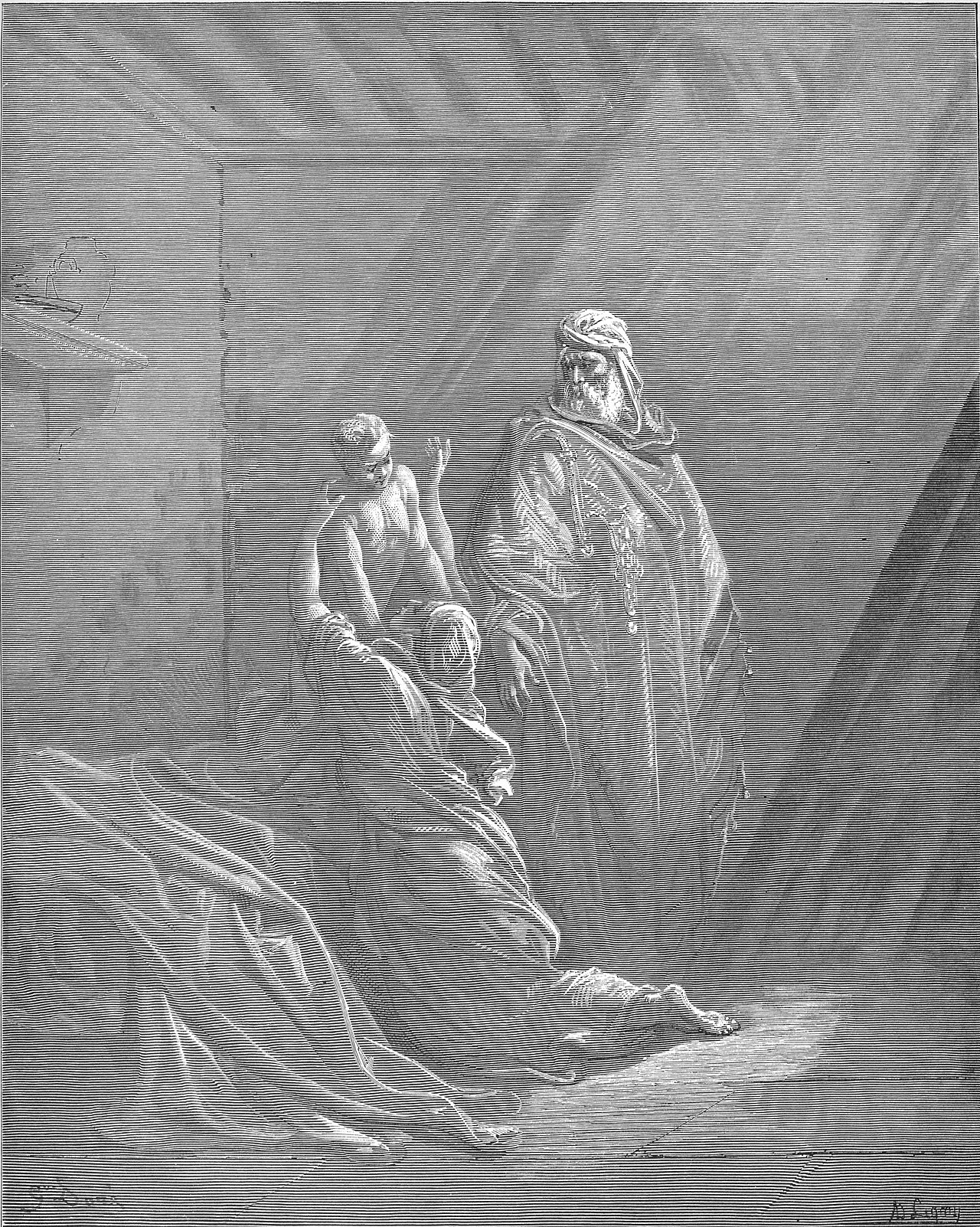
1 Kingschapter 17
24 verses · Jeremiah, by tradition · 6th century BC · History
For thus saith the Lord God of Israel, The barrel of meal shall not waste, neither shall the cruse of oil fail, until the day that the Lord sendeth rain upon the earth.
Introduction
Jeremiah, by tradition, History, 1 Kings Overview.
The writer of Kings is not named, and Jewish tradition gives the book to Jeremiah. Here he slows his account and opens the story of Elijah. His first hearers were exiles living among nations who credited their harvests to the gods of the storm. The chapter is prophetic narrative, and the prophet arrives with no call story and no introduction beyond his home region. It asks who truly controls the rain, the grain and the life of a child. Listen for where Elijah is sent and who feeds him there, and for the confession spoken at the end by someone outside Israel.
Context
- Who
- Israelites who had been taught for a generation that Baal sent the rain
- What
- An account of Elijah announcing a drought to Ahab, being fed by ravens and by a widow of Zarephath, and raising her son.
- Where
- Ahab's court, the Brook of Cherith east of the Jordan, and the Phoenician town of Zarephath between Tyre and Sidon.
- When
- The reign of Ahab, about 865 to 862 BC, in the first years of a drought the New Testament counts at three years and six months.
- Why
- To show that the LORD, and not Baal, withholds and gives the rain and holds life and death.
Historical context
The chapter belongs to Elijah, who enters the book with no introduction beyond a place name, the Tishbite of the settlers of Gilead.
Show the rest of the historical context, 5 more paragraphs
The time is the first years of the drought he announces, in the reign of Ahab son of Omri. Kings dates the word that ends it in the third year at 18:1, and the New Testament gives the span as three years and six months at Luke 4:25 and James 5:17.
The places run outward from Israel at every step, from Cherith, a ravine east of the Jordan, to Zarephath, a Phoenician town between Tyre and Sidon inside the home country of Jezebel's father Ethbaal.
Baal was the storm god, the rider of the clouds and the giver of rain, and Jezebel had brought his worship into Israel as state religion.
A first hearer knew what rainfall farming meant, since Israel grew its grain on the rains between October and April. Three years without them meant no barley, no wheat, empty cisterns and dying livestock. He also knew that flour and oil were kept in narrow mouthed storage jars of the kind found across Iron Age sites.
The famine reached past Israel's border because Tyre and Sidon depended on Israel's grain, which is why the widow is down to a handful of flour. Josephus quotes the Tyrian historian Menander recording a year without rain in the reign of Ethbaal, the one notice of this drought outside the Bible.
Significance
The first hearers heard a foreign widow, living in the territory of the queen who was killing Israel's prophets, put a stranger's word ahead of her last meal and be fed through the whole famine.
Show the rest of the significance, 2 more paragraphs
They also heard a mother's raw complaint when her son died anyway, and a prophet who carried that complaint straight to God. Faith in this chapter is reported without being smoothed.
The last line was the verdict they were meant to take away. A Gentile woman says that the word of the LORD in Elijah's mouth is truth, and she says it about the word that had ruined her own harvest.
This chapter in Jewish lifeWhat this chapter is in Jewish life and reading.
How it is read
The corpus opens this chapter by joining it to the verse before it, which is how the classical commentary explains why a prophet arrives with no introduction. Rashi asks why the oath about the rain is placed here, and answers from the Talmud at Sanhedrin that Elijah and Ahab had gone together to console the builder of Jericho in his mourning. The king put the question that follows from that funeral: "Is it possible that the student’s curse was fulfilled while Moshe our teacher’s curse was not fulfilled". All Israel was serving other gods, and the rain had gone on falling. The oath is read as the prophet's answer to that question. Radak's note in the same place gives the purpose. It reads: "Eliyahu intended that by withholding the rain and dew, some or all of the people would repent from their idol worship." (Rashi on I Kings 17:1:2, The Metsudah Tanach series, Lakewood, N.J, CC-BY). The prophet's title Rashi reads as a place name, from a land called Toshav (Rashi on I Kings 17:1:1).
The hiding is read as flight from named people. The command to hide means "From Achov and Ezevel.", with Radak's note that no one should know where he was (Rashi on I Kings 17:3:1). The drying of the brook is given a purpose of its own. It is the note in this chapter that most changes how the sequence reads. The brook dried "In order that he realize the need for rain and trouble himself to go into exile". Rashi gives the reason, "for it was displeasing to the Holy One Blessed Is He, that Yisroel should be living in hunger." (Rashi on I Kings 17:7:1). The prophet who called for the drought is in this reading moved by hunger he shares.
At Zarephath the corpus reads a scene of recognition. Rashi says the prophet could identify no particular widow. He took his method from an earlier servant on an earlier road, "But he learned from Eliezer, the servant of Avrohom", and set the asking for water as his sign (Rashi on I Kings 17:10:1). Radak's note names the woman as the mother of Jonah the son of Amittai, which is the tradition that ties this house to a later book. The town itself Rashi marks as a place name and nothing more (Rashi on I Kings 17:9:1). On the cake asked for first Rashi points to a midrash on Leah's words at the birth of Gad (Rashi on I Kings 17:13:1). The word for the small cake he glosses plainly (Rashi on I Kings 17:12:1).
The raising of the boy is read as the point of the whole stay. Rashi says the illness came "So that he should need the Key of Resurrection of the Dead". He points to the Talmud at Sanhedrin, where the keys held back from any messenger are discussed (Rashi on I Kings 17:17:1). The mother's complaint he reads as a statement about scale rather than about blame. She says: "Before you came, they would weigh my deeds and the deeds of my city, and I was worthy of a miracle." (Rashi on I Kings 17:18:1). Beside it he sets Ralbag, who has her say that compared with the prophet she is a sinner. He sets Radak there too, who has her fear that she had failed in serving him. He closes with Lot's words at Zoar as the same complaint in another mouth. The stretching out over the child he explains from the root for measure, that "he spread himself upon him." (Rashi on I Kings 17:21:1). Radak's note says the posture is the one Elisha later takes over the Shunammite's son, eyes to eyes and mouth to mouth.
Radak, Metzudat David and Malbim comment across the chapter as well. The corpus carries their refs with the reason that Sefaria holds no English version of them, so they stand here cited and unquoted. The corpus holds Radak on I Kings 17:3:1, 17:4:1, 17:11:1, 17:14:1, 17:15:1, 17:16:1, 17:20:1 and 17:24:1. It holds Metzudat David on I Kings 17:4:1 and 17:6:1. It holds Malbim on I Kings 17:5:1, 17:7:1 and 17:19:1.
What the rabbis say
The corpus carries forty rabbinic locators for this chapter and the text of none, so each is cited and linked here rather than quoted. Five stand on the first verse, where the prophet enters the book: Aggadat Bereshit 44:2, Aggadat Bereshit 53:1, Bamidbar Rabbah 12:11, Bamidbar Rabbah 14:1 and Bava Metzia 106a:8. On the second it carries Sanhedrin 113a:13, which is the same passage Rashi cites there.
The brook carries a cluster of its own. Midrash Tanchuma, Miketz 6:2 stands across the third and fourth verses. Bamidbar Rabbah 23:9 and Yalkut Shimoni on Torah 237:1 stand on the fourth. Five stand on the sixth, where the birds bring bread and meat morning and evening: Bereshit Rabbah 33:1, Bereshit Rabbah 5:5, Bereshit Rabbati, Parashat Vayetze 33, Chullin 5a:3 and Ein Yaakov (Glick Edition), Chullin 1:1. Two of those five sit in a tractate on what may be eaten, which is where the question of food brought by ravens is argued.
Zarephath carries the longest run. On the ninth verse the corpus carries Bereshit Rabbah 98:11, Jerusalem Talmud Sukkah 5:1:3 and Otzar Midrashim, Baraita of Rabbi Pinchas Ben Yair 1:36. It carries Otzar Midrashim, Midrashim on Sefer Yonah, Midrash Yonah (version 1) 4 there as well. That last locator is the written form of the tradition Radak reports in the commentary, which joins this house to the book of Jonah. On the twelfth it carries Midrash Lekach Tov, Numbers 17:3:1. On the thirteenth the prophet asks for the first cake. It carries Ein Yaakov (Glick Edition), Sanhedrin 11:137, Mekhilta DeRabbi Yishmael, Tractate Pischa 14:12, Midrash Lekach Tov, Exodus 12:39:1 and Midrash Sekhel Tov, Shemot 12:39:2. Three of the four stand in places about dough that held out. On the fourteenth it carries Midrash Tanchuma, Ki Tisa 29:2 and Pirkei DeRabbi Eliezer 39:12. On the fifteenth it carries Otzar Midrashim, Midrashim on Missing and Extra Letters 1:26, Pirkei DeRabbi Eliezer 33:2 and Shir HaShirim Rabbah 2:5:3. On the sixteenth it carries Sifrei Devarim 95:7.
The raising of the boy closes the chapter's locators. On the seventeenth the corpus carries Pirkei DeRabbi Eliezer 33:3 and Sanhedrin 113a:14. On the eighteenth it carries Bereshit Rabbah 50:11, Bereshit Rabbati, Parashat Noah 35 and Pesikta Rabbati 3:1. The first of those three is the midrash on Lot that Rashi quotes in his own note. On the twentieth, where the prophet argues with God over the woman who housed him, it carries Midrash Tanchuma, Shemot 16:3 and Shemot Rabbah 4:2. On the twenty-third it carries Bamidbar Rabbah 15:13, Midrash Tanchuma Buber, Beha'alotcha 15:1 and Midrash Tanchuma, Beha'alotcha 9:1. On the twenty-fourth, where the woman states what she now knows, it carries Midrash Lekach Tov, Deuteronomy 33:1:2. What each of them teaches is a saying of the rabbis, and is reported as theirs wherever this site quotes one. The quotations wait on a fetch that carries the text.
Sources: Rashi, Rashi on I Kings 17:1:1, 17:1:2, 17:3:1, 17:7:1, 17:9:1, 17:10:1, 17:12:1, 17:13:1, 17:17:1, 17:18:1 and 17:21:1, The Metsudah Tanach series, Lakewood, N.J, CC-BY; Radak, Radak on I Kings 17:3:1, 17:4:1, 17:11:1, 17:14:1, 17:15:1, 17:16:1, 17:20:1 and 17:24:1, cited by ref because the corpus carries no English text; Metzudat David, Metzudat David on I Kings 17:4:1 and 17:6:1, cited by ref because the corpus carries no English text; Malbim, Malbim on I Kings 17:5:1, 17:7:1 and 17:19:1, cited by ref because the corpus carries no English text; The Sefaria corpus, scripts/data/sources/sefaria/1-kings/17.json, the 40 Talmud and Midrash locators of this chapter.
The heads below are this chapter's scenes. The numbered points under each are its verses.
Neither dew nor rain, but according to my word
1 Kings 17:1-2
As the Lord God of Israel liveth: Elijah enters Scripture with no genealogy beyond a place name, the Tishbite of the inhabitants of Gilead, unlike the fuller introductions Kings gives its other prophets. His oath, before whom I stand, is the standing formula he repeats to Obadiah at 18:15, and it grounds his authority to shut heaven in a single sentence rather than in any king's sending. Kings measures the drought as these years and the third year at 18:1; Luke 4:25 and James 5:17 give the New Testament's own count, three years and six months.
1 Kings 17:1
“Great is the virtue of fasting. Indeed, its military appearance is so beautiful that it delightfully attracts and elevates humans to heaven for fasting and for Christ: so powerful that it raises men up to heaven. And to use more human than divine examples, from the fasting mouth of Elijah a voice was uttered that closed heaven to the sacrilegious people of the Jews. For when Ahab, the king, had set up an altar to the idol, according to the words of the prophet, there was no rain for three years and six months upon the earth.”
Ambrose of Milan · written before 397 · On Elijah and Fasting, Chapter 2, 2-3patristic
1 more voice on this verseWhat preachers and commentators have said about this verse, in their own words.
1 Kings 17:1
“The name Elijah means “Yahweh is my God.” It is expressive of the truth which his whole life preached. The two words rendered “Tishbite” and “inhabitant” are in the original (setting aside the vowel points) “exactly alike.” The meaning consequently must either be “Elijah the stranger, of the strangers of Gilead,” or (more probably) “Elijah the Tishbite, of Tishbi of Gilead.” Of Tishbi in Gilead there is no further trace in Scripture; it is to be distinguished from another Tishbi in Galilee.”
This word comes right after Elijah stands before Ahab at verse 1, and it sends him into hiding at once. Obadiah reports at 18:10 that Ahab searched every nation and kingdom for him. The LORD hid His prophet first.
1 Kings 17:2
“And the word of the Lord came to him,.... The word of prophecy, as the Targum; this shows that by word, in the former verse, he means the word of the Lord by him: saying; as follows.”
1 Kings 17:3-4
hide thyself by the brook Cherith: The command sends Elijah east across Jordan to Cherith, away from Ahab's reach, where ravens rather than any human hand supply his bread and flesh morning and evening. Jamieson, Fausset and Brown defend the plain reading of raven against conjectures that would emend the word to Arabians or merchants, since a miraculous feeding needs no natural explanation for where the birds found food. The prophet who shut heaven by his own word now depends on a daily supply he did not arrange, the same lesson Zarephath will teach a widow's jar.
1 Kings 17:3
“Brook Cherith - Rather, “the torrent course,” one of the many which carry the winter rains from the highlands into that stream.”
1 more voice on this verse
1 Kings 17:3
“When the woman, the church, is driven into the wilderness, care it taken that she be fed and nourished there, time, times, and half a time, that is, three years and a half, which was just the time of Elijah's concealment.”
Matthew Henry · Commentary on the Whole Bible (1707-1721)puritan
I have commanded the ravens: The words I have commanded return at verse 9 for the widow of Zarephath. John Wesley reads the command to the ravens as an instinct laid on the birds, as binding on them as a law is on men. Birds and a widow receive the same order.
1 Kings 17:4
“Have commanded - Or, I shall command, that is, effectually move them, by instincts which shall be as forcible with them, as a law or command is to men. God is said to command both brute creatures, and senseless things; when he causeth them to do the things which he intends to effect by them.”
John Wesley · Explanatory Notes upon the Old Testament (1765)evangelical
1 Kings 17:5-7
did according unto the word of the Lord: Elijah obeys at once and settles by the brook until it fails after a while, at the end of days, Wesley notes, meaning a year, the season a severe drought would need to dry a perennial stream. Clarke ties the drought itself to the curse Deuteronomy attached to a land that turns after other gods, that the Lord's wrath be kindled and he shut up the heaven. The drying brook lays a second trial on the first, teaching the prophet who called the drought to depend on the God who sent it rather than on the brook itself.
1 Kings 17:5
“So he went, and did according to the word of the Lord,.... Took his journey eastward, and hid himself in the place directed to: for he went and dwelt by the brook Cherith, that is before Jordan; see Gill on 1Ki 17:3.”
Adam Clarke notes that the Greek Codex Vaticanus has the ravens bring bread each morning and meat each evening. Israel received meat at twilight and bread in the morning at Exodus 16:12. Ambrose of Milan saw Elijah hidden from all but ravens.
1 Kings 17:6
“And the ravens brought him bread and flesh - The Septuagint, in the Codex Vaticanus, and some ancient fathers, read the passage thus: - Και οἱ κορακες εφερον αυτῳ αρτους το πρωΐ, και κρεα το δειλης, And the crows brought him bread in the morning, and flesh in the evening: but all the other versions agree with the Hebrew text.”
Adam Clarke · Commentary on the Bible (1810-1826)evangelical
1 more voice on this verse
1 Kings 17:6
“Therefore do not boast when you fast, do not glory lest fasting profit you nothing; for those things that are done for ostentation will not prolong their fruit into the future, but they consume the reward for present deeds. Elijah was in the desert that no one might see him fast except the ravens alone, when they supplied him with food. Elisha was in the desert where no food except poisonous wild gourds could be found. John was in the desert, where he could find only locusts and wild honey.”
Ambrose of Milan · written before 397 · On Elijah and Fasting, Chapter 11, 40patristic
the brook dried up: John Wesley notes that the dry brook also struck the Israelites who lived near it and had drawn water from it. The judgment Elijah spoke at verse 1 now reaches his own hiding place. The prophet shares the thirst of the land.
1 Kings 17:7
“The brook dried up - Because there had been no rain in the land for some time, God having sent this drought as a testimony against the idolatry of the people: see Deu 11:16, Deu 11:17.”
Adam Clarke · Commentary on the Bible (1810-1826)evangelical
1 more voice on this verse
1 Kings 17:7
“A while - Hebrew. at the end of days; that is, of a year; for so the word days is often used. Dried - God so ordering it, for the punishment of those Israelites who lived near it, and had hitherto been refreshed by it: and for the exercise of Elijah's faith, and to teach him to depend upon God alone.”
John Wesley · Explanatory Notes upon the Old Testament (1765)evangelical
A handful of meal that would not spend
1 Kings 17:8-10
the word of the Lord came unto him, saying: When Cherith fails, the word comes a second time and sends Elijah further still, to Zarephath in Sidon itself, inside the territory of Jezebel's own father. Barnes notes Zarephath's dependence on Sidon from the Assyrian inscriptions and suggests the prophet is sent to the one place least likely for Ahab to search. Wesley reads the sequence as provision from an unclean bird and then from a Gentile in turn, and Jesus draws the same widow into his own preaching at Nazareth, naming her against the many widows in Israel in the days of Elias.
1 Kings 17:8
“And the word of the Lord came unto him,.... As before, after he had been a year at the brook, and that was dried up: saying; as follows.”
2 more voices on this verse
1 Kings 17:8
“THE Prophets taught as much by their doings as by their sayings—they were as truly prophesying to the people by the miracles which they worked, as by the messages which they delivered. There was oftentimes a symbolic meaning in their actions, in fact, they were constantly teaching the people by outward symbols, which, alas, those people were usually of too dull an understanding to interpret, but which, nevertheless, were a sign unto them.”
1 Kings 17:8
“Meeting, at his entrance into the town, the very woman who was appointed by divine providence to support him, his faith was severely tested by learning from her that her supplies were exhausted and that she was preparing her last meal for herself and son.”
Jamieson, Fausset & Brown · Commentary Critical and Explanatory on the Whole Bible (1871)reformed
Jamieson, Fausset and Brown hold that the LORD sent Elijah to Zarephath for the widow's faith as well as for his own safety. Ephrem the Syrian reads the move as God teaching mercy to the prophet who held back the rain and dew. Elijah must now receive bread from a widow of Sidon.
1 Kings 17:9
“The dependence of Zarephath (Sarepta) on Sidon is indicated in the inscriptions of Sennacherib, where it is mentioned as belonging to Luliya (Elulaeus), king of Sidon, and as submitting to the Assyrian monarch on Luliya’s flight from his capital. Elijah may have been sent to this place, so near the city of Jezebel’s father, as one which it was most unlikely that he would visit.”
2 more voices on this verse
1 Kings 17:9
“Zidon - To the jurisdiction of that city, which was inhabited by Gentiles. And God's providing for his prophet, first, by an unclean bird, and then by a Gentile, whom the Jews esteemed unclean, was a presage of the calling of the Gentiles, and rejection of the Jews. So Elijah was the first prophet of the Gentiles.”
John Wesley · Explanatory Notes upon the Old Testament (1765)evangelical
1 Kings 17:9
“The prophet was sent to this widow, not merely for his own security, but on account of her faith, to strengthen and promote which he was directed to go to her rather than to many widows in Israel, who would have eagerly received him on the same privileged terms of exception from the grinding famine.”
Jamieson, Fausset & Brown · Commentary Critical and Explanatory on the Whole Bible (1871)reformed
Elijah meets the widow at the city gate while she gathers sticks for her fire. Matthew Henry reads her labour as the mark of a humble and hard working woman, and he says the prophet came to board with her and to pay well for his table. Water was scarce, and he asks for it first.
1 Kings 17:10
“To her Elijah was sent, that he might still live upon Providence as much as he did when the ravens fed him. It was in compassion to the low estate of his handmaiden that God sent the prophet to her, not to beg of her, but to board with her, and he would pay well for his table. (2.) That she was very humble and industrious.”
Matthew Henry · Commentary on the Whole Bible (1707-1721)puritan
1 Kings 17:11-12
Bring me, I pray thee, a morsel of bread: Elijah's request for bread tests the widow before she can test him, though she has told him only that she gathers sticks for a last meal. Her answer names her stock exactly, an handful of meal in a barrel and a little oil in a cruse, enough by her own reckoning for one meal before she and her son die of the famine. Wesley notes the famine's effects reached beyond Israel into Tyre and Sidon, since both regions depended on Israel's grain, so her poverty is the drought's own doing before Elijah asks anything further of her.
Adam Clarke describes the jar as an earthen vessel of the kind used in the East to keep flour safe from insects. Her oath takes up the words Elijah spoke to Ahab at verse 1. She names the LORD as his God.
1 Kings 17:12
“For though the famine was chiefly in the land of Israel, yet the effects of it were in Tyre and Sidon, which were fed by the corn of that land. But what a poor supporter was this likely to be? who had no fuel, but what she gathered in the streets, and nothing to live upon herself, but an handful of meal and a little oil!”
John Wesley · Explanatory Notes upon the Old Testament (1765)evangelical
1 more voice on this verse
1 Kings 17:12
“A handful of meal in a barrel - The word כד cad is to be understood as implying an earthen jar; not a wooden vessel, or barrel of any kind. In the East they preserve their corn and meal in such vessels; without which precaution the insects would destroy them. Travellers in Asiatic countries abound with observations of this kind. The word cruse, צפחת tsappachath, says Jarchi, signifies what in our tongue is expressed by bouteille, a bottle. Jarchi was a French rabbin.”
Adam Clarke · Commentary on the Bible (1810-1826)evangelical
1 Kings 17:13-14
make me thereof a little cake first: Elijah asks the widow to feed him before she feeds her own son, a request Clarke calls an extraordinary trial of faith, since her last handful of meal is at stake for a stranger she has met only at the city gate. The promise attached is exact rather than vague, that the barrel of meal shall not waste, neither shall the cruse of oil fail, until the day the Lord sends rain, tying the miracle's own end to the very drought Elijah pronounced at verse 1. Wesley reads the command as a trial God intended to reward, given as much to encourage others toward the same obedience as to test her own.
1 Kings 17:13
“But make me thereof a little cake first - This was certainly putting the widow’s faith to an extraordinary trial: to take and give to a stranger, of whom she knew nothing, the small pittance requisite to keep her child from perishing, was too much to be expected.”
Adam Clarke · Commentary on the Bible (1810-1826)evangelical
Elijah speaks for the God of Israel inside Sidon, the land of Ethbaal, the priest king whose daughter brought Baal worship to Samaria. The promise sets its own end at the return of rain, which falls at 18:45. The oil lasts as long as the drought.
1 Kings 17:15-16
did eat many days: The widow obeys, and she, he, and her house eat many days on a supply that never runs out. Henry calls the widow's own faith as great a miracle in the kingdom of grace as the oil's increase was in the kingdom of providence, since believing the promise came before seeing it kept. Gill compares the standing increase to the loaves and fishes multiplied in the disciples' own hands while they were still distributing them, a later miracle worked on the same pattern.
1 Kings 17:15
“And she went, and did according to the saying of Elijah,..... Made a cake for him first, and brought it to him, which showed great faith in the word of the Lord by him: and she, and he, and her house, did eat; many days, a year at least, if not two years, see 1Ki 17:7 the widow, the prophet, and her family, lived upon the meal and oil so long; we read but of one son, but she might have more.”
1 more voice on this verse
1 Kings 17:15
“But surely the increase of this widow's faith, to such a degree as to enable her thus to deny herself and to depend upon the divine promise, was as great a miracle in the kingdom of grace as the increase of her oil was in the kingdom of providence. Happy are those who can thus, against hope, believe and obey in hope.”
Matthew Henry · Commentary on the Whole Bible (1707-1721)puritan
Matthew Henry reads the widow's reward in the light of Matthew 10:41, where whoever receives a prophet will receive a prophet's reward. She gave Elijah a room, and he supplied her household with food. The flour and oil answered the word spoken through Elijah.
1 Kings 17:16
“And the barrel of meal wasted not, neither did the cruse of oil fail, according to the word of the Lord, which he spake by Elijah. There being a continual increase and supply of both, through the mighty power of God working a continued miracle; just as the loaves and fishes were increased while the disciples were eating, Mat 14:19.”
1 more voice on this verse
1 Kings 17:16
“There is nothing lost by being kind to God's people and ministers; she that received a prophet had a prophet's reward; she gave him house-room, and he repaid her with food for her household. Christ has promised to those who open their doors to him that he will come in to them, and sup with them, and they with him, Rev. iii.”
Matthew Henry · Commentary on the Whole Bible (1707-1721)puritan
Stretched upon the child three times: now I know
1 Kings 17:17-18
there was no breath left in him: The widow's son dies outright, no breath left in him, and her grief turns at once into an accusation, art thou come unto me to call my sin to remembrance, and to slay my son. Wesley reads her question as fear that Elijah's presence, and his prayers, have brought her own guilt under the same judgment his word brought on the whole land. Clarke notes that adversity commonly surfaces a conscience adversity itself had let sleep, so the death forces an examination the drought alone had not.
1 Kings 17:17
“No breath - Or, “no spirit,” “no soul.” (Compare Gen 2:7). The word used is translated “spirit” in Pro 20:27; Ecc 3:21; Job 26:4; and elsewhere.”
Matthew Henry reads the loss as God calling past sins to mind, so that the woman will remember them and repent. Ephrem the Syrian sees humility in her grief, and she accepts the death of her son as deserved. She calls Elijah man of God.
1 Kings 17:18
“Art thou come - Didst thou come for this end, that thou mightest severely observe my sins, and by thy prayers bring down God's just judgment upon me, as thou hast brought down this famine upon the nation? To call, &c. - To God's remembrance: for God is said in scripture, to remember sins, when he punisheth them; and to forget them, when he spares the sinner.”
John Wesley · Explanatory Notes upon the Old Testament (1765)evangelical
1 Kings 17:19-21
carried him up into a loft: Elijah takes the child from her arms, carries him to his own upper room, and lays him on his own bed before he prays. Barnes notes the stretching of himself upon the child three times differs from the method Elisha later uses over the Shunammite's son, and compares it instead to the touch by which Jesus later raises the dead. The prayer names the God he serves twice, O Lord my God, and asks plainly that this child's soul come into him again, a request Wesley calls bold, made by a man whose own experience of answered prayer had already earned him standing to make it.
1 Kings 17:19
“And he said unto her, give me thy son, and he took him out of her bosom,.... Where she had laid him, mourning over him; from thence the prophet took him with her leave: and carried him up into a loft, where he abode, and laid him upon his own bed; an upper room, which was his bedchamber; hither he carried him, that he might be alone, and use the greater freedom both in his expressions and gestures.”
1 more voice on this verse
1 Kings 17:19
“Into a loft - Rather, “into the upper chamber;” often the best apartment in an Eastern house.”
Elijah grounds his complaint on the kindness of the widow, who opened her home to him. John Wesley hears a plea that her kindness to a prophet should bring her no harm, since wicked men would then mock her and her faith. The prayer brings grief straight to God.
1 Kings 17:20
“Thou art the Lord, that canst revive the child: and my God; and therefore wilt not, deny me. She is a widow, add not affliction to the afflicted; deprive her not of the support and staff of her age: she hath given me kind entertainment: let her not fare the worse for her kindness to a prophet, whereby wicked men will take occasion to reproach both her, and religion.”
John Wesley · Explanatory Notes upon the Old Testament (1765)evangelical
Ephrem the Syrian reads the three times Elijah stretched himself over the child as a sign of the three names of God. Elisha later stretches himself over a dead boy at 2 Kings 4:34, and Albert Barnes sets the two acts apart. Verse 22 answers the prayer in its own words.
1 Kings 17:21
“He stretched himself upon the child three times - This action of Elijah is different from that of Elisha (marginal reference), and does not imply the use of any natural means for the restoration of suspended animation. It is nearly parallel to the “touch,” through which our Lord performed similar miracles Mat 9:25; Luk 7:14.”
1 Kings 17:22-24
the soul of the child came into him again: The Lord hears, and the child's soul returns to him. Gill calls this the first instance in Scripture of anyone being raised from the dead, and notes that pagan literature's own tales of revived men are its later, lesser copy. Elijah carries the boy down and hands him to his mother with the plainest possible proof, see, thy son liveth, and her confession closes the chapter where it opened: now by this I know that thou art a man of God, and that the word of the Lord in thy mouth is truth, the same word that shut heaven at verse 1 now proven true over a single household.
1 Kings 17:22
“And the Lord heard the voice of Elijah,.... In prayer, and answered it: and the soul of the child came into him again, and he revived; this is the first instance of anyone being raised from the dead; this Satan has imitated; hence the many fabulous stories with the Heathens of persons being raised to life after death (k). (k) Vid. Huet. Alnetan. Quaest. l. 2. c. 12. sect. 30.”
1 more voice on this verse
1 Kings 17:22
“And the soul - נפש nephesh, of the child came into him again, על קרבו al kirbo, into the midst of him; and he revived, ויח vaiyechi, and he became alive. Did he not become alive from the circumstance of the immaterial principle coming again into him? Although רוח ruach is sometimes put for the breath, yet נפש generally means the immortal spirit, and where it seems to refer to animal life alone, it is only such a life as is the immediate and necessary effect of the presence of the immortal spirit.”
Adam Clarke · Commentary on the Bible (1810-1826)evangelical
Elijah carries the boy down from the upper room himself and hands him to his mother. Luke 7:15 closes the raising of the widow's son at Nain the same way, when Jesus gave him back to his mother. Hebrews 11:35 remembers women who received back their dead.
Adam Clarke counts three results of the death and return of the boy: the widow searched her own heart, the power of God was shown, and she was convinced of the word of the LORD. At verse 18 she had called Elijah a man of God in fear. Now she says it in faith.
1 Kings 17:24
“The word of the Lord in thy mouth is truth - Three grand effects were produced by this temporary affliction: 1. The woman was led to examine her heart, and try her ways; 2. The power of God became highly manifest in the resurrection of the child; 3. She was convinced that the word of the Lord was truth, and that not one syllable of it could fall to the ground. Through a little suffering all this good was obtained. The subject in the fourth verse of this chapter deserves a more particular consideration.”
Adam Clarke · Commentary on the Bible (1810-1826)evangelical
How this psalm is built
The form: Prophetic narrative, and the covenant curse of Deuteronomy carried out on a land that had turned after other gods, as Clarke classes it.
The patterns in this chapter
| Device | What it does | Where to see it |
|---|---|---|
| Then the word of the LORD came to Elijah | The clause moves the chapter at verse 2 and again at verse 8, and each time it sends the prophet somewhere he would not have chosen. The word is also what the miracle keeps at verse 16, according to the word that the LORD had spoken through Elijah, and what the widow names at verse 24. Counted in the Berean text of the store, the chapter turns on that word four times and on Elijah's own planning never. | 1 Kings 17:2, 1 Kings 17:8, 1 Kings 17:16, 1 Kings 17:24 |
| The word in his mouth, sworn at the start and confessed at the end | Elijah opens the chapter by staking the weather on his own word, and the widow closes it by telling him that the word of the LORD from his mouth is truth. The chapter's exposition notes make the same join, that the word which shut heaven at verse 1 is proven true over a single household at verse 24. The frame turns a national judgment into a personal verdict delivered by a Phoenician woman.John Gill and Matthew Henry, cited in the chapter's exposition notes, Exposition of the Old Testament, 1748 to 1763, and Commentary on the Whole Bible, 1710, on 1 Kings 17:24. | 1 Kings 17:1, 1 Kings 17:24 |
| As surely as the LORD lives | The oath is taken twice in the chapter and by two different people. Elijah swears it to Ahab at verse 1 with the formula he repeats to Obadiah at 18:15, before whom I stand. The widow of Zarephath swears it back to him at verse 12 with your God added. A woman inside Sidon takes the God of Israel into her own oath before she has seen Him do anything.Albert Barnes, Notes, Explanatory and Practical, on the Old and New Testaments, 1832 to 1869, on 1 Kings 17:1. | 1 Kings 17:1, 1 Kings 17:12 |
| Bread in the morning and evening, a jar that holds, a boy who breathes | The chapter lists three supplies in order and each one costs the prophet more of his own standing. Ravens carry bread and meat to a man who arranged nothing. The jar and the jug hold for a household he had to ask for food first. The third supply is a life he can only pray back. John Wesley reads the order as provision from an unclean bird and then from a Gentile in turn.John Wesley, Explanatory Notes upon the Old Testament, 1765, on 1 Kings 17:9. | 1 Kings 17:6, 1 Kings 17:15, 1 Kings 17:22 |
The New Testament's use
9 more paragraphs on the patterns
The chapter is quoted twice in the New Testament and by two different speakers. Luke 4:25 and 26 have Jesus name this widow at Nazareth, setting her against the many widows in Israel in the days of Elijah. The point He draws from her is that the prophet was sent outside Israel. James 5:17 makes Elijah a man with a nature like ours and counts the closed heaven at three years and six months.
Both New Testament places give the same figure, and Kings gives a different one. Kings dates the word that ends the drought in the third year at 18:1. The chapter's exposition notes set the two counts side by side rather than harmonizing them.
The debated concept
The first question is what fed Elijah at Cherith. The Hebrew word carries the sense of ravens. Readers since the Middle Ages have proposed that the same consonants be read as Arabians or as merchants, which would make the supply a caravan. Jamieson, Fausset and Brown defend the plain reading and argue that a miraculous feeding needs no natural explanation for where the birds found food. The objection worth weighing is that ravens are unclean by the Law, which is also the reason Wesley reads the sequence as running from an unclean bird to a Gentile.
The second is how long the heaven stayed shut. 1 Kings 18:1 says the word came in the third year of the drought. Luke 4:25 and James 5:17 both say three years and six months. One reading counts the three years from the start of the drought and adds the dry season that preceded it. Another takes the three years and six months as the settled tradition of the length, and the third year as Kings counting from Elijah's arrival at Zarephath. The two numbers stand in the text and the page states both.
The divine connection
The promise at verse 14 is exact rather than general. The jar of flour and the jug of oil are to hold until the day the LORD sends rain upon the face of the earth. That binds the end of the miracle to the end of the drought Elijah pronounced at verse 1. The same word governs both.
John Gill sets the standing increase of the meal beside the loaves and fishes multiplied in the disciples' own hands while they were still handing them out, a later miracle worked on the same pattern. Matthew Henry reads the widow's faith as the greater of the two miracles in the chapter. She believed the promise before she saw it kept, and her last handful was the price of finding out.
The raising at verse 22 is the first of its kind in the record. John Gill calls it the first instance in Scripture of anyone raised from the dead, and notes that the tales of revived men in pagan literature are its later and lesser copy. Albert Barnes observes that Elijah's method, stretching himself over the child three times, differs from the method Elisha later uses over the Shunammite's son.
Keep studying
Places1
Sources for this chapter
The summary
Jamieson, Fausset & Brown, Commentary Critical and Explanatory; John Wesley, Notes on the Old Testament and Matthew Henry, Complete Commentary.
The form and classifications
Adam Clarke, Commentary on the Bible, 1832, on 1 Kings 17:7; John Wesley and Matthew Henry, Commentary on the Whole Bible, 1710, on 1 Kings 17:15.
The exposition
Adam Clarke, Commentary on the Bible; Albert Barnes; Ambrose of Milan, Concerning Virginity 2.5.38; Ephrem the Syrian, ON THE FIRST BOOK OF KINGS 16:29; Jamieson Fausset and Brown, Commentary Critical and Explanatory on the Whole Bible; Jamieson, Fausset & Brown, Commentary Critical and Explanatory on the Whole Bible; John Gill; John Wesley, Explanatory Notes upon the Old Testament and Matthew Henry, Commentary on the Whole Bible.