
1 Kings 17:8
in 1 Kings 17Then the word of the LORD came to Elijah:
BSB
The same verse in ASV and KJV ▾
ASV
And the word of Jehovah came unto him, saying,
KJV
And the word of the Lord came unto him, saying,
⋯
This verse in 1 Kings 17
Commentary
5 notes on this verseThis site's exposition
the word of the LORD came to Elijah
on 1 Kings 17:8-10
When Cherith fails, the word sends Elijah to “Zarephath of Sidon”, the land of Jezebel's own father. Assyrian inscriptions place Zarephath under Sidon, Barnes notes. Jesus names this widow at Nazareth, set against the “many widows in Israel in the time of Elijah” at Luke 4:25.
The record, by era
The Puritans and the Awakening1 voice
And the word of the Lord came unto him,.... As before, after he had been a year at the brook, and that was dried up: saying; as follows.
The Nineteenth Century3 voices
A commentator
Jamieson, Fausset & Brown1802–1910
Commentary Critical and Explanatory on the Whole Bible (1871)
proposed
Meeting, at his entrance into the town, the very woman who was appointed by divine providence to support him, his faith was severely tested by learning from her that her supplies were exhausted and that she was preparing her last meal for herself and son.
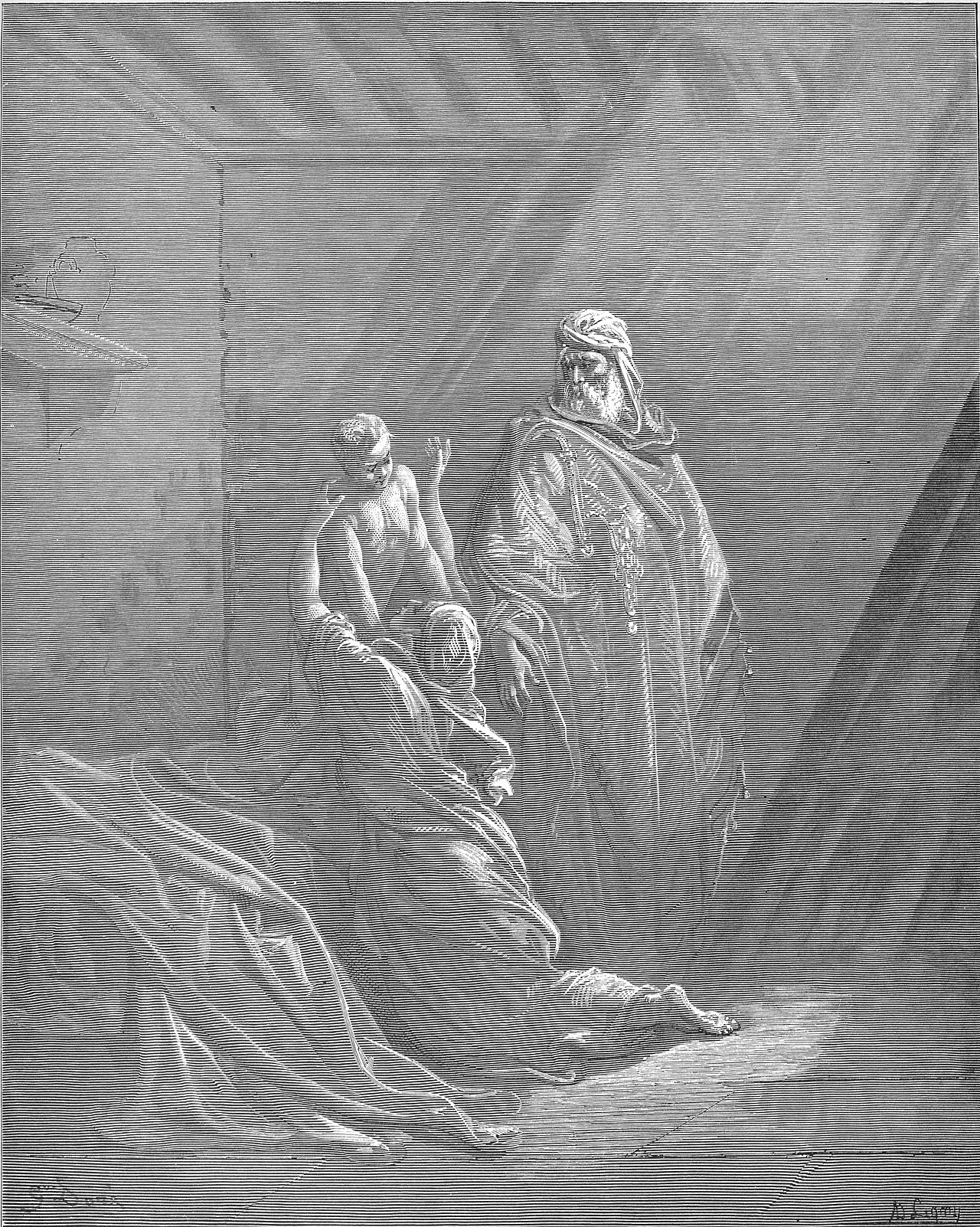
THE Prophets taught as much by their doings as by their sayings—they were as truly prophesying to the people by the miracles which they worked, as by the messages which they delivered. There was oftentimes a symbolic meaning in their actions, in fact, they were constantly teaching the people by outward symbols, which, alas, those people were usually of too dull an understanding to interpret, but which, nevertheless, were a sign unto them. In the case of Elijah, a Prophet of laconic speech who said but little, but said that with a voice of thunder, I do not doubt that the narratives connected with his life are meant to be to us a kind of acted prophesying, full of richest meaning. Let us see what we can gather, this morning, from the inexhaustible barrel and unfailing cruse of the widow of Sarepta. I know not how it is that I feel bound in spirit to preach upon this incident this morning, but this widow seems to have followed me for the last two or three days with all the importunity of the widow in the parable who would take no denial! And I trust that there may be some here for whom I bear, under sacred constraint, a message from the Lord. Grant it so, blessed Spirit, and we will praise Your name! I. Our first observation will be, this morning, that the case of this woman of Sarepta is an instance of DIVINE ELECTION. We are not now inventing anything of our own.
THE Prophets taught as much by their doings as by their sayings—they were as truly prophesying to the people by the miracles which they worked, as by the messages which they delivered. There was oftentimes a symbolic meaning in their actions, in fact, they were constantly teaching the people by outward symbols, which, alas, those people were usually of too dull an understanding to interpret, but which, nevertheless, were a sign unto them.
The words behind it
5 Hebrew wordsEvery Hebrew word of this verse in the order it stands, with what it means and the door to its own study. The last column counts the times a word stands in the whole Bible: the rarer the word, the more the places it appears belong together.
| Hebrew | Sound | Meaning | Word study | In the Bible |
|---|---|---|---|---|
| וַיְהִ֥י | vayhi | and it came | H1961 → | 3559 times |
| דְבַר־ | devar- | [the] word of | H1697 → | 1440 times |
| יְהוָ֖ה | yahweh | Yahweh | H3068 → | 6520 times |
| אֵלָ֥יו | ʾelav | to him | H413 → | 5510 times |
| לֵאמֹֽר׃ | lemor | <to> saying | H559 → | 5305 times |
וַיְהִ֥יand it came
vayhiH1961 →3559 times
דְבַר־[the] word of
devar-H1697 →1440 times
יְהוָ֖הYahweh
yahwehH3068 →6520 times
אֵלָ֥יוto him
ʾelavH413 →5510 times
לֵאמֹֽר׃<to> saying
lemorH559 →5305 times
A shaded row is a word that stands 400 times or fewer in the Bible.
The walk
8 stopsEach card is a verse this one points to, and under it the verses that one points to in turn. Where several paths arrive at the same place, that place is listed first: the text keeps returning to it.
Through
Hebrews 13:6So we say with confidence: “The Lord is my helper; I will not be afraid. What can man do to me?”
it leads to
- Psalms 118:6–9
The LORD is on my side; I will not be afraid. What can man do to me?
- Isaiah 41:10
Do not fear, for I am with you; do not be afraid, for I am your God. I will strengthen you; I will surely help you; I will uphold you with My right hand…
- Romans 8:31
What then shall we say in response to these things? If God is for us, who can be against us?
- Psalms 27:1–3
The LORD is my light and my salvation— whom shall I fear? The LORD is the stronghold of my life— whom shall I dread?
- Psalms 124:8
Our help is in the name of the LORD, the Maker of heaven and earth.
- Psalms 118:6–9
Through
Genesis 22:14And Abraham called that place The LORD Will Provide. So to this day it is said, “On the mountain of the LORD it will be provided.”
it leads to
- Genesis 22:13
Then Abraham looked up and saw behind him a ram in a thicket, caught by its horns. So he went and took the ram and offered it as a burnt offering in place of…
- Exodus 17:15
And Moses built an altar and named it The LORD Is My Banner.
- Judges 6:24
So Gideon built an altar to the LORD there and called it The LORD Is Peace. To this day it stands in Ophrah of the Abiezrites.
- Genesis 22:13
Where this verse is studied
On this page
About 1 Kings
Who and where
1 name in this verse with a page on the site.
This page draws on Albert Barnes, Notes, Explanatory and Practical, on the Old and New Testaments; Charles Spurgeon, The Metropolitan Tabernacle Pulpit, Sermon No. 817: “The Widow of Sarepta” (lightly modernized text, CCEL edition); Jamieson, Fausset & Brown, Commentary Critical and Explanatory on the Whole Bible; John Gill, Exposition of the Old Testament (1748-1763) and John Wesley, Explanatory Notes upon the Old Testament.