
1 Kings 17:18
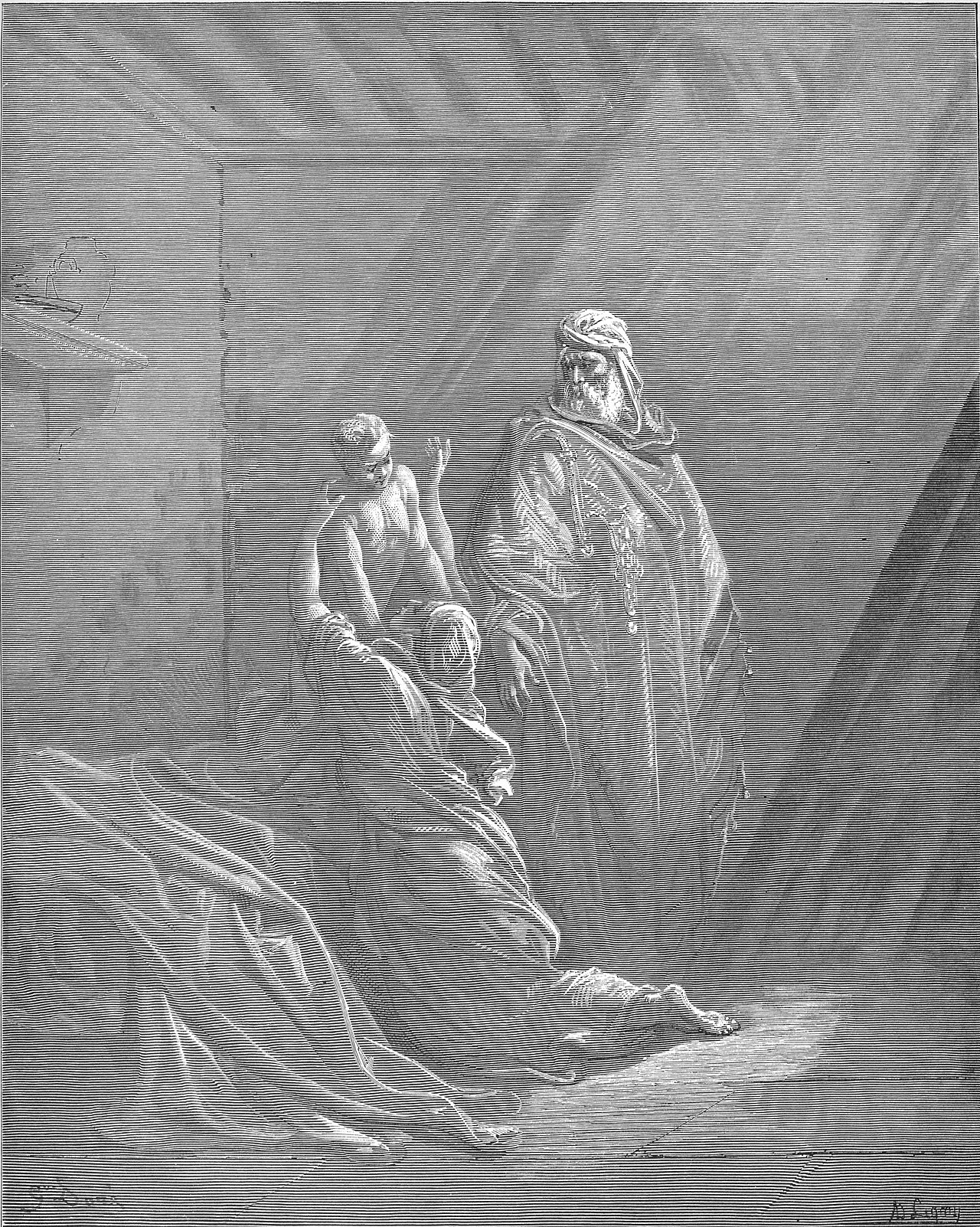
in 1 Kings 17“O man of God,” said the woman to Elijah, “what have you done to me? Have you come to remind me of my iniquity and cause the death of my son?”
BSB
The same verse in ASV and KJV ▾
ASV
And she said unto Elijah, What have I to do with thee, O thou man of God? thou art come unto me to bring my sin to remembrance, and to slay my son!
KJV
And she said unto Elijah, What have I to do with thee, O thou man of God? art thou come unto me to call my sin to remembrance, and to slay my son?
⋯
This verse in 1 Kings 17
Commentary
10 notes on this verseObserve carefully the tears of that woman, and see her humility in her grief, because she does not at all blame the judgment of God or rise against the prophet. In the humility of her intellect, she recognizes that that sentence struck her because of …
This site's exposition
there was no breath left in him
on 1 Kings 17:17-18
The widow's son dies outright, no breath left in him, and her grief turns at once into an accusation, art thou come unto me to call my sin to remembrance, and to slay my son. Wesley reads her question as fear that Elijah's presence, and his prayers, have brought her own guilt under the same judgment his word brought on the whole land. Clarke notes that adversity commonly surfaces a conscience adversity itself had let sleep, so the death forces an examination the drought alone had not.
This site's exposition
remind me of my iniquity
Matthew Henry reads the loss as God calling past sins to mind, so that the woman will remember them and repent. Ephrem the Syrian sees humility in her grief, and she accepts the death of her son as deserved. She calls Elijah man of God.
The record, by era
The Puritans and the Awakening5 voices
Art thou come - Didst thou come for this end, that thou mightest severely observe my sins, and by thy prayers bring down God's just judgment upon me, as thou hast brought down this famine upon the nation? To call, &c. - To God's remembrance: for God is said in scripture, to remember sins, when he punisheth them; and to forget them, when he spares the sinner.
Note, (1.) When God removes our comforts from use he remembers our sins against us, perhaps the iniquities of our youth, though long since past, Job xiii. Our sins are the death of our children. (2.) When God thus remembers our sins against us he designs thereby to make us remember them against ourselves and repent of them.
He prayed earnestly (in a holy indignation at Israel's apostasy, and a holy zeal for the glory of God, whose judgments were defied) that it might not rain; and, according to his prayers, the heavens became as brass, till he prayed again that it might rain. In allusion to this story it is said of God's witnesses ( Rev. xi.
quarantine:debris (2026-07-29) — unbalanced-parens
And she said unto Elijah, what have I to do with thee, O thou man of God!....
Thus his story begins with judgments and miracles, designed to awaken that stupid generation that had to deeply corrupted themselves. 1 And Elijah the Tishbite, who was of the inhabitants of Gilead, said unto Ahab, As the L ORD God of Israel liveth, before whom I stand, there shall not be dew nor rain these years, but according to my word.
2 more voices on this verse
The Nineteenth Century2 voices
To call my sin to remembrance - She seems to be now conscious of some secret sin, which she had either forgotten, or too carelessly passed over; and to punish this she supposes the life of her son was taken away. It is mostly in times of adversity that we duly consider our moral state; outward afflictions often bring deep searchings of heart.
A commentator
Albert Barnes1798–1870
Notes, Explanatory and Practical, on the Old and New Testaments (1832-1869)
proposed
What have I to do with thee? - i. e., “What have we in common?” - implying a further question, “Why hast thou not left me in peace?” The woman imagines that Elijah’s visit had drawn God’s attention to her, and so to her sins, which (she feels) deserve a judgment - her son’s death. Thou man of God - In the mouth of the Phoenician woman this expression is remarkable. Among the Jews and Israelites 1Ki 12:22; Jdg 13:6, Jdg 13:8 it seems to have become the ordinary designation of a prophet. We now see that it was understood in the same sense beyond the borders of the holy land.
The words behind it
16 Hebrew wordsEvery Hebrew word of this verse in the order it stands, with what it means and the door to its own study. The last column counts the times a word stands in the whole Bible: the rarer the word, the more the places it appears belong together.
| Hebrew | Sound | Meaning | Word study | In the Bible |
|---|---|---|---|---|
| וַתֹּ֙אמֶר֙ | vatomer | and she said | H559 → | 5305 times |
| אֶל־ | ʾel- | to | H413 → | 5510 times |
| אֵ֣לִיָּ֔הוּ | ʾeliyahu | Elijah | H452 → | 71 times |
| מַה־ | mah- | what? | H4100 → | 752 times |
| לִּ֥י | li | [is] to me | ||
| וָלָ֖ךְ | valakh | and to <the> you | ||
| אִ֣ישׁ | ʾish | O man of | H376 → | 1663 times |
| הָאֱלֹהִ֑ים | haelohim | <the> God | H430 → | 2601 times |
| בָּ֧אתָ | bata | you have come | H935 → | 2568 times |
| אֵלַ֛י | ʾelai | to me | H413 → | 5510 times |
| לְהַזְכִּ֥יר | lehazkir | to bring to remembrance | H2142 → | |
| אֶת־ | ʾet- | <obj.> | H853 → | 10935 times |
| עֲוֹנִ֖י | ʾavoni | iniquity my | H5771 → | |
| וּלְהָמִ֥ית | ulehamit | and to put to death | H4191 → | 839 times |
| אֶת־ | ʾet- | <obj.> | H853 → | 10935 times |
| בְּנִֽי׃ | beni | son my | H1121 → | 4930 times |
וַתֹּ֙אמֶר֙and she said
vatomerH559 →5305 times
אֶל־to
ʾel-H413 →5510 times
אֵ֣לִיָּ֔הוּElijah
ʾeliyahuH452 →71 times
מַה־what?
mah-H4100 →752 times
לִּ֥י[is] to me
li
וָלָ֖ךְand to <the> you
valakh
אִ֣ישׁO man of
ʾishH376 →1663 times
הָאֱלֹהִ֑ים<the> God
haelohimH430 →2601 times
בָּ֧אתָyou have come
bataH935 →2568 times
אֵלַ֛יto me
ʾelaiH413 →5510 times
לְהַזְכִּ֥ירto bring to remembrance
lehazkirH2142 →
אֶת־<obj.>
ʾet-H853 →10935 times
עֲוֹנִ֖יiniquity my
ʾavoniH5771 →
וּלְהָמִ֥יתand to put to death
ulehamitH4191 →839 times
אֶת־<obj.>
ʾet-H853 →10935 times
בְּנִֽי׃son my
beniH1121 →4930 times
A shaded row is a word that stands 400 times or fewer in the Bible.
The walk
8 stopsEach card is a verse this one points to, and under it the verses that one points to in turn. Where several paths arrive at the same place, that place is listed first: the text keeps returning to it.
Through
John 2:4“Woman, why does this concern us?” Jesus replied. “My hour has not yet come.”
it leads to
- John 7:6
Therefore Jesus told them, “Although your time is always at hand, My time has not yet come.
- John 13:1
It was now just before the Passover Feast, and Jesus knew that His hour had come to leave this world and return to the Father. Having loved His own who were in the world,…
- John 7:30
So they tried to seize Him, but no one laid a hand on Him, because His hour had not yet come.
- John 8:20
He spoke these words while teaching in the temple courts, near the treasury. Yet no one seized Him, because His hour had not yet come.
- John 12:23
But Jesus replied, “The hour has come for the Son of Man to be glorified.
- John 7:6
Through
Luke 5:8When Simon Peter saw this, he fell at Jesus’ knees. “Go away from me, Lord,” he said, “for I am a sinful man.”
it leads to
- Isaiah 6:5
Then I said: “Woe is me, for I am ruined, because I am a man of unclean lips dwelling among a people of unclean lips; for my eyes have seen the King, the LORD…
- Revelation 1:17
When I saw Him, I fell at His feet like a dead man. But He placed His right hand on me and said, “Do not be afraid. I am the First and the Last,
- Isaiah 6:5
Through
Luke 4:34“Ha! What do You want with us, Jesus of Nazareth? Have You come to destroy us? I know who You are—the Holy One of God!”
it leads to
- Mark 1:24
“What do You want with us, Jesus of Nazareth? Have You come to destroy us? I know who You are—the Holy One of God!”
- Mark 1:24
Where this verse is studied
On this page
Studies1
About 1 Kings
Who and where
1 name in this verse with a page on the site.
This page draws on Adam Clarke, Commentary on the Bible; Albert Barnes, Notes, Explanatory and Practical, on the Old and New Testaments (1832-1869); Ephrem the Syrian, ON THE FIRST BOOK OF KINGS 17:2; Ephrem the Syrian, ON THE FIRST BOOK OF KINGS 16:29; John Gill, Exposition of the Old Testament (1748-1763); John Wesley, Explanatory Notes upon the Old Testament and Matthew Henry, Commentary on the Whole Bible.