
1 Kings 17:21
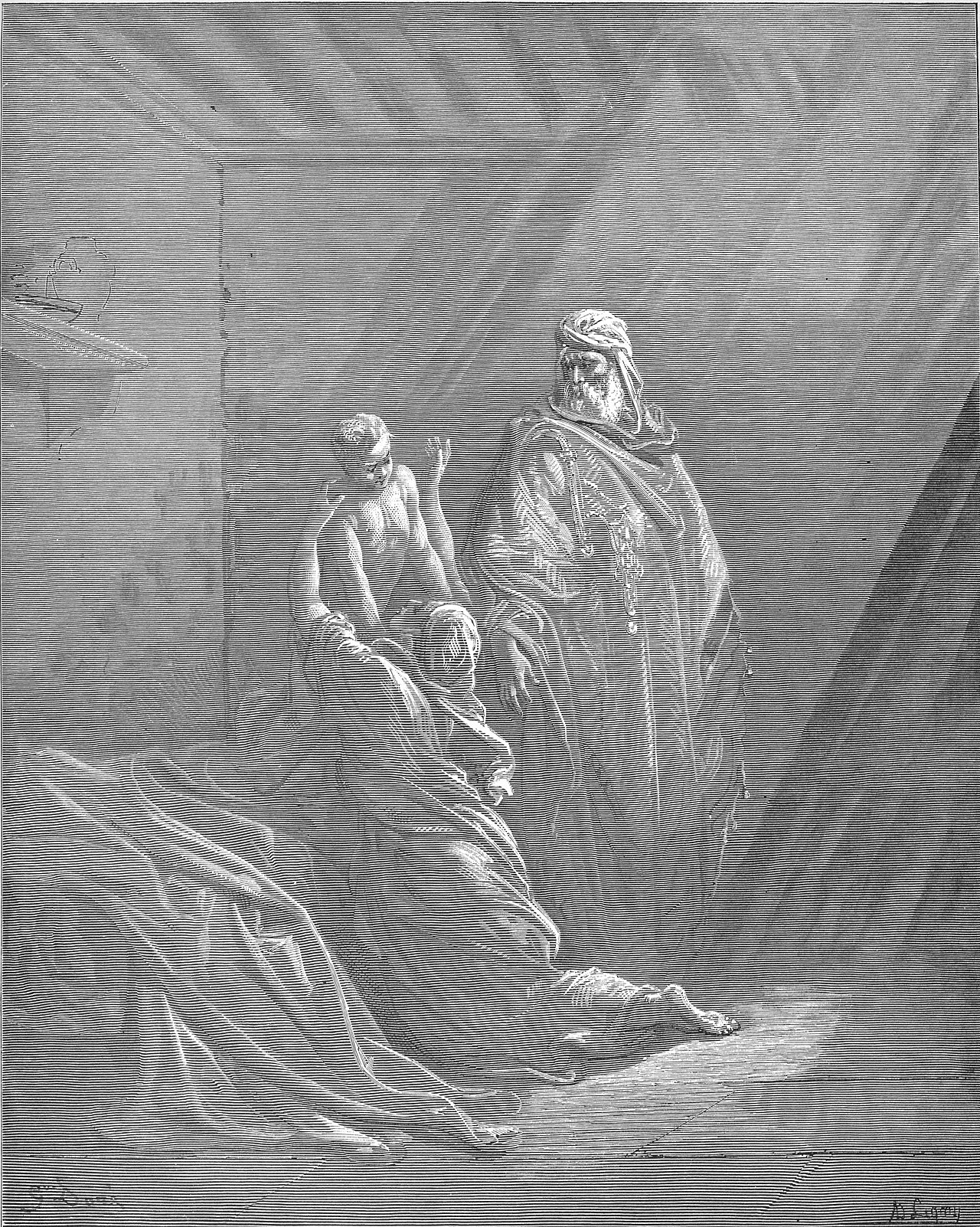
in 1 Kings 17Then he stretched himself out over the child three times and cried out to the LORD, “O LORD my God, please let this boy’s life return to him!”
BSB
The same verse in ASV and KJV ▾
ASV
And he stretched himself upon the child three times, and cried unto Jehovah, and said, O Jehovah my God, I pray thee, let this child’s soul come into him again.
KJV
And he stretched himself upon the child three times, and cried unto the Lord, and said, O Lord my God, I pray thee, let this child’s soul come into him again.
⋯
This verse in 1 Kings 17
Commentary
10 notes on this verse"He stretched himself on the child three times and cried out to the Lord, 'O Lord my God, let this child's life come into him again.' " These words contain many symbols. [The Scripture] shows us immediately that through the invocation of the three names …
This site's exposition
carried him up into a loft
on 1 Kings 17:19-21
Elijah takes the child from her arms, carries him to his own upper room, and lays him on his own bed before he prays. Barnes notes the stretching of himself upon the child three times differs from the method Elisha later uses over the Shunammite's son, and compares it instead to the touch by which Jesus later raises the dead. The prayer names the God he serves twice, O Lord my God, and asks plainly that this child's soul come into him again, a request Wesley calls bold, made by a man whose own experience of answered prayer had already earned him standing to make it.
This site's exposition
stretched himself out over the child three times
Ephrem the Syrian reads the three times Elijah stretched himself over the child as a sign of the three names of God. Elisha later stretches himself over a dead boy at 2 Kings 4:34, and Albert Barnes sets the two acts apart. Verse 22 answers the prayer in its own words.
The record, by era
The Church Fathers1 voice
As we mentioned, that widow prefigured the church, and her son was a type of the Gentiles. The son of the widow lay dead because the son of the church, that is, the Gentiles, was dead because of many sins and offenses. At the prayer of Elijah, the widow's son was revived; at the coming of Christ, the church's son or the Christian people were brought back from the prison of death. Elijah bent down in prayer, and the widow's son was revived; Christ sank down in his passion, and the Christian people were brought back to life. Why blessed Elijah bent down three times to arouse the boy I believe that the understanding of your charity has grasped even before I say it. In the fact that he bowed three times is shown the mystery of the Trinity. Not only the Father without the Son, nor the Father and Son without the Holy Spirit, but the whole Trinity restored the widow's son or the Gentiles to life. Moreover, this is further demonstrated in the sacrament of baptism, for the old person is plunged in the water three times, in order that the new person may merit to rise.
The Puritans and the Awakening4 voices
We do not read before this of any that were raised to life; yet Elijah, by a divine impulse, prays for the resurrection of this child, which yet will not warrant us to do the like. David expected not, by fasting and prayer, to bring his child back to life ( 2 Sam. xii.
quarantine:debris (2026-07-29) — unbalanced-parens
Come into him - By which it is evident, that the soul was gone out of his body, this was a great request; but Elijah was encouraged to make it; by his zeal for God's honour, and by the experience which he had of his prevailing power with God in prayer.
And he stretched himself upon the child three times,....
Thus his story begins with judgments and miracles, designed to awaken that stupid generation that had to deeply corrupted themselves. 1 And Elijah the Tishbite, who was of the inhabitants of Gilead, said unto Ahab, As the L ORD God of Israel liveth, before whom I stand, there shall not be dew nor rain these years, but according to my word.
2 more voices on this verse
The Nineteenth Century2 voices
A commentator
Albert Barnes1798–1870
Notes, Explanatory and Practical, on the Old and New Testaments (1832-1869)
He stretched himself upon the child three times - This action of Elijah is different from that of Elisha (marginal reference), and does not imply the use of any natural means for the restoration of suspended animation. It is nearly parallel to the “touch,” through which our Lord performed similar miracles Mat 9:25; Luk 7:14.
Stretched himself upon the child three times - It is supposed that he did this in order to communicate some natural warmth to the body of the child, in order to dispose it to receive the departed spirit. Elisha, his disciple, did the same in order to restore the dead child of the Shunammite, 2Ki 4:34. And St. Paul appears to have stretched himself on Eutychus in order to restore him to life, Act 20:10. Let this child’s soul come into him again - Surely this means no more than the breath. Though the word נפש nephesh may sometimes signify the life, yet does not this imply that the spirit must take possession of the body in order to produce and maintain the flame of animal life? The expressions here are singular: Let his soul, נפש nephesh, come into him, על קרבו al kirbo, into the midst of him.
The words behind it
18 Hebrew wordsEvery Hebrew word of this verse in the order it stands, with what it means and the door to its own study. The last column counts the times a word stands in the whole Bible: the rarer the word, the more the places it appears belong together.
| Hebrew | Sound | Meaning | Word study | In the Bible |
|---|---|---|---|---|
| וַיִּתְמֹדֵ֤ד | vaiyitmoded | and he stretched himself | H4058 → | |
| עַל־ | ʾal- | over | H5921 → | 5755 times |
| הַיֶּ֙לֶד֙ | haiyeled | the lad | H3206 → | 89 times |
| שָׁלֹ֣שׁ | shalosh | three | H7969 → | 432 times |
| פְּעָמִ֔ים | peamim | times | H6471 → | 118 times |
| וַיִּקְרָ֥א | vaiyikra' | and he called out | H7121 → | 733 times |
| אֶל־ | ʾel- | to | H413 → | 5510 times |
| יְהוָ֖ה | yahweh | Yahweh | H3068 → | 6520 times |
| וַיֹּאמַ֑ר | vaiyomar | and he said | H559 → | 5305 times |
| יְהוָ֣ה | yahweh | O Yahweh | H3068 → | 6520 times |
| אֱלֹהָ֔י | ʾelohai | God my | H430 → | 2601 times |
| תָּ֥שָׁב | tasho | let it return | H7725 → | 1056 times |
| נָ֛א | na' | please | H4994 → | 404 times |
| נֶֽפֶשׁ־ | nefesh- | [the] life of | H5315 → | 754 times |
| הַיֶּ֥לֶד | haiyeled | the lad | H3206 → | 89 times |
| הַזֶּ֖ה | hazeh | <the> this | H2088 → | 1180 times |
| עַל־ | ʾal- | to | H5921 → | 5755 times |
| קִרְבּֽוֹ׃ | kirbo | inward part[s] his | H7130 → | 227 times |
וַיִּתְמֹדֵ֤דand he stretched himself
vaiyitmodedH4058 →
עַל־over
ʾal-H5921 →5755 times
הַיֶּ֙לֶד֙the lad
haiyeledH3206 →89 times
שָׁלֹ֣שׁthree
shaloshH7969 →432 times
פְּעָמִ֔יםtimes
peamimH6471 →118 times
וַיִּקְרָ֥אand he called out
vaiyikra'H7121 →733 times
אֶל־to
ʾel-H413 →5510 times
יְהוָ֖הYahweh
yahwehH3068 →6520 times
וַיֹּאמַ֑רand he said
vaiyomarH559 →5305 times
יְהוָ֣הO Yahweh
yahwehH3068 →6520 times
אֱלֹהָ֔יGod my
ʾelohaiH430 →2601 times
תָּ֥שָׁבlet it return
tashoH7725 →1056 times
נָ֛אplease
na'H4994 →404 times
נֶֽפֶשׁ־[the] life of
nefesh-H5315 →754 times
הַיֶּ֥לֶדthe lad
haiyeledH3206 →89 times
הַזֶּ֖ה<the> this
hazehH2088 →1180 times
עַל־to
ʾal-H5921 →5755 times
קִרְבּֽוֹ׃inward part[s] his
kirboH7130 →227 times
A shaded row is a word that stands 400 times or fewer in the Bible.
The walk
8 stopsEach card is a verse this one points to, and under it the verses that one points to in turn. Where several paths arrive at the same place, that place is listed first: the text keeps returning to it.
Through
Acts 9:40Then Peter sent them all out of the room. He knelt down and prayed, and turning toward her body, he said, “Tabitha, get up!” She opened her eyes, and seeing Peter, she sat up.
it leads to
- Matthew 9:25
After the crowd had been put outside, Jesus went in and took the girl by the hand, and she got up.
- Mark 5:40–42
And they laughed at Him. After He had put them all outside, He took the child’s father and mother and His own companions, and went in to see the child.
- Luke 8:54
But Jesus took her by the hand and called out, “Child, get up!”
- 2 Kings 4:32–36
When Elisha reached the house, there was the boy lying dead on his bed.
- Matthew 9:25
Through
Acts 10:10He became hungry and wanted something to eat, but while the meal was being prepared, he fell into a trance.
it leads to
- Acts 22:17
Later, when I had returned to Jerusalem and was praying at the temple, I fell into a trance
- Acts 22:17
Through
Hebrews 11:19Abraham reasoned that God could raise the dead, and in a sense, he did receive Isaac back from death.
it leads to
- Romans 4:17–21
As it is written: “I have made you a father of many nations.” He is our father in the presence of God, in whom he believed, the God who gives life to the dead…
- Matthew 9:28
After Jesus had entered the house, the blind men came to Him. “Do you believe that I am able to do this?” He asked. “Yes, Lord,” they answered.
- Romans 4:17–21
Through
Acts 20:10But Paul went down, threw himself on the young man, and embraced him. “Do not be alarmed!” he said. “He is still alive!”
it leads to
- John 11:40
Jesus replied, “Did I not tell you that if you believed, you would see the glory of God?”
- John 11:40
Where this verse is studied
On this page
Studies1
About 1 Kings
This page draws on 9 works. Open the list of works
This page draws on Adam Clarke, Commentary on the Bible; Albert Barnes, Notes, Explanatory and Practical, on the Old and New Testaments; Albert Barnes, Notes, Explanatory and Practical, on the Old and New Testaments (1832-1869); Augustine of Hippo, SERMON 124.4; Ephrem the Syrian, ON THE FIRST BOOK OF KINGS 17:2; Ephrem the Syrian, ON THE FIRST BOOK OF KINGS 16:29; John Gill, Exposition of the Old Testament (1748-1763); John Wesley, Explanatory Notes upon the Old Testament and Matthew Henry, Commentary on the Whole Bible.