
Genesis 19:26
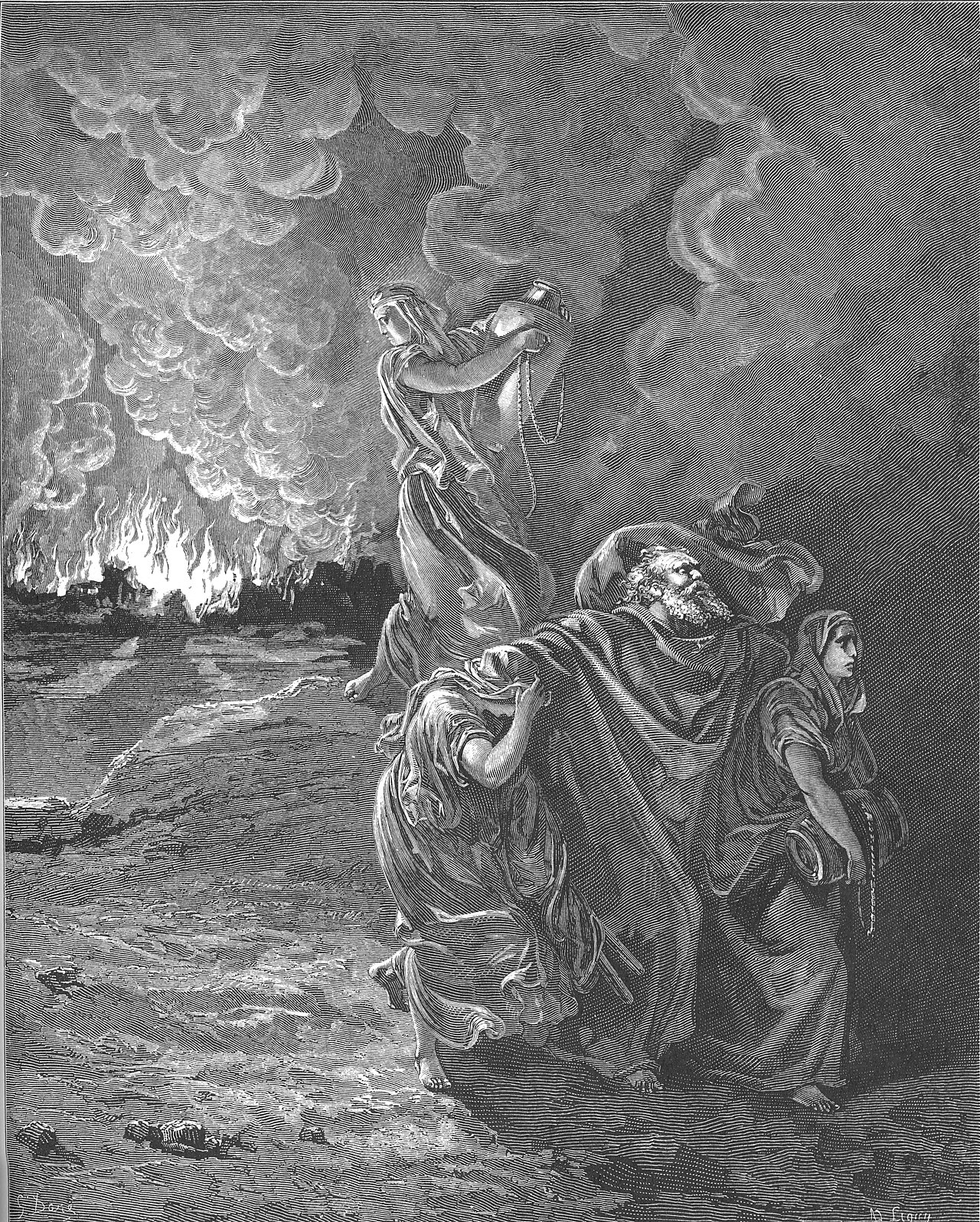
in Genesis 19But Lot’s wife looked back, and she became a pillar of salt.
BSB
The same verse in ASV and KJV ▾
ASV
But his wife looked back from behind him, and she became a pillar of salt.
KJV
But his wife looked back from behind him, and she became a pillar of salt.
⋯
This verse in Genesis 19
Commentary
12 notes on this verseBut let us return to Lot, who, fleeing the destruction of Sodom with his wife and daughters after he had received the command from the angels to not look back, was proceeding to Zoar. But his wife became negligent of the command. "She looked back"; she violated the imposed law; "she became a little statue of salt." Do we think there was so much evil in this transgression, that the woman, because she looked behind her, incurred the destruction that she appeared to be fleeing by divine favor?
This site's exposition
He destroyed these cities and the entire plain
on Genesis 19:25-26
The cities, the entire plain, the inhabitants and everything that grew on the ground go together. Isaiah, Jeremiah, Amos and Zephaniah name it later and expect their hearers to know it. Lot's wife looked back and became a pillar of salt, in one sentence. Jesus gives her three words at Luke 17:32, remember Lot's wife.
This site's exposition
a pillar of salt
Adam Clarke sets aside the many old tales about how the change happened and keeps to what the text says. She was walking behind her husband, and she looked back against the command of verse 17. Scripture says little more.
The record, by era
The Church Fathers3 voices
A commentator
Philoxenus of Mabbug13 Ascetic Discourses, Discourse 9 -- Second Discourse on Poverty · Written before 523.
proposed
Remember Lot's wife, who, because the love of her kinsfolk and the outcries of her beloved ones constrained her, turned and looked back behind her, and became a pillar of salt, even as is written concerning her; and because her soul had not been salted …
For God looks closely at the actual inner purpose, as when Lot's wife was the only one to turn of her own free will toward the wickedness of the world. He left her insensible, giving her the likeness of a pillar of salt and leaving her without the power of forward movement, a statue, yet not one without a useful message but one intended to season and salt the person capable of spiritual perception.
A commentator
Clement of RomeClement's First Letter to the Corinthians, Chapter 11 · Written before 99.
proposed
On account of his hospitality and godliness, Lot was saved out of Sodom when all the country round was punished by means of fire and brimstone, the Lord thus making it manifest that He does not forsake those that hope in Him, but gives up such as depart from Him to punishment and torture. [Genesis 19:15-26, 2 Peter 2:6-9] For Lot's wife, who went forth with him, being of a different mind from himself, and not continuing in agreement with him [as to the command which had been given them], was made an example of, so as to be a pillar of salt unto this day. This was done that all might know that those who are of a double mind, and who distrust the power of God, bring down judgment on themselves and become a sign to all succeeding generations.
The Medieval Church1 voice
And his wife, looking back, was turned into a pillar of salt. This indeed must be believed to have happened literally. Finally, Josephus reports that even up to his time the same pillar of salt had endured at the gates of the same city.
The Puritans and the Awakening1 voice
Probably she hankered after her house and goods in Sodom, and was loath to leave them. Christ intimates this to be her sin, Luke xvii, 31, 32, she too much regarded her stuff. And her looking back spoke an inclination to go back; and therefore our saviour uses it as a warning against apostasy from our Christian profession.
4 more voices on this verse
The Puritans and the Awakening2 voices
As by the example of Sodom the wicked are warned to turn from their wickedness, so by the example of Lot's wife the righteous are warned not to turn from their righteousness. The sin of Lot's wife: She looked back from behind him. This seemed a small thing, but we are sure, by the punishment of it, that it was a great sin, and exceedingly sinful.
But his wife looked back from behind him,....
The Nineteenth Century2 voices
She became a pillar of salt - The vast variety of opinions, both ancient and modern, on the crime of Lot’s wife, her change, and the manner in which that change was effected, are in many cases as unsatisfactory as they are ridiculous. On this point the sacred Scripture says little. God had commanded Lot and his family not to look behind them; the wife of Lot disobeyed this command; she looked back from behind him - Lot, her husband, and she became a pillar of salt.
A commentator
Jamieson, Fausset & Brown1802–1910
Commentary Critical and Explanatory on the Whole Bible (1871)
But whether it was from irresistible curiosity or perturbation of feeling, or that she was about to return to save something, his wife lingered, and while thus disobeying the parting counsel, "to look not back, nor stay in all the plain" [Ge 19:17], the torrent of liquid lava enveloped her so that she became the victim of her supine indolence or sinful rashness.
The words behind it
6 Hebrew wordsEvery Hebrew word of this verse in the order it stands, with what it means and the door to its own study. The last column counts the times a word stands in the whole Bible: the rarer the word, the more the places it appears belong together.
| Hebrew | Sound | Meaning | Word study | In the Bible |
|---|---|---|---|---|
| וַתַּבֵּ֥ט | vatabet | and she looked | H5027 → | 69 times |
| אִשְׁתּ֖וֹ | ʾishto | wife his | H802 → | 781 times |
| מֵאַחֲרָ֑יו | meacharav | from behind him | H310 → | 715 times |
| וַתְּהִ֖י | vatehi | and she was | H1961 → | 3559 times |
| נְצִ֥יב | netziv | a pillar of | H5333 → | |
| מֶֽלַח׃ | melach | salt | H4417 → |
וַתַּבֵּ֥טand she looked
vatabetH5027 →69 times
אִשְׁתּ֖וֹwife his
ʾishtoH802 →781 times
מֵאַחֲרָ֑יוfrom behind him
meacharavH310 →715 times
וַתְּהִ֖יand she was
vatehiH1961 →3559 times
נְצִ֥יבa pillar of
netzivH5333 →
מֶֽלַח׃salt
melachH4417 →
A shaded row is a word that stands 400 times or fewer in the Bible.
The walk
8 stopsEach card is a verse this one points to, and under it the verses that one points to in turn. Where several paths arrive at the same place, that place is listed first: the text keeps returning to it.
Through
Hebrews 10:38But My righteous one will live by faith; and if he shrinks back, I will take no pleasure in him.”
it leads to
- Galatians 3:11
Now it is clear that no one is justified before God by the law, because, “The righteous will live by faith.”
- Habakkuk 2:4
Look at the proud one; his soul is not upright—but the righteous will live by faith—
- Romans 1:17
For the gospel reveals the righteousness of God that comes by faith from start to finish, just as it is written: “The righteous will live by faith.”
- Psalms 85:8
I will listen to what God the LORD will say; for He will surely speak peace to His people and His saints; He will not let them return to folly.
- Galatians 3:11
Through
Genesis 19:17As soon as the men had brought them out, one of them said, “Run for your lives! Do not look back, and do not stop anywhere on the plain! Flee to the mountains, or…
it leads to
- Matthew 24:16–18
then let those who are in Judea flee to the mountains.
- Luke 9:62
Then Jesus declared, “No one who puts his hand to the plow and then looks back is fit for the kingdom of God.”
- Philippians 3:13–14
Brothers, I do not consider myself yet to have taken hold of it. But one thing I do: Forgetting what is behind and straining toward what is ahead,
- Genesis 19:22
Hurry! Run there quickly, for I cannot do anything until you reach it.” That is why the town was called Zoar.
- Matthew 24:16–18
Where this verse is studied
On this page
About Genesis
This page draws on 10 works. Open the list of works
This page draws on Adam Clarke, Commentary on the Bible; Bede, Commentary on Genesis (Hexaemeron); Clement of Alexandria, The Stromata Book 2; Clement of Rome, Clement's First Letter to the Corinthians, Chapter 11; Jamieson, Fausset & Brown, Commentary Critical and Explanatory on the Whole Bible; John Gill, Exposition of the Old Testament (1748-1763); John Wesley, Explanatory Notes upon the Old Testament; Matthew Henry, Commentary on the Whole Bible; Origen of Alexandria, HOMILIES ON GENESIS 5.2 and Philoxenus of Mabbug, 13 Ascetic Discourses, Discourse 9 -- Second Discourse on Poverty.