
Luke 15:11 to 32 · Story · Repentance
The Prodigal's Return
Luke 15:11 to 32 is the third of three parables about the lost being found, and it follows a father and two brothers.
Jesus ends the story with the elder son standing outside the feast, and He never says whether he went in.
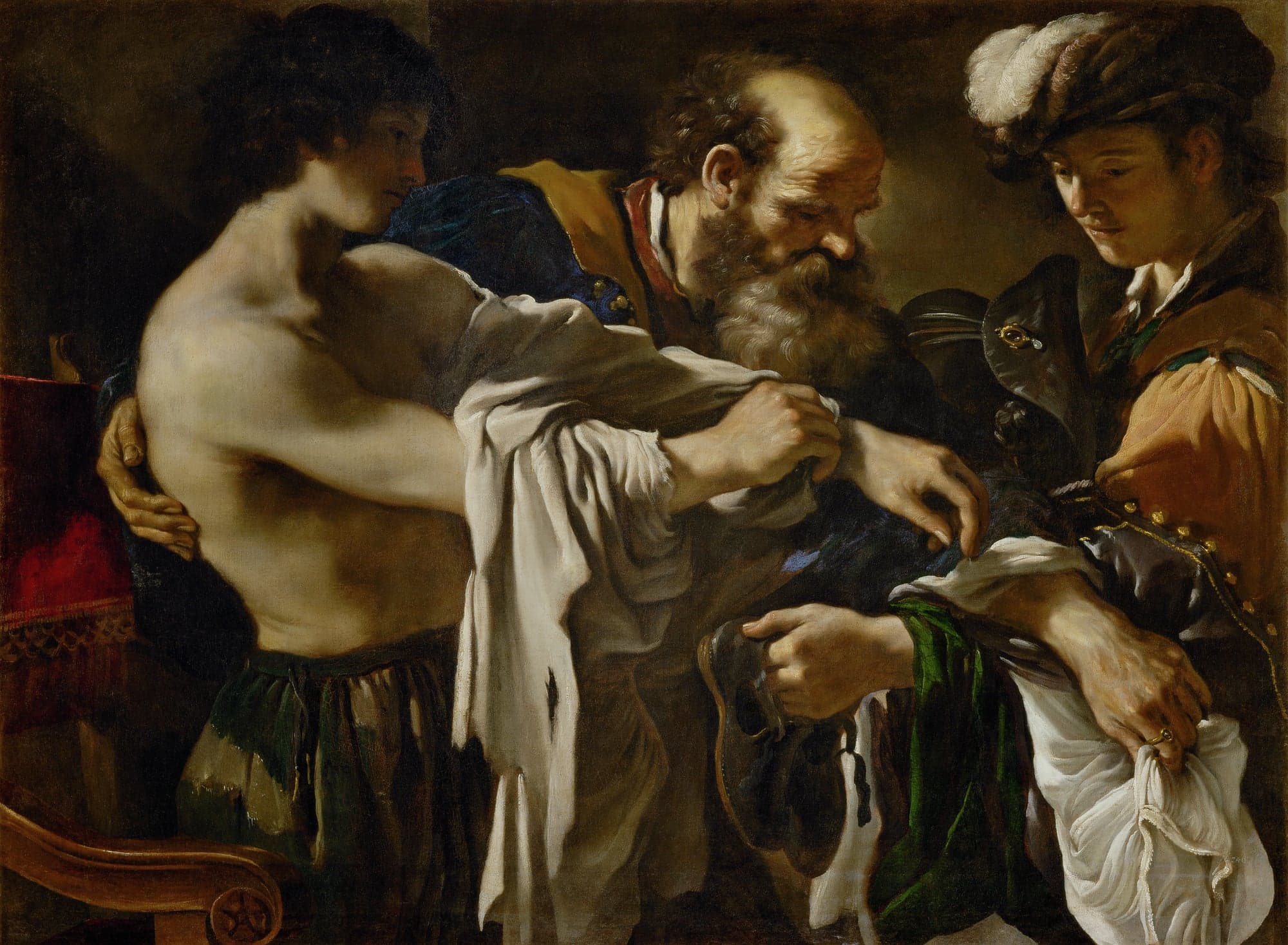
So he got up and went to his father. But while he was still in the distance, his father saw him and was filled with compassion. He ran to his son, embraced him, and kissed him.
- Who
- Jesus of Nazareth
Summary
Repentance in this story begins in the son's mind, moves to his feet and ends in his mouth. The welcome at the end of the road shows how God receives a sinner who comes back. The elder son never left the house, and he shows that a man can live near his father and still refuse his father's joy.
- Tax collectors and sinners gathered to hear Jesus, and the Pharisees and scribes grumbled that He welcomed sinners and ate with them. The three stories are His answer (Luke 15:1 to 3).
- Jesus closes the stories of the sheep and the coin by speaking of the joy in heaven, and before God's angels, when one sinner repents (Luke 15:7 and Luke 15:10).
- Hungry in a far country and hired out to feed pigs, the younger son resolved to go back and confess that he had sinned against heaven and against his father (Luke 15:15 to 19).
- Before the son could ask to be made a hired servant, the father called for the best robe, a ring, sandals and the fattened calf (Luke 15:21 to 23).
- The elder son was angry that his brother was feasted and complained that he had served for years, and the father told him that all he had was his (Luke 15:28 to 31).
The Third of Three Stories
The sheep and the coin end with neighbours called in to rejoice, and the son's story ends with a feast.
The prodigal son, as the story is often called, shows a sinner coming home to God. It belongs to repentance, the turn from sin back to God that the New Testament says God now commands of all people everywhere (Acts 17:30).
The question it answers is what repentance looks like when Jesus tells it as a story, and how the one who returns is received. It also asks what is wrong with the elder son. The story is drawn in ten events and told scene by scene with its verses. It is read against the law of Israel behind it, with three readings of the elder son and their holders.
Jesus answered first with a shepherd who leaves the ninety-nine sheep in the pasture to find the one that is lost. Then He told of a woman who lights a lamp and sweeps her house until she finds one silver coin (Luke 15:4 to 9).
The three stories share one shapeLuke 15:4 to 32
In each of the three stories one of many is lost and found, and each ends with a call to rejoice.
| Story | What is lost | Who moves | The words of joy |
|---|---|---|---|
| The lost sheep | One sheep of a hundred | The shepherd goes after it and carries it home on his shoulders | "more joy in heaven over one sinner who repents" |
| The lost coin | One silver coin of ten | The woman lights a lamp and searches carefully | "joy in the presence of God’s angels" |
| The lost son | One son of two | The son walks home himself, and the father runs to meet him | "Let us feast and celebrate." |
The Parable in Ten Events
The story moves from the house to a distant country and back to the house.
The younger son goes from a demand for his share to a feast held in his honour, and the story ends with the father pleading outside with the elder son.
- The younger son demands his inheritance"Father, give me my share of the estate."Luke 15:11 to 12
- He leaves for a distant country and spends it all"squandered his wealth in wild living"Luke 15:13
- A famine comes, and he is hired out to feed pigs"to feed the pigs"Luke 15:14 to 16
- He comes to his senses"Finally he came to his senses"Luke 15:17
- He resolves to go back and confess"I will get up and go back"Luke 15:18 to 19
- The father sees him far off and runs to him"He ran to his son"Luke 15:20
- The confession begins"I am no longer worthy"Luke 15:21
- The servants bring the robe, and the feast begins"Bring the best robe"Luke 15:22 to 24
- His brother hears the music and stays outside"became angry and refused to go in"Luke 15:25 to 28
- The father goes out to plead with him"came out and pleaded with him"Luke 15:28 to 32
A timeline of ten events in Luke 15:11 to 32 in their order, each card carrying words of its verse from the Berean text.
The confession begins, The servants bring the robe, and the feast begins, His brother hears the music and stays outside, The father goes out to plead with him
The Story Told in Order
Luke tells the story in four scenes, from the far country to the field outside the house.
The younger son took his share to a distant countryLuke 15:11 to 16
The request was granted at once, and a few days later the young man gathered everything and went to a distant country, where he wasted it (Luke 15:12 to 13).
After he had spent all he had, a severe famine swept through that country, and he began to be in need. So he went and hired himself out to a citizen of that country, who sent him into his fields to feed the pigs. He longed to fill his belly with the pods the pigs were eating, but no one would give him a thing.These verses measure how far he fell, for he was hired out to a foreigner, sent to feed animals the law called unclean and left hungry for their food.
Hunger brought him to his sensesLuke 15:17 to 19
Finally he came to his senses and said, ‘How many of my father’s hired servants have plenty of food? But here I am, starving to death!This is the turn of the story, for the son first sees his own state truly and sets it beside the plenty of his father's house.
I will get up and go back to my father and say to him, “Father, I have sinned against heaven and against you. I am no longer worthy to be called your son. Make me like one of your hired servants.”’The son plans his confession before he takes a step, and he asks for no more than a servant's place.
The father spoke over the end of the confessionLuke 15:21 to 24
The son began the speech he had planned. He confessed his sin and said that he was unworthy to be called a son, but he never reached the line about the hired servants (Luke 15:21).
But the father said to his servants, ‘Quick! Bring the best robe and put it on him. Put a ring on his finger and sandals on his feet.The father answers the confession with orders to his servants, and each thing he calls for belongs to a son of the house rather than to a hired hand.
He also called for the fattened calf to be killed for a feast (Luke 15:23).
The brother in the field would not go inLuke 15:25 to 32
The elder son came in from the field, heard music and dancing, and learned from a servant that his brother was home and the calf had been killed (Luke 15:25 to 27).
The older son became angry and refused to go in. So his father came out and pleaded with him.The father who ran to one son now goes out to the other, so the story shows the father leaving his house twice.
The elder son answered that he had served his father for years and never disobeyed a command, yet had never been given a young goat to celebrate with his friends. He did not call the younger man his brother but "this son of yours" (Luke 15:29 to 30).
“As the father's receiving the younger son did not cause him to disinherit the elder; so God's receiving notorious sinners will be no loss to those who have always served him; neither will he raise these to a state of glory equal to that of those who have always served him, if they have, upon the whole, made a greater progress in inward as well as outward holiness.”
John Wesley · Explanatory Notes upon the New Testament · on Luke 15:31Evangelical
What the Son Shows of Repentance
The son's turn begins inside him and is finished in his father's arms.
In the Berean text the word repents stands in Luke 15:7 and Luke 15:10 and in no verse of Luke 15:11 to 32. The story of the two sons shows the thing that word names.
Luke sets the turn inside the son before he moves (Luke 15:17 to 18). It lies in his memory of the hired servants who have food to spare and in his resolve to go back.
“Therefore God chose these whom the world despises, because very often that contempt itself calls a person back to himself. For he who left his father and squandered prodigally the portion of substance he had received, after he began to hunger, returned to himself and said: ‘How many hired servants in my father's house have bread in abundance?’ Indeed he had departed far from himself when he was sinning. And if he had not hungered, he would never have returned to himself, because only after he lacked earthly things did he begin to consider what he had lost of spiritual things.”
Gregory the Dialogist · Forty Gospel Homilies, Homily 36 · on Luke 15:17Patristic
Luke places the son's confession after his father's embrace and kiss (Luke 15:20 to 21), so the son speaks as one already received.
“When he had received the kiss which sealed his pardon, yet he said, Father, I have sinned. Note, Even those that have received the pardon of their sins, and the comfortable sense of their pardon, must have in their hearts a sincere contrition for it, and with their mouths must make a penitent confession of it, even of those sins which they have reason to hope are pardoned.”
Matthew Henry · Commentary on the Whole Bible · on Luke 15:21Puritan
“That prodigal son also the father's patience receives, and clothes, and feeds, and makes excuses for, in the presence of the angry brother's impatience. He, therefore, who ‘had perished’ is saved, because he entered on the way of repentance. Repentance perishes not, because it finds Patience (to welcome it).”
Tertullian · Of Patience · on Luke 15:11Patristic
The father in the story is also Jesus's teaching about God the Father, which has its own study.
The Law Behind the Story
Two laws of Moses stand behind the elder son's place and the pigs his brother fed.
Instead, he must acknowledge the firstborn, the son of his unloved wife, by giving him a double portion of all that he has. For that son is the firstfruits of his father’s strength; the right of the firstborn belongs to him.The law gave the firstborn the larger share, and it stands behind the elder son's place in the house.
Luke says that the property was divided between the two sons in one act (Luke 15:12). The father's later word to the elder son, "all that is mine is yours", rests on that division (Luke 15:31).
And the pig, though it has a split hoof completely divided, does not chew the cud; it is unclean for you.The law named the pig unclean, so a son of Israel feeding pigs for a foreigner had gone as far from his people as he could go.
What the Story Leaves Unsaid
Two things a reader may want to know are left untold in the story.
Jesus describes the younger son's life in the far country only as wild living (Luke 15:13). Only the elder son speaks of prostitutes, and the story does not say whether he knew it or assumed it (Luke 15:30).
The story gives no name to the father, to either son or to the distant country.
Three Readings of the Elder Son
Commentators from the fourth century to the nineteenth have read the elder son in three ways.
He stands for the Pharisees and scribesAlbert Barnes, Notes, Explanatory and Practical, on Luke 15:25
Albert Barnes wrote in his Notes, "This eldest son is designed to represent the Pharisees who had found fault with the Saviour."
Against a plain match stands the father's answer in Luke 15:31, which speaks to the elder son as a son who has never lost his place.
He stands for Israel, and his brother for the GentilesAmbrose of Milan, in Thomas Aquinas's Catena Aurea on Luke 15:25 to 26
Ambrose of Milan, as Aquinas gathers him in the Catena Aurea, wrote that "the younger son, that is the Gentile people, is envied by Israel as the elder brother".
He tied the elder son's anger to the complaint that Christ sat down to eat with the Gentiles.
The sons stand for the righteous and the sinner who repentsCyril of Alexandria, on Luke 15:11 and Luke 15:25 to 32
Cyril of Alexandria, in Aquinas's Catena Aurea, reads the two sons as "the righteous who follow righteousness from the beginning" and "those men who are brought back by repentance to righteousness".
Against the reading of Ambrose he wrote in his Commentary on Luke, "In no way is it fitting to say that Israel chose a blameless life."
Dead and Alive Again
Jesus ends the parable in the father's voice.
The younger son came home with nothing to offer but his confession, and he was received as a son. The feast that began for him was open to his brother as well.
But it was fitting to celebrate and be glad, because this brother of yours was dead and is alive again; he was lost and is found.’”The verse closes the story on the father's plea, and it repeats the words he spoke at the younger son's return.
Sources
Scripture is the Berean Standard Bible.
- Gregory the Dialogist, Forty Gospel Homilies, Homily 36 (Gregory died in 604)
- Thomas Aquinas, Catena Aurea on Luke 15 (1264), gathering Ambrose of Milan and Cyril of Alexandria.
- Matthew Henry, Commentary on the Whole Bible (1710), on Luke 15:21.
- Tertullian, Of Patience (third century)
- John Wesley, Explanatory Notes upon the New Testament (1755), on Luke 15:31.
- Albert Barnes, Notes, Explanatory and Practical, on the New Testament (1832 to 1869), on Luke 15:25.
- Cyril of Alexandria, Commentary on Luke, Homily 107 (fifth century)