
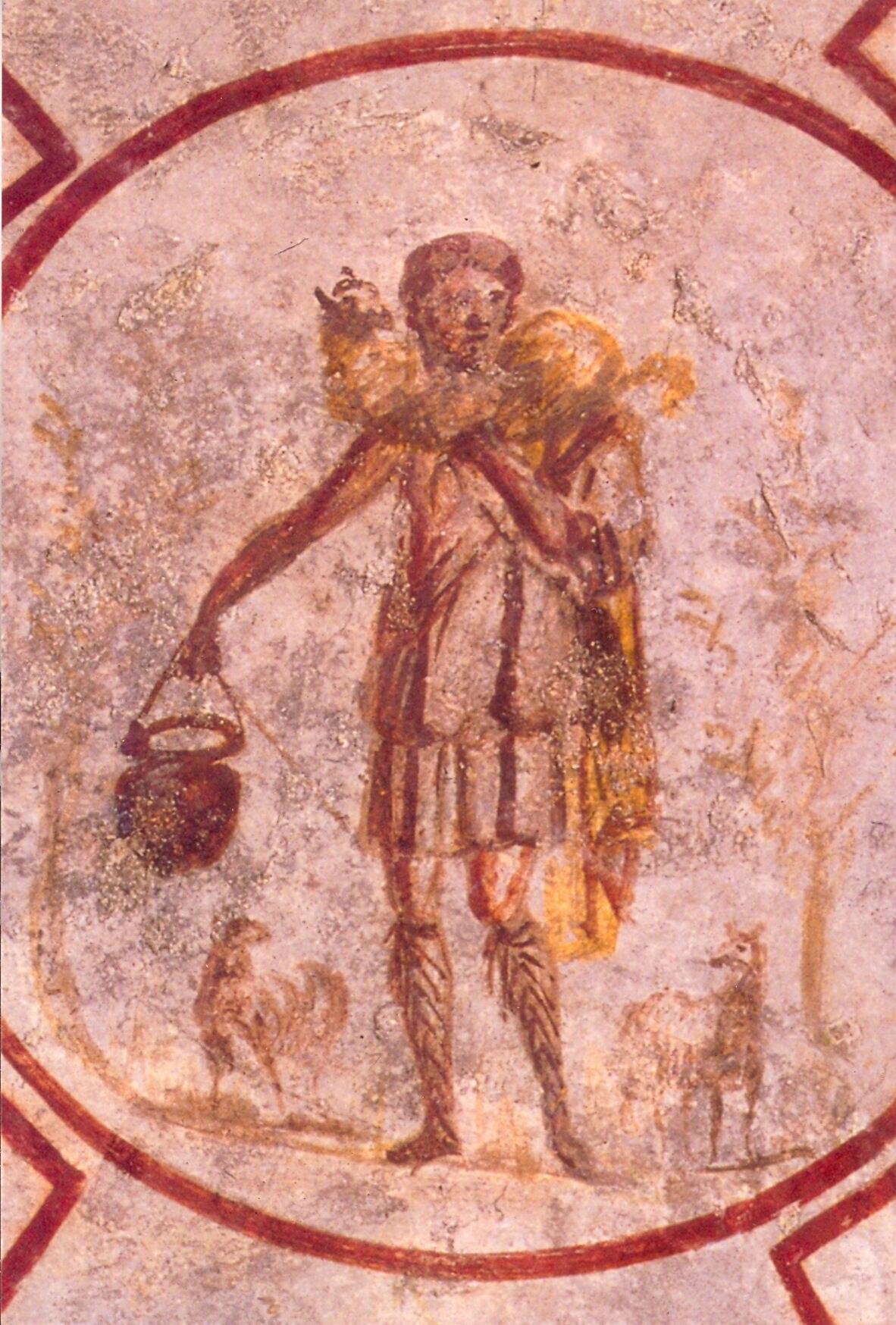
The Good Shepherd, wall painting in the catacomb of San Callisto, Rome, artist unknown, photographed by Jim Forest in 2008, public domain (PD-Art)
Rome, the cemeteries outside the walls · Place · Featured Study
The Catacombs
The Roman church called its burial grounds sleeping places and laid its bishops and martyrs in them.
Labourers digging sand in a vineyard outside Rome in 1578 broke into a buried Christian cemetery with paintings on its walls.
I am the good shepherd. The good shepherd lays down His life for the sheep.
I am the good shepherd. The good shepherd lays down His life for the sheep.
- Today
- Rome, beyond the ancient walls
- Region
- The roads leading out of Rome
Summary
The catacombs are long tunnels cut in the soft rock under the roads outside Rome. The Christians of the city buried their dead there and met there to worship. Northcote and Brownlow wrote about them in English from the digs of de Rossi.
- Zephyrinus, bishop of Rome, put Callistus in charge of the church's burial ground. The largest catacomb now bears his name.
- Valerian banned the Christians from their burial grounds, and Gallienus gave them back.
- The walls show Christ as a shepherd and people standing in prayer.
The Shepherd on the Walls
Christ called Himself the good shepherd, and Luke tells of the shepherd who carries the lost sheep home.
And when he finds it, he joyfully puts it on his shoulders,The shepherd lifts the found sheep onto his shoulders, which is how the paintings show him.
The LORD is my shepherd; I shall not want.The Old Testament already speaks of the LORD as the shepherd of His people.
Northcote and Brownlow found the shepherd painted on roofs and walls and scratched on gravestones. He was also carved on stone coffins, traced in gold on glass, moulded on lamps and engraved on rings. They held that the painters chose the subject because it expressed the whole substance of the Christian faith.
A Gallery on Three Levels
The drawing cuts across three galleries stacked one over another, to the measures Northcote and Brownlow give.
The galleries were two to four feet wide and were cut on as many as five levels.
10 feet, about 3 m
- A galleryTwo to four feet wide, its height set by the rock
- The nichesCut flat into both walls, one above another, each once holding a body
- The levelsThree, four or even five galleries, one above the other
- The stairStairs joined the levels and, later, ran up to the sand pits beside them
The book gives the widths, the niches and the number of levels; the height of each gallery and the depth between levels vary with the rock and are drawn evenly here.
A cross section through three levels of galleries, with the burial niches cut into both walls; drawn in feet, the surface at the top.
From Callistus to the Vineyard of 1578
Six moments in the history of the Roman cemeteries, from the bishop who managed one to the men who found them again.
The cemeteries were managed, seized, restored, forgotten and found again.
- Zephyrinus's time, about 200Callistus is brought back from Antium and put over the cemeteryHippolytus, Refutation 9.7
- 257Valerian's prefect forbids the Christians of Alexandria their assemblies and cemeteriesEusebius 7.11.10
- 258Xistus, bishop of Rome, is killed in the cemetery with four deaconsCyprian, Epistle 81
- After Valerian's captureGallienus writes that the bishops may take back the cemeteriesEusebius 7.13.3
- 31 May 1578Workmen on the Via Salaria open a painted cemetery about two miles out of RomeNorthcote and Brownlow, page 1
- 1869Northcote and Brownlow publish de Rossi's findings in EnglishRoma Sotterranea, title page
Each row gives the moment and the source that records it.
Sleeping Places
The Christians named their burial grounds for the sleep of the dead in Christ.
For since we believe that Jesus died and rose again, we also believe that God will bring with Jesus those who have fallen asleep in Him.Paul speaks of believers who have fallen asleep in Jesus, the hope the name cemetery carried.
The Greek word koimeteria means sleeping places, McGiffert explains. The Christians gave it to their burial grounds because they looked on death as a sleep.
Northcote and Brownlow held that the Christians dug the catacombs for burial and for their assemblies, and did not take over abandoned sand pits. The galleries rarely run past the third milestone from the city, and the two authors reckoned their length at no less than 350 miles.
What the Galleries Hold
The tombs of the bishops, the hidden stairs and a boy's Sunday walks are each recorded in Roma Sotterranea.
The Papal CryptNorthcote and Brownlow, page 138
A chapel in the cemetery of Callistus held the gravestones of Anteros and Fabian, bishops of Rome from 235 to 250. It also held the stones of Lucius, bishop in 252, and of Eutychianus, who died about thirty years later. De Rossi judged them the original stones.
The hidden stairsNorthcote and Brownlow, page 88
Once the graves were no longer safe, the Christians began to hide the ways in. Stairs leading up into the neighbouring sand pits still show it.
Jerome's SundaysNorthcote and Brownlow, pages 97 to 98
Let death seize them by surprise; let them go down to Sheol alive, for evil is with them in their homes.The dark galleries brought this line of the Psalm to Jerome's mind.
Jerome wrote that as a boy at school in Rome he went every Sunday with his friends to the tombs of the apostles and martyrs. The crypts were dark, and the bodies of the dead lay in the walls on either side.
What the Sources Leave Unsaid
The oldest witnesses name a cemetery without saying which one.
Hippolytus says only that Callistus was set over the cemetery, and McGiffert writes that the catacomb bearing his name may be the very one. Cyprian likewise says Xistus died in the cemetery without naming it.
The Witnesses of the Cemeteries
Three writers of the third and fourth centuries name the Christian cemeteries in their own words.
Hippolytus of Rome (died 235)
Refutation of All Heresies, book 9, chapter 7
Three witnesses to the cemeteries
“And after Victor's death, Zephyrinus, having had Callistus as a fellow-worker in the management of his clergy, paid him respect to his own damage; and transferring this person from Antium, appointed him over the cemetery.”
Early Church
About this saying1 paragraph
Hippolytus of Rome wrote against Callistus, his rival, and still recorded the charge Zephyrinus gave him.
Cyprian (died 258)
Epistle 81, to Successus, section 1
Three witnesses to the cemeteries
“But know that Xistus was martyred in the cemetery on the eighth day of the Ides of August, and with him four deacons.”
Early Church
About this saying1 paragraph
Cyprian told a fellow bishop how the persecution had reached the bishop of Rome.
Eusebius of Caesarea (died 339)
Church History, book 7, chapter 11, section 10
Three witnesses to the cemeteries
“it shall by no means be permitted you or any others, either to hold assemblies, or to enter into the so called cemeteries.”
Patristic
About this saying1 paragraph
Eusebius of Caesarea copied the words the prefect Aemilianus spoke to Dionysius of Alexandria.
In Their Own Words
Two graves in the cemetery of Callistus and a bishop's verse in its Papal Crypt speak for the people of the catacombs.
Damasus of Rome (died 384)
the epitaph of the Papal Crypt, in W. H. Withrow, The Catacombs of Rome (1888), pages 177 to 178
A bishop who would not lie among them
“Here I, Damasus, confess I wished to lay my limbs, But I feared to disturb the holy ashes of the saints.”
Patristic
About this saying1 paragraph
Damasus, bishop of Rome until 384, wrote a verse epitaph for the Papal Crypt. In the rubble of the chamber de Rossi found it in 120 fragments and set it back on the wall.
The catacomb epitaphs
J. Spencer Northcote, Epitaphs of the Catacombs; or, Christian Inscriptions in Rome during the First Four Centuries (1878), page 94, from the Cemetery of St. Callixtus
A prayer on Januaria's grave
“Januaria, mayest thou be well refreshed, and pray for us.”
Early Church
About this saying1 paragraph
A Christian of the first four centuries cut this prayer on the grave of Januaria in the cemetery of Callistus. Northcote printed it in English in 1878.
The catacomb epitaphs
J. Spencer Northcote, Epitaphs of the Catacombs; or, Christian Inscriptions in Rome during the First Four Centuries (1878), page 26, from the Cemetery of St. Callixtus
A father for his son
“who had lived one year, three months, twenty-three days, six hours and a half. In peace.”
Early Church
About this saying1 paragraph
From the same cemetery de Rossi copied this line, which a Christian father of those centuries set on his young son's grave.
Who Is the Figure at Prayer?
Two books of the 1860s and 1870s read the praying figures of the walls in two ways.
Figures standing with their arms stretched out in prayer, called oranti, appear in great numbers on the walls. A woman at prayer often stands beside the shepherd.
Mary or the ChurchNorthcote and Brownlow, 1869
Northcote and Brownlow read the woman beside the shepherd as Mary or as the Church. They held that both meanings may have been in the painter's mind (page 254).
Withrow answers that the figure on a gravestone matches in sex and apparent age the person the inscription names.
The one buried thereW. H. Withrow, 1874
Withrow read the praying figures as portraits of the dead who lived a life of prayer and died in the faith. He noted that Northcote had once said the same (pages 304 to 305).
Northcote and Brownlow answer that in most cases the figure cannot be the one buried in the chamber's chief tomb (page 255).
Books to Read Next
Roma Sotterranea
J. Spencer Northcote and W. R. Brownlow, after Giovanni Battista de Rossi · 1869
It gives de Rossi's excavations in the cemetery of Callistus in English, with plates of the paintings.
Read Roma Sotterranea free at the Internet ArchiveThe Catacombs of Rome and Their Testimony Relative to Primitive Christianity
W. H. Withrow · 1874
It reads the paintings and inscriptions as a Protestant and tests the Roman readings against the early record.
Read Withrow free at the Internet ArchiveThe First Christian Walls
The church of Rome laid its dead to sleep under the image of the Shepherd who gave His life for the sheep.
Sources
Scripture is the Berean Standard Bible.
- The Holy Bible, Berean Standard Bible (read 2026)
- J. Spencer Northcote and W. R. Brownlow, Roma Sotterranea (Longmans, Green, Reader and Dyer, London, 1869), pages 1, 26, 28, 88, 97 to 98, 138, 235 to 236, 254 and 255.
- W. H. Withrow, The Catacombs of Rome and Their Testimony Relative to Primitive Christianity (Nelson and Phillips, New York, 1874), pages 304 to 305.
- J. Spencer Northcote, Epitaphs of the Catacombs; or, Christian Inscriptions in Rome during the First Four Centuries (Longmans, Green, and Co., London, 1878), pages 26 and 94.
- W. H. Withrow, The Catacombs of Rome (Hodder and Stoughton, London, 1888), pages 177 to 178, the epitaph of the Papal Crypt by Damasus, and the pages naming him bishop of Rome to 384 and Jerome his secretary.
- Ante-Nicene Fathers, volume 5 (Christian Literature Publishing Co., Buffalo, 1886): Hippolytus, Refutation of All Heresies 9.7, translated by J. H. MacMahon; Cyprian, Epistle 81 (Oxford 80), translated by Ernest Wallis, with the editor's note 3043 dating it to 258.
- Eusebius, Church History, translated by Arthur Cushman McGiffert, Nicene and Post-Nicene Fathers, second series, volume 1 (1890), book 7, chapters 11 and 13, with McGiffert's notes 1941, 2240 and 2450.
Keep Studying
People and groups5