
Luke 15:24
in Luke 15For this son of mine was dead and is alive again! He was lost and is found!’ So they began to celebrate.
BSB
The same verse in ASV and KJV ▾
ASV
for this my son was dead, and is alive again; he was lost, and is found. And they began to be merry.
KJV
For this my son was dead, and is alive again; he was lost, and is found. And they began to be merry.
⋯
This verse in Luke 15
Commentary
22 notes on this verseThe Father rejoices "because my son was dead and has come to life again. He was lost and is found." "He who was, is lost." He, who was not, cannot be lost. The Gentiles are not, the Christian is, according as it is written above that, "God has chosen things that are not, that he might bring to nothing things that are." It is also possible to understand here the likeness of the human race in one man. Adam was, and we were all in him. Adam was lost, and all were lost in him.
This site's exposition
was filled with compassion
on Luke 15:20-24
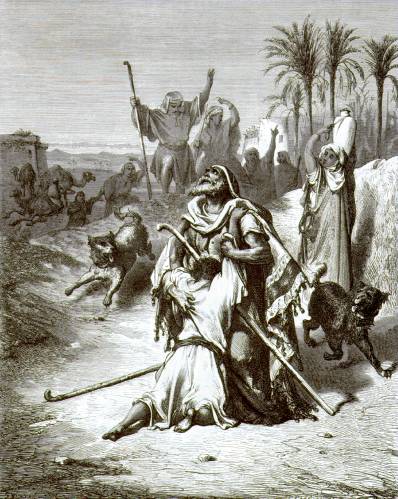
His father saw him far off and was filled with compassion, splanchnizomai, the verb Luke keeps for the deepest mercy. He ran to his son, which no dignified householder did, and the confession stops short of the hired-servant clause.
This site's exposition
was dead and is alive again
The father gives the reason for the feast in two pairs, dead and alive, lost and found. The second pair ties it to the sheep and coin. Adam Clarke notes that Greek writers used dead in this figurative sense, for a man lost to all good.
The record, by era
The Church Fathers5 voices
Then he shall get up, come to his father, and confess to him, "I have sinned against heaven and before you. I am no longer worthy to be called your son. Treat me like one of your hired servants."When he confesses like that, he will be considered worthy of more than that for which he prayed. His father neither takes him in like a hired servant nor treats him like a stranger. Oh no, he kisses him as a son. He accepts him as a dead man come back to life again.
(ubi sup.) Those banquets are now celebrated, the Church being enlarged and extended throughout the whole world. For that calf in our Lord's body and blood is both offered up to the Father, and feeds the whole house.
But that according to Luke, taking up [His] priestly character, commenced with Zacharias the priest offering sacrifice to God. For now was made ready the fatted calf, about to be immolated for the finding again of the younger son.
What is the object of the parable? Let us examine the occasion that led to it so we will learn the truth. The blessed Luke had said a little before of Christ the Savior of us all.… The Pharisees and scribes made this outcry at his gentleness and love to people. They wickedly and impiously blamed him for receiving and teaching people whose lives were impure. Christ very necessarily set before them the present parable. He clearly shows them that the God of all requires even him who is thoroughly steadfast, firm, holy, and has attained to the highest praise for sobriety of conduct to be earnest in following his will. When any are called to repentance, even if they have a bad reputation, he must rejoice rather and not give way to an unloving irritation because of them.
It is the opinion of some that the two sons signify the holy angels and us earth dwellers. The elder one, who lived soberly, represents the company of the holy angels, while the younger and prodigal son is the human race. Some among us give it a different explanation, arguing that the older and well-behaved son signifies Israel after the flesh. The other son, who chose to live in the lust of pleasures and moved far away from his father, depicts the company of the Gentiles.
14 more voices on this verse
The Church Fathers3 voices
(ut sup.) For the father himself rejoices in the return of his son, and feasts on the calf, because the Creator, rejoicing in the acquisition of a believing people, feasts on the fruit of His mercy by the sacrifice of His Son. Hence it follows, For this my son was dead, and is alive again.
Leaving those that have not strayed, the good Shepherd seeks you. If you will surrender yourself, he will not hold back. In his kindness, he will lift you up on his shoulders, rejoicing that he has found his sheep that was lost. The Father stands and awaits your return from your wandering. Only turn to him, and while you are still afar off, he will run and embrace your neck. With loving embraces, he will enfold you, now cleansed by your repentance.… He says, "Truly I say to you that there is joy in heaven before God over one sinner who repents." If any one of those who seem to stand will bring a charge that you have been quickly received, the good Father himself will answer for you. He will say, "It is fitting that we should celebrate and be glad, for this my daughter was dead and is come to life again. She was lost and is found."
Rightly the flesh of the calf, because it is the priestly victim which was offered for sin. But he introduces him feasting, when he says, Be merry; to show that the food of the Father is our salvation; the joy of the Father the redemption of our sins. He is dead who was. Therefore the Gentiles are not, the Christian is. Here however might be understood one individual of the human race; Adam was, and in him we all were. Adam perished, and in him we all have perished. Man then is restored in that Man who has died. It might also seem to be spoken of one working repentance, because he dies not who has not at one time lived. And the Gentiles indeed when they have believed are made alive again by grace. But he who has fallen recovers by repentance.
The Medieval Church4 voices
And they began to celebrate. These feasts and festivities are now celebrated, extended and spread throughout the world by the Church. For indeed that calf is offered in the body and blood of the Lord, both to the Father, and it feeds the whole household.
So then, everyone who repents and becomes a son of God, and especially one who is restored and generally cleansed from sin, partakes of this fatted Calf and becomes a cause of joy for the Father and His servants, the Angels and priests: "For he …
As then with respect to the condition of his sins, he had been despaired of; so in regard to human nature, which is changeable and can be turned from vice to virtue, he is said to be lost. For it is less to be lost than to die. But every one who is recalled and turned from sin, partaking of the fatted calf, becomes an occasion of joy to his father and his servants, that is, the angels and priests. Hence it follows, And they all began to be merry.
Secondly, as regards the consideration of the man who is saved, he adds: Because this my son was dead, through sin, which makes men dead: Psalm: "The dead shall not praise you, O Lord"; and again John 8: "You shall die in your sin." And …
The Puritans and the Awakening3 voices
They are sometimes ranked with harlots ( Matt. xxi. 32 ); here and elsewhere with sinners, such as were openly vicious, that traded with harlots, known rakes. Some think that the sinners here meant were heathen, and that Christ was now on the other side Jordan, or in Galilee of the Gentiles.
A sinner is not only dead in law, as he is under a sentence of death, but dead in state too, dead in trespasses and sins, destitute of spiritual life; no union with Christ, no spiritual senses exercised, no living to God, and therefore dead.
For this my son was dead,....
The Nineteenth Century4 voices
Was dead - Lost to all good - given up to all evil. In this figurative sense the word is used by the best Greek writers. See many examples in Kypke.
A commentator
J.C. Ryle1816–1900
Expository Thoughts on the Gospels: Luke (lightly modernized text, Grace Gems edition) (1858)
proposed
The parable before us is commonly known as the parable of "the prodigal son." It may be truly called a mighty spiritual picture. Unlike some of our Lord's parables, it does not convey to us one great lesson only, but many. Every part of it is particularly rich in instruction. We see, firstly, in this parable — a man following the natural bent of his own heart. Our Lord shows us a "younger son" making haste to go far away from a kind father's house, and "wasting his substance in riotous living."
A commentator
J.C. Ryle1816–1900
Expository Thoughts on the Gospels: Luke (lightly modernized text, Grace Gems edition) (1858)
proposed
The parable before us is commonly known as the parable of "the prodigal son." It may be truly called a mighty spiritual picture. Unlike some of our Lord's parables, it does not convey to us one great lesson only, but many. Every part of it is particularly rich in instruction. We see, firstly, in this parable — a man following the natural bent of his own heart. Our Lord shows us a "younger son" making haste to go far away from a kind father's house, and "wasting his substance in riotous living." We have in these words, a faithful portrait of the mind with which we are all born. This is our likeness. We are all naturally proud and self-willed. We have no pleasure in fellowship with God. We long to depart, and go afar away from Him. We spend our time, and strength, and faculties, and affections — on things that cannot profit. The covetous man does it in one way; the slave of lusts and passions in another way; and the lover of pleasure in another way. In one point alone are all agreed. Like sheep, we all naturally "go astray, and turn every one to his own way." (Isaiah 53:6.) In the younger son's initial conduct, we see the natural heart of every man. He who knows nothing of these things, has yet much to learn. He is spiritually blind. The eyes of his understanding need to be opened. The worst ignorance in the world, is not to know ourselves. Happy is he who has been delivered from the kingdom of darkness — and been made acquainted with himself! Of too many it may be said, "They know not, neither will they understand. They walk on in darkness." (Psalm 82:5.) We see, secondly, in this parable — man finding out by bitter experience, that the ways of sin are hard.
A commentator
Albert Barnes1798–1870
Notes, Explanatory and Practical, on the Old and New Testaments (1832-1869)
proposed
Was dead - This is capable of two significations: 1. “I supposed” that he was dead, but I know now that he is alive. 2. He was “dead to virtue” - he was sunk in pleasure and vice. The word is not unfrequently thus used. See 1Ti 5:6; Mat 8:22; Rom 6:13. Hence, to be restored to “virtue” is said to be restored again to life, Rom 6:13; Rev 3:1; Eph 2:1. It is probable that this latter is the meaning here. See Luk 15:32. Was lost - Had wandered away from home, and we knew not where he was.
The words behind it
16 Greek wordsEvery Greek word of this verse in the order it stands, with what it means and the door to its own study. The last column counts the times a word stands in the whole Bible: the rarer the word, the more the places it appears belong together.
| Greek | Sound | Meaning | Word study | In the Bible |
|---|---|---|---|---|
| ὅτι | hoti | For | G3754 → | 1292 times |
| οὗτος | houtos | this | G3778 → | 1381 times |
| ὁ | ho | the | G3588 → | 19766 times |
| υἱός | huios | son | G5207 → | 377 times |
| μου | mou | of mine | G3165 → | 1936 times |
| νεκρὸς | nekros | dead | G3498 → | 128 times |
| ἦν | en | was | G1510 → | 2333 times |
| καὶ | kai | and | G2532 → | 9120 times |
| ἀνέζησεν, | anezesen | is alive again, | G326 → | |
| ἦν | en | he was | G1510 → | 2333 times |
| ἀπολωλὼς | apololos | having been lost | G622 → | 90 times |
| καὶ | kai | and | G2532 → | 9120 times |
| εὑρέθη. | heurethe | is found. | G2147 → | 175 times |
| καὶ | kai | And | G2532 → | 9120 times |
| ἤρξαντο | erxanto | they began | G757 → | 85 times |
| εὐφραίνεσθαι.¶ | euphrainesthai | to be merry. | G2165 → | 14 times |
ὅτιFor
hotiG3754 →1292 times
οὗτοςthis
houtosG3778 →1381 times
ὁthe
hoG3588 →19766 times
υἱόςson
huiosG5207 →377 times
μουof mine
mouG3165 →1936 times
νεκρὸςdead
nekrosG3498 →128 times
ἦνwas
enG1510 →2333 times
καὶand
kaiG2532 →9120 times
ἀνέζησεν,is alive again,
anezesenG326 →
ἦνhe was
enG1510 →2333 times
ἀπολωλὼςhaving been lost
apololosG622 →90 times
καὶand
kaiG2532 →9120 times
εὑρέθη.is found.
heuretheG2147 →175 times
καὶAnd
kaiG2532 →9120 times
ἤρξαντοthey began
erxantoG757 →85 times
εὐφραίνεσθαι.¶to be merry.
euphrainesthaiG2165 →14 times
A shaded row is a word that stands 400 times or fewer in the Bible.
The walk
8 stopsEach card is a verse this one points to, and under it the verses that one points to in turn. Where several paths arrive at the same place, that place is listed first: the text keeps returning to it.
Through
Luke 19:10For the Son of Man came to seek and to save the lost.”
it leads to
- Ezekiel 34:16
I will seek the lost, bring back the strays, bind up the broken, and strengthen the weak; but the sleek and strong I will destroy. I will shepherd them with justice.’
Reached by 2 separate paths from here.
- Luke 15:4–7
“What man among you, if he has a hundred sheep and loses one of them, does not leave the ninety-nine in the pasture and go after the one that is lost, until he finds…
Reached by 2 separate paths from here.
- Matthew 1:21
She will give birth to a Son, and you are to give Him the name Jesus, because He will save His people from their sins.”
- 1 Timothy 1:13–16
I was formerly a blasphemer, a persecutor, and a violent man; yet because I had acted in ignorance and unbelief, I was shown mercy.
- Luke 5:31–32
Jesus answered, “It is not the healthy who need a doctor, but the sick.
- Ezekiel 34:16
Through
Luke 15:4“What man among you, if he has a hundred sheep and loses one of them, does not leave the ninety-nine in the pasture and go after the one that is lost, until he finds…
it leads to
- Luke 19:10
For the Son of Man came to seek and to save the lost.”
Reached by 2 separate paths from here.
- Luke 19:10
Through
Ephesians 2:5made us alive with Christ even when we were dead in our trespasses. It is by grace you have been saved!
it leads to
- Romans 3:24
and are justified freely by His grace through the redemption that is in Christ Jesus.
- Ephesians 2:8
For it is by grace you have been saved through faith, and this not from yourselves; it is the gift of God,
- Romans 3:24
Where this verse is studied
On this page
About Luke
This page draws on 19 works. Open the list of works
This page draws on Adam Clarke, Commentary on the Bible; Albert Barnes, Notes, Explanatory and Practical, on the Old and New Testaments (1832-1869); Alexander Maclaren, Expositions of Holy Scripture, Luke; Ambrose of Milan, Exposition of the Gospel of Luke; Ambrose of Milan, Catena Aurea by Aquinas; Athanasius of Alexandria, FESTAL LETTER 7; Augustine of Hippo, Catena Aurea by Aquinas; Basil of Caesarea, LETTER 46; Bede, On the Gospel of Luke; Bonaventure, Commentary on Luke, Chapter 15; Cyril of Alexandria, COMMENTARY ON LUKE, HOMILY 107; Irenaeus, Against Heresies Book III; J.C. Ryle, Expository Thoughts on the Gospels: Luke (lightly modernized text, Grace Gems edition); Jamieson, Fausset & Brown, Commentary Critical and Explanatory on the Whole Bible; John Chrysostom, Catena Aurea by Aquinas; John Gill, Exposition of the New Testament (1746-1748); Matthew Henry, Commentary on the Whole Bible; Theophylact of Ohrid, Commentary on Luke and Theophylact of Ohrid, Catena Aurea by Aquinas.