
Judges 16:15
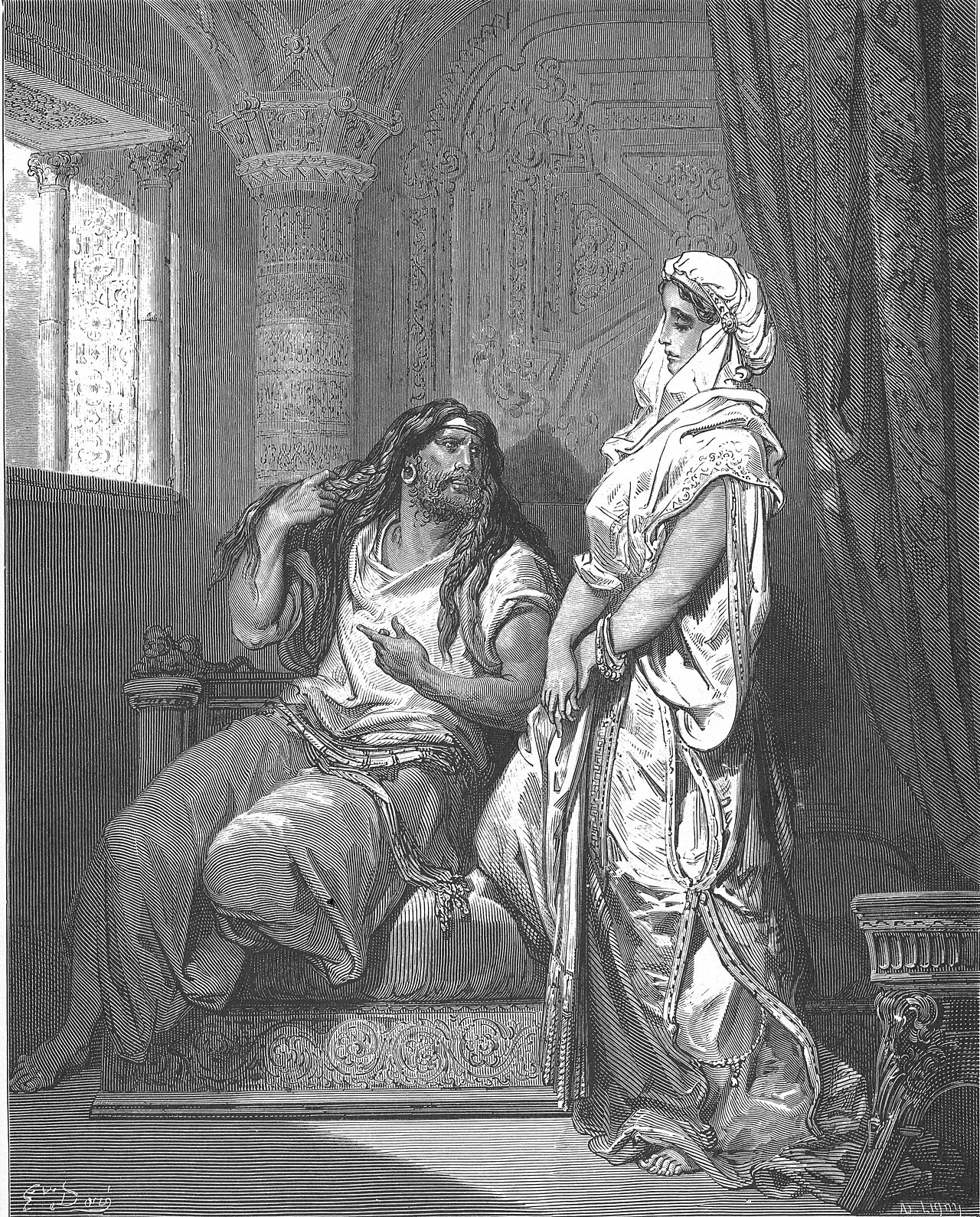
in Judges 16“How can you say, ‘I love you,’” she asked, “when your heart is not with me? This is the third time you have mocked me and failed to reveal to me the source of your great strength!”
BSB
The same verse in ASV and KJV ▾
ASV
And she said unto him, How canst thou say, I love thee, when thy heart is not with me? thou hast mocked me these three times, and hast not told me wherein thy great strength lieth.
KJV
And she said unto him, How canst thou say, I love thee, when thine heart is not with me? thou hast mocked me these three times, and hast not told me wherein thy great strength lieth.
⋯
This verse in Judges 16
Commentary
8 notes on this verseThis site's exposition
your heart is not with me
on Judges 16:15-17
Her complaint that his “heart is not with me” repeats the one made at 14:16, and so does the pressure. The text gives one reason he spoke, that she pleaded “until he was sick to death”. Verse 17 is the one place Samson calls himself “a Nazirite to God”, and he recites the vow's terms correctly in the act of giving them away.
The record, by era
The Church Fathers5 voices
Is that, then, Samson who broke ropes twisted with thongs, and new cords like weak threads? Is that Samson who did not feel the bonds of his hair fastened to the beam, so long as he had the grace of the Spirit? He, I say, after the Spirit of God departed from him, was greatly changed from that Samson Who returned clothed in the spoils of the aliens, but fallen from his greatness on the knees of a woman, caressed and deceived, is shorn of his hair. Was, then, the hair of his head of such importance that, so long as it remained, his strength should endure unconquered, but when his head was shorn the man should suddenly lose all his strength? It is not so, nor may we think that the hair of his head has such power. There is the hair of religion and faith; the hair of the Nazarite perfect in the Law, consecrated in sparingness and abstinence, with which she (a type of the Church), who poured ointment on the feet of the Lord, wiped the feet of the heavenly Word, for then she knew Christ also after the flesh. That hair it is of which it is said: "Thy hair is as flocks of goats," growing on that head of which it is said: "The head of the man is Christ," and in another place: "His head is as fine gold, and his locks like black pine-trees." And so, also, in the Gospel our Lord, pointing out that some hairs are seen and known, says: "But even the hairs of your head are all numbered," implying, indeed, acts of spiritual virtues, for God does not take care for our hair. Though, indeed, it is not absurd to believe that literally, seeing that according to His divine Majesty nothing can be hidden from Him. But what does it profit me, if God Himself knows all my hairs? That rather abounds and profits me, if the watchful witness of good works reward me with the gift of eternal life. […]
He was faced with a third battle: he had lost everything he had, that is, his inheritance with his sons; his flesh was enduring wounds; he remained to conquer the temptations of words. No ordinary battle. Adam was deceived by speech, Samson was overcome by words. For nothing penetrates the soul like deceitful speech, and nothing bites as hard as harsh words. Many, after overcoming physical torment, could not endure the harshness of words. Job suffered, but endured, and carried the burden of wounds alongside the burden of words. His agonothetes saw him struggling in the cloud and whirlwind and gave him a helping hand, and declared that those struggling had fallen with a heavy fall, but he declared himself the victor and brought back the crown.
Like the famed Samson, whose power lay in the strength of his hair, whose locks were endowed with sacred might, he must throttle and bring low the lion by means of the strong arms of prayers and pluck the sweet fruit of notable victory from …
But last of all the wanton woman complaining that she had been so often deceived, and grieving that her lover deemed her unworthy to be entrusted with his secret, and that under her pretext of succour her treacherous purpose was suspected, won his confidence by her tears. By this means, and because also it was ordained that this man of hitherto unshaken fortitude should fall into calamity, Samson was touched and opened to her his heart.
What was the meaning of Samson? If I say he signified Christ, it seems to me that I speak the truth. However, the thought immediately occurs to anyone who reflects: Was Christ overcome by the flattery of a woman? How is Christ understood to have …
2 more voices on this verse
The Puritans and the Awakening2 voices
): How canst thou say, I love thee, when they heart is not with me? That is, "when thou canst not trust me with the counsels of they heart?" Passionate lovers cannot bear to have their love called in question; they would do any thing rather than their sincerity should be suspected.
quarantine:debris (2026-07-29) — leading-punctuation+unbalanced-parens
And she said unto him, how canst thou say, I love thee, when thine heart is not with me?....
How the passage was read
What the Jewish commentators add
On the verses either side of this one
And goaded him. She oppressed him. There is no similar word.
This section is reception history: how the passage was read and kept in the Jewish tradition. Where a reading parts from an essential of the Christian faith, the section says so at that point.
Texts and citation data: Sefaria; each excerpt follows its version’s licence. 5 further sources are cited on this chapter that carry no English text this site may quote or only restate the verse.
The words behind it
19 Hebrew wordsEvery Hebrew word of this verse in the order it stands, with what it means and the door to its own study. The last column counts the times a word stands in the whole Bible: the rarer the word, the more the places it appears belong together.
| Hebrew | Sound | Meaning | Word study | In the Bible |
|---|---|---|---|---|
| וַתֹּ֣אמֶר | vatomer | and she said | H559 → | 5305 times |
| אֵלָ֗יו | ʾelav | to him | H413 → | 5510 times |
| אֵ֚יךְ | ʾeikh | how? | H349 → | |
| תֹּאמַ֣ר | tomar | will you say | H559 → | 5305 times |
| אֲהַבְתִּ֔יךְ | ʾahavtikh | I love you | H157 → | 211 times |
| וְלִבְּךָ֖ | velibekha | and heart your | H3820 → | 595 times |
| אֵ֣ין | ʾein | not | H369 → | 789 times |
| אִתִּ֑י | ʾiti | [is] with me | H854 → | 929 times |
| זֶ֣ה | zeh | this | H2088 → | 1180 times |
| שָׁלֹ֤שׁ | shalosh | three | H7969 → | 432 times |
| פְּעָמִים֙ | peamim | times | H6471 → | 118 times |
| הֵתַ֣לְתָּ | hetalta | you have deceived | H2048 → | 10 times |
| בִּ֔י | bi | <in> <the> me | ||
| וְלֹא־ | velo'- | and not | H3808 → | 5168 times |
| הִגַּ֣דְתָּ | higadta | you have told | H5046 → | 370 times |
| לִּ֔י | li | to <the> me | ||
| בַּמֶּ֖ה | bameh | <in> how? | H4100 → | 752 times |
| כֹּחֲךָ֥ | kochakha | [is] strength your | H3581 → | 126 times |
| גָדֽוֹל׃ | gadol | great | H1419 → | 526 times |
וַתֹּ֣אמֶרand she said
vatomerH559 →5305 times
אֵלָ֗יוto him
ʾelavH413 →5510 times
אֵ֚יךְhow?
ʾeikhH349 →
תֹּאמַ֣רwill you say
tomarH559 →5305 times
אֲהַבְתִּ֔יךְI love you
ʾahavtikhH157 →211 times
וְלִבְּךָ֖and heart your
velibekhaH3820 →595 times
אֵ֣יןnot
ʾeinH369 →789 times
אִתִּ֑י[is] with me
ʾitiH854 →929 times
זֶ֣הthis
zehH2088 →1180 times
שָׁלֹ֤שׁthree
shaloshH7969 →432 times
פְּעָמִים֙times
peamimH6471 →118 times
הֵתַ֣לְתָּyou have deceived
hetaltaH2048 →10 times
בִּ֔י<in> <the> me
bi
וְלֹא־and not
velo'-H3808 →5168 times
הִגַּ֣דְתָּyou have told
higadtaH5046 →370 times
לִּ֔יto <the> me
li
בַּמֶּ֖ה<in> how?
bamehH4100 →752 times
כֹּחֲךָ֥[is] strength your
kochakhaH3581 →126 times
גָדֽוֹל׃great
gadolH1419 →526 times
A shaded row is a word that stands 400 times or fewer in the Bible.
The walk
8 stopsEach card is a verse this one points to, and under it the verses that one points to in turn. Where several paths arrive at the same place, that place is listed first: the text keeps returning to it.
Through
John 15:10If you keep My commandments, you will remain in My love, just as I have kept My Father’s commandments and remain in His love.
it leads to
- John 14:15
If you love Me, you will keep My commandments.
- 1 John 5:3
For this is the love of God, that we keep His commandments. And His commandments are not burdensome,
- 1 John 3:21–24
Beloved, if our hearts do not condemn us, we have confidence before God,
- 1 John 2:5
But if anyone keeps His word, the love of God has been truly perfected in him. By this we know that we are in Him:
- John 14:15
Through
Proverbs 23:26My son, give me your heart, and let your eyes delight in my ways.
it leads to
- Psalms 119:2
Blessed are those who keep His testimonies and seek Him with all their heart.
- Psalms 119:9–11
How can a young man keep his way pure? By guarding it according to Your word.
- Deuteronomy 6:5
And you shall love the LORD your God with all your heart and with all your soul and with all your strength.
- Matthew 10:37–38
Anyone who loves his father or mother more than Me is not worthy of Me; anyone who loves his son or daughter more than Me is not worthy of Me;
- Psalms 119:2
About Judges
This page draws on Ambrose of Milan, On the Holy Spirit 2, Introduction 13-16; Ambrose of Milan, The Prayer of Job and David 2.3.8; Ambrose of Milan, Letter 19; Caesarius of Arles, SERMON 118.3; John Gill, Exposition of the Old Testament (1748-1763); Keil and Delitzsch, Biblical Commentary on the Old Testament: Joshua, Judges, Ruth; Matthew Henry, Commentary on the Whole Bible and Paulinus of Nola, POEM 24.529-581.