
2 Kings 4:30
in 2 Kings 4And the mother of the boy said, “As surely as the LORD lives and as you yourself live, I will not leave you.” So he got up and followed her.
BSB
The same verse in ASV and KJV ▾
ASV
And the mother of the child said, As Jehovah liveth, and as thy soul liveth, I will not leave thee. And he arose, and followed her.
KJV
And the mother of the child said, As the Lord liveth, and as thy soul liveth, I will not leave thee. And he arose, and followed her.
⋯
This verse in 2 Kings 4
Commentary
8 notes on this verseI will not leave thee - The prophet it seems had no design to accompany her; he intended to wait for Gehazi’s return; but as the woman was well assured the child was dead, she was determined not to return till she brought the prophet with her.
This site's exposition
As the Lord liveth, and
on 2 Kings 4:30-31
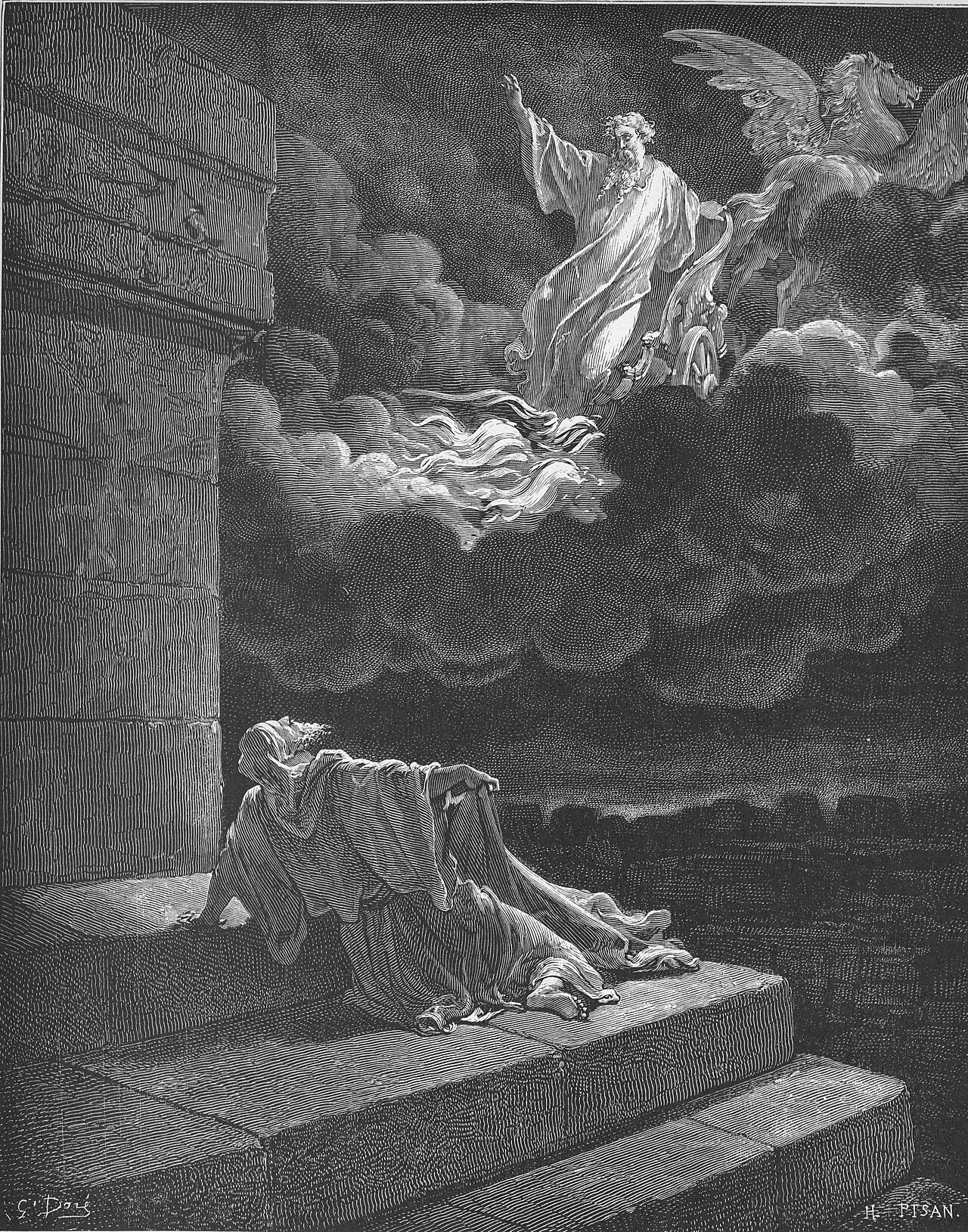
The woman's oath, as the Lord liveth, and as thy soul liveth, I will not leave thee, is the identical formula Elisha himself swore three times to Elijah before the whirlwind (2 Ki 2:2, 2:4, 2:6), and now the man who spoke it as disciple hears it spoken to him as master. Gehazi's staff accomplishes nothing, neither voice, nor hearing, and he returns to report a silence the object itself could not break. The chapter has already shown that its miracles happen at shut doors and by prayer, never by proxy.
The record, by era
The Church Fathers1 voice
"Then the mother of the child said, 'As the Lord lives, and as you yourself live, I will not leave without you.' " Now, since Elisha had stayed at home and had sent his disciple, the mother of the [dead] child pressed him to aid …
The Medieval Church1 voice
Therefore fear had no power to raise us from the death of sin, but the infused grace of meekness erected us to the seat of life. Which is well denoted by Elisha when he raised the child of the Shunamite.
The Puritans and the Awakening3 voices
): I will not leave thee. She had no great expectation from the staff, she would have the hand, and she was in the right of it. Perhaps God intended hereby to teach us not to put that confidence in creatures, that are servants, which the power of the Creator, their Master and ours, will alone bear the weight of.
quarantine:debris (2026-07-29) — leading-punctuation+unbalanced-parens
Will not leave thee - Until thou goest home with me. For she had no great confidence in Gehazi, nor was her faith so strong as to think that the prophet could work so great a miracle at this distance.
And the mother of the child said,.... Having no faith in what the servant was to do, or could do: as the Lord liveth, and as thy soul liveth, I will not leave thee; signifying she would not go with his servant, but insisted upon it that he himself went with her, or she would not depart: and he arose, and followed her; influenced by her importunity, and a sense of favours he had received from her, and more especially by the Spirit of God.
1 more voice on this verse
The Nineteenth Century1 voice
A commentator
Jamieson, Fausset & Brown1802–1910
Commentary Critical and Explanatory on the Whole Bible (1871)
The act of Gehazi was allowed to fail, in order to free the Shunammite, and the people of Israel at large, of the superstitious notion of supposing a miraculous virtue resided in any person, or in any rod, and to prove that it was only through earnest prayer and faith in the power of God and for His glory that this and every miracle was to be performed.
The words behind it
12 Hebrew wordsEvery Hebrew word of this verse in the order it stands, with what it means and the door to its own study. The last column counts the times a word stands in the whole Bible: the rarer the word, the more the places it appears belong together.
| Hebrew | Sound | Meaning | Word study | In the Bible |
|---|---|---|---|---|
| וַתֹּ֙אמֶר֙ | vatomer | and she said | H559 → | 5305 times |
| אֵ֣ם | ʾem | [the] mother of | H517 → | 220 times |
| הַנַּ֔עַר | hanaar | the lad | H5288 → | 239 times |
| חַי־ | chai- | [by] [the] life | H2416 → | 498 times |
| יְהוָ֥ה | yahweh | of Yahweh | H3068 → | 6520 times |
| וְחֵֽי־ | vechei- | and [by] [the] life of | H2416 → | 498 times |
| נַפְשְׁךָ֖ | nafshekha | self your | H5315 → | 754 times |
| אִם־ | ʾim- | if | H518 → | 1069 times |
| אֶעֶזְבֶ֑ךָּ | ʾeezveka | I will leave you | H5800 → | 215 times |
| וַיָּ֖קָם | vaiyakom | and he arose | H6965 → | 628 times |
| וַיֵּ֥לֶךְ | vaiyelekh | and he went | H1980 → | 1546 times |
| אַחֲרֶֽיהָ׃ | ʾachareiha | after her | H310 → | 715 times |
וַתֹּ֙אמֶר֙and she said
vatomerH559 →5305 times
אֵ֣ם[the] mother of
ʾemH517 →220 times
הַנַּ֔עַרthe lad
hanaarH5288 →239 times
חַי־[by] [the] life
chai-H2416 →498 times
יְהוָ֥הof Yahweh
yahwehH3068 →6520 times
וְחֵֽי־and [by] [the] life of
vechei-H2416 →498 times
נַפְשְׁךָ֖self your
nafshekhaH5315 →754 times
אִם־if
ʾim-H518 →1069 times
אֶעֶזְבֶ֑ךָּI will leave you
ʾeezvekaH5800 →215 times
וַיָּ֖קָםand he arose
vaiyakomH6965 →628 times
וַיֵּ֥לֶךְand he went
vaiyelekhH1980 →1546 times
אַחֲרֶֽיהָ׃after her
ʾachareihaH310 →715 times
A shaded row is a word that stands 400 times or fewer in the Bible.
The walk
8 stopsEach card is a verse this one points to, and under it the verses that one points to in turn. Where several paths arrive at the same place, that place is listed first: the text keeps returning to it.
Through
2 Kings 2:4And Elijah said to Elisha, “Please stay here, for the LORD has sent me on to Jericho.” But Elisha replied, “As surely as the LORD lives and as you yourself live, I will not…
it leads to
- 2 Kings 2:2
and Elijah said to Elisha, “Please stay here, for the LORD has sent me on to Bethel.” But Elisha replied, “As surely as the LORD lives and as you yourself live, I will not…
- Joshua 6:26
At that time Joshua invoked this solemn oath: “Cursed before the LORD is the man who rises up and rebuilds this city, Jericho; at the cost of his firstborn he will lay its foundations;…
- 1 Kings 16:34
In Ahab’s days, Hiel the Bethelite rebuilt Jericho. At the cost of Abiram his firstborn he laid its foundation, and at the cost of Segub his youngest he set up its gates, according to…
- 2 Kings 2:2
Through
2 Kings 2:2and Elijah said to Elisha, “Please stay here, for the LORD has sent me on to Bethel.” But Elisha replied, “As surely as the LORD lives and as you yourself live, I will not…
it leads to
- 2 Kings 2:6
And Elijah said to Elisha, “Please stay here, for the LORD has sent me on to the Jordan.” But Elisha replied, “As surely as the LORD lives and as you yourself live, I will…
- Ruth 1:15–18
“Look,” said Naomi, “your sister-in-law has gone back to her people and her gods; follow her back home.”
- John 6:67–68
So Jesus asked the Twelve, “Do you want to leave too?”
- 1 Samuel 1:26
“Please, my lord,” said Hannah, “as surely as you live, my lord, I am the woman who stood here beside you praying to the LORD.
- 2 Samuel 15:19–21
Then the king said to Ittai the Gittite, “Why should you also go with us? Go back and stay with the new king, since you are both a foreigner and an exile from your…
- 2 Kings 2:6
Where this verse is studied
On this page
About 2 Kings
This page draws on 9 works. Open the list of works
This page draws on Adam Clarke, Commentary on the Bible; Ephrem the Syrian, ON THE SECOND BOOK OF KINGS 4:30-35; Gregory the Dialogist, Morals on the Book of Job, Book 9; Jamieson, Fausset & Brown, Commentary Critical and Explanatory on the Whole Bible; John Gill, Exposition of the Old Testament; John Gill, Exposition of the Old Testament (1748-1763); John Wesley, Explanatory Notes upon the Old Testament; Keil, The Books of the Kings and Matthew Henry, Commentary on the Whole Bible.