
Zechariahchapter 6
15 verses · Zechariah · 520 to 518 BC · The Twelve
And you are to tell him that this is what the LORD of Hosts says: ‘Here is a man whose name is the Branch, and He will branch out from His place and build the temple of the LORD.
Introduction
Zechariah, The Twelve, Zechariah Overview.
This chapter closes the night of visions and then records a sign Zechariah was told to act out by day. His hearers had a governor from David's line who could never be king and a high priest who could never wear a crown. The chapter speaks into that gap under the eye of the Persian empire. Listen for how the last vision answers the first one in chapter 1. Listen also for the metals brought from Babylon, whose head receives the crown, and where the crown is kept afterward.
Context
- Who
- A people under an empire that would never let them crown a king
- What
- A vision of four chariots going out to the four winds, then a crown of silver and gold set on the head of Joshua the high priest as a sign of the Branch who will build the temple of the LORD.
- Where
- Jerusalem, at the house of Josiah son of Zephaniah, where exiles newly arrived from Babylon had come.
- When
- The night of 15 February 519 BC for the vision; the crowning follows it and carries no date of its own.
- Why
- To show that God rules the whole earth and to promise a figure who would join the offices of priest and king.
Historical context
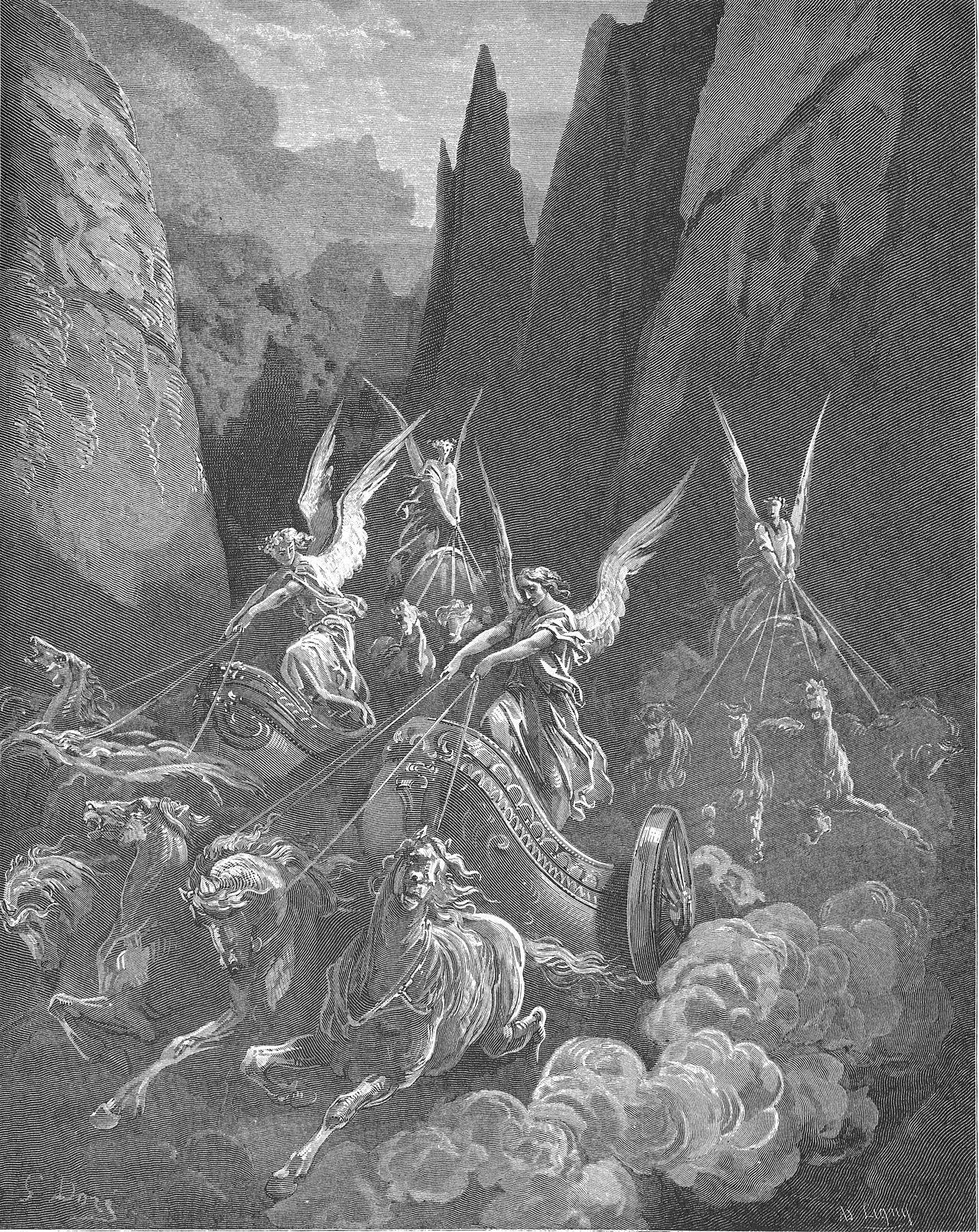
The night ends where it started, with horses. Four chariots come out from between two bronze mountains and go to patrol the earth, the same idea as the first vision, but now with chariots instead of scouts, and with a result: the ones going north "have quieted my spirit in the north country." The north was where Babylon had come from.
Show the rest of the historical context, 5 more paragraphs
Then the vision stops and something physical happens. Silver and gold are taken from men newly arrived from Babylon, a crown is made, and it is set on the head of Joshua the high priest.
That is startling, and it was meant to be. In Israel the crown and the priesthood were separate offices in separate families, kings from Judah, priests from Levi, and kings who reached for priestly work were punished for it. Here a priest is crowned and told, "he shall be a priest upon his throne: and the counsel of peace shall be between them both."
The name given to the figure is BRANCH again, and he is the one who "shall build the temple of the LORD", said while a temple was being built by other hands.
The crown is then kept in the temple as a memorial. It was not a coronation of Joshua; it was a sign hung up where people could see it. Persia would never have tolerated an actual king in Jerusalem, and Zerubbabel, the Davidic heir, is not the one crowned.
The chapter ends with an open door: they that are far off shall come and build in the temple of the LORD.
Significance
The returnees had a governor who could not be king and a priest who could not be royal, and no prospect of independence. This sign told them both offices would one day sit in one person, and put the crown in the sanctuary as a receipt.
Show the rest of the significance, 1 more paragraph
The last line was conditional and personal: this shall come to pass if you will diligently obey the voice of the LORD your God. The promise was firm; their share in it was not automatic.
This chapter in Jewish lifeWhat this chapter is in Jewish life and reading.
What is done
The site's own table in src/lib/hebraic/readings.ts, probed for this lane, printed no weekly portion and no Haftarah from this chapter, and no festival reading for the book. That table carries the Haftarah of each of the fifty-four weekly portions and the books read whole at the feasts. It carries nothing for the special Sabbaths, the festival days or the fast days, so this card names no public reading of chapter 6 and leaves that question to a source that holds those readings.
How it is read
Rashi is the one commentator on this chapter whose English the corpus carries. He is quoted from The Judaica Press complete Tanach with Rashi, translated by A. J. Rosenberg, which Sefaria reports as CC-BY, and every quotation is held to fifty words or fewer.
Rashi reads the four chariots as the four kingdoms. They are messengers sent "to give ruling power to the four kingdoms of Babylon, Media, Greece, and Edom" (Rashi on Zechariah 6:1:1). The colours follow. The red horses are Babylon (Rashi on Zechariah 6:2:1). The black are Media, which "blackened the faces of Israel in the days of Haman" (Rashi on Zechariah 6:2:2). The white are Persia, which built the Temple (Rashi on Zechariah 6:3:1). The spotted are Greece, and the ash-coloured that ask to walk the whole earth are the kingdom of Edom (Rashi on Zechariah 6:3:2 and 6:7:2).
The crowning of Joshua draws the chapter's sharpest reading. Rashi takes the Shoot as Zerubbabel and names the other view beside his own. "Some interpret this as referring to the King Messiah, but the entire context deals with the [time of the] Second Temple" (Rashi on Zechariah 6:12:1). Here Rashi records a reading and rejects it himself.
The crowns themselves he reads as a memorial. He calls the fourteenth verse transposed, and says the crowns hung in the Temple for those who gave the silver and the gold. They hung "in the windows in the height of the Temple", as tractate Middot records (Rashi on Zechariah 6:14:1).
The corpus carries 6 further notes on this chapter without an English text, each marked linked because Sefaria holds no English version of the ref. They stand cited and unquoted here. Ibn Ezra on Zechariah is cited at 6:1:1, 6:4:1, 6:9:1 and 6:11:1. Radak on Zechariah is cited at 6:4:1 and 6:9:1.
What the rabbis say
The corpus carries 19 rabbinic locators on this chapter and the text of none, so each is cited and linked here and none is quoted. The verse numbers are the corpus's own.
At 6:1 it holds Aggadat Bereshit 48:1, Aggadat Bereshit 68:1 and Midrash Tanchuma, Tazria 9:1. It also holds Midrash Tannaim on Deuteronomy 32:22:5, Midrash Tannaim on Deuteronomy 32:9:22 and Shemot Rabbah 15:4 there. It also holds Sifrei Devarim 320:13 and Yalkut Shimoni on Torah 945:16 there. At 6:5 it holds Yalkut Shimoni on Torah 942:29. At 6:12 it holds Bamidbar Rabbah 18:21, Eikhah Rabbah 1:51 and Jerusalem Talmud Berakhot 2:4:12.
It also holds Midrash Mishlei 19:3, Midrash Tanchuma, Korach 12:1 and Otzar Midrashim, Chuppah of Eliyahu, Chuppat Eliyahu Rabbah 228 there. It also holds Pirkei DeRabbi Eliezer 30:12, Pirkei DeRabbi Eliezer 48:17 and Pirkei DeRabbi Eliezer 51:7 there. It also holds Yalkut Shimoni on Torah 64:1 there.
What each of them teaches is a saying of the rabbis, and is reported as theirs wherever this site quotes one. The quotations wait on a fetch that carries the text.
Sources: Rashi, Rashi on Zechariah 6:1:1 to 6:14:1, The Judaica Press complete Tanach with Rashi, translated by A. J. Rosenberg, reported CC-BY; Ibn Ezra, Ibn Ezra on Zechariah 6:1:1, 6:4:1, 6:9:1 and 6:11:1, cited by ref because the corpus carries no text it may quote; Radak, Radak on Zechariah 6:4:1 and 6:9:1, cited by ref because the corpus carries no text it may quote; The Sefaria corpus, scripts/data/sources/sefaria/zechariah/6.json, the 19 Talmud and Midrash locators of this chapter; The site's own files, src/lib/hebraic/readings.ts, probed for this lane through haftarahUsesForChapter("zechariah", 6) and festivalReadingForBook("zechariah").
The heads below are this chapter's scenes. The numbered points under each are its verses.
Four chariots out from between two mountains of brass
Zechariah 6:1-3
The last night vision closes the series where it began in chapter 1, with colored horses. Now they draw “four chariots coming out from between two mountains”, and the mountains are “mountains of bronze”. The teams are red, black, white and “dappled horses”, “all of them strong”.
Zechariah 6:1
“Behold, four chariots going forth - Alb.: “By the secret disposal of God into the theater of the world,” “from between two mountains of brass.” Both Jews and Christians have seen that the four chariots relate to the same four empires, as the visions in Daniel. “The two mountains.” It may be that the imagery is from the two mountains on either side of the valley of Jehoshaphat, which Joel had spoken of as the place of God’s judgment, Joe 3:2, and Zechariah afterward Zec 14:4. It may then picture that the judgments go forth from God.”
2 more voices on this verseWhat preachers and commentators have said about this verse, in their own words.
Zechariah 6:1
“Four chariots - Angels who are sometimes styled chariots of God. These as employed in the affairs of church and empire, act their part in the revolution and changes of things, 'till the gospel be preached by the Messiah, and the apostles.”
John Wesley · Explanatory Notes upon the Old Testament (1765)evangelical
Zechariah 6:1
“HENDERSON explains them to be the Medo-Persian kingdom, represented by the "two horns" (Da 8:3, 4), now employed to execute God's purpose in punishing the nations; but the prophecy reaches far beyond those times.”
Jamieson, Fausset & Brown · Commentary Critical and Explanatory on the Whole Bible (1871)reformed
The first chariot had red horses: Clarke read each colour as an empire in turn. The red horses were the Chaldeans who overthrew Assyria, and the black horses the Persians under Cyrus who overthrew the Chaldeans. Wesley took the chariots as angels, and Barnes linked them with the four empires of Daniel.
Zechariah 6:2
“In the first chariot were red horses - The empire of the Chaldeans, which overthrew the empire of the Assyrians. The second chariot black horses - The empire of the Persians founded by Cyrus, which destroyed the empire of the Chaldeans.”
Adam Clarke · Commentary on the Bible (1810-1826)evangelical
Clarke took the white horses as the Greeks under Alexander and the dappled horses as Rome or the divided Greek kingdoms. The Berean “all of them strong” follows the sense Jamieson, Fausset and Brown preferred for the horses. Calvin dismissed reading the chariots as the four Gospels.
Zechariah 6:3
“The third chariot white horses - The empire of the Greeks, founded by Alexander the Great, which destroyed the empire of the Persians. The fourth chariot grisled and bay horses - That is party-coloured horses, or with horses, some grisled and some bay. The empire of the Romans or of the Greeks. The Greeks divided after the death of Alexander; one part pointing out the Lagidae, who attacked and subdued Egypt; and the other, the seleucidae, who subdued Syria under Seleucus.”
Adam Clarke · Commentary on the Bible (1810-1826)evangelical
2 more voices on this verse
Zechariah 6:3
“But as the vision is obscure, interpreters have given it different meanings. They who think that the four Gospels are designated by the four chariots, give a very frigid view. I have elsewhere reminded you, that we are to avoid these futile refinements which of themselves vanish away.”
John Calvin · Commentaries (1554)reformed
Zechariah 6:3
“All four dispensations, though various in character to the Gentile nation, portended alike good to God's people. bay--rather, "strong" or "fleet"; so Vulgate [GESENIUS]. The horses have this epithet, whose part it was to "walk to and fro through the earth" (Zec 6:7). However, the Septuagint and Chaldee agree with English Version in referring the Hebrew to color, not strength.”
Jamieson, Fausset & Brown · Commentary Critical and Explanatory on the Whole Bible (1871)reformed
Zechariah 6:4-5
I inquired of the angel who was speaking with me: The angel answers plainly this time: “These are the four spirits of heaven, going forth from their station before the Lord of all the earth”. Henry sets the chariots beside the seven eyes of chapter four, sent out now to the four quarters of the earth.
Zechariah 6:4
“Then I answered and said unto the angel that talked with me,.... After he had seen the chariots come out, and had observed the different colours of the horses in them: what are these, my lord? that is, what do they signify? what is the meaning of this vision?”
the four spirits of heaven: Barnes took the four spirits as angels who stand before God as his servants, like the sons of God in Job 1:6. Wesley saw them resting in heaven until sent and returning when their work is done. The same Hebrew word can mean winds.
Zechariah 6:5
“These are - The angels of heaven, who have a great share in the management of the affairs both of the church and states. Of the heavens - Which reside in heaven, 'till employed, go thence when employed, and having done their work, return thither.”
John Wesley · Explanatory Notes upon the Old Testament (1765)evangelical
1 more voice on this verse
Zechariah 6:5
“The various providences of God concerning nations and churches are represented by the different colours of horses, Rev. vi. And so we may observe here, 1. That the counsels and decrees of God are the spring and original of all events, and they are immovable, as mountains of brass.”
Matthew Henry · Commentary on the Whole Bible (1707-1721)puritan
Zechariah 6:6-8
The one with the black horses: The black horses go “toward the land of the north”, the white “toward the west”, and the dappled “toward the south”. The north is Babylon's direction, and the LORD says those going there “have given rest to My Spirit in the land of the north”.
Zechariah 6:6
“The black horses - This refers to the second chariot; of the first the angel makes no mention, because the empire designed by it had ceased to exist. This had red horses, to show the cruelty of the Chaldeans towards the Jews, and the carnage they committed in the land of Judea. The black - Cyrus, at the head of the Persians and Medes, bringing devastation and death among the Chaldeans, called the north in many parts of Scripture. The white - Alexander, who was splendid in his victories, and mild towards all that he conquered.”
Adam Clarke · Commentary on the Bible (1810-1826)evangelical
3 more voices on this verse
Zechariah 6:6
“Such are God's dealings with his church and people: if the black horses go forth, the white ones presently go after them; for as affliction abounds consolation much more abounds. That the common general aspect of providence is mixed and compounded.”
Matthew Henry · Commentary on the Whole Bible (1707-1721)puritan
Zechariah 6:6
“Rather, I think, the white are sent to victoriously subdue Medo-Persia, the second world kingdom, lying in the same quarter as Babylon, namely, north. grizzled . . . toward the south--that is, to Egypt, the other great foe of God's people. It, being a part of the Græco-Macedonian kingdom, stands for the whole of it, the third world kingdom.”
Jamieson, Fausset & Brown · Commentary Critical and Explanatory on the Whole Bible (1871)reformed
Zechariah 6:6
“The grisled - The angels signified by these, managed the Roman power, which was sometimes favourable, sometimes fierce and severe, to those they had to do with. The south-country - Egypt and Arabia, which lay south of Judea. It may perhaps point at their invading Africa too, whose punishments were mixed, with kindness and mercy more than the punishments of Babylon were.”
John Wesley · Explanatory Notes upon the Old Testament (1765)evangelical
they were eager to go and patrol the earth: Barnes matched the strong horses to the reach of their commission, to go and patrol the whole earth unhindered. He saw that reach in Rome, which held the east and the west of the earth together. Wesley heard Christ giving the command to go.
Zechariah 6:7
“And the strong went forth and sought to go, that they might walk to and fro through the earth - The mention of their strength corresponds to the extent of the power and commission, for which they asked, to go to and fro, up and down, at their will, unhindered, through the whole earth. The Babylonian empire held Egypt only out of Asia; the Persian was conquered in its efforts against Europe, in Greece; Alexander’s was like a meteor, gleaming but breaking into the four: the Roman combined East and West and within large limits tranquilly.”
1 more voice on this verse
Zechariah 6:7
“Sought to go - Waited for a commission. He said - Christ who hath all power in heaven and on earth. Through the earth - Thro' the rest of the kingdoms of the world remote from Judea, but not remote from God's wise and sovereign providence.”
John Wesley · Explanatory Notes upon the Old Testament (1765)evangelical
those going to the land of the north: Clarke read the land of the north as Chaldea, and the rest as God's judgment carried out on it by Cyrus and later by Alexander. Jamieson, Fausset and Brown noted that Babylon alone of the four kingdoms had been punished by Zechariah's day. God's anger rested there first.
Zechariah 6:8
“Have quieted my spirit in the north country - They have fulfilled my judgments on Assyria and Chaldea. Nabopolassar and Cyrus first, against the Assyrians and Chaldeans; and Alexander next, against the Persians. On this vision Abp. Newcome remarks: - The black horses seem to denote the Persian empire; which, by subduing the Chaldeans, and being about to inflict a second heavy chastisement on Babylon, quieted God’s spirit with respect to Chaldea; a country always spoken of as lying to the north of the Jews. The white horses seem to be the Macedonian empire; which, like the Persian, overcame Chaldea.”
Adam Clarke · Commentary on the Bible (1810-1826)evangelical
2 more voices on this verse
Zechariah 6:8
“Cried he - Christ spake aloud, and called to him. Quieted my spirit - By doing what I appointed them in revenge of my peoples injuries, and by bringing my people back into Canaan.”
John Wesley · Explanatory Notes upon the Old Testament (1765)evangelical
Zechariah 6:8
“Babylon alone of the four great world kingdoms had in Zechariah's time been finally punished; therefore, in its case alone does God now say His anger is satisfied; the others had as yet to expiate their sin; the fourth has still to do so. The double crown is placed on Joshua's head, symbolizing that the true priesthood and the kingdom shall be conferred on the one Messiah.”
Jamieson, Fausset & Brown · Commentary Critical and Explanatory on the Whole Bible (1871)reformed
A crown for Joshua, and the man whose name is the BRANCH
Zechariah 6:9-11
The word of the LORD also came to me: The visions end and an acted sign begins. Zechariah takes an offering from Heldai, Tobijah and Jedaiah, and sets “an ornate crown” on the head of “the high priest, Joshua”. Gill sets the sign in the line of Jeremiah's yoke and Ezekiel's baggage, plain objects that fix a prophet's word.
Zechariah 6:9
“And the word of the Lord came unto me, saying. Either "the word of prophecy from the Lord", as the Targum paraphrases it; the visions being ended, the prophetic part of the book begins; and many excellent prophecies concerning the Messiah, and his kingdom, are contained in this and the following chapters: or an order from the Lord, which is expressed in the next verses Zec 6:10.”
1 more voice on this verse
Zechariah 6:9
“And the word of the Lord came to me - The visions being closed, Zechariah marks the change by adopting the usual formula, with which the prophets authenticated, that they spake not of themselves, but by the Spirit of God. The act enjoined is a symbolic act, pointing and summing up and interpreting the visions, as some of the visions had been already expanded by fresh revelations following immediately upon them.”
Jamieson, Fausset and Brown gave the meanings of the names: Heldai is strong, Tobijah the goodness of God, and Jedaiah God knows. Heldai appears as Helem in verse 14. Clarke took the three as bearers of silver and gold for the temple, and Josiah as a craftsman in precious metal.
Zechariah 6:10
“Take of them of the captivity - The names that follow were probably those to whom the silver and golden vessels of the temple were intrusted; and who might have had bullion of silver and gold, for particular purposes, about the ornaments of the temple. The house of Josiah - Probably an artificer in silver, gold, etc.”
Adam Clarke · Commentary on the Bible (1810-1826)evangelical
make an ornate crown: The Hebrew word is plural, and Wesley took it as two crowns, one of silver and one of gold. Barnes read it as a single royal crown, a word never used of the high priest's turban. A king's crown rests on a priest's head.
Zechariah 6:11
“Make crowns - One of silver, the other of gold. Set them - Put both of them, one after another. Joshua - Who herein is now a type of Christ, king and priest forever for his people.”
John Wesley · Explanatory Notes upon the Old Testament (1765)evangelical
1 more voice on this verse
Zechariah 6:11
“And make crowns - Or a “crown” , as in Job, “I would bind it as a crown unto me,” and our Lord is seen in the Revelation, “on His Head were many crowns” . The singular is used of “a royal crown” , apparently of a festive crown ; and figuratively; (Job 19:9, (plur. Job 31:36) Pro 4:9; Pro 12:4; Pro 14:24; Pro 16:31. Pro 17:6); even of Almighty God Himself as a crown ; but no where of the mitre of the high priest.”
Zechariah 6:12-13
The word over Joshua names “a man whose name is the Branch”, the title Isaiah and Jeremiah give the righteous shoot of David's line. This Branch will build the temple, rule on His throne and “be a priest on His throne”, joining offices the law kept apart.
Zechariah 6:12
“Behold the man whose name is The Branch! - I cannot think that Zerubbabel is here intended; indeed, he is not so much as mentioned in Zec 3:8. Joshua and his companions are called אנשי מופת anshey mopheth, figurative or typical men; the crowning therefore of Joshua in this place, and calling him the Branch, was most probably in reference to that glorious person, the Messiah, of whom he was the type or figure. The Chaldee has, “whose name is my Messiah,” or Christ.”
Adam Clarke · Commentary on the Bible (1810-1826)evangelical
2 more voices on this verse
Zechariah 6:12
“Out of his place - Of the tribe and family, and in the place foretold. He shall build - He it is, though unseen, that stands by you, who build the material temple, far inferior to the spiritual temple, which Christ will build, preserve, and dwell in forever. The glory - Of both kingly and priestly office; the glory of both those crowns shall abide on him.”
John Wesley · Explanatory Notes upon the Old Testament (1765)evangelical
Zechariah 6:12
“Therefore God helps the city, producing in it early morning by his own rising and coming. "Behold a man," it is said, "the Orient is his name." For those upon whom the spiritual light will rise, when the darkness that comes from ignorance and wickedness is destroyed, early morning will be at hand. Since, then, light has come into the world in order that he who walks about in it may not stumble, his help is able to cause the early morning.”
Basil of Caesarea · written before 379 · Homilies on the Psalms 45:18.5patristic
He will be a priest on His throne: Barnes stressed the repeated He, so the one who builds the temple is the one clothed in splendor. Henry wrote that glory is a weight, and that Christ carried both the cross and the crown. Priest and king share one throne.
Zechariah 6:13
“LET us first look at the historical setting of this passage. It would seem that three Jews of the captivity had come from Babylon with a contribution towards the building of the temple at Jerusalem under Zerubbabel and Joshua. Their names are given in the 10th verse of the chapter before us. Now, the Jews at Jerusalem had become exceedingly exclusive and, in some measure, rightly so. They would not accept help for the building of the Temple from Samaritans because they were a mixed race.”
1 more voice on this verse
Zechariah 6:13
“That Christ shall bear the glory. Glory is a burden, but not too heavy for him to bear who upholds all things. The cross was his glory, and he bore that; so was the crown an exceeding weight of glory, and he bears that.”
Matthew Henry · Commentary on the Whole Bible (1707-1721)puritan
Zechariah 6:14-15
The crown will reside in the temple: The crown stays “in the temple of the LORD as a memorial” to the men who brought the offering. The visions close on the hope that “those far away will come and build the temple”. That hope holds only “if you diligently obey the voice of the LORD your God”.
Zechariah 6:14
“And the crowns shall be - One of my MSS. has אטרות ataroth, crowns, corrected into עטרת atereth, crown; and so the Septuagint, Syriac, and Arabic. The Chaldee has, “And praise shall be,” etc. The meaning appears to be this, that the crown made for Joshua should be delivered to the persons mentioned here and in Zec 6:10, to be laid up in the temple of the Lord, as a memorial of this typical transaction.”
Adam Clarke · Commentary on the Bible (1810-1826)evangelical
2 more voices on this verse
Zechariah 6:14
“The crowns - The two crowns before mentioned. Helem - These persons we know no more of than their names. A memorial - Of the Messiah's certain and speedy coming.”
John Wesley · Explanatory Notes upon the Old Testament (1765)evangelical
Zechariah 6:14
“Either they were laid up in the temple treasury or (as the Jews' tradition is) they were hung up in the windows of the temple, in the view of all, in perpetuam rei memoriam--for a perpetual memorial, for a traditional evidence of the promise of the Messiah and this typical transaction used for the confirmation of that promise.”
Matthew Henry · Commentary on the Whole Bible (1707-1721)puritan
Even those far away will come: Barnes saw the exiles who came from Babylon with gifts as a picture of the Gentiles, the far off of Ephesians 2:13. Wesley gave the verse two references, the rebuilt temple and the bringing in of the Gentiles. Jamieson, Fausset and Brown tied its fulfilment to obedience.
Zechariah 6:15
“The completion of the temple shall "come to pass," if ye diligently on your part "obey the Lord." It is not meant that their unbelief could set aside God's gracious purpose as to Messiah's coming. But there is, secondarily, meant, that Messiah's glory as priest-king of Israel shall not be manifested to the Jews till they turn to Him with obedient penitence.”
Jamieson, Fausset & Brown · Commentary Critical and Explanatory on the Whole Bible (1871)reformed
2 more voices on this verse
Zechariah 6:15
“That promise, that those that were afar off should come and assist them in building the temple of the Lord, was as it were the giving of them a sign; by this they might be assured that the other promises should be fulfilled in due time.”
Matthew Henry · Commentary on the Whole Bible (1707-1721)puritan
Zechariah 6:15
“They that are far off - This verse hath a double reference, one to the Jews, and the building of the material temple, the other to the bringing in of the Gentiles.”
John Wesley · Explanatory Notes upon the Old Testament (1765)evangelical
Keep studying
Studies7
Places1
Sources for this chapter
The summary
Jamieson, Fausset & Brown, Commentary Critical and Explanatory; John Calvin, Commentaries; John Wesley, Notes on the Old Testament and Matthew Henry, Complete Commentary.
The exposition
Adam Clarke, Commentary on the Bible; Albert Barnes; Carl Friedrich Keil, The Twelve Minor Prophets; Edward Bouverie Pusey, The Minor Prophets: A Commentary; Jamieson, Fausset & Brown, Commentary Critical and Explanatory on the Whole Bible; John Calvin; John Gill, Exposition of the Old Testament; John Wesley, Explanatory Notes upon the Old Testament and Matthew Henry, Commentary on the Whole Bible.