
Zechariah 6:2
in Zechariah 6The first chariot had red horses, the second black horses,
BSB
The same verse in ASV and KJV ▾
ASV
In the first chariot were red horses; and in the second chariot black horses;
KJV
In the first chariot were red horses; and in the second chariot black horses;
⋯
This verse in Zechariah 6
Commentary
5 notes on this verseIn the first chariot were red horses - The empire of the Chaldeans, which overthrew the empire of the Assyrians. The second chariot black horses - The empire of the Persians founded by Cyrus, which destroyed the empire of the Chaldeans.
This site's exposition
there came four chariots out from between two mountains
on Zechariah 6:1-3
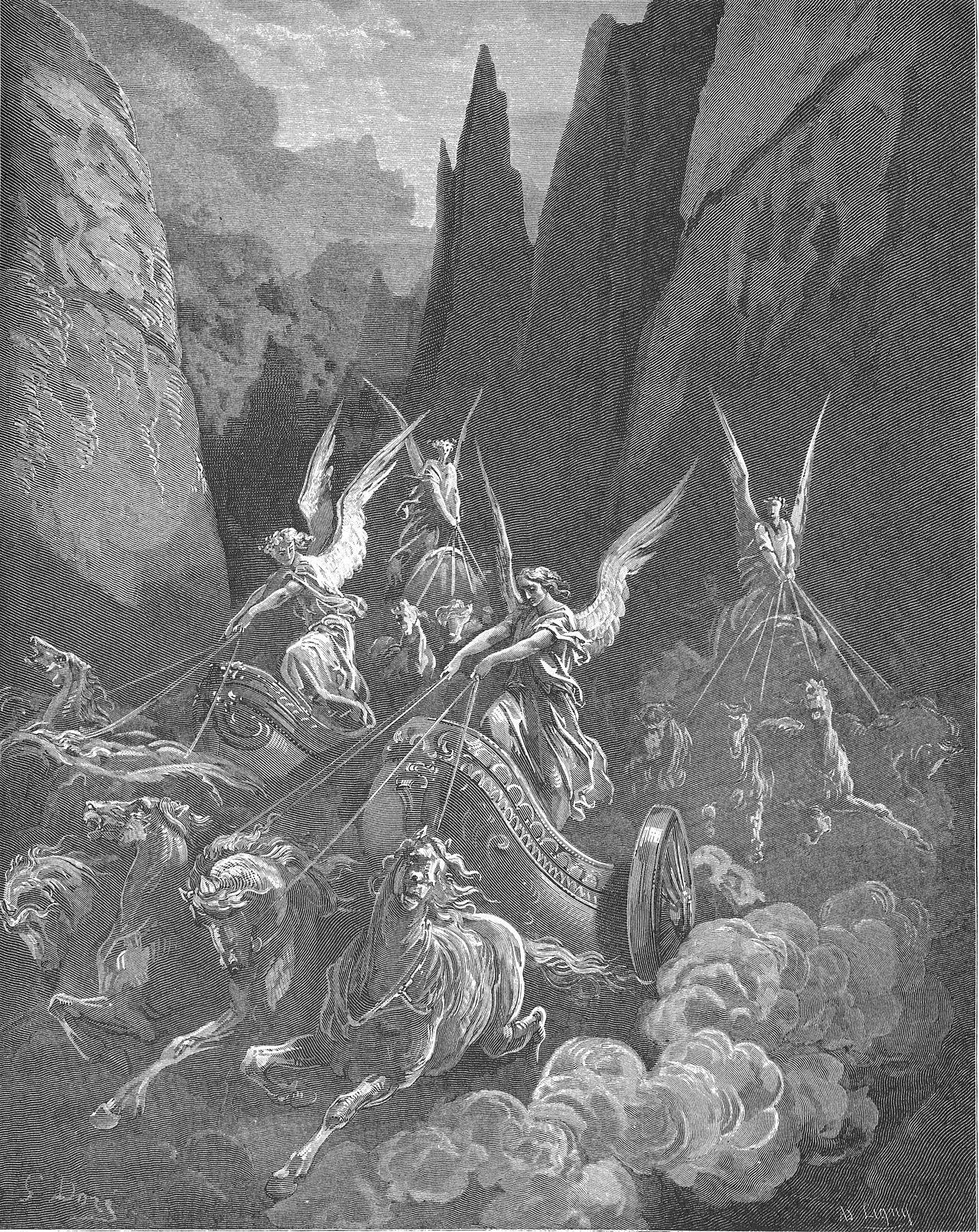
The last night vision closes the series where it began, with chariots rather than a single horseman, four of them coming out from between two mountains of brass, each drawn by horses of a different color, red, black, white, and grisled with bay. Keil reads the bronze mountains as the fixed gate of heaven's own decree, the place from which God's providence issues out over the whole earth, and the four colors as the same range of judgment and peace the first vision's four horses already carried in chapter one.
The record, by era
The Puritans and the Awakening2 voices
In the first chariot were red horses,....
He did not look long before he discovered that which was worth seeing, and which would serve very much for the encouraging of himself and his friends in this dark day. We are very much in the dark concerning the meaning of this vision.
The Nineteenth Century1 voice
A commentator
Albert Barnes1798–1870
Notes, Explanatory and Practical, on the Old and New Testaments (1832-1869)
proposed
The symbol is different from that in the first vision. There Zec 1:8, they were horses only, with their riders, to go to and fro to enquire; here they are war-chariots with their horses, to execute God’s judgments, each in their turn. In the first vision also, there is not the characteristic fourfold division, which reminds of the four world-empires of Daniel Dan. 2; after which, in both prophets, is the mention of the kingdom of Christ. Even if the grisled horses be the same as the speckled of the first vision, the black horses are wanting there, as well as the succession, in which they go forth. The only resemblance is, that there are horses of divers colors, two of which, red and white, are the same. The symbol of the fourth empire, grizzled, strong, remarkably corresponds with the strength and mingled character of the fourth empire in Daniel.
The words behind it
8 Hebrew wordsEvery Hebrew word of this verse in the order it stands, with what it means and the door to its own study. The last column counts the times a word stands in the whole Bible: the rarer the word, the more the places it appears belong together.
| Hebrew | Sound | Meaning | Word study | In the Bible |
|---|---|---|---|---|
| בַּמֶּרְכָּבָ֥ה | bamerkavah | [were] with the chariot | H4818 → | 44 times |
| הָרִֽאשֹׁנָ֖ה | harishonah | <the> first | H7223 → | 182 times |
| סוּסִ֣ים | susim | horses | H5483 → | 140 times |
| אֲדֻמִּ֑ים | ʾadumim | red | H122 → | 9 times |
| וּבַמֶּרְכָּבָ֥ה | uvamerkavah | and [were] with the chariot | H4818 → | 44 times |
| הַשֵּׁנִ֖ית | hashenit | <the> second | H8145 → | 156 times |
| סוּסִ֥ים | susim | horses | H5483 → | 140 times |
| שְׁחֹרִֽים׃ | shechorim | black | H7838 → |
בַּמֶּרְכָּבָ֥ה[were] with the chariot
bamerkavahH4818 →44 times
הָרִֽאשֹׁנָ֖ה<the> first
harishonahH7223 →182 times
סוּסִ֣יםhorses
susimH5483 →140 times
אֲדֻמִּ֑יםred
ʾadumimH122 →9 times
וּבַמֶּרְכָּבָ֥הand [were] with the chariot
uvamerkavahH4818 →44 times
הַשֵּׁנִ֖ית<the> second
hashenitH8145 →156 times
סוּסִ֥יםhorses
susimH5483 →140 times
שְׁחֹרִֽים׃black
shechorimH7838 →
A shaded row is a word that stands 400 times or fewer in the Bible.
The walk
8 stopsEach card is a verse this one points to, and under it the verses that one points to in turn. Where several paths arrive at the same place, that place is listed first: the text keeps returning to it.
Through
Revelation 17:3And the angel carried me away in the Spirit into a wilderness, where I saw a woman sitting on a scarlet beast that was covered with blasphemous names and had seven heads and ten…
it leads to
- Revelation 12:3
Then another sign appeared in heaven: a huge red dragon with seven heads, ten horns, and seven royal crowns on his heads.
- Revelation 13:1–6
Then I saw a beast with ten horns and seven heads rising out of the sea. There were ten royal crowns on its horns and blasphemous names on its heads.
- Revelation 12:3
Through
Revelation 12:3Then another sign appeared in heaven: a huge red dragon with seven heads, ten horns, and seven royal crowns on his heads.
it leads to
- Revelation 17:12
The ten horns you saw are ten kings who have not yet received a kingdom, but will receive one hour of authority as kings, along with the beast.
- Revelation 12:9
And the great dragon was hurled down—that ancient serpent called the devil and Satan, the deceiver of the whole world. He was hurled to the earth, and his angels with him.
- Daniel 7:24
And the ten horns are ten kings who will rise from this kingdom. After them another king, different from the earlier ones, will rise and subdue three kings.
- Daniel 7:20
I also wanted to know about the ten horns on its head and the other horn that came up, before which three of them fell—the horn whose appearance was more imposing than the others,…
- Revelation 17:16
And the ten horns and the beast that you saw will hate the prostitute. They will leave her desolate and naked, and will eat her flesh and burn her with fire.
- Revelation 17:12
Through
Zechariah 1:8I looked out into the night and saw a man riding on a red horse. He was standing among the myrtle trees in the hollow, and behind him were red, sorrel, and white horses.
it leads to
- Revelation 6:4
Then another horse went forth. It was bright red, and its rider was granted permission to take away peace from the earth and to make men slay one another. And he was given a…
- Revelation 6:4
Where this verse is studied
On this page
Studies4
About Zechariah
This page draws on Adam Clarke, Commentary on the Bible; Albert Barnes, Notes, Explanatory and Practical, on the Old and New Testaments (1832-1869); Carl Friedrich Keil, The Twelve Minor Prophets; John Gill, Exposition of the Old Testament; John Gill, Exposition of the Old Testament (1748-1763) and Matthew Henry, Commentary on the Whole Bible.