
Romanschapter 3
31 verses · Paul · AD 56 or 57 · Paul's letters
God presented Him as the atoning sacrifice through faith in His blood, in order to demonstrate His righteousness, because in His forbearance He had passed over the sins committed beforehand.
Introduction
Paul, Paul's letters, Romans Overview.
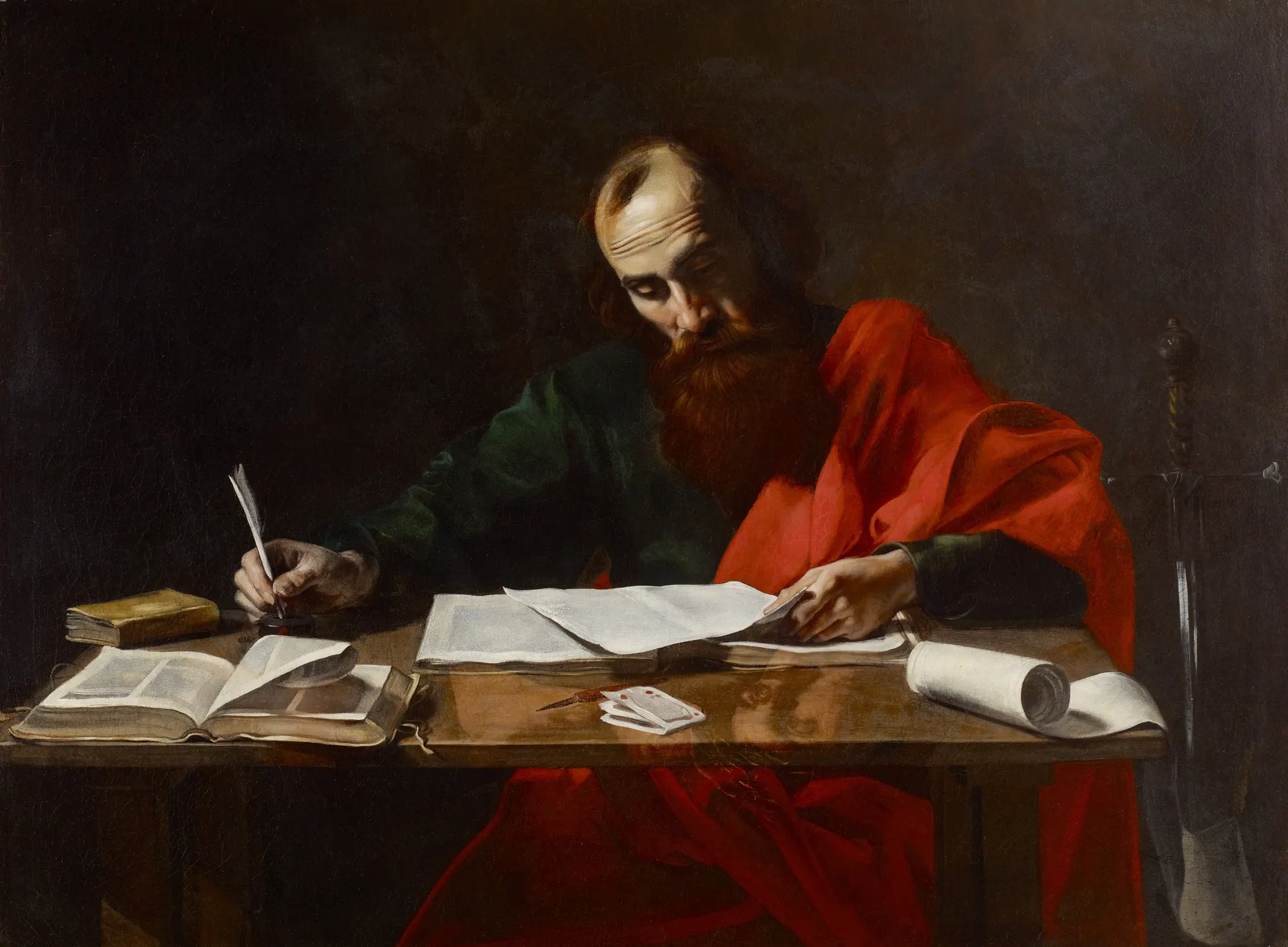
Paul wrote this letter from Corinth about AD 57 to house churches in Rome where Jews and Gentiles worshiped together. Both groups had reasons to rank themselves above the other. This chapter is the hinge of the letter's opening argument, where the long charge ends and the answer begins. Listen for the short questions and the sharp refusals in its first half, as Paul hears the objections before anyone raises them. Then listen for the chain of lines from the Psalms and the prophets, and for the turn that follows. Read it slowly, for much of the letter rests on it.
Context
- Who
- House churches in Rome holding Jews and Gentiles together, needing to know that neither group entered on better terms.
- What
- The answer to a Jewish objector, a chain of Scripture showing that all are under sin, and the statement that God's righteousness comes through faith in Jesus Christ.
- Where
- Written from Corinth to the house churches in Rome.
- When
- About AD 57, early in the reign of Nero, while Paul was at Corinth.
- Why
- To silence every claim to stand before God by the law, and to show that God justifies Jew and Gentile alike through faith.
Historical context
The chain of Scripture quotations in the middle of the chapter is drawn mostly from the Psalms and Isaiah, strung together the way Jewish teachers argued, a series of texts on a theme, expected to be recognized rather than looked up. None is invented for the occasion.
Show the rest of the historical context, 2 more paragraphs
The image Paul reaches for at the turning point is the mercy seat: the gold lid of the ark in the innermost room of the sanctuary, where blood was sprinkled once a year on the Day of Atonement. To anyone who knew the temple, saying that God publicly set Jesus forth as that place of atonement moved the holiest hidden thing in Israel out into the open street.
The word translated "redemption" came from the world of slavery and captivity, where a price bought a person's freedom. Rome was full of freedmen who had been bought out, and many of the believers in these house churches were slaves or former slaves. The metaphor was not abstract to them.
Significance
The first hearers were being handed the letter's central claim: a righteousness from God, apart from law, for all who believe, because there is no distinction, all have sinned.
Show the rest of the significance, 1 more paragraph
The practical result lands in the last lines. If everyone is justified as a gift, then boasting is excluded, and the God of the Jews is the God of the Gentiles too. Two groups who had every social reason to rank themselves were left with nothing to rank.
The heads below are this chapter's scenes. The numbered points under each are its verses.
What Advantage Then Hath the Jew?
Romans 3:1-2
the advantage of being a Jew?: Chapter 2 seemed to leave Israel with nothing, so Paul asks what the advantage is. The answer is much in every way. The first advantage named is stewardship: Israel was entrusted with the very words of God.
Romans 3:1
“What advantage then hath the Jew?.... If he is not properly a Jew, who is born of Jewish parents, and brought up in the customs, rites, and religion of the Jewish nation, but anyone of whatsoever nation, that is born again of water, and of the Spirit; where is the superior excellency of the Jew to the Gentile?”
entrusted with the very words of God: Chrysostom marks what Paul counts here: God's gifts to the Jews, and none of their own merits. The first advantage is the very words of God. Wesley finds the rest at Romans 9:4 and 5.
Romans 3:2
“For what if some did not believe?--It is the unbelief of the great body of the nation which the apostle points at; but as it sufficed for his argument to put the supposition thus gently, he uses this word "some" to soften prejudice. shall their unbelief make the faith of God--or, "faithfulness of God." of none effect?--"nullify," "invalidate" it.”
Jamieson, Fausset & Brown · Commentary Critical and Explanatory on the Whole Bible (1871)reformed
2 more voices on this verse
Romans 3:2
“Chiefly in that they were intrusted with the oracles of God - The scriptures, in which are so great and precious promises. Other prerogatives will follow, chap. ix, 4-5. St. Paul here singles out this by which, after removing the objection, he will convict them so much the more.”
John Wesley · Explanatory Notes upon the New Testament (1755)evangelical
Romans 3:2
“In this Epistle Paul, sitting as a kind of arbiter between the Jews and the Greeks — that is, those who believe from among the Gentiles — so summons and invites both to faith in Christ that he neither gives offense to the Jews by utterly destroying the Jewish rites, nor casts the Gentiles into despair by confirming the observance of the law and the letter; and whether he makes mention of the promises or of the punishments, he divides his word to each people.”
Origen of Alexandria · written before 253 · Commentary on the Epistle to the Romanspatristic
Romans 3:3-4
What if some did not have faith?: Israel's own history raised the objection: some did not have faith, and the question is whether that cancels God's faithfulness. Paul answers with the first of the chapter's flat refusals. God is true and every man a liar, and verse 4 quotes Psalm 51:4.
Romans 3:3
“The oracles of God, therefore, were entrusted to those first ones of whom we spoke above; but some, as he says, did not believe, whether God or the oracles of God. You see that those who do not believe are themselves according to the flesh, of whom he says also elsewhere: "The natural man does not perceive the things which are of the Spirit of God; for it is foolishness to him." But their unbelief does not make void the faith of God.”
Origen of Alexandria · written before 253 · Commentary on the Epistle to the Romanspatristic
3 more voices on this verse
Romans 3:3
“For what if some did not believe? - This is to be regarded as another objection of a Jew. “What then? or what follows? if it be admitted that some of the nation did not believe, does it not follow that the faithfulness of God in his promises will fail?” The points of the objection are these: (1) The apostle had maintained that the nation was sinful Rom. 2; that is, that they had not obeyed or believed God. (2) This, the objector for the time admits or supposes in relation to some of them.”
Romans 3:3
“He had said that the universal guilt and corruption of mankind gave occasion to the manifestation of God's righteousness in Jesus Christ. Now it may be suggested, If all our sin be so far from overthrowing God's honour that it commends it, and his ends are secured, so that there is no harm done, is it not unjust for God to punish our sin and unbelief so severely?”
Matthew Henry · Commentary on the Whole Bible (1707-1721)puritan
Romans 3:3
“THE seed of Israel had great privileges even before the coming of Christ. God had promised by Covenant that they should have those privileges and they enjoyed them. They had Revelation and a Divine Light, while all the rest of the world sat in heathen darkness. Yet so many Jews did not believe, that, as a whole, the nation missed the promised blessing. A great multitude of them only saw the outward symbols and never understood their spiritual meaning. They lived and died without the blessing promised to their fathers. Did this make the Covenant of God to be void?”
Charles Spurgeon · written before 1892 · The Metropolitan Tabernacle Pulpit, Sermon No. 2255: “God Justified, Though Man Believes Not” (lightly modernized text, CCEL edition)Particular Baptist
Let God be true and every man a liar: Certainly not is a flat refusal, and it returns at verses 6 and 31. In Psalm 51:4 David says it while confessing his own sin. Augustine turns the line into hope: a man is a liar in himself and true in God.
Romans 3:4
“But, it may be farther objected, if our unrighteousness be subservient to God's glory, is it not unjust in him to punish us for it? I speak as a man - As human weakness would be apt to speak.”
John Wesley · Explanatory Notes upon the New Testament (1755)evangelical
Cross references
Romans 3:4
- QuotingPsalms 51:4“Against You, You only, have I sinned and done what is evil in Your sight, so that You may be proved right when You speak and blameless when You judge.”
'That thou mightest be justified in thy sayings' (God true, every man a liar)
Romans 3:5-6
if our unrighteousness highlights the righteousness of God: The objection presses further: if human unrighteousness highlights the righteousness of God, then punishing that sin would look unjust. Paul marks it as a man's argument and refuses it. A judge who could be unjust could never judge the world, which verse 6 gives as the answer.
Romans 3:5
"But if our iniquity commends the justice of God, what shall we say? Is God unjust, who inflicts wrath? I speak according to man. God forbid. Otherwise, how shall God judge this world? For if the truth of God has abounded through my lie unto his glory, why am I also still judged as a sinner? and not (as we are blasphemed, and as some affirm that we say) let us do evil that good may come? whose condemnation is just."
Origen of Alexandria · written before 253 · Commentary on the Epistle to the Romanspatristic
1 more voice on this verse
Romans 3:5
“But if our unrighteousness - If our sin. The particular sin which had been specified Rom 3:3 was “unbelief.” But the apostle here gives the objection a general form. This is to be regarded as an objection which a Jew might make. The force of it is this: (1) It had been conceded that some had not believed; that is, had sinned. (2) But God was true to his promises. Notwithstanding their sin, God’s character was the same.”
how could God judge the world?: Matthew Henry hears Abraham's question in Genesis 18:25, whether the Judge of all the earth will do what is right. Wesley draws out the logic: if sin that served God's glory went unpunished, all sin would escape, and no one could be judged.
Romans 3:6
“But as to what he says: "Otherwise how shall God judge the world," in this passage by "world" he means the men who are in this world, just as we read elsewhere, "that the whole world lies in the evil one"; which surely shows that the men who dwell in this world are set in wickedness.”
Origen of Alexandria · written before 253 · Commentary on the Epistle to the Romanspatristic
2 more voices on this verse
Romans 3:6
"Let God be true, and every man a liar" (Ro 3:4); and as many advocates of salvation by grace as say, "Let us do evil that good may come," "their damnation is just" (Ro 3:8). THAT THE JEW IS SHUT UP UNDER LIKE CONDEMNATION WITH THE GENTILE IS PROVED BY HIS OWN SCRIPTURE.
Jamieson, Fausset & Brown · Commentary Critical and Explanatory on the Whole Bible (1871)reformed
Romans 3:6
“The argument is much the same with that of Abraham ( Gen. xviii. 25 ): Shall not the Judge of all the earth do right? If he were not infinitely just and righteous, he would be unfit to be the judge of all the earth.”
Matthew Henry · Commentary on the Whole Bible (1707-1721)puritan
Romans 3:7-8
why am I still condemned as a sinner?: Verse 7 puts the same objection in the first person, where it becomes an excuse any sinner could offer. Verse 8 shows the slander already in circulation, that Paul taught men to do evil so good would come. He pronounces sentence on it, and their condemnation is deserved.
Romans 3:7
“Daring sinners take occasion to boast in mischief, because the goodness of God endures continually, Ps. lii. Let us do evil that good may come is oftener in the heart than in the mouth of sinners, so justifying themselves in their wicked ways.”
Matthew Henry · Commentary on the Whole Bible (1707-1721)puritan
Chrysostom traces the slander to Paul's teaching that grace abounds where sin abounds, a line opponents turned into ridicule. Wesley takes it as a flat ban on doing any evil so that good may result. Chapter 6 answers the charge at length.
Romans 3:8
Whose condemnation is just - The condemnation of all who either speak or act in this manner. So the apostle absolutely denies the lawfulness of " doing evil," any evil, "that good may come."
John Wesley · Explanatory Notes upon the New Testament (1755)evangelical
1 more voice on this verse
Romans 3:8
“These men, even as the Gentiles, have been sent forth by Satan to bring dishonour upon the Church, so that, in one way or another, men hearing the things which they speak, and imagining that we all are such as they, may turn away their ears from the preaching of the truth; or, again, seeing the things they practise, may speak evil of us all, who have in fact no fellowship with them, either in doctrine or in morals, or in our daily conduct.”
Irenaeus · written before 202 · Against Heresies Book Ipatristic
There Is None Righteous, No, Not One
Jews and Greeks alike are all under sin: Verse 9 shuts the last door. Jews and Greeks alike stand under sin, and the charge of chapters 1 and 2 is summed in one line. The Greek is hypo hamartian, under sin, which names a power a man is held beneath.
Romans 3:10-12
The verdict now comes from Scripture itself. Three lines open the chain: no one righteous, no one who understands, and no one seeking God. All have turned away and together become worthless, and the denial has reached desire as well as deed.
Romans 3:10
For this reason, then, Paul says it is written: “Because there is none righteous; there is none that understands, there is none that seeks after God: all have turned aside, together they have become unprofitable”; just as elsewhere the Prophet says: “For in your sight shall no living person be justified.” And this may perhaps seem contrary to other Scriptures, which bear witness to some as though they were righteous — so much so that it is even said to Jerusalem concerning Sodom that “Sodom has been justified more than you.”
Origen of Alexandria · written before 253 · Commentary on the Epistle to the Romanspatristic
2 more voices on this verse
Romans 3:10
“As it is written - See Psa 14:1-3; from which this and the two following verses are taken. There is none righteous - This is true, not only of the Jews, but of the Gentiles; of every soul of man, considered in his natural and practical state, previously to his receiving the mercy of our Lord Jesus Christ. There is no righteous principle in them, and, consequently, no righteous act can be expected from them; see on Rom 3:12 (note).”
Adam Clarke · Commentary on the Bible (1810-1826)evangelical
Romans 3:10
“As it is written - That all men are under sin appears from the vices which have raged in all ages. St. Paul therefore rightly cites David and Isaiah, though they spoke primarily of their own age, and expressed what manner of men God sees, when he "looks down from heaven;" not what he makes them by his grace. There is none righteous - This is the general proposition.”
John Wesley · Explanatory Notes upon the New Testament (1755)evangelical
Cross references
Romans 3:10
- QuotingPsalms 14:1“The fool says in his heart, “There is no God.” They are corrupt; their acts are vile. There is no one who does good.”
'There is none righteous, no, not one', head of Paul's catena of universal sin
ConnectionsPsalms 14:1
no one who seeks God: The line comes from Psalm 14:2, where God looks down from heaven to see whether any man understands and seeks Him. Matthew Henry calls the want of understanding folly. Seeking God is the first thing missing.
Romans 3:11
“Religion and righteousness have so much reason on their side that if people had but any understanding they would be better and do better. But they do not understand. Sinners are fools. [3.] None that seeketh after God, that is,none that has any regard to God, any desire after him.”
Matthew Henry · Commentary on the Whole Bible (1707-1721)puritan
1 more voice on this verse
Romans 3:11
“There is none that understandeth - In the Hebrew Psa 14:2, God is represented as looking down from heaven to see, that is, to make investigation, whether there were any that understood or sought after him. This circumstance gives not only high poetic beauty to the passage, but deep solemnity and awfulness. God, the searcher of hearts, is represented as making investigation on this very point. He looks down from heaven for this very purpose, to ascertain whether there were any righteous.”
All have turned away: Origen presses the verb: only a man who once stood on the right way could have turned away from it. Theodore of Mopsuestia sees David's words as a fair summary of Paul's own day. Matthew Henry adds that those who forsake God soon become worthless.
Romans 3:12
“All have turned aside, together they have become useless.” It seems to me that he is not said to have turned aside except one who at some time stood on the straight road. From this it appears that that first work of rational nature, which was made by God, was upright, and was set upon the straight road by the gift of the Creator himself.
Origen of Alexandria · written before 253 · Commentary on the Epistle to the Romanspatristic
2 more voices on this verse
Romans 3:12
“They are all gone out of the way - παντες εξεκλιναν, they have all diverged from the right way, they have either abandoned or corrupted the worship of God: the Jews, in forsaking the law and the prophets, and the Gentiles, in acting contrary to the law which God had written on their hearts. And the departure of both from the truth proves the evil propensity of human nature in general. They are together become unprofitable - ηχρειωθησαν.”
Adam Clarke · Commentary on the Bible (1810-1826)evangelical
Romans 3:12
“Those that have forsaken God soon grow good for nothing, useless burdens of the earth. Those that are in a state of sin are the most unprofitable creatures under the sun; for it follows, [5.] There is none that doeth good; no, not a just man upon the earth, that doeth good, and sinneth not, Eccl. vii.”
Matthew Henry · Commentary on the Whole Bible (1707-1721)puritan
Romans 3:13-14
The chain moves from the heart to the mouth. Throats are open graves, tongues practice deceit, viper's venom sits on the lips, and mouths are full of cursing and bitterness. Four organs of speech are named in turn, and each carries the same decay out of a man.
Romans 3:13
“Their throat - Is noisome and dangerous as an open sepulchre. Observe the progress of evil discourse, proceeding out of the heart, through the throat, tongue, lips, till the whole mouth is filled therewith. The poison of asps - Infectious, deadly backbiting, tale-bearing, evil-speaking, is under (for honey is on) their lips.”
John Wesley · Explanatory Notes upon the New Testament (1755)evangelical
1 more voice on this verse
Romans 3:13
“This is mentioned as one of the great sins of the tongue, Jam. iii. But those that thus love cursing shall have enough of it, Ps. cix. How many, who are called Christians, do by these sin evince that they are still under the reign and dominion of sin, still in the condition that they were born in.”
Matthew Henry · Commentary on the Whole Bible (1707-1721)puritan
Cross references
Romans 3:13
- QuotingPsalms 140:3“They sharpen their tongues like snakes; the venom of vipers is on their lips. Selah”
'the poison of asps is under their lips' (sin catena)
- QuotingPsalms 5:9“For not a word they speak can be trusted; destruction lies within them. Their throats are open graves; their tongues practice deceit.”
'Their throat is an open sepulchre' (sin catena)
The line is Psalm 10:7, where David describes his bitter enemies, and Barnes notes that Paul gives its sense in free words. Jamieson, Fausset and Brown set James 3:6 beside it. Mouths made to bless God are full of cursing and bitterness.
Romans 3:14
“Whose mouth is full of cursing and bitterness. These words are taken from Psa 10:7, by cursing is meant, cursing of God, which is sometimes internal with the heart, and sometimes external with the mouth, as here; and of all good men, though without cause, and to no purpose with respect to the persons they curse, since God has blessed them, and they are blessed, and greatly to their own detriment, for, in the issue, their curses will be turned against themselves.”
2 more voices on this verse
Romans 3:14
“Whose mouth - Psa 10:7. The apostle has not quoted this literally, but has given the sense. David in the psalm is describing his bitter enemies. Cursing - Reproachful and opprobrious language, such as Shimei used in relation to David; 2Sa 16:5, 2Sa 16:7-8. Bitterness - In the psalm, deceits. The word “bitterness” is used to denote severity, harshness, cruelty; reproachful and malicious words.”
Romans 3:14
Whose mouth, &c.-- (Ps 10:7): that is, "That mouth which should be 'most sweet' (So 5:16), being 'set on fire of hell' (Jas 3:6), is filled with burning wrath against those whom it should only bless."
Jamieson, Fausset & Brown · Commentary Critical and Explanatory on the Whole Bible (1871)reformed
Cross references
Romans 3:14
- QuotingPsalms 10:7“His mouth is full of cursing, deceit, and violence; trouble and malice are under his tongue.”
'Whose mouth is full of cursing and bitterness' (sin catena)
Romans 3:15-17
The chain moves from speech to action. Feet run quickly to shed blood, and ruin and misery lie in the wake behind them. The way of peace is a road these men have never known.
Romans 3:15
“There is added in what follows: “Their feet are swift to shed blood.” Yet this crime will perhaps seem unable to be fitted to most of those of whom he said: “For we have charged that all, both Jews and Greeks, are under sin”; unless perhaps we understand it thus, that not only is the blood of those shed bodily whose bodies are butchered, but that those also who by any stumbling-block separate a soul from God are called men of blood.”
Origen of Alexandria · written before 253 · Commentary on the Epistle to the Romanspatristic
3 more voices on this verse
Romans 3:15
“Their feet are swift to shed blood. The sins of the heart and mouth are before described, and now the sins of action are taken notice of; for "the feet" are the instruments of motion and action: and when these are said to be "swift to shed blood", it denotes the readiness and eagerness of men, to murder innocent creatures; which shows the dreadful malice and hatred that is in them.”
Romans 3:15
“Their feet are swift to shed blood-- (Pr 1:16; Isa 59:7): that is, "Those feet, which should 'run the way of God's commandments' (Ps 119:32), are employed to conduct men to deeds of darkest crime." 16, 17.”
Jamieson, Fausset & Brown · Commentary Critical and Explanatory on the Whole Bible (1871)reformed
Romans 3:15
“Besides the destruction and misery that are at the end of their ways (death is the end of these things), destruction and misery are in their ways; their sin is its own punishment: a man needs no more to make him miserable than to be a slave to his sins.-- And the way of peace have they not known; that is, they know not how to preserve peace with others, nor how to obtain peace for themselves.”
Matthew Henry · Commentary on the Whole Bible (1707-1721)puritan
Cross references
Romans 3:15
- QuotingIsaiah 59:7“Their feet run to evil; they are swift to shed innocent blood. Their thoughts are sinful thoughts; ruin and destruction lie in their wake.”
'Their feet are swift to shed blood' (sin catena)
ConnectionsIsaiah 59:7
ruin and misery lie in their wake: Verses 15 to 17 come from Isaiah 59:7 and 8, where the prophet charges Israel itself with these roads. Clarke reads the ruin both ways: it falls on the victims and returns on the men who caused it. Barnes adds that it follows them wherever they go.
Romans 3:16
“Contrition and misery are in their ways: and the way of peace they have not known.” Here he speaks of a contrition, not that by which the spirit is broken over sins in repentance, whence it is said in the Psalms: “A contrite and humbled heart God does not despise;” but he speaks of that contrition by which sinners are said to break the yoke of the Lord and to cast it from their necks.
Origen of Alexandria · written before 253 · Commentary on the Epistle to the Romanspatristic
the way of peace: Origen reads the way of peace as the way of Christ, since Ephesians 2:14 names Christ as peace. Gill takes the line from Isaiah 59:8 as ignorance of true peace with God and of the way to it. Clarke calls such men brooders of discord.
Romans 3:17
“And the way of peace they have not known.” Christ is our peace. Therefore the way of peace is the way of Christ. But even if we take it that sinners, since they are always pressed by the wars of the vices, do not know the way of peace, we understand rightly. For the prophet says to the Lord: “Much peace to those who love your name, and there is no stumbling-block for them.”
Origen of Alexandria · written before 253 · Commentary on the Epistle to the Romanspatristic
1 more voice on this verse
Romans 3:17
“And the way of peace have they not known. This is a citation front Isa 59:8, and expresses the ignorance of mankind, with regard to true peace, and the way unto it: men are naturally ignorant of the way of peace with God; of the first step which God took towards it; of the council and covenant of peace, in which the scheme of it was drawn, and the method fixed; of Christ the peacemaker, and of the way in which he has made it; and of the Gospel, which reveals and publishes it.”
The chain closes on the root. No fear of God stands before their eyes, and everything above it grows from that. The citations of verses 10 to 18 make the charge of universal sin Scripture's own verdict, what the law and the prophets had already said.
Romans 3:18
“After these things is added: “There is no fear of God before their eyes.” If there be anyone who always thinks upon the fear of God, who inquires what pleases him and what displeases him, of such a one it is said that the fear of God is before his eyes. But he ought to be skilled and diligently instructed from the law of the Lord, lest perhaps he fear there with fear where fear will not be necessary.”
Origen of Alexandria · written before 253 · Commentary on the Epistle to the Romanspatristic
1 more voice on this verse
Romans 3:18
“There is no fear of God before their eyes - This completes their bad character; they are downright atheists, at least practically such. They fear not God’s judgments, although his eye is upon them in their evil ways. There is not one article of what is charged against the Jews and Gentiles here that may not be found justified by the histories of both, in the most ample manner. And what was true of them in those primitive times is true of them still.”
Adam Clarke · Commentary on the Bible (1810-1826)evangelical
Cross references
Romans 3:18
- QuotingPsalms 36:1“An oracle is in my heart regarding the transgression of the wicked man: There is no fear of God before his eyes.”
'There is no fear of God before their eyes' (close of the sin catena)
Romans 3:19-20
every mouth may be silenced: The law speaks to those under it, so silencing those who held the law silences every mouth and holds the whole world accountable to God. Verse 20 gives the law's work: it brings awareness of sin.
Romans 3:19
“But we know that whatever the law says, it says to those who are in the law, that every mouth may be stopped and all the world may be made subject to God. Therefore from the works of the law no flesh shall be justified in the sight of God. For through the law is the knowledge of sin.” We stated beforehand at the outset that the Apostle in this Epistle would treat of several laws, and that unless their discernment and distinction be maintained in each several passage, it will be able to confound the sense of the reader.
Origen of Alexandria · written before 253 · Commentary on the Epistle to the Romanspatristic
3 more voices on this verse
Romans 3:19
“Now we know that what . . . the law--that is, the Scriptures, considered as a law of duty. saith, it saith to them that are under the law--of course, therefore, to the Jews. that every mouth--opened in self-justification. may be stopped, and all the world may become--that is, be seen to be, and own itself. guilty--and so condemned before God.”
Jamieson, Fausset & Brown · Commentary Critical and Explanatory on the Whole Bible (1871)reformed
Romans 3:19
“When all the world was corrupt, God had his eye upon one righteous Noah. Even those who through grace are justified and sanctified were none of them righteous by nature. No righteousness is born with us.”
Matthew Henry · Commentary on the Whole Bible (1707-1721)puritan
Romans 3:19
“Now we know - We all admit. It is a conceded plain point. What things soever - Whether given as precepts, or recorded as historical facts. Whatever things are found in the Law. “The law saith.” This means here evidently the Old Testament. From that the apostle had been drawing his arguments, and his train of thought requires us here to understand the whole of the Old Testament by this. The same principle applies, however, to all law, that it speaks only to those to whom it is expressly given.”
the law merely brings awareness of sin: Paul's wording echoes Psalm 143:2, and Matthew Henry reads no one as no flesh, every corrupted man since Genesis 6:3. Chrysostom and Augustine both guard the law here: the charge falls on those who break it, and the law itself stands. Its work is to name sin.
Romans 3:20
“Therefore, by the deeds of the law - On the score of obedience to this moral law, there shall no flesh, ου πασα σαρξ, no human being, be justified; none can be accepted in the sight of God. And why? Because by the law is the knowledge of sin: it is that which ascertains what sin is; shows how men have deviated from its righteous demands; and sentences them to death because they have broken it.”
Adam Clarke · Commentary on the Bible (1810-1826)evangelical
4 more voices on this verse
Romans 3:20
“9 , Therefore by the deeds of the law shall no flesh be justified in his sight. Observe, (1.) No flesh shall be justified, no man, no corrupted man ( Gen. vi. 3 ), for that he also is flesh, sinful and depraved; therefore not justified, because we are flesh.”
Matthew Henry · Commentary on the Whole Bible (1707-1721)puritan
Romans 3:20
“But if to someone it should seem that this was said of human beings alone, both that he said the natural law is present in them and that he takes it as written of them alone, “That every mouth may be stopped, and the whole world may become accountable to God,” such a one will take occasion from the words that follow, where he says: “Because by the works of the law no flesh shall be justified.” And this will certainly seem to have been said only of those who are placed in the flesh.”
Origen of Alexandria · written before 253 · Commentary on the Epistle to the Romanspatristic
Romans 3:20
“And it is not without reason, that he so often mentions the works of the law, whether ceremonial or moral; for it was on these only the Jews relied, being wholly ignorant of those that spring from faith. For by the law is only the knowledge of sin - But no deliverance either from the guilt or power of it.”
John Wesley · Explanatory Notes upon the New Testament (1755)evangelical
Romans 3:20
“Only when these humiliating conclusions are accepted and felt, are we in a condition to appreciate and embrace the grace of the Gospel, next to be opened up. GOD'S JUSTIFYING RIGHTEOUSNESS THROUGH FAITH IN JESUS CHRIST, ALIKE ADAPTED TO OUR NECESSITIES AND WORTHY OF HIMSELF.”
Jamieson, Fausset & Brown · Commentary Critical and Explanatory on the Whole Bible (1871)reformed
Justified Freely by His Grace Through the Redemption
Romans 3:21-22
apart from the law, the righteousness of God has been revealed: Apart from the law, God's righteousness has now been revealed, and the Law and the Prophets stand as its witnesses. That righteousness comes through faith in Jesus Christ, and it reaches everyone who believes. No distinction is drawn between Jew and Gentile at this point.
Romans 3:21
“But now the righteousness of God - That is, the manner of becoming righteous which God hath appointed. Without the law - Without that previous obedience which the law requires; without reference to the law, or dependence on it. Is manifested - In the gospel.”
John Wesley · Explanatory Notes upon the New Testament (1755)evangelical
2 more voices on this verse
Romans 3:21
But the servants would then have been proved false, and not sent by the Lord, if Christ on His advent, by being found exactly such as He was previously announced, had not fulfilled their words. Wherefore He said, "Think not that I have come to destroy the law or the prophets; I came not to destroy, but to fulfil. For verily I say unto you, Until heaven and earth pass away, one jot or one tittle shall not pass from the law and the prophets till all come to pass."
Irenaeus · written before 202 · Against Heresies Book IVpatristic
Romans 3:21
“Justification may be obtained without the keeping of Moses's law: and this is called the righteousness of God, righteousness of his ordaining, and providing, and accepting,--righteousness which he confers upon us; as the Christian armour is called the armour of God, Eph. vi. Now concerning this righteousness of God observe, (1.) That it is manifested.”
Matthew Henry · Commentary on the Whole Bible (1707-1721)puritan
There is no distinction: No distinction answers the question of 3:9, whether Jews are any better, and repeats the rule of 2:11. Chrysostom notes the alarm this caused the Jew, who found himself with no advantage over the Greek. All who believe come by the same faith.
Romans 3:22
“Even the righteousness of God - That method of saving sinners which is not of works, but by faith in Christ Jesus; and it is not restrained to any particular people, as the law and its privileges were, but is unto all mankind in its intention and offer, and becomes effectual to them that believe; for God hath now made no difference between the Jews and the Gentiles.”
Adam Clarke · Commentary on the Bible (1810-1826)evangelical
1 more voice on this verse
Romans 3:22
“THE Apostle here says that "there is no difference," yet he does not mean that all men are alike in all respects. There are very many and important variations among men. It would be quite untrue and unjust to say that there are no differences of character even among unregenerate men, for there certainly are many varieties and gradations of sinners. There are some who have, as it were, sold themselves to work iniquity, and there are others who have, apparently, kept the Commandments of God from their youth up.”
Charles Spurgeon · written before 1892 · The Metropolitan Tabernacle Pulpit, Sermon No. 2608: “"There Is No Difference"” (lightly modernized text, CCEL edition)Particular Baptist
all have sinned and fall short of the glory of God: All have sinned, and all fall short of the glory of God. Fall short is hysterountai, a present tense, so the shortfall is a standing condition that continues. The glory here is the one man was made to reflect.
Romans 3:23
“For all have sinned - This was the point which he had fully established in the discussion in these chapters. Have come short - Greek, “Are deficient in regard to;” are lacking, etc. Here it means, that they had failed to obtain, or were destitute of. The glory of God - The praise or approbation of God. They had sought to be justified, or approved, by God; but all had failed. Their works of the Law had not secured his approbation; and they were therefore under condemnation.”
2 more voices on this verse
Romans 3:23
“For all have sinned - In Adam, and in their own persons; by a sinful nature, sinful tempers, and sinful actions. And are fallen short of the glory of God - The supreme end of man; short of his image on earth, and the enjoyment of him in heaven.”
John Wesley · Explanatory Notes upon the New Testament (1755)evangelical
Romans 3:23
“Come short of justification, or acceptance with God, which is glory begun--come short of the holiness or sanctification which is the glorious image of God upon man, and have overthrown all hopes and expectations of being glorified with God in heaven by any righteousness of their own. It is impossible now to get to heaven in the way of spotless innocency.”
Matthew Henry · Commentary on the Whole Bible (1707-1721)puritan
justified freely by His grace: Three words are stacked in one verse, justified, grace and redemption, and freely is dorean, given without cause. Redemption is apolytrosis, the ransom paid to release a captive, the word a marketplace used for buying a slave out of slavery. The whole of it is in Christ Jesus.
Romans 3:24
“Being justified freely by his grace - So far from being able to attain the glory of God by their obedience, they are all guilty: and, to be saved, must be freely pardoned by God’s grace; which is shown to them who believe, through the redemption, απολυτρωσεως, the ransom price, which is in the sacrifice of Christ Jesus. The original is compounded of απο, from, and λυτροω, I redeem, and properly means the price laid down for the redemption of a captive.”
Adam Clarke · Commentary on the Bible (1810-1826)evangelical
3 more voices on this verse
Romans 3:24
“That word of God took hold of my heart, Ye are justified freely by His grace, through the redemption that is in Christ Jesus. Rom. iii. 24. But oh! what a turn it made upon me!”
John Bunyan · Grace Abounding to the Chief of Sinners (1666)English Puritan
Romans 3:24
“Therefore the righteousness of God, coming through faith in Jesus Christ to all who believe, whether they be Jews or Greeks, justifies them once cleansed of their former crimes, and makes them capable of the glory of God: and this he does not from their merits, nor for their works, but freely bestows glory upon those who believe. "Through the redemption," he says, "which is in Christ Jesus." Let us consider more attentively what is meant by the redemption which is in Christ Jesus.”
Origen of Alexandria · written before 253 · Commentary on the Epistle to the Romanspatristic
Romans 3:24
“By his grace - Not their own righteousness or works. Through the redemption - The price Christ has paid. Freely by his grace - One of these expressions might have served to convey the apostle's meaning; but he doubles his assertion, in order to give us the fullest conviction of the truth, and to impress us with a sense of its peculiar importance.”
John Wesley · Explanatory Notes upon the New Testament (1755)evangelical
Romans 3:25-26
God presented Him as the atoning sacrifice: The word behind atoning sacrifice is hilasterion, the turning aside of God's wrath by a sacrifice that answers the sin. The Septuagint uses it for the mercy seat where blood was sprinkled, so Christ is the place where God and the sinner meet.
Romans 3:25
"Whom God set forth as a propitiation through faith in his blood, for the showing forth of his righteousness, through the remission of former offenses, in the forbearance of God, for the showing forth of his righteousness at this present time: that he himself may be just, and the one who justifies him who is of the faith of Jesus Christ."
Origen of Alexandria · written before 253 · Commentary on the Epistle to the Romanspatristic
2 more voices on this verse
Romans 3:25
“But if, as some teach, God never was offended, there was no need of this propitiation. And, if so, Christ died in vain. To declare his righteousness - To demonstrate not only his clemency, but his justice; even that vindictive justice whose essential character and principal office is, to punish sin.”
John Wesley · Explanatory Notes upon the New Testament (1755)evangelical
Romans 3:25
“Whom God hath set forth - Margin, “Fore-ordained” (προέθετο proetheto). The word properly means, “to place in public view;” to exhibit in a conspicuous situation, as goods are exhibited or exposed for sale, or as premiums or rewards of victory were exhibited to public view in the games of the Greeks. It sometimes has the meaning of decreeing, purposing, or constituting, as in the margin (compare Rom 1:13; Eph 1:9); and many have supposed that this is its meaning here.”
ConnectionsExodus 25:17, Hebrews 9:5
to be just and to justify: Chrysostom compares God's purpose to demonstrate His righteousness to a rich man proving his riches by making others rich. Henry sees God's justice shown most clearly in Christ's death. Origen sets the present time against the age to come, when justice will take the form of retribution.
Romans 3:26
“To declare, I say, at this time - To manifest now, by the dispensation of the Gospel, his righteousness, his infinite mercy; and to manifest it in such a way, that he might still appear to be the just God, and yet the justifier, the pardoner, of him who believeth in Jesus. Here we learn that God designed to give the most evident displays both of his justice and mercy.”
Adam Clarke · Commentary on the Bible (1810-1826)evangelical
3 more voices on this verse
Romans 3:26
“That he might be just - Might evidence himself to be strictly and inviolably righteous in the administration of his government, even while he is the merciful justifier of the sinner that believeth in Jesus. The attribute of justice must be preserved inviolate; and inviolate it is preserved, if there was a real infliction of punishment on our saviour.”
John Wesley · Explanatory Notes upon the New Testament (1755)evangelical
Romans 3:26
“'" Such and so great futilities of theirs wherewith they flatter God and pander to themselves, effeminating rather than invigorating discipline, with how cogent and contrary (arguments) are we for our part able to rebut,-(arguments) which set before us warningly the "severity" of God, and provoke our own constancy? Because, albeit God is by nature good, still He is "just" too.”
Tertullian · written before 220 · On Modestypatristic
Romans 3:26
“He declares his righteousness, First, In the propitiation itself. Never was there such a demonstration of the justice and holiness of God as there was in the death of Christ. It appears that he hates sin, when nothing less than the blood of Christ would satisfy for it.”
Matthew Henry · Commentary on the Whole Bible (1707-1721)puritan
Romans 3:27-28
Where, then, is boasting?: Boasting is excluded, and the shape of the doctrine excludes it. A righteousness received as a gift leaves a man nothing to boast about. Verse 28 puts the principle plainly: a man is justified by faith, and works of the law have no part in it.
Romans 3:27
"Where then is your boasting? It has been shut out. By what law? Of works? No, but by the law of faith. For we reckon that a man is justified by faith without the works of the law." Again and yet more often we admonish those who desire to attend more carefully to Paul's writings to hold more tenaciously to that distinction which we spoke of above — how he pursues now the case of circumcision, now that of uncircumcision, that is, of the Jews or of the Gentiles, always along a separate track.
Origen of Alexandria · written before 253 · Commentary on the Epistle to the Romanspatristic
3 more voices on this verse
Romans 3:27
“Where is the boasting then of the Jew against the gentile? Nay - This would have left room for boasting. But by the law of faith - Since this requires all, without distinction, to apply as guilty and helpless sinners, to the free mercy of God in Christ.”
John Wesley · Explanatory Notes upon the New Testament (1755)evangelical
Romans 3:27
“If we were saved by our own works, we might put the crown upon our own heads. But the law of faith, that is, the way of justification by faith, doth for ever exclude boasting; for faith is a depending, self-emptying, self-denying grace, and casts every crown before the throne; therefore it is most for God's glory that thus we should be justified.”
Matthew Henry · Commentary on the Whole Bible (1707-1721)puritan
Romans 3:27
“Where is boasting then?.... There is no room nor reason for it, either in Jews or Gentiles: not in the Jews, who were very apt to boast of their being Abraham's seed; of their circumcision; of their being Israelites; of their having and keeping the law; of God being their God; and of their knowledge of him: nor in the Gentiles, who were ready to boast of their philosophy, wisdom, and learning; of their self-sufficiency, freewill, and of the things they had in their own power.”
justified by faith apart from works: Wesley guards the line from one side: faith justifies as it receives Christ, never as a work of its own. Augustine guards it from the other, denying that a man who believes and goes on in evil is righteous. Ambrosiaster names such works: circumcision, new moons and the Sabbath.
Romans 3:28
“It was by their obedience to the moral law that the Pharisees looked for justification, Luke xviii. Now there are two things from which the apostle here argues: the guiltiness of man, to prove that we cannot be justified by the works of the law, and the glory of God, to prove that we must be justified by faith.”
Matthew Henry · Commentary on the Whole Bible (1707-1721)puritan
2 more voices on this verse
Romans 3:28
“This therefore stamps falsehood upon every form of "justification by works," whereas the doctrine that. manifestly and entirely excludes "boasting"; and this is the best evidence of its truth. Inference second: This and no other way of salvation is adapted alike to Jew and Gentile.”
Jamieson, Fausset & Brown · Commentary Critical and Explanatory on the Whole Bible (1871)reformed
Romans 3:28
“We conclude then that a man is justified by faith - And even by this, not as it is a work, but as it receives Christ; and, consequently, has something essentially different from all our works whatsoever.”
John Wesley · Explanatory Notes upon the New Testament (1755)evangelical
Romans 3:29-30
Is God the God of Jews only?: God belongs to the Gentiles as well as to the Jews. Verse 30 grounds that on the oldest confession Israel held, that God is one. One God over all peoples justifies all peoples one way, the circumcised and the uncircumcised alike through faith.
Romans 3:29
“Is he the God ... - The Jews supposed that he was the God of their nation only, that they only were to be admitted to his favor. In these verses Paul showed that as all had alike sinned, Jews and Gentiles; and as the plan of salvation by faith was adapted to sinners, without any special reference to Jews; so God could show favors to all, and all might be admitted on the same terms to the benefits of the plan of salvation.”
3 more voices on this verse
Romans 3:29
“Tell me, is not all mankind one flock of God? Is not the same God both Lord and Shepherd of the universal nations? Who more "perishes" from God than the heathen, so long as he "errs? "Who is more "re-sought" by God than the heathen, when he is recalled by Christ? In fact, it is among heathens that this order finds antecedent place; if, that is, Christians are not otherwise made out of heathens than by being first "lost," and "re-sought" by God, and "carried back" by Christ.”
Tertullian · written before 220 · On Modestypatristic
Romans 3:29
“This would by no means agree with the idea we have of the divine goodness, for his tender mercies are over all his works; therefore it is one God of grace that justifies the circumcision by faith, and the uncircumcision through faith, that is, both in one and the same way.”
Matthew Henry · Commentary on the Whole Bible (1707-1721)puritan
Romans 3:29
“Is he the God of the Jews only? &c.--The way of salvation must be one equally suited to the whole family of fallen man: but the doctrine of justification by faith is the only one that lays the basis of a Universal Religion; this therefore is another mark of its truth.”
Jamieson, Fausset & Brown · Commentary Critical and Explanatory on the Whole Bible (1871)reformed
there is only one God: Augustine asks whether by faith and through faith mark two ways of justifying, and finds the same sense in both. Clarke notes the clause can also read seeing God is one. Wesley sees one mercy given to the circumcised and the uncircumcised by one means.
Romans 3:30
“Seeing it is one God - επιπερ εις ο θεος. This has been rendered, Seeing God is one. It however makes little difference in the sense: the apostle’s meaning most evidently is, it is one and the same God who made both Jews and Gentiles, who shall justify - pardon, the circumcision - the believing Jews, by faith; and the uncircumcision - the believing Gentiles, by the same faith; as there is but one Savior and one atonement provided for the whole.”
Adam Clarke · Commentary on the Bible (1810-1826)evangelical
1 more voice on this verse
Romans 3:30
“For it was not merely for those who believed on Him in the time of Tiberius Caesar that Christ came, nor did the Father exercise His providence for the men only who are now alive, but for all men altogether, who from the beginning, according to their capacity, in their generation have both feared and loved God, and practised justice and piety towards their neighbours, and have earnestly desired to see Christ, and to hear His voice.”
Irenaeus · written before 202 · Against Heresies Book IVpatristic
nullify the law by this faith?: The obvious objection is that a righteousness apart from law keeping makes the law worthless. Paul refuses that outright. Faith upholds the law, and the law's own verdict against sin is exactly what the cross answers.
Romans 3:31
“Do we then make void the law through faith?.... Which question is answered by way of detestatation, God forbid! and by asserting the contrary, yea, we establish the law. The law is not made void, neither by the grace nor doctrine of faith: not by the grace of faith; for that faith is not right which is not attended with works of righteousness; and those works are not right which do not flow from filth. Such a connection there is between faith and works; and so much do the one depend upon the other.”
3 more voices on this verse
Romans 3:31
“Do we then make void the law - Do we render it vain and useless; do we destroy its moral obligation; and do we prevent obedience to it, by the doctrine of justification by faith? This was an objection which would naturally be made; and which has thousands of times been since made, that the doctrine of justification by faith tends to licentiousness. The word “law” here, I understand as referring to the moral law, and not merely to the Old Testament.”
Romans 3:31
“On account of his humanity Emmanuel is called a prophet, who following Moses is the mediator between God and humanity. The law was a shadow, but even so it presented an image of the truth. Furthermore, the truth hardly destroys its images; rather it makes-them clearer.”
Cyril of Alexandria · written before 444 · Commentary on Romanspatristic
Romans 3:31
“We establish the law - Both the authority, purity, and the end of it; by defending that which the law attests; by pointing out Christ, the end of it; and by showing how it may be fulfilled in its purity.”
John Wesley · Explanatory Notes upon the New Testament (1755)evangelical
How this psalm is built
The form: Answers to the objections a Jew would raise, a chain of passages from the Old Testament, and then the explicit statement of how God justifies, as Barnes classes it.
The patterns in this chapter
| Device | What it does | Where to see it |
|---|---|---|
| Certainly not, three times | Three times the chapter meets an objection with Certainly not, at verses 4, 6 and 31. Adam Clarke renders the Greek as let it not be, far from it, by no means. The chapter holds seventeen question marks in the Berean text, and eleven of them fall in verses 1 to 9, where the objections are raised and answered.Adam Clarke, Commentary on the Bible, 1832, on Romans 3:4. | Romans 3:4, Romans 3:6, Romans 3:31 |
| The chain of Scripture | Verses 10 to 18 string six quoted passages together, and the Berean text opens a quotation at verses 10, 13 twice, 14, 15 and 18. Albert Barnes notes that they come from various parts of the Old Testament and show that sin marked Israel as a people across its history. The commentators trace verses 10 to 12 to Psalm 14, verse 14 to Psalm 10:7 and verse 17 to Isaiah 59:8, and the chain moves from the throat and tongue to the feet and the eyes.Albert Barnes, Notes, Explanatory and Practical, on the Old and New Testaments (1832-1869), on Romans 3:10. | Romans 3:10, Romans 3:13, Romans 3:14, Romans 3:15, Romans 3:18 |
How this chapter is built
6 more paragraphs on the patterns
Albert Barnes reads the first part of the chapter as answers to the objections a Jew would raise to chapter 2, and Adam Clarke calls its form a dialogue. The questions run through verse 9, and three of the answers are the flat refusal Certainly not, at verses 4, 6 and 31. Verses 10 to 18 then close the charge with six quoted passages, and verses 19 and 20 draw the verdict. Verse 21 turns to the righteousness of God through faith, and verses 27 to 31 draw out what follows for boasting, for Jew and Gentile and for the law.
Where it stands in the letter
Chapter 2 left the Jew's advantages under question, and this chapter answers that question before it closes the charge begun at 1:18. Barnes reads verse 21 as the explicit statement of the doctrine announced at 1:17, which the rest of the letter proves and applies, beginning with Abraham in chapter 4.
Where to go deeper
The word behind the atoning sacrifice of verse 25 has its own page at /featured/the-mercy-seat, and the teaching of verses 21 to 28 is set out at /featured/justification-by-faith and /featured/imputation. The whole charge from 1:18 to 3:20 is traced at /featured/the-universal-indictment.
Sources: Albert Barnes, Notes, Explanatory and Practical, on the Old and New Testaments (1832-1869), on Romans 3:1, 3:10 and 3:21; Adam Clarke, Commentary on the Bible, 1832, on Romans 3:4 and 3:31.
Keep studying
Studies22
Words12
Sources for this chapter
The summary
Jamieson, Fausset & Brown, Commentary Critical and Explanatory; John Calvin, Commentaries; John Wesley, Explanatory Notes Upon the New Testament and Matthew Henry, Complete Commentary.
The form and classifications
Adam Clarke, Commentary on the Bible, 1832, on Romans 3:31 and Albert Barnes, Notes, Explanatory and Practical, on the Old and New Testaments (1832-1869), on Romans 3:1, 3:10 and 3:21.
The exposition
Adam Clarke, Commentary on the Bible; Albert Barnes; Ambrosiaster, COMMENTARY ON PAUL'S EPISTLES; Augustine of Hippo; Charles Hodge, Commentary on the Epistle to the Romans; Frederic Godet, Commentary on St. Paul's Epistle to the Romans; Jamieson, Fausset & Brown, Commentary Critical and Explanatory on the Whole Bible; John Calvin, Commentary on the Epistle to the Romans; John Chrysostom; John Gill; John Wesley, Explanatory Notes upon the New Testament; Martin Luther, Preface to the Epistle to the Romans; Matthew Henry, Commentary on the Whole Bible; Origen of Alexandria, COMMENTARY ON THE EPISTLE TO THE ROMANS; Robert Haldane, Exposition of the Epistle to the Romans and Theodore of Mopsuestia, PAULINE COMMENTARY FROM THE GREEK CHURCH.