
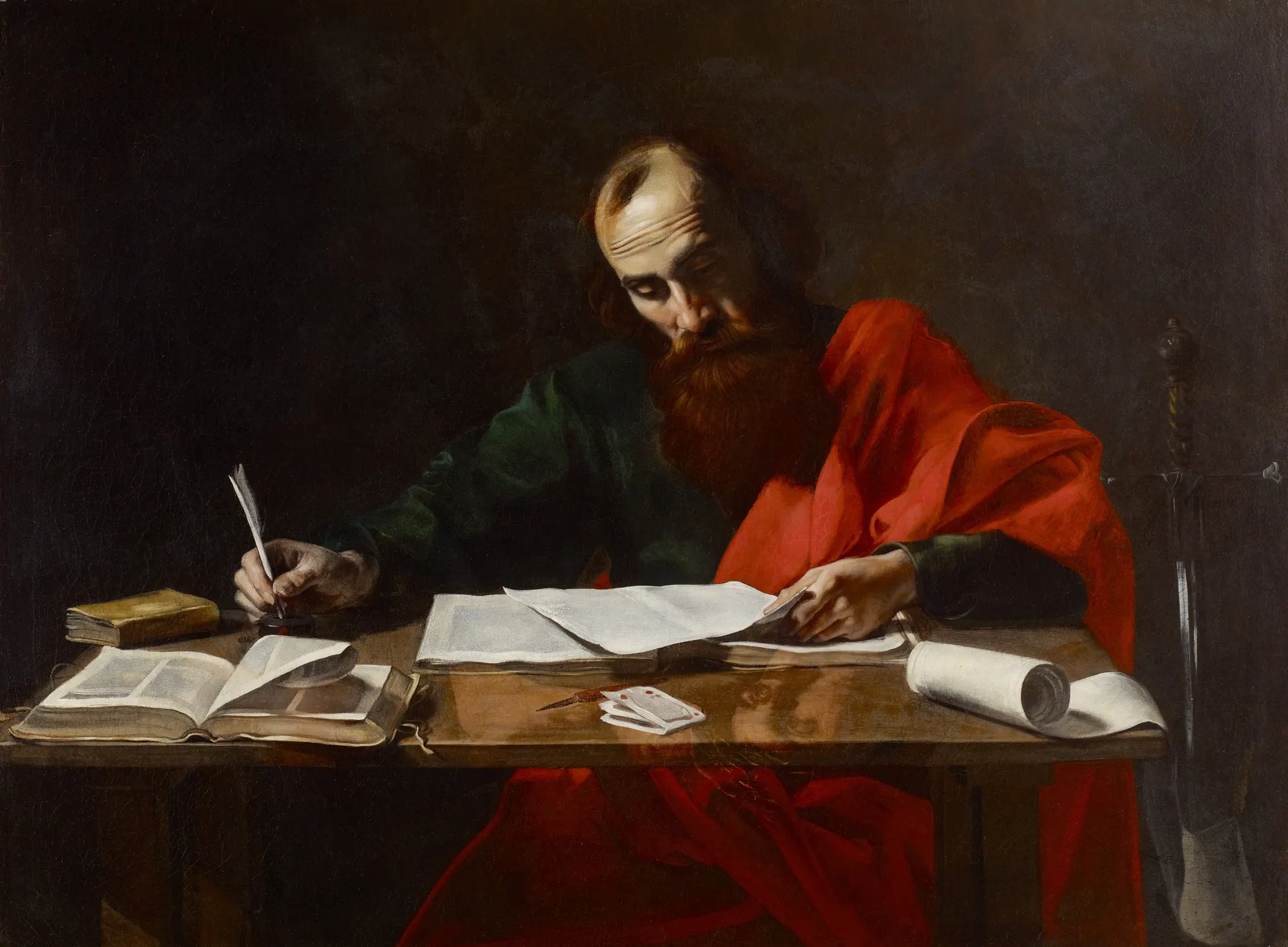
Romanschapter 14
23 verses · Paul · AD 56 or 57 · Paul's letters
One person regards a certain day above the others, while someone else considers every day alike. Each one should be fully convinced in his own mind.
Introduction
Paul, Paul's letters, Romans Overview.
Paul wrote this chapter to a church where believers from two upbringings shared one table. Some had been raised under the food laws and feast days of Moses, and others had grown up eating whatever the market sold. The quarrel was over what could be eaten and which days were holy, and it was dividing people who belonged to the same Lord. Listen for the fault Paul names on each side, and for the question he puts to both. Listen also for the point where he turns to speak to the stronger believer. Hear it as teaching for any church where sincere believers disagree.
Context
- Who
- Mixed house churches in Rome where returning Jewish believers and long-settled Gentile believers ate at the same tables.
- What
- Paul's teaching on how believers who differ over food and holy days are to accept one another under one Lord.
- Where
- Written from Corinth, in the Roman province of Achaia, to the church in Rome, the capital of the empire.
- When
- About AD 57, during Paul's three months in Greece before he carried the collection to Jerusalem, a dating most scholars accept with good confidence.
- Why
- To stop the strong from despising the weak and the weak from judging the strong, and to teach the strong to limit their freedom for a brother's sake.
Historical context
Meat in a Roman city was hard to trust. Much of what reached the market had come from a temple, since animals were sacrificed there and the surplus sold, and Rome had no reliable kosher supply chain for ordinary buyers. A conscientious Jewish believer could avoid the whole problem by eating only vegetables, which is exactly the position Paul describes.
Show the rest of the historical context, 3 more paragraphs
Wine had a parallel difficulty, since a portion was often poured out to a god before drinking.
The disagreement over days almost certainly involves the Sabbath and the Jewish festival calendar. For believers whose families had kept those days for generations, letting them go was not a small adjustment; for Gentile believers who had never kept them, insisting on them looked like adding requirements.
Underneath sits the recent expulsion and return. The group that stayed had set the customs; the group coming back had older ones. Paul refuses to legislate the answer and instead forbids two things: the strict despising the free, and the free judging the strict.
Significance
For the first hearers, the shock was that Paul, who plainly holds the freer view, will not use his authority to force it. Each is to be fully convinced in his own mind, and each answers to his own master.
Show the rest of the significance, 1 more paragraph
The rule he gives instead is heavier than a ruling would have been: do not let your eating destroy someone for whom Christ died. The kingdom of God is not food and drink but righteousness, peace, and joy in the Holy Spirit.
The heads below are this chapter's scenes. The numbered points under each are its verses.
Receive the Weak: Each Stands to His Own Master
Romans 14:1-3
Accept him whose faith is weak: The command is to accept the brother whose faith is weak and to leave his opinions alone. The dispute in Rome was food, one believer eating everything and another eating only vegetables. God has accepted him.
Romans 14:1
“Now him that is weak in faith receive, not in disputes over thoughts. For one believes that he may eat all things; but he who is weak, let him eat vegetables. In the passages above too the Apostle made mention of weakness of faith, where he says of Abraham: When he was nearly a hundred years old, he was not weakened in faith. Concerning that weakness of faith we have set forth, in those places, such things as could occur to us.”
Origen of Alexandria · written before 253 · Commentary on the Epistle to the Romanspatristic
4 more voices on this verseWhat preachers and commentators have said about this verse, in their own words.
Romans 14:1
“Him that is weak - The design here is to induce Christians to receive to their fellowship those who had scruples about the propriety of certain things, or that might have special prejudices and feelings as the result of education or former habits of belief. The apostle, therefore, begins by admitting that such an one may be “weak,” that is, not fully established, or not with so clear and enlarged views about Christian liberty others might have. In the faith - In believing.”
Romans 14:1
“Let not your Christian friendship and fellowship be disturbed with such vain janglings and strifes of words.-- Not to judge his doubtful thoughts (so the margin), "not to pump out his weak sentiments concerning those things which he is in doubt about, that you may censure and condemn him." Receive him, not to expose him, but to instruct and strengthen him.”
Matthew Henry · Commentary on the Whole Bible (1707-1721)puritan
Romans 14:1
“The import then of what he addresses to the more intelligent and the already confirmed, is this, -- that the ampler the grace which they had received from the Lord, the more bound they were to help their neighbors. Not for the debatings of questions. This is a defective sentence, as the word which is necessary to complete the sense is wanting.”
John Calvin · Commentaries (1554)reformed
Romans 14:1
“Two examples of such scruples are here specified, touching Jewish meats and days. "The strong," it will be observed, are those who knew these to be abolished under the Gospel; "the weak" are those who had scruples on this point.”
Jamieson, Fausset & Brown · Commentary Critical and Explanatory on the Whole Bible (1871)reformed
For one person has faith to eat all things: Jamieson, Fausset and Brown hold that the weak brother kept to vegetables for fear of meat offered to idols. Matthew Henry reads the faith of the strong as a settled persuasion that the old division of clean and unclean food no longer binds. Both men act from conscience.
Romans 14:2
“One believeth that he may eat all things - He believes that whatsoever is wholesome and nourishing, whether herbs or flesh - whether enjoined or forbidden by the Mosaic law - may be safely and conscientiously used by every Christian. Another, who is weak, eateth herbs - Certain Jews, lately converted to the Christian faith, and having as yet little knowledge of its doctrines, believe the Mosaic law relative to clean and unclean meats to be still in force; and therefore, when they are in a Gentile country, for fear of being defiled, avoid flesh entirely and live on vegetables.”
Adam Clarke · Commentary on the Bible (1810-1826)evangelical
for God has accepted him: Theophylact describes the two faults. The one who eats belittles the weak as still bound to Judaism, and the one who abstains judges the eater as a man without self-control. God has accepted both.
Romans 14:3
“The Apostle, therefore, composing the body of the Church in peace, says: Let him who eats not despise him who does not eat; and let him who does not eat not judge him who eats; for God has received him. Who are you that judge another's servant? To his own lord he stands, or falls: but he shall stand; for God is able to make him stand — namely, so that through these words there should be no dissension among believers on account of foods. But Paul seems to have spoken these things with a deeper meaning.”
Origen of Alexandria · written before 253 · Commentary on the Epistle to the Romanspatristic
2 more voices on this verse
Romans 14:3
“Let not him that eateth despise--look down superciliously upon "him that eateth not." and let not him that eateth not judge--sit in judgment censoriously upon "him that eateth." for God hath received him--as one of His dear children, who in this matter acts not from laxity, but religious principle.”
Jamieson, Fausset & Brown · Commentary Critical and Explanatory on the Whole Bible (1871)reformed
Romans 14:3
“Let not him that eateth - That is, he who has no scruples about eating “meat,” etc., who is not restrained by the Law of the Jews respecting the Clean and unclean, or by the fact that meat “may” have been offered to idols. Despise him - Hold him in contempt, as being unnecessarily scrupulous, etc. The word “despise” here is happily chosen. The Gentile would be very likely to “despise” the Jew as being restrained by foolish scruples and mere distinctions in matters of no importance.”
Romans 14:4-6
To his own master he stands or falls: Each believer answers to his own master, and the Lord Himself is able to make him stand. The second dispute is the calendar, and each is to be fully convinced in his own mind. Whichever way a man regards the day or eats, he does so to the Lord.
Romans 14:4
“Who art thou that judgest another man’s servant? - Who has ever given thee the right to condemn the servant of another man, in things pertaining to his own master? To his own master he standeth or falleth. He is to judge him, not thou; thy intermeddling in this business is both rash and uncharitable. Yea, he shall be holden up - He is sincere and upright, and God, who is able to make him stand, will uphold him; and so teach him that he shall not essentially err.”
Adam Clarke · Commentary on the Bible (1810-1826)evangelical
2 more voices on this verse
Romans 14:4
“You think that he who eateth will fall by his presumption, or that he who eateth not will sink under the weight of his own fears and scruples; but if they have true faith, and an eye to God, the one in the intelligent use of his Christian liberty and the other in the conscientious forbearance of it, they shall be held up--the one in his integrity, and the other in his comfort.”
Matthew Henry · Commentary on the Whole Bible (1707-1721)puritan
Romans 14:4
“Who art thou that judges another man's--rather, "another's" servant?--that is, CHRIST'S, as the whole context shows, especially Ro 14:8, 9. Yea, &c.--"But he shall be made to stand, for God is able to make him stand"; that is, to make good his standing, not at the day of judgment, of which the apostle treats in Ro 14:10, but in the true fellowship of the Church here, in spite of thy censures.”
Jamieson, Fausset & Brown · Commentary Critical and Explanatory on the Whole Bible (1871)reformed
One person regards a certain day above the others: Clarke takes the day one person regards above the others as a Jewish festival such as Passover or Pentecost. Such a day still bound the mind of the Jewish believer. Barnes notes that the Greek verb for regards is krinei, the verb the chapter uses for judging a brother.
Romans 14:5
“One judges between one day and another; another judges every day. Let each one abound in his own sense. We said above, following the sequence of the apostolic letter, that these matters seem to be treated concerning abstinence from foods, or liberty in them: since indeed the calling which is in Christ places nothing common or unclean in foods, but the principle of continence persuades us to abstain even from things permitted. For, as he himself says elsewhere, because all things are lawful, it does not therefore follow that all things are expedient, or that all things edify.”
Origen of Alexandria · written before 253 · Commentary on the Epistle to the Romanspatristic
1 more voice on this verse
Romans 14:5
“One man esteemeth - Greek “judgeth” κρίνει krinei. The word is here properly translated “esteemeth;” compare Act 13:46; Act 16:15. The word originally has the idea of “separating,” and then “discerning,” in the act of judging. The expression means that one would set a higher value on one day than on another, or would regard it as more sacred than others.”
He who observes a special day does so to the Lord: Both the one who eats and the one who abstains give thanks to God. Matthew Henry takes the verse as a witness that giving thanks before and after meat was the common practice of the church. Thanks to God unites the two.
Romans 14:6
“He who is wise concerning the day, is wise for the Lord; and he who eats, eats for the Lord: for he gives thanks to God; and he who does not eat, for the Lord does not eat, and gives thanks to God. Thanks therefore are rendered to God by both: by the one indeed for the fruit of continence; by the other for the liberty of eating.”
Origen of Alexandria · written before 253 · Commentary on the Epistle to the Romanspatristic
3 more voices on this verse
Romans 14:6
“He that regardeth the day - A beautiful apology for mistaken sincerity and injudicious reformation. Do not condemn the man for what is indifferent in itself: if he keep these festivals, his purpose is to honor God by the religious observance of them. On the other hand, he who finds that he cannot observe them in honor of God, not believing that God has enjoined them, he does not observe them at all. In like manner, he that eateth any creature of God, which is wholesome and proper food, gives thanks to God as the author of all good.”
Adam Clarke · Commentary on the Bible (1810-1826)evangelical
Romans 14:6
“4 , justly makes this observation: It appears by this that saying grace (as we commonly call it, perhaps from 1 Cor. x. 30 ) before and after meat was the common known practice of the church, among Christians of all sorts, weak and strong: an ancient, commendable, apostolical, Christian practice, derived down from Christ's example through all the ages of the church, Matt. xiv.”
Matthew Henry · Commentary on the Whole Bible (1707-1721)puritan
Romans 14:6
For none of us--Christians liveth to himself--(See 2Co 5:14, 15), to dispose of himself or shape his conduct after his own ideas and inclinations. and no man--"and none" of us Christians "dieth to himself."
Jamieson, Fausset & Brown · Commentary Critical and Explanatory on the Whole Bible (1871)reformed
Romans 14:7-9
none of us lives to himself alone: Living and dying both belong to the Lord, so no believer owns either one. Christ died and returned to life to be Lord over both the dead and the living. The question of eating sits inside that ownership.
Romans 14:7
“For none of us lives to himself, and none dies to himself; whether therefore we live, we live to the Lord; or whether we die, we die to the Lord. Whether therefore we live, or whether we die, we are the Lord's. For to this end Christ both died and lived, that he might have dominion over both the dead and the living.”
Origen of Alexandria · written before 253 · Commentary on the Epistle to the Romanspatristic
1 more voice on this verse
Romans 14:7
“For none of us ... - Whether by nature Jews or Gentiles. In the great principles of religion we are now united. Where there was evidence of a sincere desire to do the will of God there should be charitable feeling, through there was difference of opinion and judgment in many smaller matters. The meaning of the expression is, that no Christian lives to gratify his own inclinations or appetites.”
So whether we live or die, we belong to the Lord: Paul had never visited Rome, and still he counts on the believers there to agree with him. That a man belongs to the Lord in life and death was the common teaching of every preacher. The Lord keeps His own.
Romans 14:8
“For whether we live - As long as we live. We live unto the Lord - We live to do his will, and to promote his glory. This is the grand purpose of the life of the Christian. Other people live to gratify themselves; the Christian to do those things which the Lord requires. By “the Lord” here the apostle evidently intends the Lord Jesus, as it is evident from Rom 14:9; and the truth taught here is, that it is the leading and grand purpose of the Christian to do honor to the Saviour.”
1 more voice on this verse
Romans 14:8
“And since the apostle, when he wrote these words, had never been at Rome, he could only know that the Roman Christians would assent to this view of Christ, because it was the common teaching of all the accredited preachers of Christianity, and the common faith of all Christians.”
Jamieson, Fausset & Brown · Commentary Critical and Explanatory on the Whole Bible (1871)reformed
For this reason Christ died and returned to life: Gill records copies that add a third verb for rising, and Jamieson, Fausset and Brown give the true text as Christ died and lived. Those are the two verbs the Berean follows. The dead and the living are His.
Romans 14:9
“For to this end Christ both, &c.--The true reading here is, To this end Christ died and lived ("again"). that he might be Lord both of the dead and--"and of the" living--The grand object of His death was to acquire this absolute Lordship over His redeemed, both in their living and in their dying, as His of right.”
Jamieson, Fausset & Brown · Commentary Critical and Explanatory on the Whole Bible (1871)reformed
4 more voices on this verse
Romans 14:9
“For to this end Christ both died, and rose, and revived,.... This last word "revived" is omitted by the Vulgate Latin, but very naturally placed by the Syriac, between Christ's dying and rising.”
Romans 14:9
As it has been clearly demonstrated that the Word, who existed in the beginning with God, by whom all things were made, who was also always present with mankind, was in these last days, according to the time appointed by the Father, united to His own workmanship, inasmuch as He became a man liable to suffering, [it follows] that every objection is set aside of those who say, "If our Lord was born at that time, Christ had therefore no previous existence."
Irenaeus · written before 202 · Irenaeus Against Heresies Book 3patristic
Romans 14:9
“For to this end - For this purpose or design. The apostle does not say that this was the “only” design of his death, but that it was a main purpose, or an object which he had distinctly in view. This declaration is introduced in order to confirm what he had said in the previous verse, that in all circumstances we are the Lord’s. This he shows by the fact that Jesus died “in order” that we “might” be his. And rose - This expression is rejected by most modern critics.”
Romans 14:9
“This is a thing in which all the people of God are one, however they differ in other things; though some are weak and others are strong, yet both agree in this, not to live to themselves. Not one that hath given up his name to Christ is allowedly a self-seeker; it is contrary to the foundation of true Christianity.”
Matthew Henry · Commentary on the Whole Bible (1707-1721)puritan
Romans 14:10-12
do you judge your brother?: Judging a brother and belittling him are both answered by the same coming day. Every believer will stand before God's judgment seat and give an account of himself. Paul quotes Isaiah 45:23, where every knee bows before God and every tongue confesses to Him.
Romans 14:10
“NO doubt there is an error in our version, for where in the 10th verse we read, "The Judgment Seat of Christ," it should be, "The Judgment Seat of God." I suppose the word, "Christ," slipped into certain manuscripts because Paul had been speaking of Christ and it was thought to be natural that he should continue to use the same name. Paul did not say "Christ," but, "God"—but by that word he meant the same Person.”
2 more voices on this verse
Romans 14:10
“But if these things are so: Why, he says, do you judge your brother? Or why do you despise your brother, since, whether there is in you a mortification of the flesh and of the vices, it did not arise from you but was bestowed by the death of Christ; or whether you have newness of life and, walking on earth, have your conversation in heaven, you have merited this by Christ's resurrection?”
Origen of Alexandria · written before 253 · Commentary on the Epistle to the Romanspatristic
Romans 14:10
“But why dost thou - Christian Jew, observing the rites of the Mosaic law, judge - condemn thy brother - the Christian Gentile, who does not think himself bound by this law? Or why dost thou - Christian Gentile, set at nought thy Christian Jewish brother, as if he were unworthy of thy regard, because he does not yet believe that the Gospel has set him free from the rites and ceremonies of the law?”
Adam Clarke · Commentary on the Bible (1810-1826)evangelical
every knee will bow before Me: Barnes marks the speaker in Isaiah 45:23 is the LORD by His name, and Paul sets those words over the judgment seat of verse 10. Barnes and Wesley read the quotation as a witness to the deity of Christ, the Lord of verse 9 who died and returned to life.
Romans 14:11
“For it is written - This passage is recorded in Isa 45:23. It is not quoted literally, but the sense is preserved. In Isaiah there can be no doubt that it refers to Yahweh. The speaker expressly calls himself Yahweh, the name which is appropriate to God alone, and which is never applied to a creature; Rom 14:18. In the place before us, the words are applied by Paul expressly to Christ; compare Rom 14:10. This mode of quotation is a strong incidental proof that the apostle regarded the Lord Jesus as divine.”
2 more voices on this verse
Romans 14:11
“As I live - An oath proper to him, because he only possesseth life infinite and independent. It is Christ who is here termed both Lord and God; as it is he to whom we live, and to whom we die.”
John Wesley · Explanatory Notes upon the New Testament (1755)evangelical
Romans 14:11
“It is a prophecy, in general, of Christ's dominion; and here very fully applied to the judgment of the great day, which will be the highest and most illustrious exercise of that dominion. Here is a proof of Christ's Godhead: he is the Lord and he is God, equal with the Father.”
Matthew Henry · Commentary on the Whole Bible (1707-1721)puritan
Cross references
Romans 14:11
- QuotingIsaiah 45:23“By Myself I have sworn; truth has gone out from My mouth, a word that will not be revoked: Every knee will bow before Me, every tongue will swear allegiance.”
'Every knee shall bow to me' ('it is written, As I live, saith the Lord')
So then, each of us will give an account of himself to God: Clarke reads the verse as a limit on every believer's charge, for at the bar of God no one answers for the conduct of another. Ambrosiaster draws the consequence for Rome, that a man who gives no account of his brother has no call to condemn him.
Romans 14:12
“Every one of us shall give account of himself - We shall not, at the bar of God, be obliged to account for the conduct of each other - each shall give account of himself: and let him take heed that he be prepared to give up his accounts with joy.”
Adam Clarke · Commentary on the Bible (1810-1826)evangelical
2 more voices on this verse
Romans 14:12
“Let all these differences be referred to the arbitration of Christ at the great day. (5.) Because the stress of Christianity is not to be laid upon these things, nor are they at all essential to religion, either on the one side or on the other.”
Matthew Henry · Commentary on the Whole Bible (1707-1721)puritan
Romans 14:12
“On any other view, the quotation to show that we shall all stand before the judgment-seat of God would be a strange proof that Christians are all amenable to Christ.”
Jamieson, Fausset & Brown · Commentary Critical and Explanatory on the Whole Bible (1871)reformed
Do Not Destroy With Your Food One for Whom Christ Died
Romans 14:13-15
The only judging left is your own effect on your brother. Paul is convinced that nothing is unclean in itself, while a man who counts a thing unclean is bound by that conscience. Eating that distresses a brother has stopped being love, and Christ died for him.
Romans 14:13
“Let us not therefore judge ... - Since we are to give account of ourselves at the same tribunal; since we must be there on the same “level,” let us not suppose that we have a right here to sit in judgment on our fellow-Christians. But judge this rather - If disposed to “judge,” let us be employed in a better kind of judging; let us come “to a determination” not to injure the cause of Christ. This is an instance of the happy “turn” which the apostle would give to a discussion.”
1 more voice on this verse
Romans 14:13
“I know, and am persuaded by--or rather, "in" the Lord Jesus--as "having the mind of Christ" (1Co 2:16). that there is nothing unclean of itself--Hence it is that he calls those "the strong" who believed in the abolition of all ritual distinctions under the Gospel.”
Jamieson, Fausset & Brown · Commentary Critical and Explanatory on the Whole Bible (1871)reformed
nothing is unclean in itself: Origen renders unclean as common, the word for food the law kept off an Israelite's table. Cyril of Alexandria traces Paul's conviction to the saying of Jesus that food going into the mouth leaves a man clean. Paul is convinced of it in the Lord Jesus.
Romans 14:14
“I know, and am persuaded by the Lord Jesus - After reasoning so long and so much with these contending parties on the subject of their mutual misunderstandings, without attempting to give any opinion, but merely to show them the folly and uncharitableness of their conduct, he now expresses himself fully, and tells them that nothing is unclean of itself, and that he has the inspiration and authority of Jesus Christ to say so; for to such an inspiration he must refer in such words as, I know, and am persuaded by the Lord Jesus.”
Adam Clarke · Commentary on the Bible (1810-1826)evangelical
2 more voices on this verse
Romans 14:14
“I am assured by the Lord Jesus - Perhaps by a particular Revelation. That there is nothing - Neither flesh nor herbs. Unclean of itself - Unlawful under the gospel.”
John Wesley · Explanatory Notes upon the New Testament (1755)evangelical
Romans 14:14
“This is the order of nature, which order is broken if the understanding (though misguided) tell us that such a thing is a sin, and yet we will do it. This is a will to do evil; for, if it appears to us to be sin, there is the same pravity and corruption of the will in the doing of it as if really it were a sin; and therefore we ought not to do it.”
Matthew Henry · Commentary on the Whole Bible (1707-1721)puritan
If your brother is distressed by what you eat: Gennadius of Constantinople traces how the verse climbs, from food to a brother and from grief to destruction. Wesley reads destroy as real ruin for one Christ died for, and Jamieson, Fausset and Brown read the clause as the weak brother's worth. His price was Christ's death.
Romans 14:15
“Accordingly, in the next clause, that idea is brought out with great strength. Destroy not him with--"by" thy meat for whom Christ died--"The worth of even the poorest and weakest brother cannot be more emphatically expressed than by the words, 'for whom Christ died'" [OLSHAUSEN]. The same sentiment is expressed with equal sharpness in 1Co 8:11.”
Jamieson, Fausset & Brown · Commentary Critical and Explanatory on the Whole Bible (1871)reformed
3 more voices on this verse
Romans 14:15
“If thy brother is grieved - That is, wounded, led into sin. Destroy not him for whom Christ died - So we see, he for whom Christ died may be destroyed. With thy meat - Do not value thy meat more than Christ valued his life.”
John Wesley · Explanatory Notes upon the New Testament (1755)evangelical
Romans 14:15
“While thou destroyest thy brother thou art helping forward the devil's design, for he is the great destroyer; and, as much as in thee lies, thou art crossing the design of Christ, for he is the great Saviour, and dost not only offend thy brother, but offend Christ; for the work of salvation is that which his heart is upon. But are any destroyed for whom Christ died?”
Matthew Henry · Commentary on the Whole Bible (1707-1721)puritan
Romans 14:15
“But if thy brother ... - This address is to the “Gentile” convert. In the previous verse, Paul admitted. that the prejudice of the Jew was not well-founded. But admitting that still the question was, “how” he should be treated while he had that prejudice. The apostle here shows the Gentile that “he” ought not so to act as unnecessarily to wound his feelings, or to grieve him. Be grieved - Be pained; as a conscientious man always is, when he sees another, and especially a Christian brother, do anything which “he” esteems to be wrong.”
Romans 14:16-18
what you consider good: A believer's liberty is good, and it can still earn the gospel a bad name among those who watch. The kingdom of God stands in righteousness, peace, and the joy the Holy Spirit gives, and those three outrank food and drink.
Romans 14:16
“Let not then your good be evil spoken of - Do not make such a use of your Christian liberty as to subject the Gospel itself to reproach. Whatsoever you do, do it in such a manner, spirit, and time, as to make it productive of the greatest possible good. There are many who have such an unhappy method of doing their good acts, as not only to do little or no good by them, but a great deal of evil. It requires much prudence and watchfulness to find out the proper time of performing even a good action.”
Adam Clarke · Commentary on the Bible (1810-1826)evangelical
For the kingdom of God is not a matter of eating and drinking: Augustine reads the kingdom of God here as the church, where God reigns, and Wesley reads it as true religion. Theodore of Mopsuestia took the verse as a word on the life after the resurrection, which has no eating and drinking. Righteousness, peace and joy remain.
Romans 14:17
“For the kingdom of God - That is, true religion, does not consist in external observances. But in righteousness - The image of God stamped on the heart; the love of God and man, accompanied with the peace that passeth all understanding, and joy in the Holy Ghost.”
John Wesley · Explanatory Notes upon the New Testament (1755)evangelical
2 more voices on this verse
Romans 14:17
“For the kingdom of God - For an explanation of this phrase, see the note at Mat 3:2. Here it means that the uniquenesses of the kingdom of God, or of the Church of Christ on earth, do not consist in observing the distinctions between meats and drinks, it was true that by these things the Jews had been particularly characterized, but the Christian church was to be distinguished in a different manner. Is not - Does not consist in, or is not distinguished by.”
Romans 14:17
“The kingdom of God is not meat, &c. Observe here, [1.] The nature of true Christianity, what it is: it is here called, The kingdom of God; it is a religion intended to rule us, a kingdom: it stands in a true and hearty subjection to God's power and dominion.”
Matthew Henry · Commentary on the Whole Bible (1707-1721)puritan
For whoever serves Christ in this way is pleasing to God: Chrysostom and Theophylact hear a rebuke to the strong, who wanted men's approval for their freedom to eat. They answer that men approve peace more than perfection.
Romans 14:18
“And therefore he says that he who in this serves Christ pleases God, and is approved by men. This is what he says elsewhere of himself: Just as I also, he says, please all men in all things, not seeking what is useful to me, but what is useful to many.”
Origen of Alexandria · written before 253 · Commentary on the Epistle to the Romanspatristic
1 more voice on this verse
Romans 14:18
“For he that in these things - The man, whether Jew or Gentile, who in these things - righteousness, peace, and joy in the Holy Ghost, serveth Christ - acts according to his doctrine, is acceptable to God; for he has not only the form of godliness in thus serving Christ, but he has the power, the very spirit and essence of it, in having righteousness, and peace, and joy in the Holy Ghost; and therefore the whole frame of his mind, as well as his acts, must be acceptable to God.”
Adam Clarke · Commentary on the Bible (1810-1826)evangelical
Romans 14:19-21
what leads to peace and to mutual edification: The work of God named in verse 20 is the brother himself, whom food is a poor reason to tear down. Paul calls all food clean and still gives up meat and wine where they would trip a brother.
Romans 14:19
“Therefore let us pursue the things that make for peace, and the things that are for mutual edification. Do not for the sake of food destroy the work of God. Above he said: Pursuing hospitality; and here likewise he says, let us pursue the things that make for peace, and the things that are for edification one toward another: and just as we showed there in what manner hospitality is to be pursued, so here too let us understand in what manner peace is to be pursued, since David likewise says: Seek peace, and pursue it.”
Origen of Alexandria · written before 253 · Commentary on the Epistle to the Romanspatristic
2 more voices on this verse
Romans 14:19
“Peace and edification are closely joined. Practical divinity tends equally to peace and to edification. Controversial divinity less directly tends to edification, although sometimes, as they of old, we cannot build without it, Neh. iv, 17.”
John Wesley · Explanatory Notes upon the New Testament (1755)evangelical
Romans 14:19
“Let us therefore follow ... - The object of this verse is to persuade the church at Rome to lay aside their causes of contention, and to live in harmony. This exhortation is founded on the considerations which the apostle had presented, and may be regarded as the conclusion to which the argument had conducted him. The things which make for peace - The high purposes and objects of the Christian religion, and not those smaller matters which produce strife. If men aim at the great objects proposed by the Christian religion, they will live in peace.”
Do not destroy the work of God for the sake of food: Theophylact names the work of God as a brother's salvation, and Ambrosiaster as the man himself, made once by creation and again by regeneration. Wesley reads it as what God builds in the soul by faith and in the church by concord. Oecumenius places that work at the cross.
Romans 14:20
“For meat destroy not the work of God - Do not hinder the progress of the Gospel either in your own souls or in those of others, by contending about lawful or unlawful meats. And do not destroy the soul of thy Christian brother, Rom 14:15, by offending him so as to induce him to apostatize. All things indeed are pure - This is a repetition of the sentiment delivered, Rom 14:14, in different words.”
Adam Clarke · Commentary on the Bible (1810-1826)evangelical
2 more voices on this verse
Romans 14:20
“The work of God - Which he builds in the soul by faith, and in the church by concord. It is evil to that man who eateth with offense - So as to offend another thereby.”
John Wesley · Explanatory Notes upon the New Testament (1755)evangelical
Romans 14:20
“All things indeed are pure--"clean"; the ritual distinctions being at an end. but it is evil to that man--there is criminality in the man who eateth with offence--that is, so as to stumble a weak brother.”
Jamieson, Fausset & Brown · Commentary Critical and Explanatory on the Whole Bible (1871)reformed
It is better not to eat meat or drink wine: Chrysostom points to Paul's own practice of yielding, when he circumcised Timothy at Acts 16:3 and had his hair cut at Acts 18:18. Ambrosiaster notes that wine enters the verse to shield believers who abstain from both meat and drink. The free believer gives way to the weak brother.
Romans 14:21
“It is good neither to eat flesh,.... Any sort of flesh, even that which is not forbidden in the law, rather than offend a weak brother; and the apostle determines for himself, that he would not, where there was any danger of doing this, 1Co 8:13. Nor to drink wine; not only the wine of libations to Heathen deities, but wine in common; which was not prohibited by the law of Moses, but in the case of a Nazarite, and of vows: nor anything, be it what it will, whereby thy brother stumbleth.”
3 more voices on this verse
Romans 14:21
“It is good - It is right; or it is better. This verse is an explanation or enlarged specification of the meaning of the former. To eat flesh - That is, such flesh as the “Jewish” convert regarded as unclean; Rom 14:2. Nor to drink wine - Wine was a common drink among the Jews, and usually esteemed lawful. But the Nazarites were not allowed to drink it Num 6:3, and the Rechabites Jer. 35 drank no wine, and it is possible that some of the early converts regarded it as unlawful for Christians to drink it.”
Romans 14:21
“Thy brother stumbleth - By imitating thee against his conscience, contrary to righteousness. Or is offended - At what thou doest to the loss of his peace. Or made weak - Hesitating between imitation and abhorrence, to the loss of that joy in the Lord which was his strength.”
John Wesley · Explanatory Notes upon the New Testament (1755)evangelical
Romans 14:21
“This is to be extended to all such indifferent things whereby thy brother stumbleth, or is offended, is involved either in sin or in trouble: or is made weak --his graces weakened, his comforts weakened, his resolutions weakened.”
Matthew Henry · Commentary on the Whole Bible (1707-1721)puritan
Romans 14:22-23
between yourself and God: A settled conviction is kept between the believer and God, out of the weaker brother's hearing. The man who eats while he doubts is condemned by his own conscience, having acted past what he believes God allows. Whatever is not from faith is sin.
Romans 14:22
“Hast thou faith - That all things are pure? Have it to thyself before God - In circumstances like these, keep it to thyself, and do not offend others by it. Happy is he that condemneth not himself - By an improper use of even innocent things! and happy he who is free from a doubting conscience!”
John Wesley · Explanatory Notes upon the New Testament (1755)evangelical
2 more voices on this verse
Romans 14:22
“Hast thou faith--on such matters? have it to thyself--within thine own breast before God--a most important clause. It is not mere sincerity, or a private opinion, of which the apostle speaks; it is conviction as to what is the truth and will of God.”
Jamieson, Fausset & Brown · Commentary Critical and Explanatory on the Whole Bible (1871)reformed
Romans 14:22
“Though men condemn us, it is well enough if our own hearts condemn us not, 1 John iii. Another rule here prescribed is to those who are clear in these matters, and know their Christian liberty, yet to take heed of using it so as to give offence to a weak brother.”
Matthew Henry · Commentary on the Whole Bible (1707-1721)puritan
But the one who has doubts is condemned if he eats: Wesley reads faith here as a full persuasion that an act is lawful, so the rule binds the conscience of the doubter. Basil of Caesarea read it wider, joining it to faith that comes by hearing and counting every act outside holy Scripture as sin. The food itself stayed clean.
Romans 14:23
“And--rather, "But" he that doubteth is damned--On the word "damnation," see on Ro 13:2. if he eat, because he eateth not of faith--On the meaning of "faith" here, see on Ro 14:22. for whatsoever is not of faith is sin--a maxim of unspeakable importance in the Christian life.”
Jamieson, Fausset & Brown · Commentary Critical and Explanatory on the Whole Bible (1871)reformed
4 more voices on this verse
Romans 14:23
“If "all that is not of faith is sin, and faith comes by hearing, and hearing by the Word of God," then everything outside holy Scripture, not being of faith, is sin.”
Basil of Caesarea · written before 379 · The Morals 80.22patristic
Romans 14:23
“Because it is not of faith - He does not believe it lawful and, in all these cases, whatsoever is not of faith is sin - Whatever a man does without a full persuasion of its lawfulness, it is sin to him.”
John Wesley · Explanatory Notes upon the New Testament (1755)evangelical
Romans 14:23
“Taking it in general, it is the same with that of the apostle ( Heb. xi. 6 ), Without faith it is impossible to please God. Whatever we do in religion, it will not turn to any good account, except we do it from a principle of faith, with a believing regard to the will of Christ as our rule, to the glory of Christ as our end, and to the righteousness of Christ as our plea.”
Matthew Henry · Commentary on the Whole Bible (1707-1721)puritan
Romans 14:23
“He that doubteth - He that is not fully satisfied in his mind; who does not do it with a clear conscience. The margin has it rendered correctly, “He that discerneth and putteth a difference between meats.” He that conscientiously believes, as the Jew did, that the Levitical law respecting the difference between meats was binding on Christians. Is damned - We apply this word almost exclusively to the future punishment of the wicked in hell. But it is of importance to remember, in reading the Bible, that this is not of necessity its meaning.”
How this psalm is built
The form: Instruction on how the perfect should act toward the imperfect, judging no one and upholding the weak, as Aquinas classes it.
The patterns in this chapter
| Device | What it does | Where to see it |
|---|---|---|
| To the Lord, six times | The phrase to the Lord stands three times in verse 6, of the one who observes a day, the one who eats and the one who abstains, and three times in verse 8, of living, dying and belonging. John Gill reads the refrain as the reason behind the whole counsel: what each side does, it does to the Lord.John Gill, Exposition of the New Testament (1746-1748), on Romans 14:6. | Romans 14:6, Romans 14:8 |
| Belittle and judge, the fault of each side | Verse 3 names two faults in matched clauses, the eater who belittles and the abstainer who judges, and verse 10 returns to the same pair as two questions. The words judge and judgment stand six times, at verses 1, 3, 4, 10 twice and 13. Theophylact of Ohrid describes the two sides: the strong looked down on the others as still attached to Judaism, and the others condemned the strong as lacking self-control.Theophylact of Ohrid, Commentary on Romans, on Romans 14:3. | Romans 14:3, Romans 14:4, Romans 14:10, Romans 14:13 |
| Your brother, six times | The word brother stands twice in verse 10, once in verse 13, twice in verse 15 and once in verse 21, and from verse 13 it always names the one who may be made to stumble. Gennadius of Constantinople marks how the argument climbs in verse 15, from food, to the one wronged called a brother, to what is done to him called destruction.Gennadius of Constantinople, PAULINE COMMENTARY FROM THE GREEK CHURCH, on Romans 14:15. | Romans 14:10, Romans 14:13, Romans 14:15, Romans 14:21 |
| Righteousness, peace and joy | Verse 17 sets eating and drinking on one side and three things on the other, righteousness, peace and joy in the Holy Spirit. John Wesley reads the kingdom of God here as true religion, with righteousness as the image of God stamped on the heart, and the peace and joy that follow it.John Wesley, Explanatory Notes upon the New Testament, on Romans 14:17. | Romans 14:17 |
The structure
8 more paragraphs on the patterns
Romans 14:1 to 15:13 is one unit on the weak and the strong, and it runs across the seam into chapter 15. Chapter 13 ended by naming dissension and jealousy among the deeds of darkness and by making love the one debt, and this chapter carries that love to the table, where eating that distresses a brother is no longer acting in love. Verses 1 to 12 forbid judging, on the ground that each believer belongs to the Lord and answers to God. Verses 13 to 23 forbid putting a stumbling block before a brother, on the ground of love and the work of God. Theophylact of Ohrid marks verse 15 as the place where Paul turns his speech to the strong (Commentary on Romans, on Romans 14:15), and Thomas Aquinas reads the unit as reaching its second part at Romans 15:1, where the strong are told to uphold the weak (Commentary on Romans, on Romans 14:1). Chapter 15 then grounds the whole counsel in the example of Christ and in Jew and Gentile praising God together.
The debate
The readers differ over who the weak were. Adam Clarke takes them as converted Jews who still held the distinction of meats and days from the law of Moses (Commentary on the Bible, on Romans 14:1). Jamieson, Fausset and Brown take the vegetable diet as a guard against eating meat offered to idols (Commentary Critical and Explanatory on the Whole Bible, on Romans 14:2). Theodoret of Cyrus names the eaters as Gentiles and records a report that converted Jews shamed them into giving up meat altogether (INTERPRETATION OF THE LETTER TO THE ROMANS, on Romans 14:2).
The days of verse 5 are read the same several ways. Adam Clarke refers them to the Jewish festivals, the Passover, Pentecost and the new moons (Commentary on the Bible, on Romans 14:5). John Chrysostom hears a gentle hint about fasting days (Homily on Romans 25, on Romans 14:5). Augustine of Hippo applied the verses to those who fasted on Saturday and those who ate (LETTER 36, on Romans 14:3).
The Old Testament in the chapter
Verse 11 quotes Isaiah 45:23: “As surely as I live, says the Lord, every knee will bow before Me; every tongue will confess to God.” Albert Barnes notes that Paul keeps the sense of the words, that the speaker in Isaiah is the LORD by His own name, and that Paul applies the words to Christ (Notes, Explanatory and Practical, on the Old and New Testaments (1832-1869), on Romans 14:11). John Wesley reads the oath as proper to the one who alone has life in Himself (Explanatory Notes upon the New Testament, on Romans 14:11).
Where to go deeper
The chapter's subject has its own page at /featured/the-weak-and-the-strong, and the question of meat from the temples at /featured/food-offered-to-idols. The command against judging a brother is taught at /featured/judge-not, and the seat of verse 10 at /featured/judgment-seat-of-christ.
Keep studying
Studies11
Words12
Subjects2
Sources for this chapter
The summary
Jamieson, Fausset & Brown, Commentary Critical and Explanatory; John Calvin, Commentaries; John Wesley, Explanatory Notes Upon the New Testament and Matthew Henry, Complete Commentary.
The form and classifications
Adam Clarke, Commentary on the Bible, on Romans 14:1; Jamieson, Fausset & Brown, Commentary Critical and Explanatory on the Whole Bible, on Romans 14:2 and Thomas Aquinas, Commentary on Romans, on Romans 14:1.
The exposition
Adam Clarke, Commentary on the Bible; Albert Barnes; Ambrosiaster, COMMENTARY ON PAUL'S EPISTLES; Augustine of Hippo, LETTER 36; Basil of Caesarea, THE MORALS 80.22; Charles Hodge, Commentary on the Epistle to the Romans; Charles Spurgeon, Metropolitan Tabernacle Pulpit, sermons on Romans 14; Cyril of Alexandria, EXPLANATION OF THE LETTER TO THE ROMANS; Gennadius of Constantinople, PAULINE COMMENTARY FROM THE GREEK CHURCH; Jamieson, Fausset & Brown, Commentary Critical and Explanatory on the Whole Bible; John Calvin, Commentary on the Epistle to the Romans; John Chrysostom; John Gill; John Wesley, Explanatory Notes upon the New Testament; Matthew Henry, Commentary on the Whole Bible; Oecumenius, PAULINE COMMENTARY FROM THE GREEK CHURCH; Origen of Alexandria, COMMENTARY ON THE EPISTLE TO THE ROMANS; Robert Haldane, Exposition of the Epistle to the Romans; Theodore of Mopsuestia, PAULINE COMMENTARY FROM THE GREEK CHURCH; Theodoret of Cyrus, INTERPRETATION OF THE LETTER TO THE ROMANS and Theophylact of Ohrid, Commentary on Romans.