
Revelationchapter 7
17 verses · John, by tradition · AD 95 or 96 · Revelation
“Do not harm the land or sea or trees until we have sealed the foreheads of the servants of our God.”
Introduction
John, by tradition, Revelation, Revelation Overview.
John wrote this chapter in exile on Patmos for churches in the Roman province of Asia, some of whom had been told they would suffer and die. It comes after the sixth seal and before the seventh, as a pause in the judgments. The chapter answers the question that closed chapter 6. It shows two companies, one counted and one too large to count. Listen for what happens before the winds are loosed. Listen also for the promises at the end, most of them taken from Isaiah.
Context
- Who
- Believers who had just heard the sixth seal and wanted to know what happens to them
- What
- A pause between the sixth and seventh seals in which God's servants are sealed and a great multitude is seen before the throne.
- Where
- Written on the island of Patmos, off the coast of Asia Minor, to seven churches in the Roman province of Asia.
- When
- About AD 95 under Domitian on the majority view, with a minority dating the book before AD 70 under Nero.
- Why
- To assure believers facing tribulation that God marks His own before judgment falls and brings them safely to His throne.
Historical context
The chapter opens with four angels holding back the winds so that nothing can be harmed until the servants of God are sealed on their foreheads. A seal in that world was a mark of ownership and protection, pressed into wax or clay on property, stamped on documents, and in some settings marked on people. Soldiers and slaves could carry marks identifying whose they were.
Show the rest of the historical context, 4 more paragraphs
So the sealing is not a magic shield against suffering. It is a stamp of ownership placed before the trouble is released, and it is placed by God's own angel.
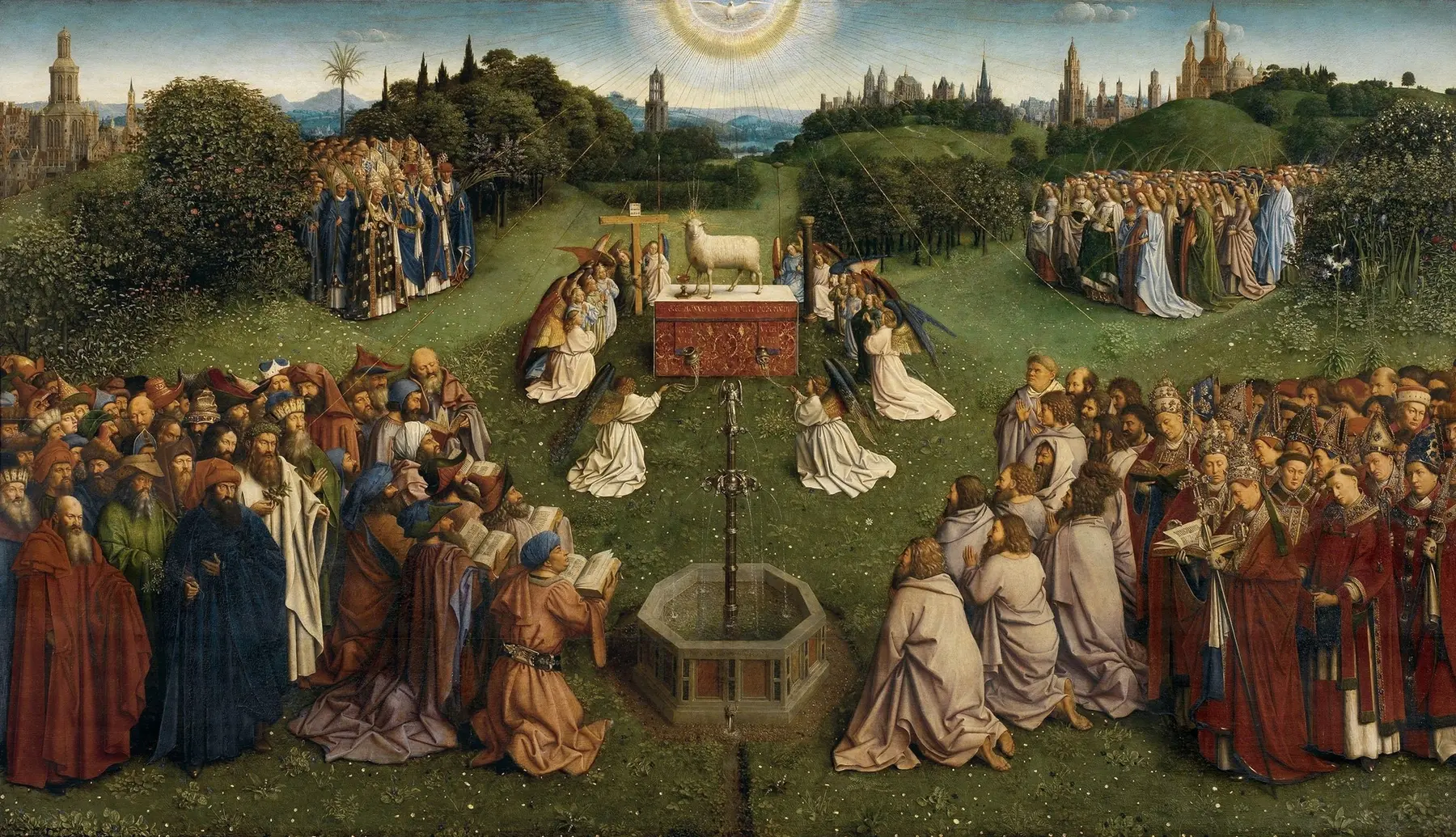
Then two groups appear back to back. A counted number out of the tribes of Israel, 144,000, twelve thousand from each of twelve tribes, and then a crowd out of every nation and tribe and people and language that no one could number. Readers have long argued about how the two relate. The text simply sets them side by side: one counted, one uncountable.
The great multitude stands in white robes with palm branches. Palms were what crowds waved at a victory procession or a festival, and Jewish readers would think of the Feast of Tabernacles, where branches were carried in celebration.
The last lines say where they came from: out of great tribulation, robes washed white in the blood of the Lamb. The Lamb in the middle of the throne becomes their shepherd and leads them to living fountains of water, and God wipes away every tear.
Significance
To churches being told that some of them would be jailed and some killed, this said the loss is not the end of the record. The people who come out of the worst of it end up in front of the throne, in white, holding palm branches like a victory parade.
Show the rest of the significance, 1 more paragraph
The shepherd image would have hit hardest. The Lamb becomes the shepherd, the one who was slaughtered leads the ones who suffered, and the crying stops.
The heads below are this chapter's scenes. The numbered points under each are its verses.
Four Winds Held Back Until the Servants Are Sealed
holding back its four winds: John sees four angels standing at the four corners of the earth, the four compass points, holding back its four winds. The judgment of the sixth seal pauses, and the next two verses name what it waits for.
Revelation 7:1
“And after these things - After the vision of the things referred to in the opening of the sixth seal. The natural interpretation would be, that what is here said of the angels and the winds occurred after those things which are described in the previous chapter. The exact chronology may not be always observed in these symbolical representations, but doubtless there is a general order which is observed. I saw four angels - He does not describe their forms, but merely mentions their agency. This is, of course, a symbolical representation.”
1 more voice on this verseWhat preachers and commentators have said about this verse, in their own words.
Revelation 7:1
“As then Revelation is the Book of the Second Advent [DE BURGH], naturally mention of God's restored favor to Israel occurs among the events that usher in Christ's advent. earth . . . sea . . . tree--The judgments to descend on these are in answer to the martyrs' prayer under the fifth seal.”
Jamieson, Fausset & Brown · Commentary Critical and Explanatory on the Whole Bible (1871)reformed
Revelation 7:2-3
the seal of the living God: Then another angel ascending from the east, as the glory comes in Ezekiel 43:2, carries the seal of the living God. He holds back harm until we have sealed the foreheads of the servants; the seal marks ownership and protection, which the beast counterfeits at 13:16.
Revelation 7:2
And I saw another (a good) angel ascending from the east - The plagues begin in the east; so does the sealing. Having the seal of the only living and true God: and he cried with a loud voice to the four angels - Who were hasting to execute their charge. To whom it was given to hurt the earth and the sea - First, and afterwards "the trees."
John Wesley · Explanatory Notes upon the New Testament (1755)evangelical
2 more voices on this verse
Revelation 7:2
“The seal of the living God - This angel is represented as the chancellor of the supreme King, and as ascending from the east, απο ανατολης ἡλιου, from the rising of the sun. Some understand this of Christ, who is called ανατολη, the east, Luk 1:78. Four angels, to whom it was given to hurt - Particular agents employed by Divine providence in the management of the affairs of the earth; but whether spiritual or material we know not.”
Adam Clarke · Commentary on the Bible (1810-1826)evangelical
Revelation 7:2
“An account of the sealing of the servants of God, where observe, 1. To whom this work was committed--to an angel, another angel. While some of the angels were employed to restrain Satan and his agents, another angel was employed to mark out and distinguish the faithful servants of God.”
Matthew Henry · Commentary on the Whole Bible (1707-1721)puritan
until we have sealed the foreheads: Henry, on verse 2, sees the angels given two tasks, some holding back harm while another marks out God's faithful servants. Wesley, on verse 2, notes that the plagues begin in the east and so does the sealing. The harm waits on the seal.
Revelation 7:3
“Mt 24:34; "this generation (the Jewish nation) shall not pass till all these things be fulfilled," which implies that Israel can no more pass away before Christ's advent, than Christ's own words can pass away (the same Greek), Mt 24:35.”
Jamieson, Fausset & Brown · Commentary Critical and Explanatory on the Whole Bible (1871)reformed
ConnectionsEzekiel 9:4
those who were sealed: John hears the number, 144,000 from all the tribes of Israel, and verses 5 to 8 give twelve thousand to each of twelve named tribes. Some read the list of ethnic Israel preserved through the judgments, with Romans 11 behind them, and others of the whole church.
Revelation 7:4
“I heard the number of them which were sealed - In the number of 144,000 are included all the Jews converted to Christianity; 12,000 out of each of the twelve tribes: but this must be only a certain for an uncertain number; for it is not to be supposed that just 12,000 were converted out of each of the twelve tribes.”
Adam Clarke · Commentary on the Bible (1810-1826)evangelical
1 more voice on this verse
Revelation 7:4
“Of the children of Israel - To these will afterwards be joined a multitude out of all nations. But it may be observed, this is not the number of all the Israelites who are saved from Abraham or Moses to the end of all things; but only of those who were secured from the plagues which were then ready to fall on the earth.”
John Wesley · Explanatory Notes upon the New Testament (1755)evangelical
Revelation 7:5-8
From the tribe of Judah 12,000: Judah heads the list, the tribe of the scepter in Genesis 49:10, and each tribe has 12,000. Dan is missing, and Levi, which held no land under Numbers 18:20, is counted, with the tribe of Joseph beside the tribe of Manasseh.
Revelation 7:5
“Someone may ask, Where does one read that all Israel will be saved? First, of course, there is the apostle: "Until the full number of the Gentiles should enter, and thus all Israel should be saved." In the second place, John says in his Apocalypse: of the tribe of Judah, twelve thousand shall believe, of the tribe of Reuben, twelve thousand shall believe, and of the remaining tribes, he says the same; and the number of all who believe became 144,000. Then too Psalm 144, which is alphabetical, treats of this number saved.”
Jerome · written before 420 · Homilies on Mark 82 (8)patristic
2 more voices on this verse
Revelation 7:5
“Of the tribe of Judah were sealed twelve thousand,.... Judah is mentioned first, because Christ sprung from that tribe, and the pure worship of God was preserved in it; and that itself was preserved a distinct tribe until the coming of Shiloh; its name signifies "praise God", Gen 29:35; and shows, that it becomes all the sealed ones, all true believers, and every member of the church of God, to praise him for all favours and blessings, temporal, spiritual, and eternal.”
Revelation 7:5
“Judah is mentioned first, in respect of the kingdom, and of the Messiah sprung therefrom.”
John Wesley · Explanatory Notes upon the New Testament (1755)evangelical
from the tribe of Manasseh 12,000: Manasseh is sealed here and Joseph in verse 8, so the house of Joseph is sealed twice among the tribes of Israel. Ephraim is left out. Gill saw a blessing in the name Asher, and in Naphtali the servants of God who wrestle in prayer.
Revelation 7:6
“Of the tribe of Aser were sealed twelve thousand,.... "Asher", which the Septuagint pronounce "Aser", as here, signifies "blessed", Gen 30:13; as all the sealed ones are, blessed with all spiritual blessings, with grace here, and glory hereafter. Of the tribe of Nephthalim were sealed twelve thousand; the name of this tribe signifies "wrestlings", Gen 30:8; and may design the wrestlings of saints, both with God in prayer, and with their enemies, sin, Satan, and the world, and also their strivings together for the faith of the Gospel.”
from the tribe of Levi 12,000: Levi, the priestly tribe that received no land, stands in the list with the others. Andreas of Caesarea reads Simeon as obedience and Levi as those taken up to God. Gill reads Simeon as hearing joined to obedience.
Revelation 7:7
“Of the tribe of Simeon were sealed twelve thousand,.... The name of this tribe signifies "hearing", Gen 29:33; and such an hearing as is attended with obedience; and denotes the spiritual and practical hearing of the Gospel by those who hear, and understand, and believe, and practise what they hear, and yield the obedience of faith unto it.”
from the tribe of Joseph 12,000: The list ends with Joseph and Benjamin, Rachel's sons. Wesley saw Dan left out of the tribes of Israel, having come down to one family long before. Andreas of Caesarea saw in Zebulun the servants of God made strong by Christ, who dwells in them.
Revelation 7:8
“Of the tribe of Zabulon were sealed twelve thousand,.... Which signifies "dwelling", Gen 30:20; and was the tribe in which Christ had his dwelling, and where he much conversed; and may denote his gracious inhabitation, as well as that of God the Father, md of the Spirit, among the saints and sealed ones. Of the tribe of Joseph were sealed twelve thousand; whose name signifies "adding", Gen 30:24; and may intend the additions both of numbers, and of gifts and graces to the churches of those times.”
1 more voice on this verse
Revelation 7:8
“It is farther observable of Daniel, that it was very early reduced to a single family; which family itself seems to have been cut off in war, before the time of Ezra; for in the Chronicles, where the posterity of the patriarchs is recited, Dan. is wholly omitted.”
John Wesley · Explanatory Notes upon the New Testament (1755)evangelical
A Multitude No Man Could Number, Out of Great Tribulation
Revelation 7:9-10
a multitude too large to count: John sees a multitude too large to count, from every nation and tribe and people and tongue, set against the counted tribes of Israel. Holding palm branches, as the crowd did in John 12:13, they cry Salvation to our God, who sits on the throne, and to the Lamb.
Revelation 7:9
“After this - Greek,” After these things” - Μετὰ ταῦτα Meta tauta: that is, after I saw these things thus represented I had another vision. This would undoubtedly imply, not only that he saw these things after he had seen the sealing of the hundred and forty-four thousand, but that they would occur subsequently to that. But he does not state whether they would immediately occur, or whether other things might not intervene.”
1 more voice on this verse
Revelation 7:9
“More are the children of the desolate than of the married woman. [2.] The Lord knows who are his, and he will keep them safe in times of dangerous temptation. [3.] Though the church of God is but a little flock, in comparison of the wicked world, yet it is no contemptible society, but really large and to be still more enlarged.”
Matthew Henry · Commentary on the Whole Bible (1707-1721)puritan
Jamieson, Fausset and Brown note that the Greek reads the salvation, with all the praise for it given to God. They hear the palm bearing crowd of Jesus' entry into Jerusalem, who also cried for salvation. Clarke names God its author and the Lamb its sacrifice.
Revelation 7:10
“Salvation to our God - That is, God alone is the author of the salvation of man; and this salvation is procured for and given to them through the Lamb, as their propitiatory sacrifice.”
Adam Clarke · Commentary on the Bible (1810-1826)evangelical
1 more voice on this verse
Revelation 7:10
“It is their continuing, ceaseless employment. Salvation--literally, "THE salvation"; all the praise of our salvation be ascribed to our God. At the Lord's entry into Jerusalem, the type, similarly "salvation" is the cry of the palm-bearing multitudes.”
Jamieson, Fausset & Brown · Commentary Critical and Explanatory on the Whole Bible (1871)reformed
Revelation 7:11-12
all the angels stood around: The angels fell facedown before the throne and worshiped God, answering the multitude's cry. Their praise has seven parts, Blessing and glory and wisdom and thanks and honor and power and strength, as the Lamb's praise at 5:12.
Revelation 7:11
“And all the angels stood round about the throne - notes on Rev 5:11. And about the elders - notes on Rev 4:4. And the four beasts - notes on Rev 4:6. The meaning is, that the angels stood in the outer circle, or outside of the elders and the four living creatures. The redeemed, it is manifest, occupied the inner circle, and were near the throne, though their precise location is not mentioned.”
1 more voice on this verse
Revelation 7:11
“The angels, as in Re 5:11, in their turn take up the anthem of praise. There it was "many angels," here it is "all the angels." stood--"were standing" [ALFORD].”
Jamieson, Fausset & Brown · Commentary Critical and Explanatory on the Whole Bible (1871)reformed
Blessing and glory and wisdom and thanks: Gill notes that the angels have no share in this salvation, yet they say Amen to the praise the redeemed give. Jamieson, Fausset and Brown count seven terms and read the number as completeness. The two Amens frame the praise.
Revelation 7:12
Greek, "The blessing, the glory, the wisdom, the thanksgiving, the honor, the power, the might [the doxology is sevenfold, implying its totality and completeness], unto the ages of the ages."
Jamieson, Fausset & Brown · Commentary Critical and Explanatory on the Whole Bible (1871)reformed
1 more voice on this verse
Revelation 7:12
“Now he is upon opening the last seal, and the seven angels are going to receive seven trumpets, in order to make the kingdoms of the world subject to God.”
John Wesley · Explanatory Notes upon the New Testament (1755)evangelical
Revelation 7:13-14
one of the elders addressed me: An elder asks who the ones in white robes are, and John answers you know. They have come out of the great tribulation, and washed their robes and made them white in the blood of the Lamb.
Revelation 7:13
“And one of the elders - See the notes on Rev 4:4. That is, as there understood, one of the representatives of the church before the throne.”
1 more voice on this verse
Revelation 7:13
“And one of the elders - What stands, verses 13-17, ver. 13-17 might have immediately followed the tenth verse; but that the praise of the angels, which was at the same time with that of the "great multitude," came in between.”
John Wesley · Explanatory Notes upon the New Testament (1755)evangelical
they have washed their robes: Tertullian saw them as those who triumph over Antichrist. Wesley saw a multitude too large to count for martyrs alone, and took in every righteous servant of God from the beginning of the world. Henry saw that only the blood of the Lamb washes robes white.
Revelation 7:14
“Sir, thou knowest - That is, I do not know, but thou canst inform me. Came out of great tribulation - Persecutions of every kind. And have washed their robes - Have obtained their pardon and purity, through the blood of the Lamb. Their white robes cannot mean the righteousness of Christ, for this cannot be washed and made white in his own blood.”
Adam Clarke · Commentary on the Bible (1810-1826)evangelical
4 more voices on this verse
Revelation 7:14
“For yet again a countless throng are revealed, clothed in white and distinguished by palms of victory, celebrating their triumph doubtless over Antichrist, since one of the elders says, "These are they who come out of that great tribulation, and have washed their robes, and made them white in the blood of the Lamb." For the flesh is the clothing of the soul.”
Tertullian · written before 220 · Scorpiacepatristic
Revelation 7:14
“It is not the blood of the martyrs themselves, but the blood of the Lamb, that can wash away sin, and make the soul pure and clean in the sight of God. Other blood stains; this is the only blood that makes the robes of the saints white and clean. The blessedness to which they are now advanced, being thus prepared for it.”
Matthew Henry · Commentary on the Whole Bible (1707-1721)puritan
Revelation 7:14
“And I said unto him, sir, thou knowest,.... John replies in a very humble, modest, and respectful manner, to the elder, calling him "sir", according to the usage of the eastern people; and it is observable, that this word is much used in his Gospel, and more than in any other book; see Joh 4:11. Some copies, and the Complutensian edition, read, "my Lord"; and so do the Vulgate Latin, Syriac, and Arabic versions.”
Revelation 7:14
“Thou knowest - That is, I know not; but thou dost. These are they - Not martyrs; for these are not such a multitude as no man can number. But as all the angels appear here, so do all the souls of the righteous who had lived from the beginning of the world.”
John Wesley · Explanatory Notes upon the New Testament (1755)evangelical
ConnectionsGenesis 3:21, Isaiah 1:18
Revelation 7:15-17
serve Him day and night: They serve Him day and night in His temple, and God will spread His tabernacle over them, the dwelling promised again at 21:3. Never again will they hunger repeats Isaiah 49:10, and God will wipe away every tear from their eyes repeats Isaiah 25:8 and returns at 21:4.
Revelation 7:15
“Therefore are they before the throne of God - The reason why they are there is to be traced to the fact that the Lamb shed his blood to make expiation for sin. No other reason can be given why anyone of the human race is in heaven; and that is reason enough why any of that race are there. And serve him day and night in his temple - That is, continually or constantly. Day and night constitute the whole of time, and this expression, therefore, denotes constant and uninterrupted service.”
2 more voices on this verse
Revelation 7:15
“Therefore - Because they came out of great affliction, and have washed their robes in his blood. Are they before the throne - It seems, even nearer than the angels. And serve him day and night - Speaking after the manner of men; that is, continually.”
John Wesley · Explanatory Notes upon the New Testament (1755)evangelical
Revelation 7:15
“These, therefore, worship God forever; and God dwells among them. One of the saints said that the dwelling of God is the unceasing remembrance of Him that remains in the souls of the saints; therefore, God reasonably dwells there. They worship Him day and night.”
Oecumenius · written before 550 · Commentary on Revelationpatristic
Gill saw these words come from Isaiah 49:10 and held that they will never hunger or thirst in the body. Bede saw Jesus, the bread of life, who said that whoever comes to Him will never hunger. Jamieson, Fausset and Brown saw the scorching sun as persecution too.
Revelation 7:16
“They shall hunger no more, nor thirst any more,.... The words are taken out of Isa 49:10, and will be true in a literal and corporeal sense.”
the Lamb in the center of the throne: Barnes saw the Lamb as their shepherd, who guards His people and gives them water as well as leading them, as in Psalm 23. Tertullian saw God wipe away every tear from the same eyes that wept on earth. He saw the body raised.
Revelation 7:17
"Everlasting joy," says Isaiah, "shall be upon their heads." Well, there is nothing eternal until after the resurrection. "And sorrow and sighing," he continues, "shall flee away." The angel echoes the same to John: "And God shall wipe away all tears from their eyes"; from the same eyes indeed that had formerly wept and that might weep again, if the lovingkindness of God did not dry up every fountain of tears.
Tertullian · written before 220 · On the Resurrection of the Flesh 58patristic
How this psalm is built
The form: A pause before the winds are loosed, showing God's restored favour to Israel among the events that lead to Christ's return, as Jamieson, Fausset & Brown classes it.
The patterns in this chapter
| Device | What it does | Where to see it |
|---|---|---|
| Counted and uncounted | John hears a number in verse 4 and then looks and sees a crowd in verse 9. The first company is counted tribe by tribe, and the second is too large to count and comes from every nation and tribe and people and tongue. John Wesley reads the multitude as joined afterward to the sealed of Israel.John Wesley, Explanatory Notes upon the New Testament, 1755, on Revelation 7:4. | Revelation 7:4, Revelation 7:9 |
| Twelve tribes of twelve thousand | Verses 5 to 8 name twelve tribes, and 12,000 stands with each name, twelve times in all. Judah is named first, Dan is not named, and Levi, Joseph and Manasseh are all counted. The twelve times twelve thousand make the 144,000 of verse 4.the site's count of the Berean text, the verses of Revelation 7 in the store, translation id 3, the Berean Standard Bible. | Revelation 7:4, Revelation 7:5, Revelation 7:6, Revelation 7:7, Revelation 7:8 |
| Isaiah's promises | Verse 16 takes up Isaiah 49:10, where the LORD's returning people will neither hunger nor thirst nor be struck by the sun. Verse 17 takes up Isaiah 25:8, where the Lord GOD will wipe away the tears from every face. John Gill holds the promise of verse 16 true in a literal and bodily sense.John Gill, Exposition of the New Testament, 1746 to 1748, on Revelation 7:16. | Revelation 7:16, Revelation 7:17 |
| The Lamb as shepherd | Verse 17 makes the Lamb a shepherd, so the one who was slain leads the flock. Albert Barnes notes that the verb covers the whole of a shepherd's care, watching, providing and guarding as well as feeding. He sets it beside Psalm 23.Albert Barnes, Notes, Explanatory and Practical, on the Old and New Testaments, 1832 to 1869, on Revelation 7:17. | Revelation 7:17 |
How the chapter is built
5 more paragraphs on the patterns
Chapter 6 ended with the question of who is able to withstand the day of wrath. Chapter 7 stands between the sixth seal and the seventh, which opens in 8:1. Verses 1 to 3 hold back the winds until God's servants are sealed. Verses 4 to 8 give the number and the tribes of the sealed. Verses 9 to 12 show the great multitude and the worship of the angels. Verses 13 to 17 are a dialogue in which an elder tells John who the multitude are. Chapter 8 then opens the seventh seal and brings in the seven trumpets.
The readings of the two companies
The relation of the sealed tribes to the multitude is read in several ways. Jamieson, Fausset and Brown read the chapter as God's restored favour to Israel before the return of Christ (Commentary Critical and Explanatory on the Whole Bible, on Revelation 7:1). The exposition note on verse 4 gives the site's own reading, the literal tribes of Israel kept through the wrath. Adam Clarke reads the sealed as the Jews converted to Christianity, a set number standing for an uncounted one (Commentary on the Bible, on Revelation 7:4). Jerome reads the list as the fulfilment of Paul's word that all Israel will be saved (Homilies on Mark 82, on Revelation 7:5). Andreas of Caesarea reads the names of the tribes by their meanings, so that Simeon stands for obedience (Commentary on the Apocalypse, on Revelation 7:7). John Wesley takes the multitude as all the righteous since the world began (Explanatory Notes upon the New Testament, on Revelation 7:14). Tertullian reads them as those who triumph over Antichrist (Scorpiace, on Revelation 7:14).
Where to go deeper
The book as a whole has its own page at /book/revelation. The 144,000 has a feature page at /featured/the-144000, the seal at /featured/the-seal, and the great tribulation at /featured/great-tribulation. The great multitude is listed as an owed feature page.
Keep studying
Studies15
Words12
Subjects1
Sources for this chapter
The summary
Jamieson, Fausset & Brown, Commentary Critical and Explanatory; John Wesley, Explanatory Notes Upon the New Testament and Matthew Henry, Complete Commentary.
The form and classifications
Adam Clarke, Commentary on the Bible, 1832, on Revelation 7:4; Jamieson, Fausset & Brown, Commentary Critical and Explanatory on the Whole Bible, 1871, on Revelation 7:1 and John Wesley, Explanatory Notes upon the New Testament, 1755, on Revelation 7:14.
The exposition
Adam Clarke, Commentary on the Bible; Albert Barnes; Andreas of Caesarea, Commentary on the Apocalypse; Bede, Commentary on Revelation; Jamieson, Fausset & Brown, Commentary Critical and Explanatory on the Whole Bible; John Gill; John Wesley, Explanatory Notes upon the New Testament; Matthew Henry, Commentary on the Whole Bible and Tertullian.