
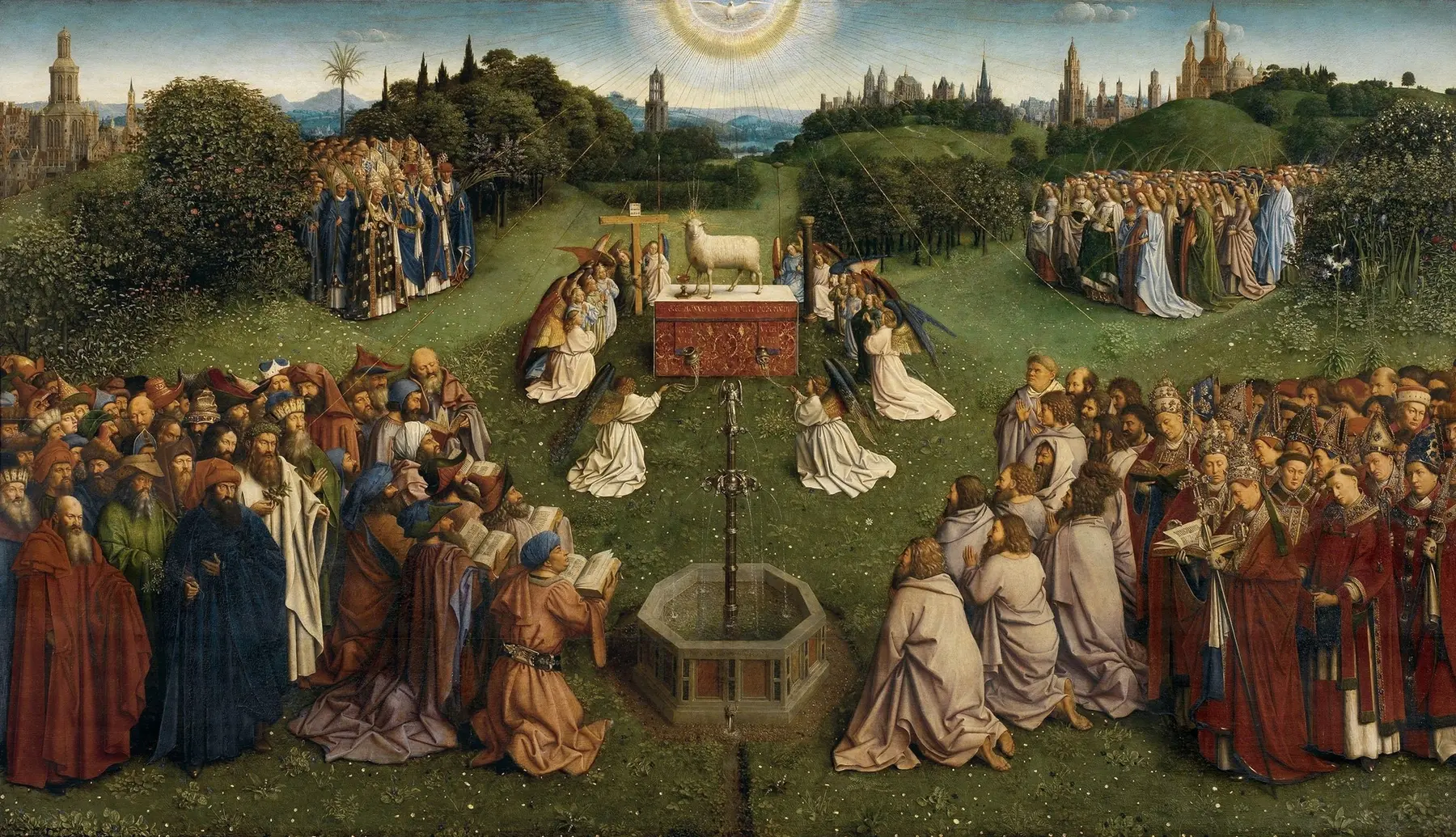
Revelationchapter 19
21 verses · John, by tradition · AD 95 or 96 · Revelation
Let us rejoice and be glad and give Him the glory. For the marriage of the Lamb has come, and His bride has made herself ready.
Introduction
John, by tradition, Revelation, Revelation Overview.
John wrote this book on Patmos for churches in the province of Asia that suffered under a power claiming divine honours. This chapter is the one they had been waiting for. It opens with the only songs of Hallelujah in the New Testament and closes on a field of battle. Listen for the two suppers it sets side by side. Listen for the names given to the Rider, and for the weapon He uses. Read it as the answer to every earlier promise in the book that the Lord would come.
Context
- Who
- Churches who had spent the whole book watching empires and were now shown the actual conqueror
- What
- Heaven's praise over Babylon's fall, the announcement of the marriage of the Lamb, and the return of Christ on a white horse to defeat the beast, the false prophet and their armies.
- Where
- The vision moves from the throne room of heaven to the earth where the armies gather, and John sent it from Patmos to the seven churches of Asia.
- When
- About AD 95, late in the reign of Domitian, on the date most commentators give; others hold an early date under Nero, about AD 68.
- Why
- To show that the Lord who reigns keeps His word, joining His people to Himself and ending the powers that persecuted them.
Historical context
The chapter opens with the only occurrences of "Hallelujah" in the New Testament, four of them, in a burst, over the fall of the city in chapter 18. The word is Hebrew, straight out of the Psalms, and would have been familiar in worship.
Show the rest of the historical context, 4 more paragraphs
Then a wedding. Betrothal and marriage in that world had two stages, an agreement and then the bringing home of the bride with a feast, and the invitations to the feast were a serious social matter. The bride is given fine linen, clean and white, and the text explains it: the righteousness of saints. The garment is granted to her, and it is made of what they actually did.
The rider comes on a white horse. A Roman general celebrating a triumph rode through the city in procession with his army behind him, and the readers knew that spectacle from coins and reliefs if not in person. This procession has armies in white linen, not armor.
His robe is dipped in blood before the battle starts, and His weapon is a sword out of His mouth, He speaks and it is over. He is called Faithful and True, the Word of God, King of kings and Lord of lords. That last title was one Persian and Roman rulers liked for themselves.
The battle itself takes almost no space. The beast and the false prophet are seized, and the birds are called to a grim supper that mirrors the wedding supper earlier in the chapter, two feasts, and everyone attends one of them.
Significance
For congregations who had been told to endure, be faithful unto death, and come out of Babylon, this was the payoff: the one they had refused to trade away shows up in the open, named on His robe, and the argument ends.
Show the rest of the significance, 1 more paragraph
The wedding image did the personal work. They were not merely rescued subjects. They were the bride, and the linen they would wear was already being woven out of the faithfulness they were practicing in Smyrna and Philadelphia right then.
The heads below are this chapter's scenes. The numbered points under each are its verses.
Hallelujahs in Heaven and the Marriage Supper of the Lamb
Revelation 19:1-3
Salvation and glory and power: Heaven answers Babylon's fall with Hallelujah, a Hebrew word given four times in this chapter and nowhere else in the New Testament. The praise rests on justice: His judgments are true and just. Her smoke rises forever and ever repeats the phrase used of the beast worshipers at 14:11.
Revelation 19:1
“And after these things - The things particularly that were exhibited in the previous chapter. See the notes on Rev 18:1. I heard a great voice of much people in heaven - The voice of the worshippers before the throne. Saying, Alleluia - The Greek method of writing “Hallelujah.” This word - ἀλληλούΐα allēlouia - occurs in the New Testament only in this chapter, Rev 19:1, Rev 19:3-4, Rev 19:6. The Hebrew phrase - הללוּ יה haleluw Yah “Hallelujah” - occurs often in the Old Testament.”
1 more voice on this verseWhat preachers and commentators have said about this verse, in their own words.
Revelation 19:1
“Compare Ps 149:4-9, which is plainly parallel, and indeed identical in many of the phrases, as well as the general idea. Israel, especially, will join in the Hallelujah, when "her warfare is accomplished" and her foe destroyed. Salvation, &c.--Greek, "The salvation . . . the glory . . . the power." and honour--so Coptic.”
Jamieson, Fausset & Brown · Commentary Critical and Explanatory on the Whole Bible (1871)reformed
His judgments are true and just: John Wesley hears the answer to the souls under the altar at 6:10, who asked how long until their blood was avenged. Their cry has become a song. Andreas of Caesarea adds that the punishment served even her own people, since it brought her sin to an end.
Revelation 19:2
“God has "avenged the blood of his servants from the hand" of Babylon and has benefited her inhabitants by accomplishing the cessation of sin through its punishment.”
Andreas of Caesarea · written before 614 · Commentary on the Apocalypse 19:1-4patristic
1 more voice on this verse
Revelation 19:2
“For true and righteous are his judgments - Thus is the cry of the souls under the altar changed into a song of praise.”
John Wesley · Explanatory Notes upon the New Testament (1755)evangelical
Albert Barnes traces the rising smoke to the cities of the plain in Genesis 19, where Abraham watched smoke go up like a furnace. Andreas of Caesarea reads it as a punishment that will never be forgotten. The second Hallelujah answers the first.
Revelation 19:3
“The surest way to have our deliverances continued and completed is to give God the glory of what he has done for us. Praising God for what we have is praying in the most effectual manner for what is yet further to be done for us; the praises of the saints blow up the fire of God's wrath against the common enemy.”
Matthew Henry · Commentary on the Whole Bible (1707-1721)puritan
Revelation 19:4-6
the twenty-four elders: The elders and living creatures, leading worship since chapter 4, fall down a final time with Amen and Hallelujah. A voice from the throne calls all His servants, small and great alike, to the same praise. The multitude gives the ground of it: the Lord our God the Almighty reigns.
Revelation 19:4
“And the four and twenty elders and the four beasts - See the notes on Rev 4:4, Rev 4:6-7. As representatives of the church, and as interested in its welfare, they are now introduced as rejoicing in its final triumph, and in the destruction of its last foe. Fell down - Prostrated themselves - the usual posture of worship. And worshipped God that sat on the throne - Rev 4:2-3, Rev 4:10. That is, they now adored him for what he had done in delivering the church from all its persecutions, and causing it to triumph in the world.”
1 more voice on this verse
Revelation 19:4
“Accordingly they are mentioned before them, with the praise they render to God, chap. iv, 9, 10; v, 8, 14; inasmuch as there the praise moves from the center to the circumference. But here, when God's judgments are fulfilled, it moves back from the circumference to the center. Here, therefore, the four and twenty elders are named before the living creatures.”
John Wesley · Explanatory Notes upon the New Testament (1755)evangelical
The voice from the throne says our God, and Albert Barnes reasons from that pronoun that the speaker is one who worships God. He allows the Messiah only if He speaks as one with the redeemed church. The speaker stays unnamed.
Revelation 19:5
“And a voice came out of the throne - A voice seemed to come from the very midst of the throne. It is not said by whom this voice was uttered. It cannot be supposed, however, that it was uttered by God himself, for the command which it gave was this: “Praise our God,” etc. For the same reason it seems hardly probable that it was the voice of the Messiah, unless it be supposed that he here identifies himself with the redeemed church, and speaks of God as his God and hers.”
the Almighty reigns: The Berean's our God follows the manuscripts Adam Clarke preferred, a reading Andreas and Arethas also give. Jamieson, Fausset and Brown note that the verb is literally reigned, which marks the reign as a fact already established. The song celebrates what has now taken place.
Revelation 19:6
“The voice of a great multitude - This is the catholic or universal Church of God gathered from among the Gentiles. The Lord God Omnipotent reigneth - Εβασιλευσε Κυριος ὁ Θεος ὁ παντοκρατωρ. Many excellent MSS., most of the versions, with Andreas and Arethas, the two most ancient commentators on this book, add ἡμων, our, after ὁ Θεος· and according to this the text reads emphatically thus: Our Lord God, the Almighty, reigneth.”
Adam Clarke · Commentary on the Bible (1810-1826)evangelical
1 more voice on this verse
Revelation 19:6
“This verse is the hearty response to the stirring call, "Alleluia! Praise our God" (Re 19:4, 5). the Lord God omnipotent--Greek, "the Omnipotent." reigneth--literally, "reigned": hence reigneth once for all. His reign is a fact already established.”
Jamieson, Fausset & Brown · Commentary Critical and Explanatory on the Whole Bible (1871)reformed
Revelation 19:7-8
the marriage of the Lamb: The bride pictured at Ephesians 5:25-32 reaches her wedding day: the marriage of the Lamb has come. Her readiness is granted, since she was given clothing of fine linen, bright and pure. She stands against Babylon the prostitute, dressed in purple and scarlet at 17:4.
Revelation 19:7
“The marriage of the Lamb is come - Is near at hand, to be solemnized speedily. What this implies, none of "the spirits of just men," even in paradise, yet know.”
John Wesley · Explanatory Notes upon the New Testament (1755)evangelical
1 more voice on this verse
Revelation 19:7
That Christ is the Bridegroom, having the Church as His bride, from which spiritual children were to be born. In Joel: "Blow with the trumpet in Sion; sanctify a fast, and call a healing; assemble the people, sanctify the Church, gather the elders, collect the little ones that suck the breast; let the Bridegroom go forth of His chamber, and the bride out of her closet."
Cyprian · written before 258 · Treatise XII Three Books of Testimonies Against the Jewspatristic
ConnectionsRevelation 21:2
the righteous acts of the saints: The verse defines the bride's clothing: the fine linen she wears is the righteous acts of the saints. It opens with a gift, for she was given clothing of fine linen, bright and pure.
Revelation 19:8
“Arrayed in fine linen - A prediction that the Church should become more pure in her doctrines, more pious in her experience, and more righteous in her conduct, than she had ever been from her formation. The fine linen here spoken of is not the righteousness of Christ imputed to believers, for it is here called the righteousness of the saints - that which the grace and Spirit of Christ has wrought in them.”
Adam Clarke · Commentary on the Bible (1810-1826)evangelical
2 more voices on this verse
Revelation 19:8
“And it is given to her - By God. The bride is all holy men, the whole invisible church. To be arrayed in fine linen, white and clean - This is an emblem of the righteousness of the saints - Both of their justification and sanctification.”
John Wesley · Explanatory Notes upon the New Testament (1755)evangelical
Revelation 19:8
“The righteousness of the saint is not, as ALFORD erroneously states, inherent, but is imputed: if it were otherwise, Christ would be merely enabling the sinner to justify himself. Ro 5:18 is decisive on this.”
Jamieson, Fausset & Brown · Commentary Critical and Explanatory on the Whole Bible (1871)reformed
This is the fourth of the book's seven beatitudes. Its invitation and supper answer the parable of the wedding feast at Matthew 22:1-14 and Luke 14:15-24. The angel seals the vision as certain: These are the true words of God.
Revelation 19:9
“And he saith unto me - The angel who made these representations to him. See Rev 19:10. Write, Blessed are they - See the notes on Rev 14:13. Which are called unto the marriage-supper of the Lamb - The idea of a festival, or a marriage-supper, was a familiar one to the Jews to represent the happiness of heaven, and is frequently found in the New Testament. Compare the Luk 14:15-16; Luk 16:22; Luk 22:16 notes; Mat 22:2 note. The image in the passage before us is that of many guests invited to a great festival.”
1 more voice on this verse
Revelation 19:9
“And he - The angel, saith to me, Write - St. John seems to have been so amazed at these glorious sights, that he needeth to be reminded of this. Happy are they who are invited to the marriage supper of the Lamb - Called to glory.”
John Wesley · Explanatory Notes upon the New Testament (1755)evangelical
I fell at his feet to worship him: John falls at his feet to worship him. The angel refuses, as again at 22:8-9, calls himself a fellow servant, and gives the reason: the testimony of Jesus is the spirit of prophecy.
Revelation 19:10
“I fell at his feet to worship him - Great as this angel was, St. John could not mistake him either for Jesus Christ, or for God the Father; nor was his prostration intended as an act of religious worship. It was merely an act of that sort of reverence which any Asiatic would pay to a superior. His mistake was, the considering that he was under obligation to the angel for the information which he had now received.”
Adam Clarke · Commentary on the Bible (1810-1826)evangelical
1 more voice on this verse
Revelation 19:10
“And I fell before his feet to worship him - It seems, mistaking him for the angel of the covenant. But he saith, See thou do it not - In the original, it is only, See not, with a beautiful abruptness. To pray to or worship the highest creature is flat idolatry.”
John Wesley · Explanatory Notes upon the New Testament (1755)evangelical
Heaven Opens: Faithful and True on a White Horse
Revelation 19:11-13
called Faithful and True: Heaven stands open as at 4:1; the rider is called Faithful and True. His eyes like blazing fire recall 1:14, and many royal crowns answer the crowned heads of the dragon and beast in chapters 12 and 13. His name is The Word of God, as in John 1:1.
Revelation 19:11
“And after these things, seeing the same Lord in a second vision, he says: "For I saw in the midst of the throne, and of the four living creatures, and in the midst of the elders, a Lamb standing as it had been slain, having seven horns, and seven eyes, which are the seven spirits of God, sent forth into all the earth." And again, he says, speaking of this very same Lamb: "And behold a white horse; and He that sat upon him was called Faithful and True; and in righteousness doth He judge and make war.”
Irenaeus · written before 202 · Against Heresies Book IVpatristic
2 more voices on this verse
Revelation 19:11
“And behold a white horse - Many little regarded Christ, when he came meek, "riding upon an ass;" but what will they say, when he goes forth upon his white horse, with the sword of his mouth? White - Such as generals use in solemn triumph. And he that sitteth on him, called Faithful - In performing all his promises.”
John Wesley · Explanatory Notes upon the New Testament (1755)evangelical
Revelation 19:11
“His attributes: he is faithful and true to his covenant and promise, he is righteous in all his judicial and military proceedings, he has a penetrating insight into all the strength and stratagems of his enemies, he has a large and extensive dominion, many crowns, for he is King of kings, and Lord of lords.”
Matthew Henry · Commentary on the Whole Bible (1707-1721)puritan
many royal crowns on His head: He has many royal crowns on His head and a name written on Him that only He Himself knows. Verse 13 then gives a name, The Word of God.
Revelation 19:12
“His eyes were as a flame of fire - To denote the piercing and all-penetrating nature of his wisdom. On his head were many crowns - To denote the multitude of his conquests, and the extent of his dominion. A name written, that no man knew - This is a reference to what the rabbins call the shem hammephorash, or tetragrammaton, יהוה Yhvh; or what we call Jehovah.”
Adam Clarke · Commentary on the Bible (1810-1826)evangelical
3 more voices on this verse
Revelation 19:12
“And his eyes are a flame of fire - They were said to be as or like a flame of fire, before, chap. i, 14; an emblem of his omniscience. And upon his head are many diadems - For he is king of all nations.”
John Wesley · Explanatory Notes upon the New Testament (1755)evangelical
Revelation 19:12
“Identifying Him with the Son of man similarly described, Re 1:14. many crowns--Greek, "diadems": not merely (Greek, "stephanoi") garlands of victory, but royal crowns, as KING OF KINGS. Christ's diadem comprises all the diadems of the earth and of heavenly powers too.”
Jamieson, Fausset & Brown · Commentary Critical and Explanatory on the Whole Bible (1871)reformed
Revelation 19:12
AH, WELL YE KNOW what head this was, and ye have not forgotten its marvellous history. A head which once in infancy reclined upon the bosom of a woman! A head which was meekly bowed in obedience to a carpenter! A head which became in after years a fountain of water, and a reservoir of tears. A head which “sweat as it were great drops of blood falling to the ground!”
a robe dipped in blood: Origen reads the blood as the Word's own, the marks of the passion He still bears from the cross. John Wesley and John Gill read it as the blood of His enemies, and Gill notes that the robe is stained before the battle begins. The victory is certain.
Revelation 19:13
“And he was clothed with a vesture dipped in blood - Red, as if dipped in blood - emblem of slaughter. The original of this image is probably Isa 63:2-3. See the notes on that passage. And his name is called The Word of God - The name which in Rev 19:12, it is said that no one knew but he himself. This name is Ὁ λόγος τοῦ Θεοῦ Ho logos tou Theou, or “the Logos of God.” That is, this is his unique name; a name which belongs only to him, and which distinguishes him from all other beings.”
2 more voices on this verse
Revelation 19:13
“John does not see the Word of God mounted on a horse naked. He is clothed with a garment sprinkled with blood, since the Word who became flesh, and died because he became flesh, is invested with traces of that passion, since his blood also was poured forth upon the earth when the soldier pierced his side. For perhaps, even if in some way we attain the most sublime and highest contemplation of the Word and of the truth, we shall not forget completely that we were introduced to him by his coming in our body.”
Origen of Alexandria · written before 253 · Commentary on the Gospel of John 2.61patristic
Revelation 19:13
“And he is clothed in a vesture dipped in blood - The blood of the enemies he hath already conquered.”
John Wesley · Explanatory Notes upon the New Testament (1755)evangelical
The armies of heaven: wear fine linen, white and pure, the clothing just given the bride in verse 8. They follow Him on white horses. The one weapon used in the battle that follows is the sword from His mouth in verses 15 and 21.
Revelation 19:14
“The armies which were in heaven - Angels and saints over whom Jesus Christ is Captain, Clothed in fine linen - All holy, pure, and righteous.”
Adam Clarke · Commentary on the Bible (1810-1826)evangelical
Revelation 19:15-16
proceeds a sharp sword: The sword from His mouth is the word of Hebrews 4:12 and 1:16, judgment by speech. He will rule them with an iron scepter answers the promise at 2:26-27, and the winepress draws on Isaiah 63:1-3. KING OF KINGS AND LORD OF LORDS is the Lamb's title at 17:14.
Revelation 19:15
“And out of his mouth goeth a sharp sword,.... The Complutensian edition, and all the Oriental versions, with the Vulture Latin, read, "a sharp twoedged sword". The word of God, or the judiciary sentence of Christ according to it, and which he will fully execute, to the utter destruction of all his enemies; See Gill on Rev 1:16 that with it he should smite the nations; the Gentiles, the Papists, the antichristian states, those that have adhered to Babylon, and have drunk of the wine of her fornication.”
2 more voices on this verse
Revelation 19:15
“Who will ply the sword without practising the contraries to lenity and justice; that is, guile, and asperity, and injustice, proper (of course) to the business of battles? See we, then, whether that which has another action be not another sword,-that is, the Divine word of God, doubly sharpened with the two Testaments of the ancient law and the new law; sharpened by the equity of its own wisdom; rendering to each one according to his own action.”
Tertullian · written before 220 · An Answer to the Jewspatristic
Revelation 19:15
“He now appears, not as a child, but as a victorious warrior. The nations have long ago felt his "iron rod," partly while the heathen Romans, after their savage persecution of the Christians, themselves groaned under numberless plagues and calamities, by his righteous vengeance; partly, while other heathens have been broken in pieces by those who bore the Christian name.”
John Wesley · Explanatory Notes upon the New Testament (1755)evangelical
written on His robe: Jamieson, Fausset and Brown picture the name running where the robe falls from the rider's thigh. Adam Clarke cites the ancient custom of inscribing titles on the garment or thigh of statues of gods, princes and victors. For Andreas of Caesarea the title joins God and man.
Revelation 19:16
"His name written on His vesture and on His thigh," was written partly on the vesture, partly on the thigh itself, at the part where in an equestrian figure the robe drops from the thigh.
Jamieson, Fausset & Brown · Commentary Critical and Explanatory on the Whole Bible (1871)reformed
1 more voice on this verse
Revelation 19:16
“On his vesture and on his thigh a name written - Dr. Dodd has well observed on this passage, that “it appears to have been an ancient custom among several nations to adorn the images of their deities, princes, victors at public games, and other eminent persons, with inscriptions, expressing either the character of the persons, their names, or some other circumstance which might contribute to their honor; and to that custom the description here given of Christ may possibly have some allusion.”
Adam Clarke · Commentary on the Bible (1810-1826)evangelical
The Beast Taken, the Birds Filled
Revelation 19:17-18
an angel standing in the sun: A second supper answers the marriage supper of verse 9: the great supper of God, to which birds are summoned. The summons echoes Ezekiel 39:17-20, where birds and beasts feast on the fallen army of Gog. Its list runs from kings and commanders to slave and free, small and great.
Revelation 19:17
“An angel standing in the sun - Exceedingly luminous; every part of him emitting rays of light. From this representation, Milton has taken his description of Uriel, the angel of the sun. Paradise Lost, b. iii. l. 648 - “The Archangel Uriel, one of the seven Who, in God’s presence, nearest to his throne Stands ready at command and are his eyes That run through all the heavens, or down to the earth Bears his swift errands over moist and dry, Over sea and land.””
Adam Clarke · Commentary on the Bible (1810-1826)evangelical
2 more voices on this verse
Revelation 19:17
“And I saw an angel standing in the sun, etc. That is, the proclamation in the Church, which the more it is oppressed, the more it shines clearly and resounds more freely.”
Bede · written before 735 · Commentary on Revelationpatristic
Revelation 19:17
“And I saw an angel standing in the sun - A different angel evidently from the one which had before appeared to him. The number of angels that appeared to John, as referred to in this book, was very great, and each one came on a new errand, or with a new message. Everyone must be struck with the image here. The description is as simple as it can be; and yet as sublime. The fewest words possible are used; and yet the image is distinct and clear.”
horses and riders: Jamieson, Fausset and Brown note that the Greek repeats flesh five times, in the plural, and read it as the carnality of the beast's followers. The pairs slave and free, small and great repeat the ranks that took the mark at 13:16. No rank is spared.
Revelation 19:18
“The "kings" are "the ten" who "give their power unto the beast." free and bond--specified in Re 13:16, as "receiving the mark of the beast." The repetition of flesh (in the Greek it is plural: masses of flesh) five times in this verse, marks the gross carnality of the followers of the beast.”
Jamieson, Fausset & Brown · Commentary Critical and Explanatory on the Whole Bible (1871)reformed
the beast and the kings: The gathering at Armageddon named at 16:16 comes to its point: the beast and the kings of the earth with their armies. They wage war against the One seated on the horse, and against His army, the war begun against the Lamb at 17:14.
Revelation 19:19
“And I saw the beast - notes on Rev 13:1, Rev 13:11. Compare Rev 17:13. And the kings of the earth, and their armies, gathered together - There is allusion here to the same assembling of hostile forces which is described in Rev 16:13-14, for the great decisive battle that is to determine the destiny of the world - the question whether the Messiah or antichrist shall reign.”
1 more voice on this verse
Revelation 19:19
“Though the divine vengeance will chiefly fall upon the beast, and the false prophet, yet it will be no excuse to those who fight under their banner that they only followed their leaders and obeyed their command; since they would fight for them, they must fall and perish with them.”
Matthew Henry · Commentary on the Whole Bible (1707-1721)puritan
the beast was captured: along with the false prophet, the land beast of chapter 13 whose signs deceived those who had the mark. Both were thrown alive into the fiery lake of burning sulfur. At 20:10 they are still there when the devil joins them.
Revelation 19:20
“There were two that went alive into heaven; perhaps there are two that go alive into hell. It may be, Enoch and Elijah entered at once into glory, without first waiting in paradise; the beast and the false prophet plunge at once into the extremest degree of torment, without being reserved in chains of darkness till the judgment of the great day.”
John Wesley · Explanatory Notes upon the New Testament (1755)evangelical
1 more voice on this verse
Revelation 19:20
“The dragon is both lion and serpent. As the first law in God's moral government is that "judgment should begin at the house of God," and be executed on the harlot, the faithless Church, by the world power with which she had committed spiritual adultery, so it is a second law that the world power, after having served as God's instrument of punishment, is itself punished.”
Jamieson, Fausset & Brown · Commentary Critical and Explanatory on the Whole Bible (1871)reformed
the rest were killed: The armies of verse 19 fall to the weapon named in verse 15: the rest were killed with the sword that proceeded from the mouth. The birds summoned in verse 17 gorged themselves on their flesh, closing the chapter's second supper.
Revelation 19:21
“And the remnant - The remainder of the assembled hosts - the army at large, in contradistinction from the leaders. Were slain with the sword - Cut down with the sword; not rescued for protracted torment. A proper distinction is thus made between the deceived multitudes and the leaders who had deceived them. Of him that sat upon the horse - The Messiah, Rev 19:11. Which sword proceeded out of his mouth - notes on Rev 19:15. That is, they were cut down by a word.”
How this psalm is built
The form: A heavenly liturgy of four Hallelujahs, the only ones in the New Testament, followed by the vision of the Rider's return, as Barnes classes it.
The patterns in this chapter
| Device | What it does | Where to see it |
|---|---|---|
| The four Hallelujahs | Hallelujah sounds at verses 1, 3, 4 and 6, and Albert Barnes records that the word occurs in the New Testament only in this chapter. The Hebrew phrase behind it occurs often in the Old Testament. The refrain ends heaven's answer to the fall of Babylon.Albert Barnes, Notes, Explanatory and Practical, on the Old and New Testaments (1832-1869), on Revelation 19:1. | Revelation 19:1, Revelation 19:3, Revelation 19:4, Revelation 19:6 |
| The Rider's names | The Rider is called Faithful and True at verse 11, carries a name only He knows at verse 12, is named The Word of God at verse 13 and wears the title King of Kings and Lord of Lords at verse 16. Matthew Henry reads the list as His attributes, faithful to His covenant, righteous in judgment and King over every crown.Matthew Henry, Commentary on the Whole Bible, on Revelation 19:11. | Revelation 19:11, Revelation 19:12, Revelation 19:13, Revelation 19:16 |
| The harlot and the Bride | Verse 2 judges the great prostitute who corrupted the earth, and verses 7 and 8 present the Bride clothed in fine linen, bright and pure. Jamieson, Fausset and Brown hold that the rights the harlot usurped will be exercised in holiness by the Bride.Jamieson, Fausset & Brown, Commentary Critical and Explanatory on the Whole Bible, on Revelation 20:5. | Revelation 19:2, Revelation 19:7, Revelation 19:8 |
Where the imagery comes from
9 more paragraphs on the patterns
Jamieson, Fausset and Brown call Psalm 149:4 to 9 plainly parallel to the opening praise, identical in many of its phrases (Commentary Critical and Explanatory on the Whole Bible, on Revelation 19:1). Albert Barnes finds the robe dipped in blood in Isaiah 63:2 to 3, the warrior who treads the winepress (Notes, Explanatory and Practical, on the Old and New Testaments (1832-1869), on Revelation 19:13). Jamieson, Fausset and Brown send the birds' summons of verse 17 to Ezekiel 39:17 to 20, the feast on the armies of Gog (Commentary Critical and Explanatory on the Whole Bible, on Revelation 19:17).
The iron scepter of verse 15 is the rod of Psalm 2:9, already promised to the overcomer at 2:27.
Where it sits in the book
The chapter closes the vision of Babylon begun at 17:1 and opens the last visions that run to 22:5. Albert Barnes ties the armies of verse 19 to the gathering of 16:13 to 14 (Notes, Explanatory and Practical, on the Old and New Testaments (1832-1869), on Revelation 19:19). Jamieson, Fausset and Brown state the order of the judgments: the world power first judges the harlot, and then the world power is itself punished (Commentary Critical and Explanatory on the Whole Bible, on Revelation 19:20). The beast and the false prophet are still in the lake of fire at 20:10, so chapter 20 follows this return.
The debated concept: the Bride's linen and the Rider's robe
Verse 8 calls the linen the righteous acts of the saints. Adam Clarke holds it is the holiness the grace and Spirit of Christ work in them, and he denies that it is imputed righteousness (Commentary on the Bible, on Revelation 19:8). Jamieson, Fausset and Brown answer that it is imputed, since otherwise Christ would only enable the sinner to justify himself, and they cite Romans 5:18 (Commentary Critical and Explanatory on the Whole Bible, on Revelation 19:8). John Wesley holds both, justification and sanctification (Explanatory Notes upon the New Testament, on Revelation 19:8). The words she was given keep the gift in view on every reading.
The robe of verse 13 divides readers too. Origen reads the blood as the Word's own, the traces of the passion He still bears (COMMENTARY ON THE GOSPEL OF JOHN 2.61). John Wesley reads it as the blood of the enemies He has conquered (Explanatory Notes upon the New Testament, on Revelation 19:13). John Gill weighs His own blood, the saints' blood and His enemies' blood, and prefers the last, the robe stained before the battle because the victory is sure (Exposition of the New Testament (1746-1748), on Revelation 19:13).
Where the New Testament touches it
Matthew Henry reads the marriage feast beside the parable of Matthew 22:4 (Commentary on the Whole Bible, on Revelation 19:7), and Albert Barnes adds Luke 14:15 to 16 and Luke 22:16 (Notes, Explanatory and Practical, on the Old and New Testaments (1832-1869), on Revelation 19:9). Barnes names the Rider's title as the Logos of John 1 (Notes, Explanatory and Practical, on the Old and New Testaments (1832-1869), on Revelation 19:13). John Gill reads the capture of the beast through 2 Thessalonians 2:8, where the Lord destroys the lawless one by the breath of His mouth (Exposition of the New Testament (1746-1748), on Revelation 19:20).
Keep studying
Studies25
- The Word / Logos
- The Scarlet Thread
- King of Kings
- Angelology
- Antichrist, the Word and the Figure
- Armageddon
Show the next 6 titles
- The Beast and the False Prophet
- Creation to New Creation
- The Words Simchah and Chara
- The Lake of Fire and the Second Death
- The Marriage Supper of the Lamb
- The Second Coming
Show the next 6 titles
Words12
Sources for this chapter
The summary
Jamieson, Fausset & Brown, Commentary Critical and Explanatory; John Wesley, Explanatory Notes Upon the New Testament and Matthew Henry, Complete Commentary.
The form and classifications
Albert Barnes and John Wesley, Explanatory Notes upon the New Testament, on Revelation 19:2.
The exposition
Adam Clarke, Commentary on the Bible; Albert Barnes, Notes, Explanatory and Practical, on the Old and New Testaments (1832-1869); Andreas of Caesarea; Charles Spurgeon, The New Park Street Pulpit, Sermon No. 281: “The Saviour's Many Crowns” (lightly modernized text, CCEL edition); Jamieson, Fausset & Brown, Commentary Critical and Explanatory on the Whole Bible; John Gill; John Wesley, Explanatory Notes upon the New Testament; Matthew Henry, Commentary on the Whole Bible and Origen of Alexandria, COMMENTARY ON THE GOSPEL OF JOHN 2.61.