
Psalm 71
24 verses · Individual lament
O God, You have taught me from my youth, and to this day I proclaim Your marvelous deeds.
Introduction
Author unstated, the Prayer of Old Age, Book 2: The Elohistic Psalter, Poetry, Psalms Overview.
This psalm carries no heading, and its writer is an old man who has trusted God since he was a child. He has known trouble for most of his life, and now he faces men who say that God has left him. He prays in words he learned long ago, borrowing the opening of an older psalm, and he asks for more years for one reason, to tell the next generation what God has done. Listen for the two ends of one life set side by side, birth and grey hair, and for how often he promises to keep praising.
Context
- Who
- A congregation with grey headed people in it and no provision set aside for them
- What
- The prayer of an old man in trouble who has trusted God from his birth.
- Where
- Israel's worship, in the voice of one worshipper near the end of a long life.
- When
- The date is unstated, since the psalm carries no heading, and it closes the second book of the Psalter.
- Why
- To ask for strength in old age so that the next generation hears what God has done.
Historical context
The psalm carries no heading, so the text names no author and no occasion. Its first three verses stand very close to Psalm 31:1 to 3, asking for refuge, for God's ear and for rescue, and calling Him rock and fortress, so an old worshipper prays the songbook back in its own sentences. The plea not to be discarded in old age was a practical fear. Israel had no pension and no institution for the old, and an elderly Israelite depended on sons, on a share of the harvest and on the law's provision for gleaning. Grey hair carried legal honour, since the Law commands rising before the aged, and the psalm leans on that honour when it asks for more time.
Significance
The congregation heard an old voice ask for one thing above comfort, time enough to show God's strength to this generation and to everyone still to come. In a society where the old were easy to set aside, that made the last years an assignment, and it gave them the words for it from a prayer they already knew.
This chapter in Jewish lifeWhat this chapter is in Jewish life and reading.
How it is read
Psalm 71 closes the second Davidic collection, Psalms 51 to 71, the last run before Solomon's psalm ends Book II. Rashi reads it as the prayer of a man grown old under watchers. The rock of verse 3 is a shelter to be entered again and again, "to save myself within it from the pursuer" (Rashi on Psalms 71:3:1). Verse 7 he reads as the hardest part of the man's position. Many saw his troubles and took him as a warning, saying of him, "just as happened to this one, so will happen to us". Rashi sets the verse beside the sign Ezekiel was made to be at Ezekiel 24:24 (Rashi on Psalms 71:7:1). The old age of verse 9 he takes as age heavy with sin (Rashi on Psalms 71:9:1). The enemies of verse 10 draw their conclusion from the man's suffering, that God has forsaken him and that they may safely strike (Rashi on Psalms 71:10:1). The vow of verse 14 is the answer, that when God saves him he will add to the praise (Rashi on Psalms 71:14:1). Ibn Ezra stands in the corpus on this psalm eleven times, every comment cited by reference alone, because Sefaria holds no English version of him here. Rashi is quoted here from the Judaica Press complete Tanach with Rashi, translated by A. J. Rosenberg, under CC-BY.
What the rabbis say
The corpus records forty places where the Midrash and the Talmud draw on this psalm, cited here by reference. Midrash Tehillim treats it at 71:1 and 71:2, and cites its verses again at 18:2, 18:4, 31:2 and 144:1. Verse 6, on being carried from the womb, is drawn into the Babylonian Talmud at Niddah 31a:1. Verse 11, on the enemies who say God has forsaken him, stands at Sotah 21a:14. Verse 8 is read at Berakhot 51a:1 and verse 4 in the Jerusalem Talmud at Yoma 6:3:5. Verse 19, on the righteousness that reaches the heights, is carried into Vayikra Rabbah 26:8, Pesikta Rabbati 46:1, Midrash Shmuel 24:8, Eikhah Rabbah 1:41 and Tractate Soferim 14:11.
Sources: Rashi, Rashi on Psalms 71:3 to 71:23, the Judaica Press complete Tanach with Rashi, translated by A. J. Rosenberg, CC-BY, 1040 to 1105; Midrash Tehillim, 71:1, 71:2, 18:2 and 144:1, cited by reference; Babylonian Talmud, Niddah 31a:1, Sotah 21a:14 and Berakhot 51a:1, cited by reference; Tractate Soferim, 14:11, cited by reference; The Sefaria corpus, scripts/data/sources/sefaria/psalms/71.json, fetched 2026-09-19, 2026; MannaFest, the shape of the Psalter, src/components/book/dossier-content/psalms-structure.ts, 2026.
Psalms 71:1-3
I have taken refuge: The first three verses repeat Psalm 31:1 to 3 almost word for word, rock and fortress included. Delitzsch reads the borrowing as an old man praying words he had prayed since his youth, and asking for a rock of refuge. The psalm opens where he has always stood.
Psalms 71:1
“In thee, O Lord, do I put my trust,.... The Targum is, "in thy Word;'' See Gill on Psa 31:1; let me never be put to confusion; or "be ashamed"; see the note as before.”
In Your justice, rescue and deliver me: The plea to rescue and deliver rests on God's justice. Spurgeon read that justice as His faithfulness to those who take refuge in Him. Cassiodorus held that to save one who calls on Him belongs to His justice.
Psalms 71:2
“Deliver me in thy righteousness,.... By it, or "for the sake of it" (q); See Gill on Psa 31:1; and cause me to escape; present danger, and out of the hands of enemies, as well as wrath to come, and eternal death; which nothing but the righteousness of God can deliver from, or cause to escape; incline thine ear unto me; or "bow it"; See Gill on Psa 31:2; and save me; out of all troubles and afflictions, and from wicked and unreasonable men. (q) בצדקתך "propter justitiam tuam", Pagninus, Piscator; so Schmidt.”
Give the command to save me: Give the command reads as an order God has already given. Henry took that command as His promise to save, as sure as any word He has spoken. Clarke heard the angels of Psalm 91 in it, sent to guard those who make the LORD their refuge.
Psalms 71:3
“DAVID, in his younger days, had been obliged to hide himself away with his followers in the great caverns and rocks of his native land. In the cave of Adullam, by the rocks of the wild goats, he had dwelt amid the most stern surroundings of Nature. No doubt he had climbed aloft upon the mountain's side and then had penetrated into one cave after another and treated them as chambers of his house of rock.”
1 more voice on this verse
Psalms 71:3
“Be thou my strong habitation,.... This is very appropiately said, when David was driven out of his dwelling place, and palace at Jerusalem, by his son, as Kimchi observes.”
Psalms 71:4-6
from the hand of the wicked: The danger is named first, the hand of the wicked and the grasp of the ruthless. Then the psalm reaches back past every adult trouble to birth itself, where God pulled him from his mother's womb. Henry reads that care as the ground of the plea.
Psalms 71:4
“Deliver me, O my God, out of the hand of the wicked. God is on the same side with us, and those who are our enemies are also his, for they are wicked; therefore will the Lord surely rescue his own confederates, and he will not suffer the evil to triumph over the just. He who addresses such a prayer as this to heaven, does more injury to his enemies than if he had turned a battery of Armstrongs upon them. Out of the hand of the unrighteous and cruel man.”
Charles Spurgeon · The Treasury of David, Vol. 3 (1872)Particular Baptist
my confidence from my youth: God has been the psalmist's hope and confidence from his youth. Gill saw that youth in David, who stood against Goliath in the strength of the LORD. Spurgeon found comfort in the memory.
Psalms 71:5
“For thou art my hope, O Lord God. God who gives us grace to hope in him, will assuredly fulfil our hope, and, therefore, we may plead it in prayer. His name is "Jehovah, the hope of Israel" (Jer 17:13); and, as he cannot be a false or failing hope, we may expect to see our confidence justified. Thou art my trust from my youth.”
Charles Spurgeon · The Treasury of David, Vol. 3 (1872)Particular Baptist
1 more voice on this verse
Psalms 71:5
“For thou art my hope, O Lord God,.... The object, ground, and foundation of it, even of present deliverance, and of future and eternal salvation; thou art my trust from my youth; in whom he trusted in his youthful days, of which there is an eminent instance in 1Sa 17:33.”
I have leaned on You since birth: Leaning on the LORD since birth is the trust of a child who cannot stand alone. Spurgeon said God held the psalmist up from birth, before he could know the power that kept him. Barnes heard the same trust in Psalm 22:9 and 10.
Psalms 71:6
“By thee have I been holden up from the womb. Before he was able to understand the power which preserved him, he was sustained by it. God knows us before we know anything. The elect of old lay in the bosom of God before they were laid on their mothers' bosoms; and when their infantile weakness had no feet strong enough to carry it, the Lord upheld it. We do well to reflect upon divine goodness to us in childhood, for it is full of food for gratitude. Thou art he that took me out of my mother's bowels.”
Charles Spurgeon · The Treasury of David, Vol. 3 (1872)Particular Baptist
Psalms 71:7-9
a portent to many: A portent is a sign people stare at, and a long life under God's hand has made the psalmist one. His mouth stays filled with praise all day long. The plea at the centre of the psalm is that God not discard him in old age, when his strength fails.
Psalms 71:7
“I am as a wonder unto many. "To thousand eyes a mark and gaze am I." The saints are men wondered at; often their dark side is gloomy even to amazement, while their bright side is glorious even to astonishment. The believer is a riddle, an enigma puzzling the unspiritual; he is a monster warring with those delights of the flesh, which are the all in all of other men; he is a prodigy, unaccountable to the judgments of ungodly men; a wonder gazed at, feared, and, by and by, contemptuously derided. Few understand us, many are surprised at us.”
Charles Spurgeon · The Treasury of David, Vol. 3 (1872)Particular Baptist
My mouth is filled with Your praise: Henry read the line as a wish that praise fill the mouth where complaint had been. Spurgeon added that a mouth filled with praise all day long has no room for murmuring. Praise crowds out complaint.
Psalms 71:8
“Let my mouth be filled with thy praise and with thy honour all the day. What a blessed mouthful! A man never grows nauseated though the flavour of it be all day in his mouth. God's bread is always in our mouths, so should his praise be. He fills us with good; let us be also filled with gratitude. This would leave no room for murmuring or backbiting; therefore, may we well join with holy David in this sacred wish.”
Charles Spurgeon · The Treasury of David, Vol. 3 (1872)Particular Baptist
2 more voices on this verse
Psalms 71:8
"Let my mouth be fulfilled with praise, that with hymn I may tell of Your glory, all the day long Your magnificence" [Psalm 71:8]. What is "all the day long"? Without intermission. In prosperity, because You comfort: in adversity, because You correct: before I was in being, because You made; when I was in being, because You gave health: when I had sinned, because You forgave; when I was converted, because You helped; when I had persevered, because You crowned.
Augustine of Hippo · written before 430 · Exposition on Psalm 71patristic
Psalms 71:8
“Let my mouth be filled - This is an appeal to himself, in view of the goodness of God, to praise him always. See the notes at Psa 35:28. With thy praise - With the expressions of praise. And with thy honor all the day - With such expressions as shall promote thy glory, and make thy honor known.”
Do not discard me in my old age: Spurgeon said the one fear of the old man was that his Master might discard him when his strength fails. He recalled the Amalekite of 1 Samuel 30, who left a sick servant to die. Henry answered that God does not forsake His old servants.
Psalms 71:9
“Cast me not off in the time of old age. David was not tired of his Master, and his only fear was lest his Master should be tired of him. The Amalekite in the Bible history left his Egyptian servant to famish when he grew old and sick, but not so the Lord of saints; even to hoar hairs he bears and carries us. Alas for us, if we were abandoned by our God, as many a courtier has been by his prince!”
Charles Spurgeon · The Treasury of David, Vol. 3 (1872)Particular Baptist
Psalms 71:10-11
my enemies speak against me: The attack is talk. Enemies speak against a man who can no longer answer them, and those who watch for his life lay their plans together. Their words are quoted in verse 11, that God has forsaken him and no one is left to rescue him.
Psalms 71:10
“For mine enemies speak against me. Dogs howl over a dying lion. When David's arm was able to chastise his foes, they were yet impudent enough to slander him, and he fears that now they will take fresh license in the hour of his weakness. The text most properly means that his enemies had said that God would forsake him; and, therefore, he is the more earnest that the Lord's faithful dealings may give them the lie. And they that lay wait for my soul take counsel together.”
Charles Spurgeon · The Treasury of David, Vol. 3 (1872)Particular Baptist
1 more voice on this verse
Psalms 71:10
“For mine enemies speak against, me,.... Or "say unto me" (y) what is expressed in the following verse, "God hath forsaken him"; and so these words are a reason of the above petitions: or "mine enemies speak to me"; or "of me" (z); not good, but evil, and so the Targum paraphrases it, "for mine enemies speak evil against me;'' or concerning me.”
The enemies take the psalmist's troubles as a sign that God has forsaken him. Clarke set out their reasoning: they count trouble as proof of God's displeasure, so no one will rescue him. Spurgeon noted that the Lord Jesus bore the same taunt.
Psalms 71:11
“Saying, God hath forsaken him. O bitter taunt! There is no worse arrow in all the quivers of hell. Our Lord felt this barbed shaft, and it is no marvel if his disciples feel the same. Were this exclamation the truth, it were indeed an ill day for us; but, glory be to God, it is a barefaced lie. Persecute and take him. Let loose the dogs of persecution upon him, seize him, worry him, for there is none to deliver him. Down with him, for he has no friends.”
Charles Spurgeon · The Treasury of David, Vol. 3 (1872)Particular Baptist
1 more voice on this verse
Psalms 71:11
“Saying, God hath forsaken him,.... Good men may seem to others to be forsaken of God; and they themselves may sometimes think they are; and they may be forsaken for a small moment, when God withdraws his gracious presence, or does not afford immediate help; but never finally and totally.”
Psalms 71:12-13
Be not far from me: The prayer turns urgent, asking God to hurry. Verse 13 asks that the scorn the accusers aimed at the psalmist fall back on them, that they be ashamed and consumed. That is imprecation, a prayer that hands the judgment of the wicked over to God.
Psalms 71:12
“O God, be not far from me. Nearness to God is our conscious security. A child in the dark is comforted by grasping its father's hand. O my God, make haste for my help. To call God ours, as having entered into covenant with us, is a mighty plea in prayer, and a great stay to our faith. The cry of "make haste" has occurred many times in this portion of the Psalms, and it was evoked by the sore pressure of affliction. Sharp sorrows soon put an end to procrastinating prayers.”
Charles Spurgeon · The Treasury of David, Vol. 3 (1872)Particular Baptist
May the accusers of my soul be ashamed and consumed: Clarke read these lines as prophecy of the shame to come on the accusers. Spurgeon placed that shame in seeing the man they called weak kept safe by God. Verse 24 reports them disgraced and confounded.
Psalms 71:13
“And very insolent they were in their deportment: They say, God has forsaken him; persecute and take him. Here their premises are utterly false, that because a good man was in great trouble and had continued long in it, and was not so soon delivered as perhaps he expected, therefore God had forsaken him and would have no more to do with him.”
Matthew Henry · Commentary on the Whole Bible (1707-1721)puritan
Psalms 71:14-16
I will always hope: Against the taunt the psalmist sets his own resolve, to keep hoping and to praise God more and more. Verse 15 admits a limit, that the measure of God's righteousness and salvation is past his counting. The righteousness he proclaims is God's alone.
Psalms 71:14
“The holy faith of the persecuted saint comes to the front in these three verses. But I will hope continually. When I cannot rejoice in what I have, I will look forward to what shall be mine, and will still rejoice. Hope will live on a bare common, and sing on a branch laden down with snow. No date and no place are unsuitable for hope. Hell alone excepted, hope is a dweller in all regions. We may always hope, for we always have grounds for it: we will always hope, for it is a never failing consolation.”
Charles Spurgeon · The Treasury of David, Vol. 3 (1872)Particular Baptist
Your righteousness and Your salvation all day long: The two words divide God's dealings between them. Albert Barnes took righteousness as God's character shown on the psalmist's behalf and salvation as the rescues it produced. Matthew Henry added that favours past counting leave him always new matter to speak of.
Psalms 71:15
“My mouth shall shew forth thy righteousness and thy salvation all the day. We are to bear testimony as experience enables us, and not withhold from others that which we have tasted and handled. The faithfulness of God in saving us, in delivering us out of the hand of our enemies, and in fulfilling his promises, is to be everywhere proclaimed by those who have proved it in their own history. How gloriously conspicuous is righteousness in the divine plan of redemption! It should be the theme of constant discourse.”
Charles Spurgeon · The Treasury of David, Vol. 3 (1872)Particular Baptist
I will enter in the strength of the Lord GOD: Clarke gave the verb as entering the tabernacle, with the strength of God as support. Spurgeon read the strength as God's mighty deeds, which the psalmist would proclaim wherever he went. The second line names his one theme, God's righteousness alone.
Psalms 71:16
“I will go in the strength of the Lord God. Our translators give us a good sense, but not the sense in this place, which is on this wise, "I will come with the mighty deeds of the Lord Jehovah." He would enter into those deeds by admiring study, and then, wherever he went, he would continue to rehearse them. He should ever be a welcome guest who can tell us of the mighty acts of the Lord, and help us to put our trust in him.”
Charles Spurgeon · The Treasury of David, Vol. 3 (1872)Particular Baptist
Psalms 71:17-18
taught me from my youth: The teaching reaches back to the youth named in verse 5, one life under one teacher. Verse 18 gives the reason the psalmist asks for more time when he is old: a generation that has not heard what God can do. The work left is to hand it forward.
Psalms 71:17
And teaching those who are simple and innocent, and those who are wise and understanding, David saith, "Thou art my doctrine from my youth up, that I might shew Thy wonderful works."
Philoxenus of Mabbug · written before 523 · 13 Ascetic Discourses, Discourse 4 -- On Faith: First Discourse on Simplicitypatristic
2 more voices on this verse
Psalms 71:17
“You notice how much David is at home with God. He talks about Him. He does better, he talks to Him. He hears God speaking to him and he keeps up a dialog with God. Where did this holy familiarity come from? It sprang from long acquaintance! David as a boy had known God. He knew Him when he was old and gray-headed and, you know, old friends use language to one another which would not be tolerated in occasional acquaintances.”
Charles Spurgeon · written before 1892 · The Metropolitan Tabernacle Pulpit, Sermon No. 2318: “God's Pupil, God's Preacher—an Autobiography” (lightly modernized text, CCEL edition)Particular Baptist
Psalms 71:17
“It is a debt which the old disciples of Christ owe to the succeeding generations to leave behind them a solemn testimony to the power, pleasure, and advantage of religion, and the truth of God's promises.”
Matthew Henry · Commentary on the Whole Bible (1707-1721)puritan
until I proclaim Your power to the next generation: Behind Your power stands the Hebrew word for arm. Gill noted that the arm of the LORD can mean the Messiah, as in Isaiah 53:1. Henry said the old and gray owe this witness to the next generation and to those yet to come.
Psalms 71:18
“Now also, when I am old and grayheaded, O God, forsake me not,.... A repetition of his request, Psa 71:9; with a reason annexed to it, suggested in the following words: until I have showed thy strength unto this generation; or, "thine arm" (e); which sometimes the Messiah, Isa 53:1; who is the power of by whom he made the worlds, and in whom all things consist; and who has wrought out the salvation people; and is the arm on which they lean, and they are upheld.”
2 more voices on this verse
Psalms 71:18
Hear now also the Son's statements about the Father: "The Spirit of the Lord is on me, because he has anointed me to preach the gospel to the poor." He speaks of himself likewise to the Father in the psalm: "Forsake me not, until I have declared the might of your arm to all the generations that are to come." Also with the same substance in another psalm: "O Lord, how many are they that trouble me!"
Tertullian · written before 220 · Against Praxeas 11patristic
Psalms 71:18
“Now also when I am old and grey headed, O God, forsake me not. There is something touching in the sight of hair whitened with the snows of many a winter: the old and faithful soldier receives consideration from his king, the venerable servant is beloved by his master. When our infirmities multiply, we may, with confidence, expect enlarged privileges in the world of grace, to make up for our narrowing range in the field of nature. Nothing shall make God forsake those who have not forsaken him.”
Charles Spurgeon · The Treasury of David, Vol. 3 (1872)Particular Baptist
Psalms 71:19-21
reaches to the heavens: The praise comes before the rescue, with God's righteousness reaching to the heavens and no one like him. Verse 20 names the troubles as shown by God himself and still looks for reviving, even out of the depths of the earth. Delitzsch reads those depths as the grave.
Psalms 71:19
“The righteousness that is in God is very high; that which is done by him for his people is very great: put both together, and we shall say, O God! who is like unto thee?”
Matthew Henry · Commentary on the Whole Bible (1707-1721)puritan
You will revive me once again: Adam Clarke fixed on the verb shown, as if God had let the troubles come only so near. Their full weight would have destroyed him. Charles Spurgeon drew the inference that the hand strong to smite is strong to save.
Psalms 71:20
“Thou, which hast shewed me great and sore troubles, shalt quicken me again. Here is faith's inference from the infinite greatness of the Lord. He has been strong to smite; he will be also strong to save. He has shown me many heavy and severe trials, and he will also show me many and precious mercies. He has almost killed me, he will speedily revive me; and though I have been almost dead and buried, he will give me a resurrection, and bring me up again from the depths of the earth.”
Charles Spurgeon · The Treasury of David, Vol. 3 (1872)Particular Baptist
You will increase my honor and comfort me once again: Barnes read the Hebrew as God turning again to comfort, from a verb that can also mean to surround. Spurgeon drew out the picture: the man once surrounded by troubles is now surrounded by comfort. Honor returns with comfort.
Psalms 71:21
“Thou shalt increase my greatness. As a king, David grew in influence and power. God did great things for him, and by him, and this is all the greatness believers want. May we have faith in God, such as these words evince. And comfort me on every side. As we were surrounded with afflictions, so shall we be environed with consolations. From above, and from all around, light shall come to dispel our former gloom; the change shall be great, indeed, when the Lord returns to comfort us. Here is the final vow of praise.”
Charles Spurgeon · The Treasury of David, Vol. 3 (1872)Particular Baptist
1 more voice on this verse
Psalms 71:21
“When our Lord Jesus was quickened again, and brought back from the depths of the earth, his greatness was increased, and he entered on the joy set before him.”
Matthew Henry · Commentary on the Whole Bible (1707-1721)puritan
Psalms 71:22-24
praise You with the harp: The vow is sung with harp and lyre. What the song is about is God's faithfulness, and the singer is a soul God has redeemed. The taunt of verse 11 ends where the psalm said it would, with those who sought harm disgraced and confounded.
Psalms 71:22
“I will also praise thee with the psaltery. Love so amazing calls for sweetest praise. David would give his best music, both vocal and instrumental, to the Best of Masters. His harp should not be silent, nor his voice. Even thy truth, O my God. This is ever a most enchanting attribute—viz., the truth or faithfulness of our covenant God. On this we rest, and from it we draw streams of richest consolation. His promises are sure, his love unalterable, his veracity indisputable. What saint will not praise him as he remembers this?”
Charles Spurgeon · The Treasury of David, Vol. 3 (1872)Particular Baptist
along with my soul, which You have redeemed: Lips and soul sing together, the outward voice with the inner life. Albert Barnes noted that soul in the Psalms usually means life, so the psalmist may mean the life God rescued from his enemies. Charles Spurgeon said soul singing is the soul of singing.
Psalms 71:23
“My lips shall greatly rejoice when I sing unto thee. It shall be no weariness to me to praise thee. It shall be a delightful recreation, a solace, a joy. The essence of song lies in the holy joy of the singer. And my soul, which thou hast redeemed. Soul singing is the soul of singing. Till men are redeemed, they are like instruments out of tune; but when once the precious blood has set them at liberty, then are they fitted to magnify the Lord who bought them.”
Charles Spurgeon · The Treasury of David, Vol. 3 (1872)Particular Baptist
My tongue will indeed proclaim Your righteousness: Barnes said the Hebrew verb for proclaim first means to meditate, then to speak aloud, as a soul too full to keep silent. The accusers of verse 13 are now disgraced and confounded. Gill named Absalom and Ahithophel among them.
Psalms 71:24
“My tongue also shall talk of thy righteousness all the day long,.... See Gill on Psa 71:16; for they are confounded; his adversaries, for whose confusion he prayed, Psa 71:13; for they are brought unto shame that seek my hurt; as Absalom and Ahithophel, being both brought to a shameful end.”
1 more voice on this verse
Psalms 71:24
“God's righteousness and his salvation are here joined together; let no man think to put them asunder, nor expect salvation without righteousness, Ps. l. If these two are made the objects of our desire, let them be made the subjects of our discourse all the day, for they are subjects that can never be exhausted.”
Matthew Henry · Commentary on the Whole Bible (1707-1721)puritan
How this psalm is built
The form: A lament, the prayer of a man in trouble spoken to God by someone who expects an answer, as Gunkel classes it.
The patterns in this chapter
| Device | What it does | Where to see it |
|---|---|---|
| The shame asked for at the start and reported at the end | Verse 1 asks that the psalmist never be put to shame, and verse 24 reports his accusers disgraced and confounded. Gill reads verse 24 as the answer to the prayer of verse 13, naming the adversaries for whose confusion he prayed. The psalm closes the case it opened.John Gill, Exposition of the Old Testament, 1748 to 1763, on Psalm 71:24. | Psalm 71:1, Psalm 71:13, Psalm 71:24 |
| All day long | The phrase all day long returns three times, at verses 8, 15 and 24, each time on the psalmist's mouth or tongue. It marks praise as the work of a whole day. Henry holds that God's righteousness and His salvation can be the subject of a man's discourse all the day, since they can never be exhausted.Matthew Henry, Commentary on the Whole Bible, 1710, on Psalm 71:24. | Psalm 71:8, Psalm 71:15, Psalm 71:24 |
| Youth and old age set beside one another | The psalm pairs the two ends of one life in section after section. Verses 5 and 6 reach back to youth, to birth and to the womb, and verses 9 and 18 ask for God's hand in old age and grey hair. Henry reads verses 17 and 18 as the debt an old disciple owes the generations after him, a solemn testimony left behind.Matthew Henry, Commentary on the Whole Bible, 1710, on Psalm 71:17 and 71:18. | Psalm 71:5, Psalm 71:6, Psalm 71:9, Psalm 71:17, Psalm 71:18 |
| The names the psalm gives God | The psalm gathers its titles as it goes: refuge, rock, fortress, hope, strong refuge, and Holy One of Israel at verse 22. Spurgeon sets the hope of verse 5 beside the name Jehovah, the hope of Israel, at Jeremiah 17:13. He holds that a hope God gives a man grace to hold is a hope God will fulfil.Charles Spurgeon, The Treasury of David, Vol. 3, 1872, on Psalm 71:5. | Psalm 71:1, Psalm 71:3, Psalm 71:5, Psalm 71:7, Psalm 71:22 |
| A psalm spoken to God, with the enemies quoted inside it | Every line is addressed to God, and the one speech from anyone else is the taunt quoted at verse 11, that God has forsaken him. Spurgeon reads the psalm as talk with God himself, the language of long acquaintance rather than of occasional company. The taunt is answered by being handed over to God.Charles Spurgeon, The Metropolitan Tabernacle Pulpit, Sermon No. 2318, "God's Pupil, God's Preacher, an Autobiography", 1893, on Psalm 71:17. | Psalm 71:1, Psalm 71:11, Psalm 71:12, Psalm 71:19 |
In the New Testament
6 more paragraphs on the patterns
The published notes on Psalm 71 name no New Testament citation of it. Tertullian did hear verse 18 as the Son speaking to the Father, quoting the plea to be kept until the might of God's arm is declared to all the generations to come. Henry reads verse 21 in the same direction, with the greatness of the Lord Jesus increased when He was quickened and brought back from the depths of the earth.
Two of its lines run on through the Psalter. Verses 1 to 3 repeat Psalm 31:1 to 3 nearly word for word, refuge, God's ear, rescue by His righteousness, rock and fortress. Verse 12 stands beside Psalm 40:13, which asks the LORD in the same words to hurry and help.
Inside the psalm
The psalm keeps one life in view from end to end. God held him from birth at verse 6, taught him from his youth at verse 17, and is asked twice, at verses 9 and 18, to keep hold of him now. Verse 15 admits a limit in the middle of all this, that the measure of God's righteousness and salvation is past his counting.
Where it stands in the Psalter
Psalm 71 closes the second Davidic collection of Book II, which runs from Psalm 51 to Psalm 71. The psalm after it is Solomon's, and its last line says the prayers of David son of Jesse are ended. Read in that order, Psalm 71 is the old king's last prayer and Psalm 72 is the prayer for the young one.
Keep studying
Sources for this chapter
The summary
Jamieson, Fausset & Brown, Commentary Critical and Explanatory; John Calvin, Commentaries; John Wesley, Notes on the Old Testament and Matthew Henry, Complete Commentary.
The form and classifications
Charles Spurgeon, The Metropolitan Tabernacle Pulpit, Sermon No. 2164, "Faith's Firm Resolve", 1890, on Psalm 71:16; Hermann Gunkel, Einleitung in die Psalmen, 1933, as set out for students in C. Hassell Bullock, Encountering the Book of Psalms, 2001; the type this site publishes for Psalm 71 and John Gill, Exposition of the Old Testament, 1748 to 1763, on Psalm 71:3, citing Kimchi.
The exposition
Adam Clarke, Commentary on the Bible; Albert Barnes; Alexander Maclaren, The Psalms, Expositor's Bible; Cassiodorus, Expositions of the Psalms; Charles Spurgeon; Franz Delitzsch, Biblical Commentary on the Psalms; John Calvin, Commentary on the Book of Psalms; John Gill and Matthew Henry, Commentary on the Whole Bible.
The painting
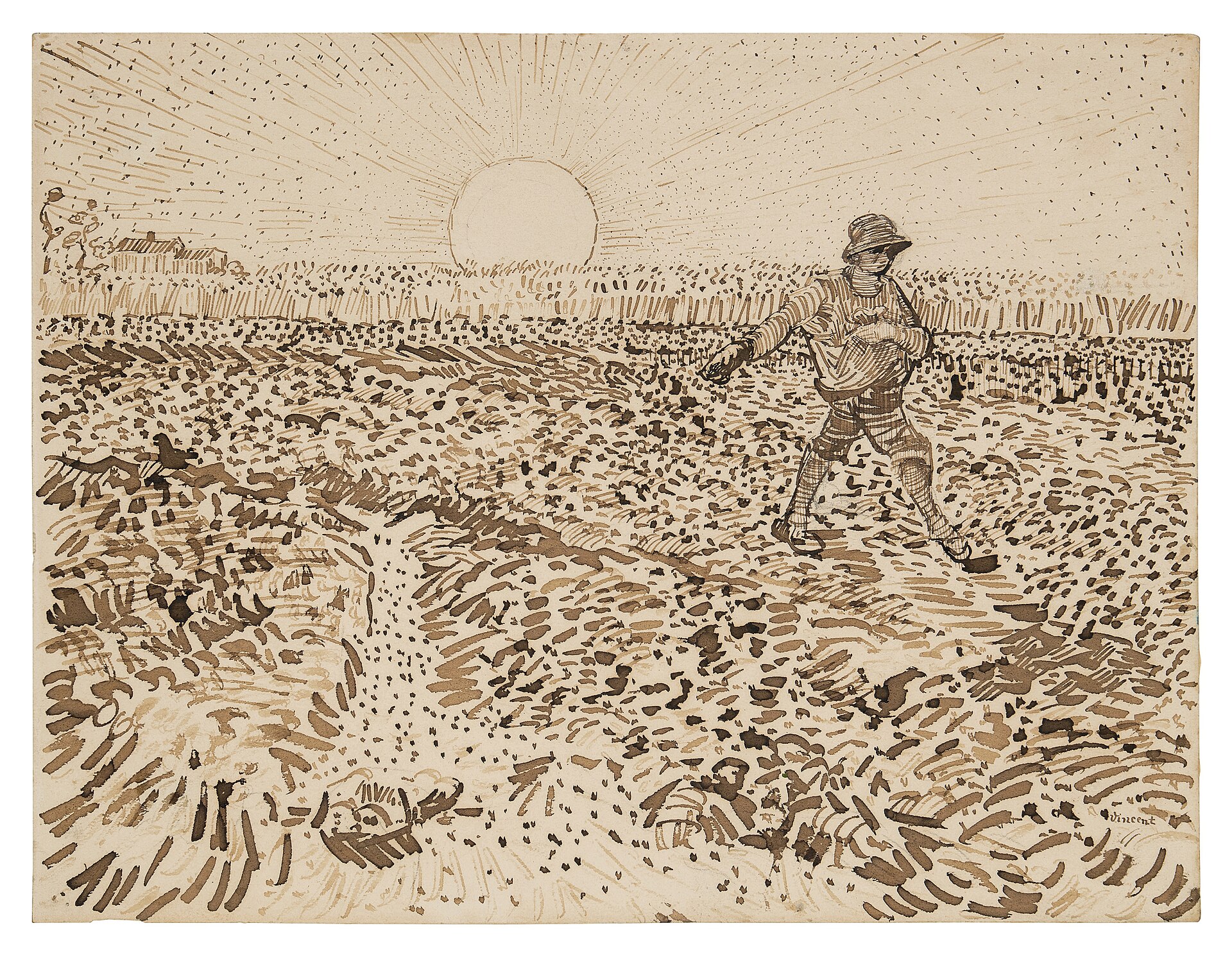
Sower with Setting Sun. Vincent van Gogh, mid July 1888. Sotheby's, New York, 18 November 2025, lot 4. Public domain.