
Psalm 31
24 verses · Individual lament
How great is Your goodness which You have laid up for those who fear You, which You have bestowed before the sons of men on those who take refuge in You!
Introduction
David, the Committed Spirit, Book 1: The book of David, Poetry, Psalms Overview.
David wrote this prayer in a season when his danger lay as much in his standing among his neighbours as in any threat to his life. It was kept for Israelites who had lost their place among their own people while enemies hunted them. The psalm swings between distress and trust more than once before it settles. Listen for the words of walls and high rock in its first half, set against one stretch of open ground. Listen also for the close, where the speaker turns from God to the congregation and gives them a charge.
Context
- Who
- Israelites who had been cut off by their neighbours as well as hunted by enemies
- What
- A prayer of a man cut off by his neighbours and hunted by enemies, which moves between distress and trust and ends in a charge to the congregation.
- Where
- A walled town used as a refuge, and a street where old friends cross to the other side
- When
- The reign of David, about 1010 to 970 BC by the superscription, which names no event.
- Why
- To give words to the loss of a place among one's own people, and to put the whole course of a life into God's keeping.
Historical context
The psalm is David's by its title, and it is the prayer of a man with enemies who are plotting and neighbours who have stopped speaking to him. The Hebrew behind stronghold is metsudah, a fort set in high rock. Against those closed words the psalm sets one open one at verse 8, ground where a hunted man cannot be cornered. What a first hearer understood is how dangerous verses 11 to 13 are. A man nobody would vouch for could not trade, could not borrow, could not marry his children well, and had nowhere to go when trouble came. The broken vessel of verse 12 is the most ordinary image in the psalm. A broken jar was past mending and past caring about. Verse 5 was a bedtime prayer and a dying man's prayer in Israel, a man handing his life back for the night or for good.
Significance
For the Israelites who sang it, the psalm gave words to a loss most laments do not name, the loss of a place among one's own people. It granted the whole of it and then put the whole course of a life, my times, into God's hands at verse 15. The last two verses turned the psalm outward. It stopped addressing God and told the congregation to love the LORD and take courage, so a private trouble ended as a public instruction.
This chapter in Jewish lifeWhat this chapter is in Jewish life and reading.
What is done
The line in which the psalmist puts his spirit into God's hands is said at bedtime. This site records it in its page on prayer in Luke, which gives Psalm 31:5 as a bedtime prayer taught to Jewish children and sets it beside the words Luke puts in the mouth of Jesus at the cross (/featured/prayer-in-luke). Jewish practice and Christian practice meet at that line, and they part over who is speaking it at Luke 23:46.
How it is read
Rashi is the commentator whose English this corpus carries on this psalm, in The Judaica Press complete Tanach with Rashi, translated by A. J. Rosenberg, under a CC-BY licence. He reads the psalm inside David's flight from Saul and names the places it came out of. On the kindness shown in a besieged city he writes:
for He has been wondrously kind to me in a beseiged city In Keilah, when Saul said concerning me (I Sam. 23:7): “for he has been shut in by coming into a city with doors and bars.” (Rashi on Psalms 31:22:1)
On the words spoken in haste he writes:
But I said in my haste When I left Keilah and came to the desert of Maon, I was hastening to leave because Saul and his men were surrounding me and my men, to seize us. (Rashi on Psalms 31:23:1)
He takes the entrusting of the spirit as a settled habit with a reason behind it:
I entrust Heb. אפקיד, komondere in Old French, I will entrust. I always entrust my spirit because You redeemed me from trouble. (Rashi on Psalms 31:6:1)
He reads the goodness stored up for those who fear God as reward in the world to come, asked for in this world because the wicked surround them, at Rashi on Psalms 31:20:1. Through the psalm he glosses the Hebrew into the Old French of his own readers, as at Rashi on Psalms 31:4:1 and Rashi on Psalms 31:14:1. Ibn Ezra stands on this chapter at Ibn Ezra on Psalms 31:2:1, 31:5:1, 31:8:1, 31:15:1 and 31:17:1, and Radak at Radak on Psalms 31:1:1. Sefaria holds no English version of those references, so this card cites them and quotes neither.
What the rabbis say
The corpus records 40 places where the rabbinic literature takes up a line of this psalm, 37 of them in the Midrash. Each is a locator, so the saying stands at its reference and is read there. The Midrash on the Psalms treats it at Midrash Tehillim 71:1, 31:1, 31:2, 18:25, 31:6, 6:4, 31:4, 15:1, 31:5 and 40:1. The Mekhilta of Rabbi Ishmael takes up the entrusting of the spirit at Mekhilta DeRabbi Yishmael, Tractate Shirah 9:1, Tractate Shirah 9:2 and Tractate Vayehi Beshalach 7:24. The Talmud takes up lines of the psalm at Berakhot 5a:1, Berakhot 58b:6 and Bava Metzia 75b:10. A reference outside this chapter is a passage elsewhere in the rabbinic literature that quotes the psalm rather than a comment written on it.
Sources: Rashi, Rashi on Psalms, in The Judaica Press complete Tanach with Rashi, translated by A. J. Rosenberg, under a CC-BY licence; Ibn Ezra, Ibn Ezra on Psalms, cited at Ibn Ezra on Psalms 31:2:1, 31:5:1, 31:8:1, 31:15:1 and 31:17:1; Radak, Radak on Psalms, cited at Radak on Psalms 31:1:1; Midrash Tehillim, the Midrash on the Psalms, cited at Midrash Tehillim 71:1, 31:1, 31:2, 18:25, 31:6, 6:4, 31:4, 15:1, 31:5 and 40:1; The Talmud, cited at Berakhot 5a:1, Berakhot 58b:6 and Bava Metzia 75b:10; MannaFest, prayer in Luke, at /featured/prayer-in-luke, 2026; MannaFest, the Sefaria corpus at scripts/data/sources/sefaria/psalms/31.json, fetched 2026-09-19, 2026.
Psalms 31:1-2
I have taken refuge: The psalm opens on trust before it names a trouble. The first things asked are speed and shelter, a quick rescue and a rock of refuge. The Hebrew behind stronghold is metsudah, a fortress in high rock.
Psalms 31:1
“In thee, O Lord, do I put my trust. Nowhere else do I fly for shelter, let the tempest howl as it may. The psalmist has one refuge, and that the best one. He casts out the great sheet anchor of his faith in the time of storm. Let other things be doubtful, yet the fact that he relies on Jehovah, David lays down most positively; and he begins with it, lest by stress of trial he should afterwards forget it.”
Charles Spurgeon · The Treasury of David, Vol. 2 (1870)Particular Baptist
Incline Your ear to me: Incline Your ear pictures God bending close to hear. Adam Clarke compared it to putting an ear to the lips of the dying, to catch what a weak voice can still say. He noted that caves in Judea served as natural fortresses, the picture behind rock of refuge.
Psalms 31:2
“Bow down thine ear to me. Condescend to my low estate; listen to me attentively as one who would hear every word. Heaven with its transcendent glories of harmony might well engross the divine ear, but yet the Lord has an hourly regard to the weakest moanings of his poorest people. Deliver me speedily. We must not set times or seasons, yet in submission we may ask for swift as well as sure mercy.”
Charles Spurgeon · The Treasury of David, Vol. 2 (1870)Particular Baptist
Psalms 31:3-4
my rock and my fortress: Verse 3 states as fact what verse 2 asked, my rock and my fortress. The guidance asked is for the sake of Your name, so God's own name carries the plea. The net of verse 4 is hidden, set by another.
Psalms 31:3
“For thou art my rock and my fortress. Here the tried soul avows yet again its full confidence in God. Faith's repetitions are not vain. The avowal of our reliance upon God in times of adversity is a principle method of glorifying him. Active service is good, but the passive confidence of faith is not one jot less esteemed in the sight of God. The words before us appear to embrace and fasten upon the Lord with a fiducial grip which is not to be relaxed.”
Charles Spurgeon · The Treasury of David, Vol. 2 (1870)Particular Baptist
the net laid out for me: Theodoret of Cyrus heard in the net the plot of Ahithophel against David. Charles Spurgeon noted that the verse allows the believer to be caught like a bird and still be freed from inside the mesh. Its ground is the last clause, You are my refuge.
Psalms 31:4
“Pull me out of the net that they have laid privily for me. The enemies of David were cunning as well as mighty; if they could not conquer him by power, they would capture him by craft. Our own spiritual foes are of the same order—they are of the serpent's brood, and seek to ensnare us by their guile. The prayer before us supposes the possibility of the believer being caught like a bird; and, indeed, we are so foolish that this often happens. So deftly does the fowler do his work that simple ones are soon surrounded by it.”
Charles Spurgeon · The Treasury of David, Vol. 2 (1870)Particular Baptist
Into Your hands I commit: Jesus prayed this line from the cross at Luke 23:46, Father, into Your hands I commit My Spirit. God of truth is El Emet in Hebrew, the title of a God who is faithful to what He says. Redemption is spoken in the past tense, before the rescue comes.
Psalms 31:5
"Lord, however it goes with me, as to my body, let it go well with my soul." Note, It is the wisdom and duty of every one of us solemnly to commit our spirits into the hands of God, to be sanctified by his grace, devoted to his honour, employed in his service, and fitted for his kingdom.
Matthew Henry · Commentary on the Whole Bible (1707-1721)puritan
1 more voice on this verse
Psalms 31:5
“Into thine hand I commit my spirit. These living words of David were our Lord's dying words, and have been frequently used by holy men in their hour of departure. Be assured that they are good, choice, wise, and solemn words; we may use them now and in the last tremendous hour. Observe, the object of the good man's solicitude in life and death is not his body or his estate, but his spirit; this is his jewel, his secret treasure; if this be safe, all is well. See what he does with his pearl!”
Charles Spurgeon · The Treasury of David, Vol. 2 (1870)Particular Baptist
Cross references
Psalms 31:5
- Quoted inLuke 23:46“Then Jesus called out in a loud voice, “Father, into Your hands I commit My Spirit.” And when He had said this, He breathed His last.”
'Into thy hands I commend my spirit', the last word from the cross
ConnectionsLuke 23:46
Psalms 31:6-8
who cling to worthless idols: Verse 6 puts two allegiances together, worthless idols and the LORD, and the trust goes to one of them. Verses 7 and 8 look back on mercy already given, affliction seen and anguish known. Set my feet in the open renders merchav, a wide place.
Psalms 31:6
“I have hated them that regard lying vanities. Those who will not lean upon the true arm of strength, are sure to make to themselves vain confidences. Man must have a god, and if he will not adore the only living and true God, he makes a fool of himself, and pays superstitious regard to a lie, and waits with anxious hope upon a base delusion. Those who did this were none of David's friends; he had a constant dislike to them: the verb includes the present as well as the past tense.”
Charles Spurgeon · The Treasury of David, Vol. 2 (1870)Particular Baptist
You have known the anguish of my soul: The psalm breaks into praise in the middle of its prayer, and Charles Spurgeon read glad and rejoice as praise that needs no stinting. Adam Clarke took You have known as God acknowledging him as His own when friends had turned away. Verse 11 shows those friends fleeing.
Psalms 31:7
“He had observed the temper of his spirit and the workings of his heart under his afflictions: " Thou hast known my soul in adversities, with a tender concern and care for it." God's eye is upon our souls when we are in trouble, to see whether they be humbled for sin, submissive to the will of God, and bettered by the affliction.”
Matthew Henry · Commentary on the Whole Bible (1707-1721)puritan
1 more voice on this verse
Psalms 31:7
“I will be glad and rejoice in thy mercy. For mercy past he is grateful, and for mercy future, which he believingly anticipates, he is joyful. In our most importunate intercessions, we must find breathing time to bless the Lord: praise is never a hindrance to prayer, but rather a lively refreshment therein. It is delightful at intervals to hear the notes of the high sounding cymbals when the dolorous sackbut rules the hour.”
Charles Spurgeon · The Treasury of David, Vol. 2 (1870)Particular Baptist
You have not delivered me to the enemy: Charles Spurgeon read delivered me to the enemy as handed over wholly to his power. He pictured the believer as a prisoner whose door stays open. Adam Clarke tied it to David's escapes from Saul, the spear thrown while he played before the king among them.
Psalms 31:8
“And hast not shut me up into the hand of the enemy. To be shut up in one's hand is to be delivered over absolutely to his power; now, the believer is not in the hand of death or the devil, much less is he in the power of man. The enemy may get a temporary advantage over us, but we are like men in prison with the door open; God will not let us be shut up, he always provides a way of escape. Thou hast set my feet in a large room.”
Charles Spurgeon · The Treasury of David, Vol. 2 (1870)Particular Baptist
Psalms 31:9-10
for I am in distress: The prayer turns back to present distress, and the toll is counted on the body, eyes, soul, strength and bones. Verse 10 names the cause, an iniquity that has drained his strength, so the sin and the suffering stand together in one line.
Psalms 31:9
“Have mercy upon me, O Lord, for I am in trouble. Now, the man of God comes to a particular and minute description of his sorrowful case. He unbosoms his heart, lays bare his wounds, and expresses his inward desolation. This first sentence pithily comprehends all that follows, it is the text for his lamenting discourse. Misery moves mercy—no more reasoning is needed. "Have mercy" is the prayer; the argument is as prevalent as it is plain and personal, "I am in trouble." Mine eye is consumed with grief. Dim and sunken eyes are plain indicators of failing health.”
Charles Spurgeon · The Treasury of David, Vol. 2 (1870)Particular Baptist
1 more voice on this verse
Psalms 31:9
“Herein he was a type of Christ,--who was intimately acquainted with grief and often in tears.”
Matthew Henry · Commentary on the Whole Bible (1707-1721)puritan
my life is consumed with grief: Consumed renders kalah, to waste away or be destroyed. Adam Clarke heard in anachah, the word for groaning, the very sound a grieving man makes. Matthew Henry held that David could plead innocence toward Saul and still own his iniquity before God.
Psalms 31:10
“For my life is spent with grief, and my years with sighing. It had become his daily occupation to mourn; he spent all his days in the dungeon of distress. The sap and essence of his existence was being consumed, as a candle is wasted while it burns. His adversities were shortening his days, and digging for him an early grave.”
Charles Spurgeon · The Treasury of David, Vol. 2 (1870)Particular Baptist
1 more voice on this verse
Psalms 31:10
“As to Saul, and the quarrel he had with him, he could confidently insist upon his righteousness; but, as it was an affliction God laid upon him, he owns he had deserved it, and freely confesses his iniquity to have been the procuring cause of all his trouble; and the sense of sin touched him to the quick and wasted him more than all his calamities.”
Matthew Henry · Commentary on the Whole Bible (1707-1721)puritan
Psalms 31:11-13
I am dreaded by my friends—: Isolation deepens by degrees, a disgrace to enemies, worse among neighbors, dreaded by friends who flee at the sight of him. Verse 12 adds a dead man out of mind and a clay pot past mending. Terror on every side becomes Jeremiah's own refrain at Jeremiah 20:10.
Psalms 31:11
“I was a reproach among all mine enemies. They were pleased to have something to throw at me; my mournful estate was music to them, because they maliciously interpreted it to be a judgment from heaven upon me. Reproach is little thought of by those who are not called to endure it, but he who passes under its lash knows how deep it wounds. The best of men may have the bitterest foes, and be subject to the most cruel taunts. But especially among my neighbours. Those who are nearest can stab the sharpest.”
Charles Spurgeon · The Treasury of David, Vol. 2 (1870)Particular Baptist
1 more voice on this verse
Psalms 31:11
“Thus he heard the slander of many; every one had a stone to throw at him, because fear was in every side; that is, they durst not do otherwise, for he that would not join with his neighbours to accuse David was looked upon as disaffected to Saul.”
Matthew Henry · Commentary on the Whole Bible (1707-1721)puritan
I am like a broken vessel: The Hebrew reads forgotten from the heart, and Albert Barnes explained the heart here as the memory of other men. Charles Spurgeon recalled that David had saved his country, and his service was now buried. Theodoret of Cyrus read the vessel as mislaid and forgotten.
Psalms 31:12
“I am forgotten as a dead man out of mind. All David's youthful prowess was now gone from remembrance; he had been the saviour of his country, but his services were buried in oblivion. Men soon forget the deepest obligations; popularity is evanescent to the last degree: he who is in every one's mouth today may be forgotten by all tomorrow. A man had better be dead than be smothered in slander. Of the dead we say nothing but good, but in the psalmist's case they said nothing but evil.”
Charles Spurgeon · The Treasury of David, Vol. 2 (1870)Particular Baptist
I hear the slander of many: Albert Barnes counted slander as the third trouble, after the scorn of verse 11 and the forgetting of verse 12. Adam Clarke noted that parallels in Jeremiah 18 to 20 led several readers to name Jeremiah as the author. Matthew Henry set this plot beside the plots against Christ's life.
Psalms 31:13
“For I have heard the slander of many. One slanderous viper is death to all comfort—what must be the venom of a whole brood? What the ear does not hear the heart does not rue; but in David's case the accusing voices were loud enough to break in upon his quiet—foul mouths had grown so bold, that they poured forth their falsehoods in the presence of their victim. Shimei was but one of a class, and his cry of "Go up, thou bloody man, "was but the common speech of thousands of the sons of Belial.”
Charles Spurgeon · The Treasury of David, Vol. 2 (1870)Particular Baptist
Psalms 31:14-16
But I trust in You: My times are in Your hands is the widest claim the psalm makes, the whole course of his days held by God. Make Your face shine on Your servant asks for the priestly blessing of Numbers 6:25 in his own words. What he asks it on is God's loving devotion.
Psalms 31:14
“But I trusted in thee, O Lord. Notwithstanding all afflicting circumstances, David's faith maintained its hold, and was not turned aside from its object. What a blessed saving clause is this! So long as our faith, which is our shield, is safe, the battle may go hard, but its ultimate result is no matter of question; if that could be torn from us, we should be as surely slain as were Saul and Jonathan upon the high places of the field. I said, Thou art my God. He proclaimed aloud his determined allegiance to Jehovah.”
Charles Spurgeon · The Treasury of David, Vol. 2 (1870)Particular Baptist
1 more voice on this verse
Psalms 31:14
“Two things he comforted himself with in his straits, and he went to God and pleaded them with him:-- 1. " Thou art my God; I have chosen thee for mine, and thou hast promised to be mine;" and, if he be ours and we can by faith call him so, it is enough, when we can call nothing else ours.”
Matthew Henry · Commentary on the Whole Bible (1707-1721)puritan
My times are in Your hands: Diodorus of Tarsus read my times as seasons, hard and glad. Matthew Henry set the line beside the cave, where David spared Saul and waited for God's time to deliver him. Albert Barnes concluded that no pursuer could take his life before that time.
Psalms 31:15
“My times are in thy hand. The sovereign arbiter of destiny holds in his own power all the issues of our life; we are not waifs and strays upon the ocean of fate, but are steered by infinite wisdom towards our desired haven. Providence is a soft pillow for anxious heads, an anodyne for care, a grave for despair. Deliver me from the hand of mine enemies, and from them that persecute me.”
Charles Spurgeon · The Treasury of David, Vol. 2 (1870)Particular Baptist
1 more voice on this verse
Psalms 31:15
“When David had Saul at his mercy in the cave those about him said, " This is the time in which God will deliver thee," 1 Sam. xxiv. "No," says David, "the time has not come for my deliverance till it can be wrought without sin; and I will wait for that time; for it is God's time, and that is the best time." 2.”
Matthew Henry · Commentary on the Whole Bible (1707-1721)puritan
Make Your face shine on Your servant: Diodorus of Tarsus heard a man who felt God had turned away, asking only to be looked on again. Charles Spurgeon noted that a servant needs only his master's favor. Augustine read the shining face as God showing openly that this man belongs to Him.
Psalms 31:16
“Make thy face to shine upon thy servant. Give me the sunshine of heaven in my soul, and I will defy the tempests of earth. Permit me to enjoy a sense of thy favour, O Lord, and a consciousness that thou art pleased with my manner of life, and all men may frown and slander as they will. It is always enough for a servant if he pleases his master; others may be dissatisfied, but he is not their servant, they do not pay him his wages, and their opinions have no weight with him.”
Charles Spurgeon · The Treasury of David, Vol. 2 (1870)Particular Baptist
1 more voice on this verse
Psalms 31:16
“Since it seemed as though God had turned away from them and was angry with them, he asks for reconciliation: Only have regard to me, he is saying, and it is sufficient for my salvation.”
Diodorus of Tarsus · written before 390 · Commentary on Psalm 31patristic
Psalms 31:17-18
let me not be ashamed: The prayer of verse 1 comes back, and now the shame is asked onto the wicked. Let them lie silent in Sheol asks God to put them down among the dead. Lying lips stand against the God of truth in verse 5.
Psalms 31:17
“Let me not be ashamed, O Lord; for I have called upon thee. Put not my prayers to the blush! Do not fill profane mouths with jeers at my confidence in my God. Let the wicked be ashamed, and let them be silent in the grave. Cause them to their amazement to see my wrongs righted and their own pride horribly confounded.”
Charles Spurgeon · The Treasury of David, Vol. 2 (1870)Particular Baptist
May lying lips be silenced—: Charles Spurgeon listed three ways God may silence such lips, by repentance, by open shame, or by making their words count for nothing. Albert Barnes gave the Hebrew word for their speech as athaq, bold and impudent. Matthew Henry looked to the judgment of Jude 14 and 15.
Psalms 31:18
“Let the lying lips be put to silence. A right good and Christian prayer; who but a bad man would give liars more license than need be? May God silence them either by leading them to repentance, by putting them to thorough shame, or by placing them in positions where what they may say will stand for nothing. Which speak grievous things proudly and contemptuously against the righteous.”
Charles Spurgeon · The Treasury of David, Vol. 2 (1870)Particular Baptist
1 more voice on this verse
Psalms 31:18
“Sometimes by his providence he visibly confutes their calumnies, and brings forth the righteousness of his people as the light. However, there is a day coming when God will convince ungodly sinners of the falsehood of all the hard speeches that have spoken against his people and will execute judgment upon them, Jude 14, 15 .”
Matthew Henry · Commentary on the Whole Bible (1707-1721)puritan
Psalms 31:19-20
How great is Your goodness: Goodness laid up is a store held in reserve, and it is given out before the sons of men, in open sight. Verse 20 names the hiding place twice, the secret place of Your presence and Your shelter. He is hidden from men's schemes and from accusing tongues.
Psalms 31:19
“There is enough in bank and enough in hand. (2.) This goodness is laid up in his promise for all that fear God, to whom assurance is given that they shall want no good thing. But it is wrought, in the actual performance of the promise, for those that trust in him--that by faith take hold of the promise, put it in suit, and draw out to themselves the benefit and comfort of it.”
Matthew Henry · Commentary on the Whole Bible (1707-1721)puritan
1 more voice on this verse
Psalms 31:19
“Oh how great is thy goodness. Is it not singular to find such a joyful sentence in connection with so much sorrow? Truly the life of faith is a miracle. When faith led David to his God, she set him singing at once. He does not tell us how great was God's goodness, for he could not; there are no measures which can set forth the immeasurable goodness of Jehovah, who is goodness itself. Holy amazement uses interjections where adjectives utterly fail. Notes of exclamation suit us when words of explanation are of no avail.”
Charles Spurgeon · The Treasury of David, Vol. 2 (1870)Particular Baptist
the secret place of Your presence: The Hebrew is the secret of Your face, which Adam Clarke rendered the covering of Your countenance. Charles Spurgeon placed the hidden ones in the innermost court of God's house, where pride cannot follow. Matthew Henry recalled how the LORD hid Baruch and Jeremiah.
Psalms 31:20
“Thou shalt hide them in the secret of thy presence from the pride of man. Pride is a barbed weapon: the proud man's contumely is iron which entereth into the soul; but those who trust in God, are safely housed in the Holy of holies, the innermost court, into which no man may dare intrude; here in the secret dwelling place of God the mind of the saint rests in peace, which the foot of pride cannot disturb. Dwellers at the foot of the cross of Christ grow callous to the sneers of the haughty.”
Charles Spurgeon · The Treasury of David, Vol. 2 (1870)Particular Baptist
2 more voices on this verse
Psalms 31:20
“As if they were in thy presence chamber, where thine own eye and hand girdeth them, from all the assaults of their enemies; called his secret, partly, because the greatest part of the world are strangers to God and his presence: and partly, because it is a safe and secure place, such as secret and unknown places are.”
John Wesley · Explanatory Notes upon the Old Testament (1765)evangelical
Psalms 31:20
“He has many ways of sheltering them. When Baruch and Jeremiah were sought for the Lord hid them, Jer. xxxvi. God's grace shall keep them safe from the evil of the judgments that are abroad; to them they have no sting; and they shall hidden in the day of the Lord's anger, for there is no anger at them.”
Matthew Henry · Commentary on the Whole Bible (1707-1721)puritan
Psalms 31:21-22
in a city under siege: His loving devotion came while the city was under siege. In my alarm I said reports words spoken in panic, that he was cut off from Your sight. The verse then says God heard his plea for mercy.
Psalms 31:21
The mercy of God is not so "marvellous" when it is shown in humbler cities as when it is shown in "a strong city," and for this reason "God is to be blessed."
Hippolytus of Rome · written before 235 · Fragments from Commentaries on Various Books of Scripture - On Psalm XXXI. 22patristic
1 more voice on this verse
Psalms 31:21
“Blessed be the Lord. When the Lord blesses us we cannot do less than bless him in return. For he hath shewed me his marvellous kindness in a strong city. Was this in Mahanaim, where the Lord gave him victory over the hosts of Absalom? Or did he refer to Rabbath of Ammon, where he gained signal triumphs? Or, best of all, was Jerusalem the strong city where he most experienced the astonishing kindness of his God? Gratitude is never short of subjects; her Ebenezers stand so close together as to wall up her path to heaven on both sides.”
Charles Spurgeon · The Treasury of David, Vol. 2 (1870)Particular Baptist
In my alarm I said: Albert Barnes took the word behind alarm as the terror that sends a man running. He pointed to David's flight from Saul at 1 Samuel 23:26. Matthew Henry drew from it that God's promise held when David's faith gave way.
Psalms 31:22
“Confession of faults is always proper; and when we reflect upon the goodness of God, we ought to be reminded of our own errors and offences. For I said in my haste. We generally speak amiss when we are in a hurry. Hasty words are but for a moment on the tongue, but they often lie for years on the conscience. I am cut off from before thine eyes.”
Charles Spurgeon · The Treasury of David, Vol. 2 (1870)Particular Baptist
1 more voice on this verse
Psalms 31:22
“Note, It is a common thing to speak amiss when we speak in haste and without consideration; but what we speak amiss in haste we must repent of at leisure, particularly that which we have spoken distrustfully of God. (2.) Of God's wonderful goodness to him notwithstanding. Though his faith failed, God's promise did not: Thou hearest the voice of my supplication, for all this.”
Matthew Henry · Commentary on the Whole Bible (1707-1721)puritan
Psalms 31:23-24
Love the LORD, all His saints: The last two verses address the saints. Preserves the faithful and fully repays the arrogant are the two outcomes the psalm has prayed for since verse 1. Be strong and courageous hands his own experience on to all who hope in the LORD.
Psalms 31:23
“O love the Lord, all ye his saints. A most affecting exhortation, showing clearly the deep love of the writer to his God: there is the more beauty in the expression, because it reveals love toward a smiting God, love which many waters could not quench. To bless him who gives is easy, but to cling to him who takes away is a work of grace. All the saints are benefited by the sanctified miseries of one, if they are led by earnest exhortations to love their Lord the better. If saints do not love the Lord, who will?”
Charles Spurgeon · The Treasury of David, Vol. 2 (1870)Particular Baptist
1 more voice on this verse
Psalms 31:23
“Those that have their own hearts full of love to God cannot but desire that others also may be in love with him; for in his favour there is no need to fear a rival. It is the character of the saints that they do love God; and yet they must still be called upon to love him, to love him more and love him better, and give proofs of their love.”
Matthew Henry · Commentary on the Whole Bible (1707-1721)puritan
Be strong and courageous: Adam Clarke thought Paul's charge at 1 Corinthians 16:13 was borrowed from the Septuagint's Greek of this verse. Albert Barnes noted that Psalm 27 closes on the same charge. John Gill reasoned that no reader's trouble could be worse than David's, and David was delivered.
Psalms 31:24
“Be of good courage. Keep up your spirit, let no craven thoughts blanch your cheek. Fear weakens, courage strengthens. Victory waits upon the banners of the brave. And he shall strengthen your heart. Power from on high shall be given in the most effectual manner by administering force to the fountain of vitality. So far from leaving us, the Lord will draw very near to us in our adversity, and put his own power into us. All ye that hope in the Lord. Every one of you, lift up your heads and sing for joy of heart.”
Charles Spurgeon · The Treasury of David, Vol. 2 (1870)Particular Baptist
How this psalm is built
The form: A prayer of one in trouble, with thanksgiving set inside it before the trouble has ended, as Delitzsch classes it.
The patterns in this chapter
| Device | What it does | Where to see it |
|---|---|---|
| The fortress words, kept up from the first verse to the last | The psalm is built out of the vocabulary of defended places: a rock of refuge at verse 2, a stronghold, a fortress at verse 3, a hiding place at verse 20, and a city under siege at verse 21. The Hebrew behind stronghold is metsudah, a fort set in high rock. Against them the psalm sets one open word, the wide place of verse 8, where a hunted man is no longer cornered.Matthew Henry, Commentary on the Whole Bible, 1710, on Psalm 31:1 to 8. | Psalm 31:2, Psalm 31:3, Psalm 31:8, Psalm 31:20, Psalm 31:21 |
| Let me never be put to shame, asked at the start and again in the middle | Verse 1 asks that he never be put to shame, and verse 17 asks it again and then asks the shame onto the wicked instead. The prayer of the first line is the prayer of the turn, so the second half of the psalm is the first half answered.John Gill, Exposition of the Old Testament, 1748 to 1763, on Psalm 31:17. | Psalm 31:1, Psalm 31:17 |
| Three pictures of a man nobody will stand near | Verses 11 and 12 measure the isolation in steps: a disgrace to enemies, worse among neighbours, dreaded by friends who cross the street. Then two images finish it, a dead man out of mind and a broken pot. A clay jar past mending was swept out, and the pieces were worth nothing.Charles Spurgeon, The Treasury of David, Vol. 2, 1870, on Psalm 31:12. | Psalm 31:11, Psalm 31:12 |
| The turn at verse 14, where the psalm stops describing and starts trusting | Everything before verse 14 is the trouble and everything after it is held by one sentence, But I trust in You, O LORD. The claim that follows it, my times are in Your hands, is the widest thing the psalm says, and it covers the whole course of his days rather than the present danger alone.Matthew Henry, Commentary on the Whole Bible, 1710, on Psalm 31:14 to 18. | Psalm 31:14, Psalm 31:15 |
The New Testament's use
8 more paragraphs on the patterns
Verse 5 is the line the psalm is known by. Jesus prays it as His last sentence from the cross at Luke 23:46, adding the word Father to the front of it. In the psalm the words are a living man's, spoken while the danger is still on, and redemption is stated in the past tense before the rescue has come.
Terror on every side at verse 13 is a phrase Jeremiah takes up and makes his own. It stands in his mouth at Jeremiah 20:10, where the men around him are watching for his fall in the same way.
Verse 16, make Your face shine on Your servant, asks for the priestly blessing of Numbers 6:25 in the psalmist's own words, so the prayer of a hunted man borrows the language the priests said over the whole congregation.
The psalm keeps one pairing throughout. God is called the God of truth at verse 5, and the lying lips of verse 18 are asked to be silenced. What the enemy does with his mouth is set against what God is.
The debated concept
The psalm confesses an iniquity of its own at verse 10 and asks for vindication against liars at verse 18, and commentators divide on how the two fit. Matthew Henry reads the iniquity as the acknowledged cause of the affliction and the vindication as a claim against a specific false charge rather than a claim of innocence. Albert Barnes reads verse 10 as the sufferer tracing his weakness to sin in general terms, which leaves the charge of verse 18 untouched. Neither reading removes the tension, and the psalm does not resolve it.
The divine connection
Verse 5 is the clearest case in the psalm of a line that meant one thing to its writer and more in the event. In the psalm it is a living man entrusting himself to God through a danger. At Luke 23:46 it is the last sentence of a dying man, and the church has read the psalm since Augustine as the voice of the Head that the members learn. The text itself claims no prophecy, and the New Testament makes the connection by use rather than by citation formula, which is how the claim should be stated.
Keep studying
Sources for this chapter
The summary
Jamieson, Fausset & Brown, Commentary Critical and Explanatory; John Calvin, Commentaries; John Wesley, Notes on the Old Testament and Matthew Henry, Complete Commentary.
The form and classifications
Albert Barnes, Notes on the Book of Psalms, 1832 to 1869, on Psalm 31:20; Charles Spurgeon, The Treasury of David, Vol. 2, 1870, on Psalm 31; Franz Delitzsch, Biblical Commentary on the Psalms, on Psalm 31 and Matthew Henry, Commentary on the Whole Bible, 1710, on Psalm 31.
The exposition
Adam Clarke, Commentary on the Bible; Albert Barnes; Augustine of Hippo, Exposition on Psalm 31; Charles Spurgeon; Diodorus of Tarsus, Commentary on Psalm 31; Franz Delitzsch, Biblical Commentary on the Psalms; Jamieson, Fausset and Brown, Commentary Critical and Explanatory on the Whole Bible; John Gill, Exposition of the Old Testament; Matthew Henry, Commentary on the Whole Bible and Theodoret of Cyrus, Commentary on the Psalms.
The painting
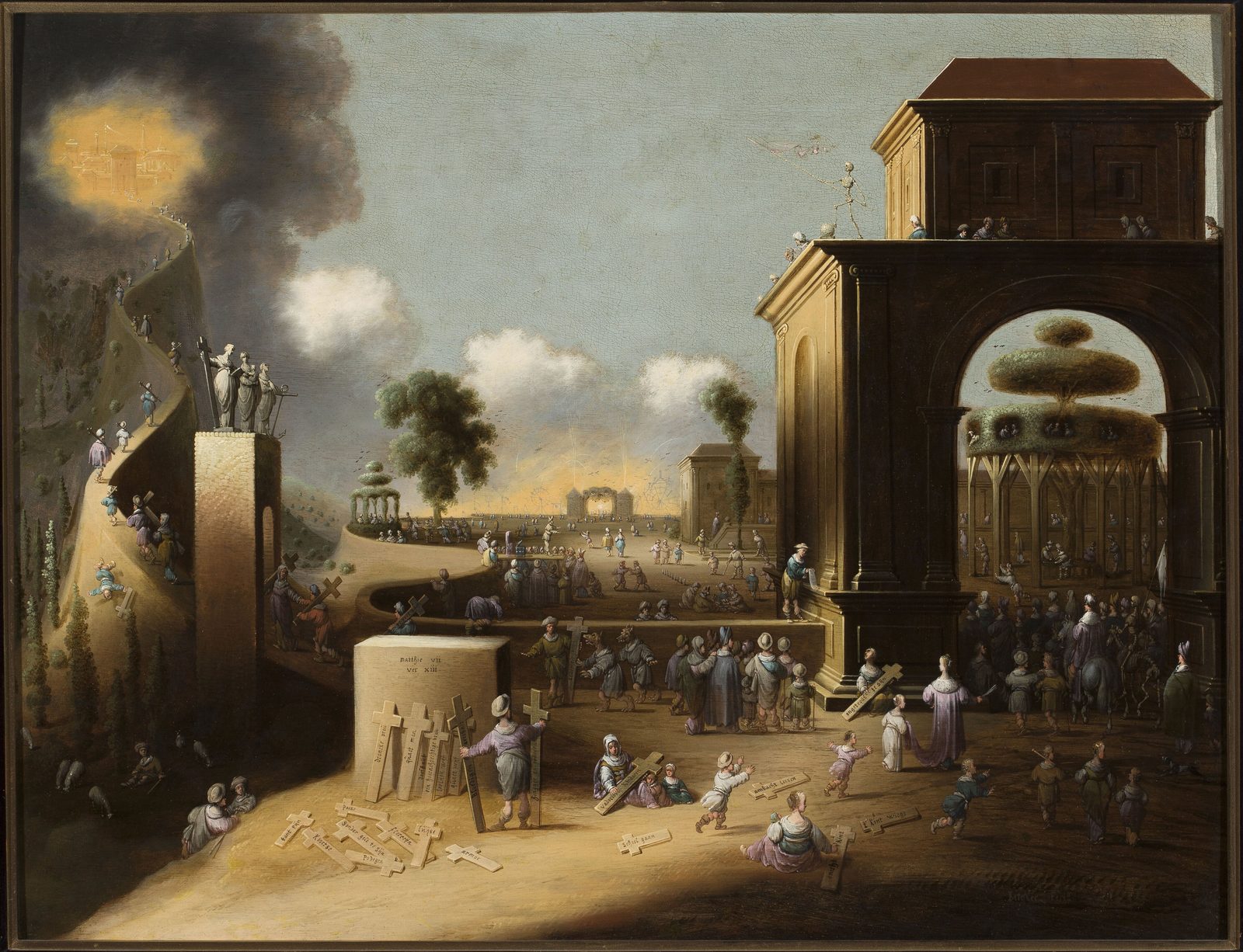
Narrow Road of Virtue and Wide Road of Sin. Jan Micker, not stated on the file page. National Museum in Warsaw. Public domain.