
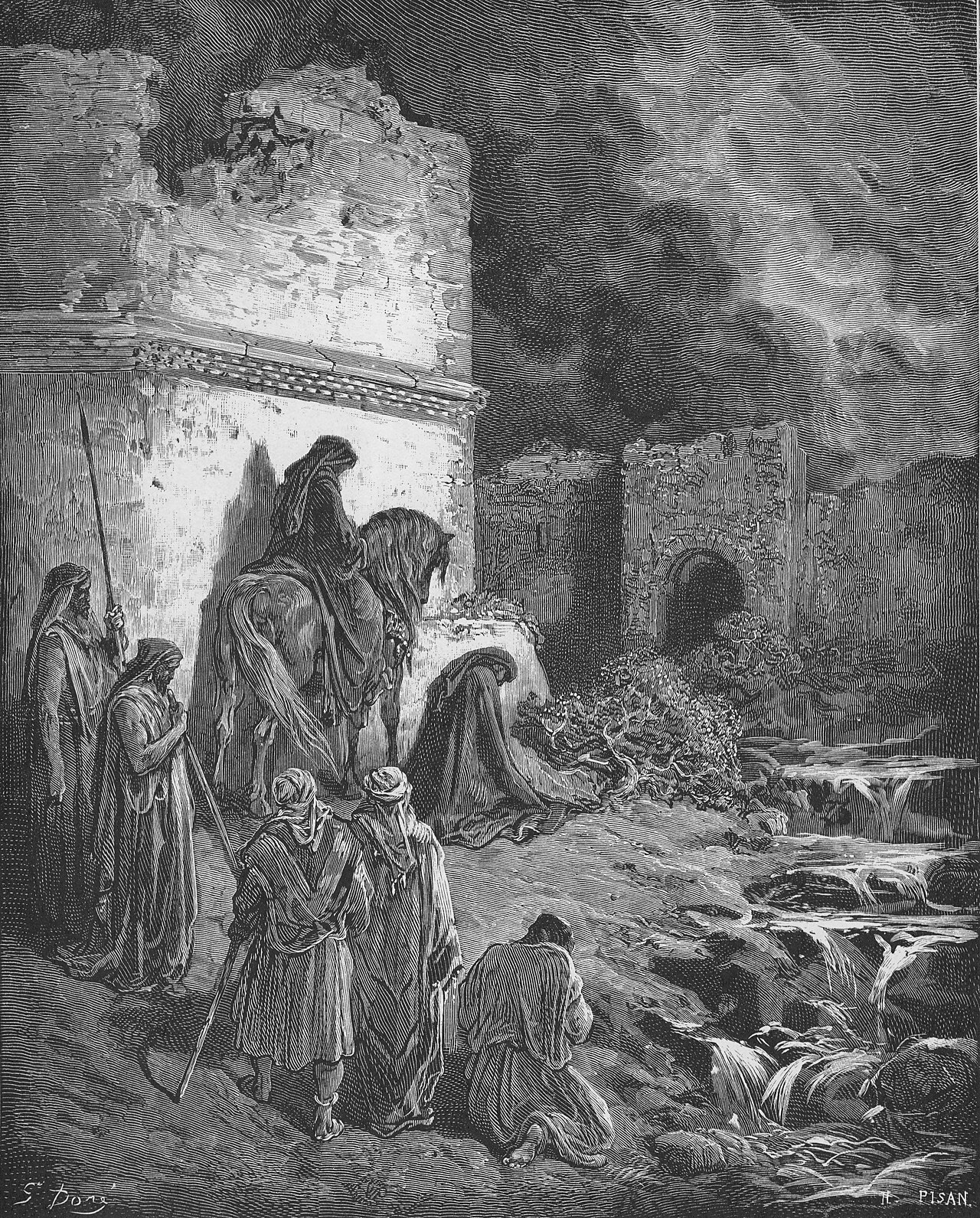
Nehemiahchapter 3
32 verses · Nehemiah · 5th century BC · History
At the Sheep Gate, Eliashib the high priest and his fellow priests began rebuilding. They dedicated it and installed its doors. After building as far as the Tower of the Hundred and the Tower of Hananel, they dedicated the wall.
Introduction
Nehemiah, History, Nehemiah Overview.
Nehemiah kept this record as governor, and it reads like the work roster of a city. His hearers were the families whose own names stood on the sections of wall they had built. The chapter is a list, and a list of this kind was a public record of who had done the work and where. It walks the reader around the whole city, gate by gate. Listen for the variety of people named, from priests and officials to craftsmen and whole towns, and for the one group that would not bend to the work. Every section of the wall has a name attached to it.
Context
- Who
- The families whose names are on the sections they built
- What
- A record of the families, towns and trades that rebuilt each section and gate of Jerusalem's wall.
- Where
- The circuit of Jerusalem's wall, beginning and ending at the Sheep Gate near the temple.
- When
- The summer of 445 BC, during the fifty-two days of the rebuilding.
- Why
- To record that the whole community shared the work, and to honour by name those who did it.
Historical context
This chapter is a work roster written as a walk around the city. It moves counter-clockwise from the Sheep Gate near the temple, naming gate after gate, Fish, Old, Valley, Dung, Fountain, Water, Horse, East, and the gate Miphkad, and the tower of the furnaces, the tower of Hananeel, the pool of Siloah, the king's garden, the stairs that go down from the city of David.
Show the rest of the historical context, 2 more paragraphs
The work was organised by group rather than by trade. Priests build the Sheep Gate. Goldsmiths and perfumers work on a stretch. Merchants take a section. Men repair the piece in front of their own houses, which is the oldest trick in civic construction and the reason a lot of it got done.
Excavation on the eastern slope of the old city has turned up wall construction from this general period on the ridge above the earlier ruins, on a tighter line than the pre-exilic city, consistent with a smaller, poorer town rebuilding fast on what it could hold.
Significance
Two details give the chapter its human edge. The nobles of Tekoa "put not their necks to the work of their Lord", the one recorded group of refusers, and their town's ordinary men are named twice for doing double duty. And Shallum's daughters are named as builders.
Show the rest of the significance, 1 more paragraph
For a people whose recent history was a list of things taken from them, this is a list of things they made. It is the least quotable chapter in Nehemiah and the reason the rest of the book happens.
This chapter in Jewish lifeWhat this chapter is in Jewish life and reading.
What is done
This chapter has no place in the synagogue year. The site's own table in src/lib/hebraic/readings.ts printed parashot total 0 and haftarah uses total 0 for Nehemiah, and no festival reading.
The corpus ties only a few of its verses to the study house. Under the first verse, the Sheep Gate, it carries Tractate Soferim 21:9, and under the fifteenth Tractate Soferim 7:1. Under the twenty-sixth it carries Yevamot 20a:8 with the Jerusalem Talmud at Kiddushin 4:1:7 and Sanhedrin 6:7:3.
How it is read
Rashi is the one commentator on this chapter whose English the corpus carries, quoted here from The Judaica Press complete Tanach with Rashi, translated by A. J. Rosenberg, which Sefaria reports as CC-BY. Most of his notes name things. The Sheep Gate, the Fish Gate and the Old Gate were the names of gates (Rashi on Nehemiah 3:1:1, 3:3:1 and 3:6:1). The Tekoites took their name from their town, and the goldsmiths were a family called by their craft (Rashi on Nehemiah 3:5:1 and 3:8:1). Beth Zur is the name of a place (Rashi on Nehemiah 3:16:1).
Two notes explain how the work was shared. A man whose house stood near a stretch of the wall had his lot fall there (Rashi on Nehemiah 3:10:1 and 3:23:1). The phrase a second section Rashi reads as a measure matched to the work of the builder before. He adds an observation about the whole chapter, that the word is kept for the wall "for we do not find in the entire chapter of the building of the gates the expression of a measure." (Rashi on Nehemiah 3:11:1).
One note keeps a detail a hurried reader passes over. Shallum repaired his section with his daughters, and Rashi lets the plain sense stand (Rashi on Nehemiah 3:12:1). The ascent to the armory he reads by the simple sense of the verse as a place near the wall where the mighty men kept their weapons (Rashi on Nehemiah 3:19:1).
The verse numbers here are the corpus's own. Sefaria numbers by the Hebrew text, and its chapter 3 carries locators as far as a thirty-fourth verse, where the corpus sets Otzar Midrashim, Midrash Minayin 1:15. A reader who counts in an English Bible may find the last verses of this chapter numbered at the start of the next chapter instead.
The corpus carries two further notes on this chapter without an English text, each marked linked because Sefaria holds no English version of the ref. They stand cited and unquoted at Metzudat David on Nehemiah 3:14:1 and 3:24:1.
What the rabbis say
The corpus carries eight rabbinic locators on this chapter and the text of none, so each is cited and linked here rather than quoted. On the first verse it holds Tractate Soferim 21:9. On the fifteenth it holds Tractate Soferim 7:1. On the sixteenth it holds Introductions to Tanaitic Literature, Introduction to Halakhic Midrashim, Sifrei Zuta 56.
On the twenty-sixth verse the corpus holds Jerusalem Talmud Kiddushin 4:1:7, Jerusalem Talmud Sanhedrin 6:7:3, Midrash Tehillim 17:15 and Yevamot 20a:8. On the thirty-fourth it holds Otzar Midrashim, Midrash Minayin 1:15. What each of them teaches is a saying of the rabbis, and is reported as theirs wherever this site quotes one. The quotations wait on a fetch that carries the text.
Sources: Rashi, Rashi on Nehemiah 3:1:1 to 3:25:1, The Judaica Press complete Tanach with Rashi, translated by A. J. Rosenberg, reported CC-BY; Metzudat David, Metzudat David on Nehemiah 3:14:1 and 3:24:1, cited by ref because the corpus carries no English text; The Sefaria corpus, scripts/data/sources/sefaria/nehemiah/3.json, the 8 Talmud and Midrash locators of this chapter; The site's own files, src/lib/hebraic/readings.ts, printing no portion, no Haftarah and no festival reading for this book.
The heads below are this chapter's scenes. The numbered points under each are its verses.
Sheep gate to dung gate: priests, goldsmiths, and rulers at work
Nehemiah 3:1-2
At the Sheep Gate: The high priest builds first, and the sheep gate he raises is the only stretch the chapter says was SANCTIFIED. The circuit that begins here will close here, and its first and last stone belong to worship. Leadership in this roll means a trowel in the high priest's hand.
Nehemiah 3:1
“Eliashib (compare the marginal reference) was the grandson of Joshua, the high priest contemporary with Zerubbabel. The sheep gate - This was a gate in the eastern wall, not far from the pool of Bethesda, marginal reference, which was perhaps originally a sheep-pool. The exact line which the writer follows in describing the circuit of the wall will probably be always a matter of dispute.”
1 more voice on this verseWhat preachers and commentators have said about this verse, in their own words.
Nehemiah 3:1
“The priests repaired the sheep-gate, so called because through it were brought the sheep that were to be sacrificed in the temple; and therefore the priests undertook the repair of it because the offerings of the Lord made by fire were their inheritance. And of this gate only it is said that they sanctified it with the word and prayer, and perhaps with sacrifices perhaps, 1.”
Matthew Henry · Commentary on the Whole Bible (1707-1721)puritan
The men of Jericho built next: Barnes explains the pattern that starts here: the men of each town worked the stretch nearest their home, so Jericho built at the northeast corner. Ezra 2:34 counts 345 men of Jericho among the first returnees.
Nehemiah 3:2
“The people of each provincial town were set to work for the most part on the portion of the wall nearest their city. Thus, “the men of Jericho,” were employed at the northeast corner of Jerusalem.”
Nehemiah 3:3-5
The Fish Gate: Verse 5 carries one shame clause: "the Tekoites made repairs, but their nobles did not put their shoulders to the work under their supervisors" (3:5). The nobles hold back while their townsmen build, and the same Tekoites repair "another section" at verse 27 while their nobles' sentence stands.
Nehemiah 3:3
“The fish gate - The gate through which fish from the Jordan and the Sea of Galilee entered Jerusalem; a gate in the north wall, a little to the east of the modern Damascus gate. Locks - The word used (here and in Neh 3:6, Neh 3:13-15) is thought to mean rather a “cross-bar” than a lock, while that translated “bars” is regarded as denoting the “hooks” or “catches” which held the cross-bar at its two ends.”
Meremoth son of Uriah, the son of Hakkoz: Gill identifies Meremoth with the priest who received the weighed temple silver on Ezra's arrival (Ezra 8:33). The family of Hakkoz had once been kept from the priesthood for want of a record (Ezra 2:61-62). Meshullam son of Berechiah reappears at 6:18, tied by marriage to Tobiah.
Nehemiah 3:4
“And next unto them repaired Meremoth, the son of Uriah, the son of Koz,.... And the men under him; see Ezr 8:33, this part of the wall on which they worked was not wholly demolished, only weakened, and therefore did not rebuild it, but repaired and strengthened it, and this phrase is used all along afterwards: and next unto them repaired Meshullam, the sort of Berechiah, the son of Meshezabeel: and next unto them repaired Zadok, the son of Baana; but who they were cannot be said.”
their nobles did not put their shoulders: The Berean reads the phrase as work under their supervisors, while Wesley reads it as work for God, whose work the wall of Jerusalem was. The nobles of Tekoa refused to put their shoulders to it. Tekoa was the home of Amos (Amos 1:1).
Nehemiah 3:5
“Of their Lord - Of God, whom they owned for their Lord, whose work this was, because it had proceeded thus far by his singular providence: and because it was done for the defense of the city, and people, and temple of God. And therefore they are branded to all posterity.”
John Wesley · Explanatory Notes upon the Old Testament (1765)evangelical
Nehemiah 3:6-12
The Jeshanah Gate: The builders are tradesmen: at verse 8 "one of the goldsmiths" and "Hananiah son of the perfumer" make repairs. At verse 12 Shallum repairs "with the help of his daughters," women named into the wall's record. Perfumers and goldsmiths doing masonry picture a city where the work outranked the trade.
Nehemiah 3:6
“Moreover, the old gate repaired Jehoiada, the son of Paseah, and Meshullam the son of Besodeiah,.... Which some think was so called because it led to the old city Salem. Dr. Lightfoot (a) thinks it is the same with the second or third gate, Zep 1:10. According to Vatablus, it was the gate of the old pool, Isa 22:11, or rather, perhaps, it was the gate of the old wall Josephus speaks of (b); it led to the north of the land: they laid the beams thereof; as in Neh 3:3. (a) Ut supra. (Chorograph.”
Melatiah the Gibeonite, Jadon the Meronothite: Gill places Gibeon and Mizpah in Benjamin (Joshua 18:25-26). Barnes reads the last clause to mean that the men answered to the governor west of the Euphrates, and still came to repair the wall.
Nehemiah 3:7
“And next unto them repaired Melatiah the Gibeonite, and Jadon the Meronothite, the men of Gibeon and Mizpah,.... Which places were both in the tribe of Benjamin, Jos 18:25 and one of these men was of the one place, and the other of the other: unto the throne of the governor on this side the river; where the governor of those parts under the king of Persia had his seat, and now Nehemiah; but, according to Aben Ezra, Cisse, rendered "throne", is the name of a man who was the governor.”
1 more voice on this verse
Nehemiah 3:7
Unto the throne ... - The meaning is thought to be “the men of Gibeon and Mizpah, who, though they worked for Nehemiah, were not under his government, but belonged to the jurisdiction of the governor on this side the river.”
one of the goldsmiths, made repairs: Clarke finds guilds of goldsmiths and perfumers, the perfumers dealing in spices for burial and in the incense of the temple. Spurgeon pictures the Broad Wall as the defence and glory of Jerusalem, and preaches it as the church's separation, security and enjoyment. The Broad Wall recurs at 12:38.
Nehemiah 3:8
“IT seems that around Jerusalem of old, in the time of her splendor, there was a broad wall which was her defense and her glory. Jerusalem is a type of the Church of God. It is always well when we can see clearly, distinctly and plainly that around the Church to which we belong there runs a broad wall. This idea of a broad wall around the Church suggests three things, separation, security and enjoyment. Let us examine each of these in its turn. I.”
Charles Spurgeon · written before 1892 · The Metropolitan Tabernacle Pulpit, Sermon No. 3281: “The Broad Wall” (lightly modernized text, CCEL edition)Particular Baptist
1 more voice on this verse
Nehemiah 3:8
“Goldsmiths - From the remotest period of the history of the Jews they had artists in all elegant and ornamental trades; and it is also evident that goldsmiths, apothecaries, and merchants were formed into companies in the time of Nehemiah. Apothecaries - Rather such as dealt in drugs, aromatics, spices, etc., for embalming, or for furnishing the temple with the incense consumed there.”
Adam Clarke · Commentary on the Bible (1810-1826)evangelical
ruler of a half-district of Jerusalem: Clarke takes Jerusalem to have been divided into two districts, one for Judah and one for Benjamin, each with its own ruler. Rephaiah held one half; Shallum held the other (3:12). Rulers of districts at Beth-haccherem, Mizpah, Beth-zur and Keilah also take sections in this chapter.
Nehemiah 3:9
“Ruler of the half part of Jerusalem - Probably the city was divided into two parts; one for Judah, and the other for Benjamin, each having its proper governor. Rephaiah mentioned here was one of these governors, and Shallum, mentioned Neh 3:12, was the other. There were other rulers or governors of particular country or village districts.”
Adam Clarke · Commentary on the Bible (1810-1826)evangelical
made repairs across from his house: Jedaiah is the first builder set to work across from his own house, a pattern that returns at verses 23, 28, 29 and 30. Matthew Henry puts the sense of it plainly: if every one sweeps before his own door, the street will be clean.
Nehemiah 3:10
“And next unto him repaired Jedaiah, the son of Harumaph, over against his house,.... That part of the wall which stood right against his house; and to take this part he could not well object to it, and it might be reasonably thought he would take care to repair it well, and make it strong for his own safety: and next unto him repaired Hattush, the son of Hashabniah; but who he was is not known.”
as well as the Tower of the Ovens: Harim and Pahath-moab are family names from the first return (Ezra 2:6, 2:32). Barnes notes that another section implies a first one, and some suppose a verse naming it has dropped out. Gill connects the Tower of the Ovens with ovens for baking bread or bricks.
Nehemiah 3:11
“Malchijah the son of Harim, and Hashub the son of Pahathmoab,.... The fathers of these were heads of families that came out of captivity with Zerubbabel, Ezr 2:6 repaired the other piece: or second piece, below and next to that which Hattush repaired, the last builder mentioned: and the tower of the furnaces; near to which were furnaces for the baking of bread, or of bricks.”
1 more voice on this verse
Nehemiah 3:11
“The other piece - Rather, “another piece” (as in Neh 3:19, Neh 3:21, Neh 3:27, Neh 3:30). It is conjectured that a verse has fallen out in which Malchijah’s and Hashub’s “first piece” was mentioned. The tower of the furnaces - Either a tower at the northwestern angle of the city; or, midway in the western wall. The origin of the name is uncertain.”
with the help of his daughters: Gill suggests that the daughters of Shallum son of Hallohesh were heiresses who paid for workmen, and that their father had no sons. Shallum ruled the other half-district of Jerusalem, beside Rephaiah (3:9).
Nehemiah 3:12
“And next unto him repaired Shallum, the son of Hallohesh,.... So called, as Ben Melech says, from his being an enchanter of serpents, or a wise prudent counsellor: the ruler of the half part of Jerusalem; of the other half; see Neh 3:9 he and his daughters; who were rich widows or heiresses, and employed men to build at their own expense; he seems to have had no sons.”
Nehemiah 3:13-15
The Valley Gate: e" is the one Nehemiah rode out of by night in chapter 2. The Fountain Gate stands by "the wall of the Pool of Shelah near the king’s garden" (3:15). Siloam's pool and the stepped descent survive, so the roll traces ground a visitor can still walk.
Nehemiah 3:13
“The valley gate repaired Hanun,.... Of which see Neh 2:13, and the inhabitants of Zanoah; a city in the tribe of Judah, Jos 15:34, they built it, and set up the doors thereof, &c. see Neh 3:3, and a thousand cubits on the wall to the dung gate; that is, they repaired the wall to such a length from the valley gate to the dung gate; see Neh 2:13.”
The Dung Gate was repaired by: Gill asks whether Malchijah was one of the Rechabites, who were forbidden to build houses, and judges it more likely he came from another family. Beth-haccherem lay between Tekoa and Jerusalem. Jeremiah 6:1 names it as a place for a signal.
Nehemiah 3:14
“But the dung gate repaired Malchiah the son of Rechab,.... If this was one of the Rechabites, they were forbid to build houses, Jer 35:7 but, perhaps, though they might not build private houses for themselves to dwell in, they might be employed in building walls and fortresses for public security; though it is more probable that this man was not of that family: the ruler of part of Bethhaccerem; or of the tract of Bethhaccerem, a place between Tekoah and Jerusalem; see Jer 6:1, he built it, and set up the doors thereof; &c. as in Neh 3:3.”
Around to the corner, every man building before his own house
the wall of the Pool of Shelah: Barnes places the pool at the southwestern foot of the temple hill, outside the city wall and joined to it by a fortification. Shallun also roofed the Fountain Gate. Bede reads Siloam, meaning Sent, as a figure of Christ, recalling the man born blind (John 9:7).
Nehemiah 3:15
“The “pool of Siloah” lies at the southwestern foot of the temple hill, near the lower end of the Tyropoeon. It appears to have been at all times beyond the line of the city wall, but was perhaps joined to the city by a fortification of its own. The king’s gardens - See 2Ki 25:4 note. The stairs - A flight of steps, still to be seen, led from the low valley of the Tyropoeon up the steep sides of Ophel to the “city of David,” which it reached probably at a point not far south of the temple.”
Nehemiah 3:16-27
Nehemiah son of Azbuk: The roll passes David's tombs and a guard-house in one clause. Through this stretch men repair opposite their own houses, the Levites, priests and temple servants each by their dwelling. The Tekoites appear a second time at verse 27, the commoners doubling the portion their nobles refused.
Nehemiah 3:16
“The pool that was made - Calmet supposes that this was the reservoir made by Hezekiah, when besieged by Sennacherib, 2Ch 32:4. The house of the mighty - Probably a place where a band of soldiers was kept, or the city guard.”
Adam Clarke · Commentary on the Bible (1810-1826)evangelical
the Levites made repairs under Rehum: From here the Levites, the priests and the temple servants appear again and again, and Barnes takes this stretch as the priestly quarter. Keilah had two rulers, Hashabiah here and Binnui in verse 18. David once rescued Keilah from the Philistines (1 Samuel 23:5).
Nehemiah 3:17
“The constant mention of “priests,” “Levites,” and Nethinims,” sufficiently indicates that the writer is here concerned with the sacerdotal quarter, that immediately about the temple. Neh 3:18 Bavai - Or, “Binnui” Neh 3:24; Neh 10:9. The armoury at the turning of the wall - literally, “the armoury of the corner.” The northwestern corner of the special wall of the “city of David” seems to be intended. See Neh 3:1 note.”
their countrymen made repairs under Binnui: Older versions call this ruler of Keilah Bavai, and Barnes identifies him with the Binnui of verse 24 and of the covenant list at 10:9. Their countrymen are the Levites of verse 17. The sons of Henadad already stand among the Levites in Ezra 3:9.
Nehemiah 3:18
“After him repaired their brethren,.... Either the brethren of the two before named particularly, or the Levites their brethren in general, as Jarchi: Bavai, the son of Henadad, the ruler of the half part of Keilah; the other half of that place.”
the Ascent to the Armory: Shallun also rules a district of Mizpah, and Gill allows either a second Mizpah or the other half of the same district. Ezer's section faces the Armory. Gill places it on the western wall and links it with the tower of David hung with shields in Song of Songs 4:4.
Nehemiah 3:19
“And next to him repaired Ezer, the son of Jeshua, the ruler of Mizpah,.... Either of another Mizpah, or of the other half of Mizpah, Neh 3:15 another piece; or a second piece; one of the two pieces; for another is mentioned in the next verse: over against the going up to the armoury, at the turning of the wall; the western wall towards the south, near to which was a place where armour was laid up; perhaps the same with the tower of David, to which there is an allusion in Son 4:4.”
diligently repaired another section: Baruch son of Zabbai starts at the angle in the wall where Ezer's section ends, which Gill places on the western wall toward the south. Only his work is called diligent. It runs to the house of Eliashib the high priest, who in 13:4-7 lodges Tobiah in the temple.
Nehemiah 3:20
“Earnestly repaired - He distinguished himself by his zeal and activity.”
Adam Clarke · Commentary on the Bible (1810-1826)evangelical
1 more voice on this verse
Nehemiah 3:20
“Earnestly - Did his work with eminent diligence and fervency: which is here noted to his commendation. And it is probable, this good man's zeal provoked many, to take the more pains, and make the more haste.”
John Wesley · Explanatory Notes upon the Old Testament (1765)evangelical
from the doorway of the house of Eliashib: Meremoth son of Uriah, already at work in verse 4, repairs a second section here. Gill reads such second sections as the work of crews who finished one stretch and took on another, as the Tekoites do at verse 27. This stretch runs the length of the high priest's house.
Nehemiah 3:21
“After him repaired Meremoth the son of Uriah, the son of Koz, another piece,.... He had wrought before in another part, Neh 3:4, but having finished that, he sets his hand a second time to the work: from the door of the house of Eliashib, even to the end of the house of Eliashib; the door of his house seems to have been at one end of it, and from that end to the other was a considerable length; he being a great man, the high priest, had a large house.”
the priests from the surrounding area: Clarke places these priests in the plain around Jerusalem, where some of the singers also lived (12:28). Priests from the city made repairs in front of their own houses at verse 28. These came in from the surrounding area to take a share.
Nehemiah 3:22
“The priests, the men of the plain - Some of the officers of the temple, particularly the singers, dwelt in the plain country round about Jerusalem, Neh 12:28; and it is likely that several of the priests dwelt in the same place.”
Adam Clarke · Commentary on the Bible (1810-1826)evangelical
Benjamin and Hasshub made repairs in front: Benjamin and Hasshub worked in front of their shared house, and Azariah beside his own. Azariah's house then marks where Binnui starts. Gill notes the same rule at verse 25, where a man who lived at a spot repaired the wall right against his house.
Binnui son of Henadad repaired another section: This is the second section of Binnui son of Henadad, whose crew of Levites first appears at verse 18, and Barnes makes the link. His stretch starts from the house of Azariah. Houses serve as the markers along this part of the wall.
Nehemiah 3:24
“After him repaired Binnui the son of Henadad, another piece..... Beginning where Azariah ended: unto the turning of the wall, even unto the corner; the corner where the wall turned from the south to the east.”
the tower that juts out from: Gill links the courtyard of the guard with the court where Jeremiah was held, beside the king's house (Jeremiah 32:2). Gill thinks the tower was built for its view. Pedaiah son of Parosh belongs to the family of Parosh, first in the list of returnees at Ezra 2:3.
Nehemiah 3:25
“Palal the son of Uzai, over against the turning of the wall,.... Who dwelt there, and so repaired what was right against him: and the tower which lieth out from the king's high house: which might be built for prospect, or his upper house: that was by the court of the prison; and we often read in Jeremiah of the court of the prison being in or near the king's house, see Jer 32:2, after him Pedaiah the son of Parosh; went on from hence with the repair.”
living on the hill of Ophel: Bede takes the temple servants as descendants of the Gibeonites whom Joshua set to serve the house of the Lord. Gill notes that their work included carrying water for the temple, so homes near the Water Gate suited them. Ezra later reads the Law in the square before this gate.
Nehemiah 3:26
“Moreover, the Nethinims dwelt in Ophel,.... An high tower upon the wait, in this part of it, see 2Ch 27:3, these were servants to the Levites, and repaired here, where their dwellings were: unto the place over against the water gate toward the east: and as one part of their work was to fetch water for the temple, they were here very properly situated; it led to the king's garden, the valley of Jehoshaphat, and from thence a plain way to Bethany: and the tower that lieth out; from the wall.”
the Tekoites repaired another section: Gill reads the second section as zeal. The Tekoites had finished their first stretch at verse 5, and now they work from the great tower to the wall of Ophel.
Nehemiah 3:27
“After them the Tekoites repaired another piece,.... Having finished what they undertook in another part of the wall, Neh 3:5, they engage in this part of it; which shows their great zeal and diligence, when their nobles were so backward to it, and withdrew from it: over against the great tower that lieth out; the same as in the preceding verse: even unto the wall of Ophel; from right against the great tower unto the wall the Tekoites repaired.”
Nehemiah 3:28-32
Above the Horse Gate: Then "the guard of the East Gate" takes his stretch, and "the goldsmiths and merchants" carry the wall back to the Sheep Gate. The loop closes and the map is complete. Guilds and priesthood share one wall, and the last crew named are tradesmen finishing what the high priest started.
Nehemiah 3:28
“From above the horse gate repaired the priests,.... So called, either because near it were stables for horses; or through it horses were led to be watered at the brook of Kidron, to which it was near; or to be exercised in the valley; Josephus (c) speaks of the "hippie", or horse tower, which might be near it: everyone over against his house; for it seems there was a row of houses in which the priests dwelt, and each of them repaired as much of the wall as was right against his house. (c) Ut supra. (De Bello Jud. l.”
Zadok son of Immer made repairs: Immer is a priestly family, listed among the priests of the first return (Ezra 2:37), so Zadok carries on the row of priests' houses. Gill describes that row, each man repairing the wall right against his own house. Shemaiah is named by his office, guard of the East Gate.
Nehemiah 3:29
“After them repaired Zadok the son of Immer, over against his house,.... After the last of the priests, this begun where they ended, and repaired as far as his house reached; and being, perhaps, a person of some note, his house might be a large one: after him repaired also Shemaiah, the son of Shechaniah, the keeper of the east gate; that is, of the temple; for the gates of the city having been burnt so long, it cannot be thought there should be a keeper of any of them.”
Hanun the sixth son of Zalaph: Hanun alone is counted by birth order. Matthew Henry draws from such entries that a younger brother who does better service is the more honourable man. Meshullam son of Berechiah, at work in verse 4, now repairs opposite his own quarters.
Nehemiah 3:30
“When a general good work is to be done each should apply himself to that part of it that falls nearest to him and is within his reach. If every one will sweep before his own door, the street will be clean; if every one will mend one, we shall be all mended.”
Matthew Henry · Commentary on the Whole Bible (1707-1721)puritan
opposite the Inspection Gate: The Inspection Gate renders the Hebrew Miphkad, which Gill links either with a house of correction or with a seat where causes were tried. Temple servants and merchants had a house near it. Gill also allows that Malchijah was the son of a man named Tzoreph, called after his trade.
Nehemiah 3:31
“After him repaired Malchiah, the goldsmith's son,.... Or the son of Tzoreph, as some, so called from his business: unto the place of the Nethinims, and of the merchants; he repaired up to the place where these dwelt: over against the gate Miphkad; where some think was an house of visitation or correction; and others, where the sanhedrim sat, tried causes, and exercised justice: and to the going up of the corner; from the east to the north.”
the goldsmiths and merchants made repairs: Gill allows that the merchants were druggists, and notes that the wall of Jerusalem with its gates was finished in fifty-two days (6:15). Clarke finds the ancient versions divided over the two trades. The Syriac has goldsmiths and druggists.
Nehemiah 3:32
“And between the going up of the corner unto the sheep gate,.... Where the building first began and where it now ended: repaired the goldsmiths and the merchants; or druggists; which was done at their expense; and so the wall all round, with the gates of it, were rebuilt and repaired, which was all done in fifty two days, Neh 6:15.”
1 more voice on this verse
Nehemiah 3:32
“The goldsmiths and the merchants - The word הצרפים hatstsorephim may signify smiths, or persons who worked in metals of any kind; but it is generally understood to mean those who worked in gold. I have already observed, that the mention of merchants and goldsmiths shows that these persons were formed into bodies corporate in those ancient times. But these terms are differently rendered in the versions. The Vulgate is the same as ours, which probably our translators copied: aurifices et negociatores. The Syriac is, goldsmiths and druggists. The Arabic, smelters of metal and porters.”
Adam Clarke · Commentary on the Bible (1810-1826)evangelical
How this psalm is built
The patterns in this chapter
How this chapter is built
1 more paragraph on the patterns
The chapter is a list arranged as a walk around the city. It begins at the Sheep Gate in verse 1 and ends there in verse 32. Between them it names the Fish, Jeshanah, Valley, Dung, Fountain, Water, Horse, East and Inspection Gates in order. Each entry follows one pattern: who built, and the phrase next to him or after him, which ties each section to the one before it. The same gates are named again in Nehemiah 12:31 to 39, when two choirs walk the finished wall in opposite directions.
Keep studying
Sources for this chapter
The summary
Jamieson, Fausset & Brown, Commentary Critical and Explanatory; John Wesley, Notes on the Old Testament and Matthew Henry, Complete Commentary.
The exposition
Adam Clarke, Commentary on the Bible; Albert Barnes, Notes, Explanatory and Practical, on the Old and New Testaments (1832-1869); Bede, Commentary on Ezra and Nehemiah; Charles Spurgeon, The Metropolitan Tabernacle Pulpit, Sermon No. 3281: “The Broad Wall” (lightly modernized text, CCEL edition); Jamieson Fausset and Brown, Commentary Critical and Explanatory on the Whole Bible; John Gill; John Wesley, Explanatory Notes upon the Old Testament; Keil, The Books of Ezra, Nehemiah, and Esther; Matthew Henry, Commentary on the Whole Bible and W. F. Adeney, Ezra, Nehemiah and Esther (Expositor's Bible).