
Nehemiah 3:14
in Nehemiah 3The Dung Gate was repaired by Malchijah son of Rechab, ruler of the district of Beth-haccherem. He rebuilt it and installed its doors, bolts, and bars.
BSB
The same verse in ASV and KJV ▾
ASV
And the dung gate repaired Malchijah the son of Rechab, the ruler of the district of Beth-haccherem; he built it, and set up the doors thereof, the bolts thereof, and the bars thereof.
KJV
But the dung gate repaired Malchiah the son of Rechab, the ruler of part of Beth–haccerem; he built it, and set up the doors thereof, the locks thereof, and the bars thereof.
⋯
This verse in Nehemiah 3
Commentary
6 notes on this verseBut the dung gate repaired Malchiah the son of Rechab,.... If this was one of the Rechabites, they were forbid to build houses, Jer 35:7 but, perhaps, though they might not build private houses for themselves to dwell in, they might be employed in building walls and fortresses for public security; though it is more probable that this man was not of that family: the ruler of part of Bethhaccerem; or of the tract of Bethhaccerem, a place between Tekoah and Jerusalem; see Jer 6:1, he built it, and set up the doors thereof; &c. as in Neh 3:3.
This site's exposition
The valley gate
on Nehemiah 3:13-15
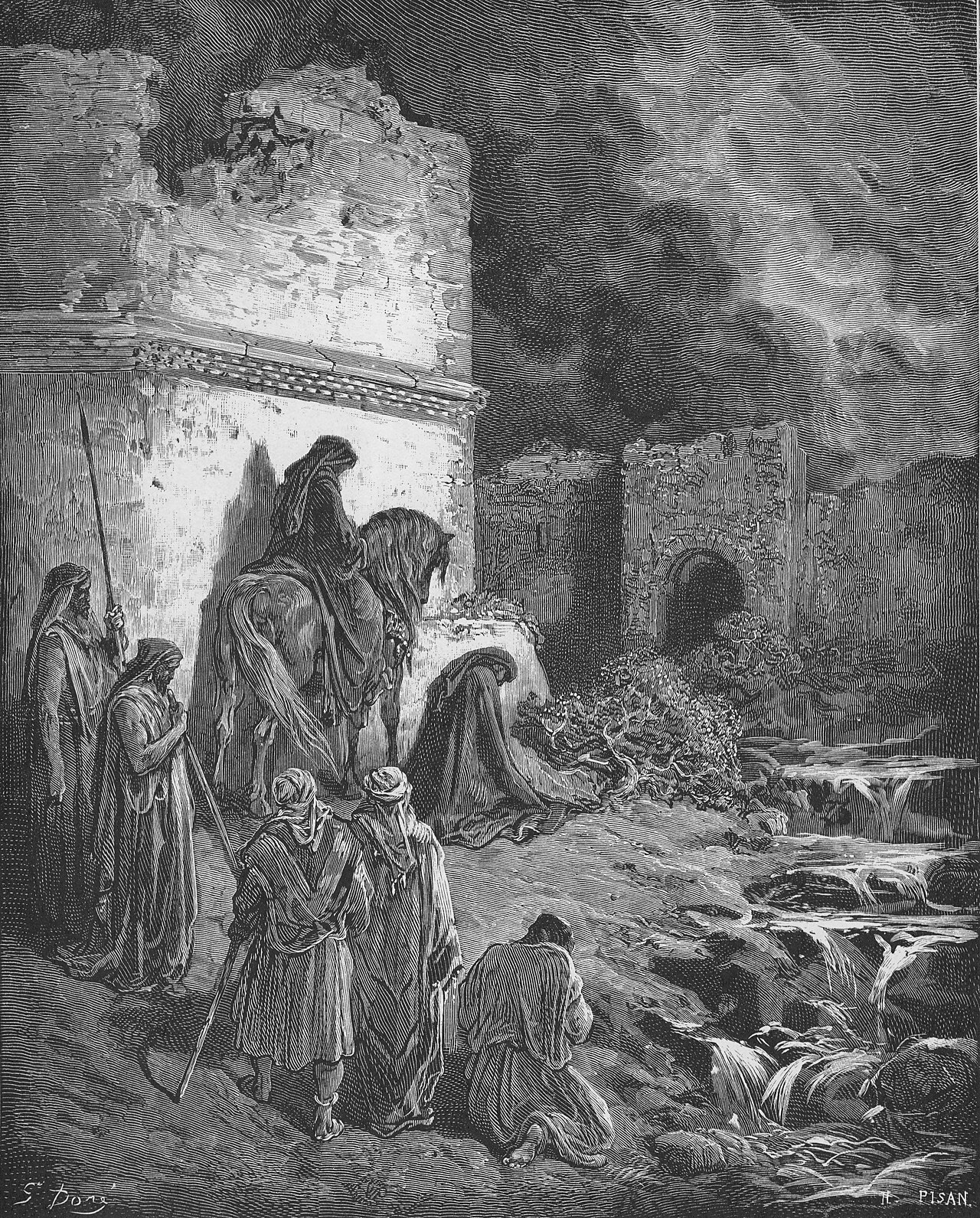
The gates name the city's working anatomy: the valley gate Nehemiah rode out of by night in chapter 2, a thousand cubits of wall to the dung gate where the refuse left, and the gate of the fountain with the wall of the pool of Siloah by the king's garden and the stairs that go down from the city of David. The topography is real and excavated: Siloam's pool and the stepped descent of the old city survive, and the roll reads as a walking survey of ground a visitor can still trace. The dung gate gets its builder's name recorded with the same dignity as the sheep gate's.
The record, by era
The Medieval Church1 voice
And a thousand cubits along the wall up to the Dung Gate, etc. They say that the site of the city of Jerusalem is arranged on such a gentle slope, facing north and east, that rain falling there never remains, but flows like rivers through …
The Puritans and the Awakening1 voice
They did not think their callings excused them, nor plead that they could not leave their shops to attend the public business, knowing that what they lost would certainly be made up to them by the blessing of God upon their callings. Some ladies are spoken of as helping forward this work-- Shallum and his daughters (
quarantine:debris (2026-07-29) — unbalanced-parens
The Nineteenth Century2 voices
A commentator
Jamieson, Fausset & Brown1802–1910
Commentary Critical and Explanatory on the Whole Bible (1871)
proposed
Beth-haccerem--a city of Judah, supposed to be now occupied by Bethulia, on a hill of the same name, which is sometimes called also the mountain of the Franks, between Jerusalem and Tekoa.
Beth-haccerem - A village or town in the tribe of Benjamin. See Jer 6:1.
How the passage was read
What the Jewish commentators add
On the verses either side of this one
the ruler of the district of Mizpah the prince and duke of Mizpah.
This section is reception history: how the passage was read and kept in the Jewish tradition. Where a reading parts from an essential of the Christian faith, the section says so at that point.
Texts and citation data: Sefaria; each excerpt follows its version’s licence. 2 further sources are cited on this chapter that carry no English text this site may quote or only restate the verse.
The words behind it
17 Hebrew wordsEvery Hebrew word of this verse in the order it stands, with what it means and the door to its own study. The last column counts the times a word stands in the whole Bible: the rarer the word, the more the places it appears belong together.
| Hebrew | Sound | Meaning | Word study | In the Bible |
|---|---|---|---|---|
| וְאֵ֣ת׀ | veet | and <obj.> | H853 → | 10935 times |
| שַׁ֣עַר | shaar | [the] gate of | H8179 → | 374 times |
| הָאַשְׁפּ֗וֹת | haashpot | the dung | H830 → | 7 times |
| הֶחֱזִיק֙ | hechezik | he repaired | H2388 → | 291 times |
| מַלְכִּיָּ֣ה | malkiyah | Malkijah | H4441 → | 16 times |
| בֶן־ | ven- | [the] son of | H1121 → | 4930 times |
| רֵכָ֔ב | rekhav | Rechab | H7394 → | |
| שַׂ֖ר | sar | [the] official of | H8269 → | 421 times |
| פֶּ֣לֶךְ | pelekh | [the] district of | H6418 → | 10 times |
| בֵּית־ | beit- | Beth | H1021 → | |
| הַכָּ֑רֶם | hakarem | Hakkerem | H1021 → | |
| ה֣וּא | hu' | he | H1931 → | 1879 times |
| יִבְנֶ֔נּוּ | yivnenu | he rebuilt it | H1129 → | 376 times |
| וְיַעֲמִיד֙ | veyaamid | and he may set up | H5975 → | 521 times |
| דַּלְתֹתָ֔יו | daltotav | doors its | H1817 → | 88 times |
| מַנְעֻלָ֖יו | manulav | bolts its | H4514 → | 6 times |
| וּבְרִיחָֽיו׃ ס | uverichav | and bars its | H1280 → | 40 times |
וְאֵ֣ת׀and <obj.>
veetH853 →10935 times
שַׁ֣עַר[the] gate of
shaarH8179 →374 times
הָאַשְׁפּ֗וֹתthe dung
haashpotH830 →7 times
הֶחֱזִיק֙he repaired
hechezikH2388 →291 times
מַלְכִּיָּ֣הMalkijah
malkiyahH4441 →16 times
בֶן־[the] son of
ven-H1121 →4930 times
רֵכָ֔בRechab
rekhavH7394 →
שַׂ֖ר[the] official of
sarH8269 →421 times
פֶּ֣לֶךְ[the] district of
pelekhH6418 →10 times
בֵּית־Beth
beit-H1021 →
הַכָּ֑רֶםHakkerem
hakaremH1021 →
ה֣וּאhe
hu'H1931 →1879 times
יִבְנֶ֔נּוּhe rebuilt it
yivnenuH1129 →376 times
וְיַעֲמִיד֙and he may set up
veyaamidH5975 →521 times
דַּלְתֹתָ֔יוdoors its
daltotavH1817 →88 times
מַנְעֻלָ֖יוbolts its
manulavH4514 →6 times
וּבְרִיחָֽיו׃ סand bars its
uverichavH1280 →40 times
A shaded row is a word that stands 400 times or fewer in the Bible.
The walk
8 stopsEach card is a verse this one points to, and under it the verses that one points to in turn. Where several paths arrive at the same place, that place is listed first: the text keeps returning to it.
Through
Nehemiah 2:13So I went out at night through the Valley Gate toward the Well of the Serpent and the Dung Gate, and I inspected the walls of Jerusalem that had been broken down and the…
it leads to
- Nehemiah 1:3
And they told me, “The remnant who survived the exile are there in the province, in great trouble and disgrace. The wall of Jerusalem is broken down, and its gates are burned with fire.”
- Nehemiah 3:13–14
The Valley Gate was repaired by Hanun and the residents of Zanoah. They rebuilt it, installed its doors, bolts, and bars, and repaired a thousand cubits of the wall as far as the Dung…
- Nehemiah 2:17
Then I said to them, “You see the trouble we are in. Jerusalem lies in ruins, and its gates have been burned down. Come, let us rebuild the wall of Jerusalem, so that we…
- Nehemiah 2:3
and replied to the king, “May the king live forever! Why should I not be sad when the city where my fathers are buried lies in ruins, and its gates have been destroyed by…
- 2 Chronicles 26:9
Uzziah built towers in Jerusalem at the Corner Gate, the Valley Gate, and the angle in the wall, and he fortified them.
- Nehemiah 1:3
Through
Nehemiah 3:9Next to them, Rephaiah son of Hur, ruler of a half-district of Jerusalem, made repairs;
it leads to
- Nehemiah 3:12
And next to them, Shallum son of Hallohesh, ruler of the other half-district of Jerusalem, made repairs, with the help of his daughters.
- Nehemiah 3:17
Next to him, the Levites made repairs under Rehum son of Bani, and next to him, Hashabiah, ruler of a half-district of Keilah, made repairs for his district.
- Nehemiah 3:12
Through
Jeremiah 6:1“Run for cover, O sons of Benjamin; flee from Jerusalem! Sound the ram’s horn in Tekoa; send up a signal over Beth-haccherem, for disaster looms from the north, even great destruction.
it leads to
- Jeremiah 4:5–6
Announce in Judah, proclaim in Jerusalem, and say: “Blow the ram’s horn throughout the land. Cry aloud and say, ‘Assemble yourselves and let us flee to the fortified cities.’
- Jeremiah 4:5–6
Where this verse is studied
On this page
Studies1
About Nehemiah
This page draws on Adam Clarke, Commentary on the Bible; Bede, Commentary on Ezra and Nehemiah; Jamieson Fausset and Brown, Commentary Critical and Explanatory on the Whole Bible; Jamieson, Fausset & Brown, Commentary Critical and Explanatory on the Whole Bible; John Gill, Exposition of the Old Testament (1748-1763); Keil, The Books of Ezra, Nehemiah, and Esther and Matthew Henry, Commentary on the Whole Bible.