
Nehemiahchapter 12
47 verses · Nehemiah · 5th century BC · History
On that day they offered great sacrifices, rejoicing because God had given them great joy. The women and children also rejoiced, so that the joy of Jerusalem was heard from afar.
Introduction
Nehemiah, History, Nehemiah Overview.
This chapter joins the lists of the temple's priests and Levites to the day the finished wall was given to God. Its first hearers were a city that had rebuilt its defences in fifty-two days and now celebrated them with music. The lists reach back to the first return and down to Nehemiah's own time. Listen for the two choirs that set out in opposite directions, and for where they meet. The chapter ends with the practical care of the storerooms. The joy of Jerusalem, it says, was heard far away.
Context
- Who
- A city hearing itself sung around
- What
- The lists of priests and Levites by generation, the dedication of the wall with two thanksgiving choirs, and the appointment of men over the storerooms.
- Where
- The top of Jerusalem's wall, and the house of God where the two choirs met.
- When
- About 444 BC, after the city was resettled, with the lists reaching back to the first return about 538 BC.
- Why
- To celebrate the completed wall with thanksgiving and to set the temple's service in order for the future.
Historical context
The chapter opens with lists of priests and Levites by generation, from the first return down to Nehemiah's own day, the institutional memory of the temple staff, including the ones who led the thanksgiving.
Show the rest of the historical context, 2 more paragraphs
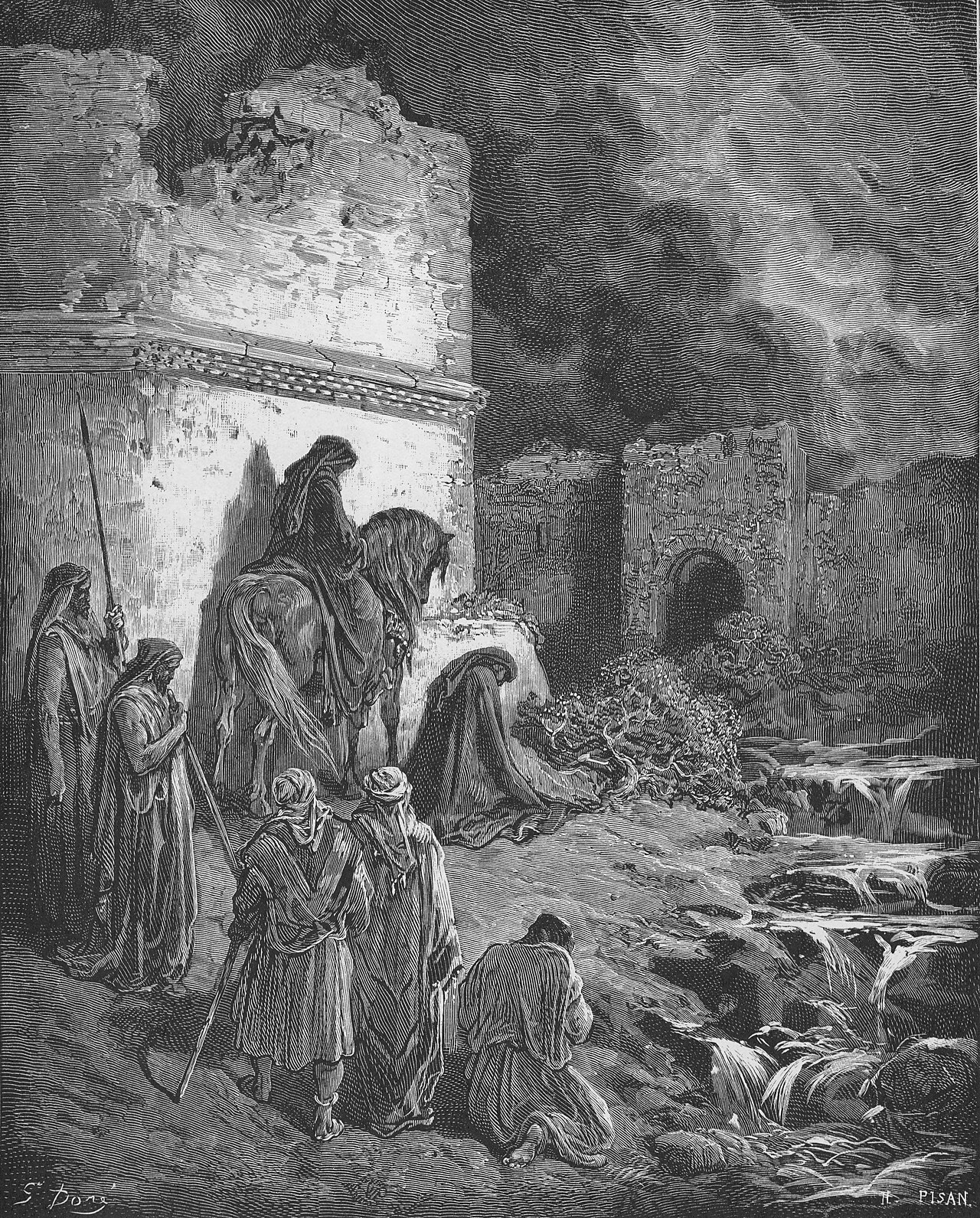
The dedication itself is one of the most cinematic scenes in the Old Testament. Levites are brought in from the surrounding villages with cymbals, psalteries and harps. The leaders are divided into two great companies that give thanks, and they go up on the wall and process in opposite directions, one right-hand toward the Dung Gate, one left toward the Water Gate, until they meet at the house of God.
The musical instruments are named as "the musical instruments of David the man of God," and Asaph's line is credited as the founders of the singers. This was a deliberate reconnection with the temple music of four hundred years earlier.
Significance
Walking the wall was the proof. Every foot of stone under their feet had been rubble a year before, built by men who slept in their clothes with weapons beside them.
Show the rest of the significance, 1 more paragraph
The verse that ends the scene says the joy was heard afar off, including, presumably, by the neighbours who had said a fox could knock it down. The chapter closes with the practical follow-through: men appointed over the storerooms for the offerings, so that the covenant of chapter 10 had somewhere to be delivered.
This chapter in Jewish lifeWhat this chapter is in Jewish life and reading.
What is done
This chapter has no place in the synagogue year. The site's own table in src/lib/hebraic/readings.ts printed parashot total 0 and haftarah uses total 0 for Nehemiah, and no festival reading.
The dedication of the wall is the one act in the book that the tradition turns into a law of the city. Rashi reads the two thanksgiving offerings on the wall as the rite by which Jerusalem was sanctified, "meaning that he sanctified the city, the princes, the tribunal, and the Levites with two thanksgiving offerings around the city, as is delineated in Tractate Shebuoth (14a, 15a, b), in order to sanctify the city." (Rashi on Nehemiah 12:31:1). Under that verse the corpus carries Shevuot 15a:6, the Jerusalem Talmud at Shevuot 2:2:2 and Sanhedrin 1:3:4 and 1:3:5, and under the next verse Shevuot 15b:13. Rashi adds that the second offering went beside the first rather than behind it (Rashi on Nehemiah 12:38:1).
How it is read
Rashi is the one commentator on this chapter whose English the corpus carries, quoted here from The Judaica Press complete Tanach with Rashi, translated by A. J. Rosenberg, which Sefaria reports as CC-BY. The chapter's lists he reads as a record of the watches. Jeshua at their head is Joshua the High Priest (Rashi on Nehemiah 12:1:1). The Levites were divided into watches, and he sends the reader to the twenty-four watches in 1 Chronicles from chapter 24 (Rashi on Nehemiah 12:9:1). Every name in the tenth verse, beginning from Jeshua, was a high priest (Rashi on Nehemiah 12:10:1).
He keeps the high priests as the frame of the lists. The priests of the next verses were the heads of their fathers' houses in the days of Joiakim, and the Levites after them in the days of Eliashib (Rashi on Nehemiah 12:12:1 and 12:22:1). The heads of the Levites until the days of Johanan were written in the chronicles (Rashi on Nehemiah 12:23:1). They stood watch opposite watch to sing (Rashi on Nehemiah 12:24:1). One word in the eighth verse he reads as a musical instrument that accompanied the songs (Rashi on Nehemiah 12:8:1).
The dedication itself he reads in order. It came at the completion of the wall, to sanctify the city (Rashi on Nehemiah 12:27:1). The priests and Levites purified themselves first and the others afterwards (Rashi on Nehemiah 12:30:1). Judah and Benjamin in the procession were two princes (Rashi on Nehemiah 12:34:1). The procession stopped at the place the text names and went no further (Rashi on Nehemiah 12:39:1).
The corpus carries four further notes on this chapter without an English text, each marked linked because Sefaria holds no English version of the ref. They stand cited and unquoted at Metzudat David on Nehemiah 12:17:1, 12:32:1, 12:33:1 and 12:35:1.
What the rabbis say
The corpus carries seventeen rabbinic locators on this chapter and the text of none, so each is cited and linked here rather than quoted. On the first verse it holds Otzar Midrashim, The Book of Zerubavel, Introduction 1. On the twenty-fourth it holds Avot DeRabbi Natan, Recension B 37:7, Midrash Tannaim on Deuteronomy 33:1:17, Sifrei Devarim 342:6 and Yalkut Shimoni on Torah 951:10. On the twenty-seventh it holds Jerusalem Talmud Sanhedrin 1:3:4-5 and Pesikta Rabbati 2:1.
On the twenty-eighth verse the corpus holds Bereshit Rabbah 98:2. On the thirty-first it holds Jerusalem Talmud Sanhedrin 1:3:4, Jerusalem Talmud Sanhedrin 1:3:5, Jerusalem Talmud Shevuot 2:2:2 and Shevuot 15a:6. On the thirty-second it holds Shevuot 15b:13. On the thirty-fifth it holds Pirkei DeRabbi Eliezer 38:23.
On the thirty-eighth verse the corpus holds Jerusalem Talmud Sanhedrin 1:3:6. On the fortieth it holds Midrash Tehillim 56:2. On the forty-third it holds Tanna DeBei Eliyahu Rabbah 18:3. What each of them teaches is a saying of the rabbis, and is reported as theirs wherever this site quotes one. The quotations wait on a fetch that carries the text.
Sources: Rashi, Rashi on Nehemiah 12:1:1 to 12:39:1, The Judaica Press complete Tanach with Rashi, translated by A. J. Rosenberg, reported CC-BY; Metzudat David, Metzudat David on Nehemiah 12:17:1, 12:32:1, 12:33:1 and 12:35:1, cited by ref because the corpus carries no English text; The Sefaria corpus, scripts/data/sources/sefaria/nehemiah/12.json, the 17 Talmud and Midrash locators of this chapter; The site's own files, src/lib/hebraic/readings.ts, printing no portion, no Haftarah and no festival reading for this book.
The heads below are this chapter's scenes. The numbered points under each are its verses.
Priests and Levites from Zerubbabel's day down to Nehemiah's
Nehemiah 12:1-9
went up with Zerubbabel: The register opens with "the priests and Levites who went up with Zerubbabel son of Shealtiel and with Jeshua." Twenty-two priestly names stand against the twenty-four courses David ordered, a gap the commentators trace to courses that never returned from Babylon.
Nehemiah 12:1
“But these were divided by Zerubbabel, or Jeshua, into the original number of twenty-four. Twenty-two only are enumerated here, and no more than twenty in Ne 12:12-21. The discrepancy is due to the extremely probable circumstance that two of the twenty-four courses had become extinct in Babylon; for none belonging to them are reported as having returned (Ne 12:2-5).”
Jamieson, Fausset & Brown · Commentary Critical and Explanatory on the Whole Bible (1871)reformed
1 more voice on this verseWhat preachers and commentators have said about this verse, in their own words.
Nehemiah 12:1
“The priests - The number of the names here given, which is 22, is probably to be connected with that of the Davidic “courses,” which was 24 1Ch 24:7-18. Eight names are identical with those of the heads in David’s time. On comparing the present list with that of the families who sealed to Nehemiah’s covenant Neh 10:2-8, we shall find that the first sixteen recur in that document nearly in the same order; but that the last six are absent from it.”
Amariah, Malluch, Hattush: Gill finds Amariah, Malluch and Hattush among the sealers of the covenant at 10:3-4. A Hattush of David's line came up with Ezra at Ezra 8:3, a different man from the priestly house named here. Amariah's house has Jehohanan at its head at 12:13.
Shecaniah, Rehum, Meremoth: Gill reads Rehum as Harim with its letters transposed, the name this house carries at 12:15 and at 10:5. He takes Meremoth as the Meraioth of 12:15. One house could carry two spellings.
Iddo, Ginnethon, Abijah: All three houses have heads in Joiakim's generation at 12:16-17: Zechariah, Meshullam and Zichri. Ginnethon and Abijah also seal the covenant at 10:6-7. Iddo is missing from the seals.
Mijamin, Maadiah, Bilgah: Gill takes Mijamin and Maadiah as the Miniamin and Moadiah of 12:17, the spellings of the next generation's list. Mijamin held the sixth of David's lots at 1 Chronicles 24:9. Bilgah follows them in both lists.
Shemaiah, Joiarib, Jedaiah: Shemaiah, Joiarib and Jedaiah are leaders of the priests who went up. Barnes finds the first sixteen names of this list among the seals of chapter 10, and the last six absent, from Joiarib and Jedaiah on. The first two lots fell to Jehoiarib and Jedaiah, 1 Chronicles 24:7.
Sallu, Amok, Hilkiah, and Jedaiah: Clarke notes that the courses David set by lot continued until the Romans destroyed Jerusalem. Jedaiah appears twice in this list, at verses 6 and 7, as two separate houses. Both have heads at 12:19 and 12:21.
Nehemiah 12:7
“The chief of the priests - They were twenty-four orders or courses in number, all subordinate to each other; as established by David, 1Ch 24:18. And these orders or courses were continued till the destruction of Jerusalem by the Romans. See Calmet.”
Adam Clarke · Commentary on the Bible (1810-1826)evangelical
led the songs of thanksgiving: Barnes finds only three of these houses in the first return, Jeshua, Kadmiel and Judah, the Hodevah of 7:43, so the others came up later. Gill calls Mattaniah the precentor, the leader who began the thanksgiving song at the daily sacrifice. Mattaniah's line runs to Asaph at 11:17.
Nehemiah 12:8
“Of the Levitical houses here mentioned, three only returned at first, those of Jeshua, Kadmiel, and Judah or Hodevah Neh 7:43. The others must have returned subsequently.”
Bakbukiah and Unni, their associates: Gill identifies Bakbukiah with the man named second among his associates at 11:17. The names Mattaniah and Bakbukiah return among the gatekeepers at 12:25. One group of singers answered the other.
Nehemiah 12:9
“Also Bakbukiah and Unni,.... Two other Levites; the first is mentioned in Neh 11:17, their brethren, were over against them in the watches; the Levites were divided into twenty four wards, and these were placed one against another, 1Ch 23:6.”
Nehemiah 12:10-11
Jeshua was the father of Joiakim: A single priestly line runs six generations from Jeshua to Jaddua. With no king in Judah, the book measures its years by these high priests. Josephus records that Jaddua was the priest who met Alexander the Great, so the register's last name reaches past Nehemiah's own generation.
Nehemiah 12:10
“Jeshua begat Joiakim, &c.--This enumeration was of great importance, not only as establishing their individual purity of descent, but because the chronology of the Jews was henceforth to be reckoned, not as formerly by the reigns of their kings, but by the successions of their high priests.”
Jamieson, Fausset & Brown · Commentary Critical and Explanatory on the Whole Bible (1871)reformed
1 more voice on this verse
Nehemiah 12:10
“The six generations of high priests covered a little more than two centuries (538-333 B.C.), or a little under thirty-five years to a generation. Jaddua was the high priest who (according to Josephus) had an interview with Alexander shortly after the battle of Issus.”
Jonathan was the father of Jaddua: Barnes spreads the six generations from Jeshua to Jaddua over a little more than two centuries, 538 to 333 B.C. A son of Joiada, spelled Jehoiada at 13:28, married into Sanballat's house, and Nehemiah drove him away. The high priest's own family broke the covenant.
Nehemiah 12:12-21
of the family of Seraiah, Meraiah: A second list of course heads follows, now serving "In the days of Joiakim," the second generation after the return. Several of these names recur among the sealers of the covenant in chapter 10. The priesthood renews itself by father's house, name matched to name and course to course.
of Ezra, Meshullam: Ezra here is a priestly house from Zerubbabel's return at 12:1, and in Joiakim's day Meshullam heads it. That house was already serving before Ezra the scribe arrived under Artaxerxes at Ezra 8:1. The book knows more than one Ezra.
of Malluchi, Jonathan: Gill matches Malluchi to the Malluch of verse 2 and Shebaniah to the Shecaniah of verse 3, the same houses under a second spelling. Jonathan and Joseph head them in Joiakim's day.
of Harim, Adna: Five priests of the house of Harim had married foreign women at Ezra 10:21, and in Joiakim's day the house is headed by Adna. Helkai leads the house verse 3 names Meremoth.
of Iddo, Zechariah: The prophet Zechariah is called son of Iddo at Ezra 5:1 and son of Berechiah, the son of Iddo, at Zechariah 1:1. Here a Zechariah heads the priestly house of Iddo. Prophet and priest share one family name.
of Abijah, Zichri: A single head, Piltai, serves both Miniamin and Moadiah, the only place in Joiakim's list where two houses share one name. Zichri heads the house of Abijah.
of Bilgah, Shammua: Shemaiah's house is headed by a Jonathan, the second man of that name in this list after the Jonathan of Malluchi's house at verse 14. Shammua heads Bilgah's house.
of Joiarib, Mattenai: Jedaiah son of Joiarib heads the priests settled in Jerusalem at 11:10-11, so these two houses stand side by side in both rolls. Uzzi heads the first Jedaiah here, and verse 21 gives the second to Nethanel. Mattenai heads Joiarib's house.
of Sallai, Kallai: Sallai stands where verse 7 lists Sallu, one of several spellings that shift between the two lists. Kallai and Eber head these two houses in Joiakim's day. Neither house sealed the covenant at 10:2-8.
of Hilkiah, Hashabiah: Joiakim's list ends with twenty heads for twenty-one houses, and Jamieson, Fausset and Brown set that twenty against the twenty-four courses of David. Hattush of verse 2 has no head in this list.
Nehemiah 12:22-23
during the reign of Darius the Persian: The record closes with a dating notice: the heads of families were recorded "during the reign of Darius the Persian". Darius reigned after Nehemiah's governorship, so the register was kept current past the events of this chapter. The "Book of the Chronicles" is a separate register of the priesthood.
recorded in the Book of the Chronicles: Gill records a second view: some refer this to the Levite roll at 1 Chronicles 9:14. Lightfoot concluded from it that Ezra wrote Chronicles in the days of Johanan. Ezra 10:6 names a chamber of Jehohanan son of Eliashib.
Nehemiah 12:23
“The sons of Levi, the chief of the fathers, were written in the book of the chronicles,.... Some think this refers to 1Ch 9:14, &c. until the days of Johanan the son of Eliashib; from whence Dr. Lightfoot (p) concludes, that the Chronicles were written by Ezra in the times of this Johanan. (p) Works, vol. 1. p. 146.”
1 more voice on this verse
Nehemiah 12:23
“The book of the chronicles - This is not the book of Chronicles which we have now, no such list being found in it; but some other book or register, which is lost.”
Adam Clarke · Commentary on the Bible (1810-1826)evangelical
Nehemiah 12:24-26
Hashabiah, Sherebiah, and Jeshua son of Kadmiel: The chief Levites lead the praise "as one section alternated with the other, as prescribed by David the man of God." Verse 26 dates the roster by three men together, Joiakim the high priest, "Nehemiah the governor and Ezra the priest and scribe."
Nehemiah 12:24
“Jeshua the son of Kadmiel - If the reading be sound, this Jeshua must have been the head of the Levitical family of Kadmiel in the time of Joiakim; but (compare Neh 8:7; Neh 9:4), some read “Jeshua, Bani, Kadmiel,” etc. Ward over against ward - i. e., “alternately,” one part of the choir corresponding the other.”
were gatekeepers who guarded the storerooms: Barnes counts six gatekeeper families against four in 1 Chronicles 9, and sets them at the temple's four chief gates, with two lesser gates beside. Gill reads their post as the treasuries of the gates.
Nehemiah 12:25
“Mattaniah, and Bakbukiah, Obadiah, Meshullam, Talmon, Akkub, were porters,.... At the gates of the temple, see 1Ch 9:15, keeping the ward, at the thresholds of the gates; of the temple, where they stood and watched; or "at the collection of the gates", meaning either where the people were gathered together, or where money gathered was laid up; and so some render it, "the treasuries of the gates": unless a place called Asuppim should be meant, 1Ch 26:15.”
1 more voice on this verse
Nehemiah 12:25
In 1Ch 9:17, 1Ch 9:24, 1Ch 9:26, four families of porters only are mentioned; six are implied here, in Neh 7:45, and in Ezr 2:42. From 1Ch 26:14-19 it appears that the temple had four chief gates, fronting the cardinal points, and two minor ones, “toward Asuppim,” and “at Parbar.”
in the days of Joiakim son of Jeshua: Gill identifies Jozadak as the high priest in Babylon, so the line runs from the captivity through Jeshua of the return to Joiakim. Ezra 10:18 also names Jeshua son of Jozadak, whose descendants had married foreign women. The verse spans three high priests.
Nehemiah 12:26
“These were in the days of Joiakim the son of Jeshua, the son of Jozadak,.... Who was high priest in Babylon, and whose grandson was now high priest in the time referred to: and in the days of Nehemiah the governor; the writer of this book: and of Ezra the priest, the scribe; who was contemporary with him.”
Cymbals, psalteries, and harps sought out for the dedication
Nehemiah 12:27-30
At the dedication of the wall: After twenty-six verses of roster the narrative returns to "the dedication of the wall of Jerusalem". The Levites are sought out from all their homes, and the singers gathered. The priests and Levites purify themselves first, then "the people, the gates, and the wall," cleansing moving outward from the leaders.
Nehemiah 12:27
“The dedication of the wall - The ceremony had been deferred for the space of nearly 12 years Neh 13:6. Perhaps Nehemiah required an express permission from the Persian king before he could venture on a solemnity which might have been liable to misrepresentation. Out of all their places - i. e., out of the various cities of Judah and Benjamin in which they dwelt Neh 11:36.”
from the villages of the Netophathites: Barnes places Netophah near Bethlehem, and the men of Bethlehem and Netophah are counted together at 7:26. Gill has the singers living in these villages between their courses and summoned for the day. Berechiah the Levite lived there at 1 Chronicles 9:16.
Nehemiah 12:28
“And the sons of the singers gathered themselves together,.... Such of the Levites that were singers, and their sons that were trained up as such: both out of the plain country round about Jerusalem the plain of Jordan by Jericho, and the plain of Saron and Lydda: and from the villages of Netophathi: see 1Ch 9:16, here they dwelt, when not in their courses, to minister in the temple; but on this public occasion were summoned together.”
1 more voice on this verse
Nehemiah 12:28
“The plain country round about Jerusalem - Perhaps the valleys of Hinnom and Jehoshaphat, which enclose Jerusalem on three sides, are intended. The villages of Netophathi - Rather, as in 1Ch 9:16. Netophah lay near Bethlehem 1Ch 2:54, and is perhaps represented by the modern Antubeh.”
from Beth-gilgal, and from the fields of Geba: Clarke identifies Beth-gilgal with the place where Israel first camped after crossing the Jordan under Joshua. Geba is a Benjamite town at Joshua 18:24, and Beth-azmaveth sent 42 men at the first return in 7:28. The singers had settled on old ground.
Nehemiah 12:29
“From the house of Gilgal, and out of the fields of Geba and Azmaveth - Or, from Beth-Gilgal; a village erected in the place where the Israelites encamped after they had, under the direction of Joshua, passed over Jordan.”
Adam Clarke · Commentary on the Bible (1810-1826)evangelical
they purified the people, the gates, and the wall: Gill describes the purification of the priests and Levites as the washing of body and clothes, with the water of purification sprinkled on them. Clarke takes the cleansing of the gates and wall as the clearing away of filth and rubbish. Then the procession could begin.
Nehemiah 12:30
“The priests and the Levites purified themselves - This consisted in washings, abstinence from wine, and other matters, which, on all other occasions, were lawful. And as to the purifying of the gates and the walls, nothing was requisite but to remove all filth from the former, and all rubbish that might have been laid against the latter.”
Adam Clarke · Commentary on the Bible (1810-1826)evangelical
1 more voice on this verse
Nehemiah 12:30
“And the priests and the Levites purified themselves,.... By washing their bodies and their clothes, perhaps by sprinkling the water of purification on them, see Num 8:6.”
Two great companies on the wall, and joy heard far away
Nehemiah 12:31-37
two great thanksgiving choirs: Nehemiah appoints "two great thanksgiving choirs," the first proceeding "to the right, toward the Dung Gate". The choir climbs "the steps of the City of David" past the house of David to the Water Gate, where Ezra had read the law. "Ezra the scribe led the procession."
Nehemiah 12:31
“Princes - And half of the people with them. The wall - For the wall was broad and strong, and so ordered that men might conveniently walk upon it. Right hand - Towards the south and east.”
John Wesley · Explanatory Notes upon the Old Testament (1765)evangelical
1 more voice on this verse
Nehemiah 12:31
“I brought up - Note the resumption of the first person, which has been laid aside since Neh 7:5, and which is confirmed now to the end of the book. It is generally allowed that we have here once more a memoir by Nehemiah himself.”
Hoshaiah and half the leaders of Judah: Hoshaiah leads the princes of the first choir, the counterpart of Nehemiah, who walks behind the second at verse 38. Gill pairs the two men at 12:40, each with half the rulers. The leaders of Judah divided evenly between the processions.
Nehemiah 12:32
“And after them went Hoshaiah, and half of the princes of Judah. The other half of them, with Hoshaiah at the head of them.”
along with Azariah, Ezra, Meshullam: Gill names these men as princes of Judah, the Ezra among them a different man from the scribe. An Azariah son of Maaseiah had rebuilt the wall beside his own house at 3:23. Names from the building lists return in the procession.
Nehemiah 12:33
“And Azariah, Ezra, and Meshullam. Not Ezra the priest and the scribe, for he has another place assigned him in this procession, Neh 12:36, but this seems to be one of the princes.”
Judah, Benjamin, Shemaiah, Jeremiah: Gill, following Jarchi, reads Judah and Benjamin as two princes of those names, standing in a list of men. Shemaiah and Jeremiah follow as two more princes. Jeremiah is also a priestly house at 12:1.
some of the priests with trumpets: The trumpeters are priests' sons, and Gill counts Zechariah among them as a priest. Zaccur in his line bears the name of the first of Asaph's sons listed at 1 Chronicles 25:2. Asaph's sons played lyres, harps and cymbals.
Nehemiah 12:35
“And certain of the priests' sons with trumpets,.... To blow with on this occasion; for these the priests sounded: namely: Zechariah the son of Jonathan, the son of Shemaiah, the son of Mattaniah, the son of Michaiah, the son of Zaccur, the son of Asaph; not the Levite, but a priest of this name.”
Ezra the scribe led the procession: The instruments of David are the lyres, harps and cymbals of 1 Chronicles 25:1, the same three named for this day at 12:27. Gill places Ezra at the head as a priest and a man of great standing. Eight associates walk with Zechariah.
At the Fountain Gate they climbed: The route retraces chapter 3, where Shallun rebuilt the Fountain Gate and the wall as far as the stairs from the City of David. Barnes follows the choir past David's old palace along the line of 3:16-26 to the eastern wall. The builders' list became the choir's map.
Nehemiah 12:37
“Above the house of David - This choir or procession went above (or beyond) the old palace of David, following the line described in Neh 3:16-26, on their way to the eastern wall.”
Nehemiah 12:38-40
The second thanksgiving choir: The second choir proceeds "to the left," and Nehemiah follows with half the people past sites chapter 3 named in the building (12:38). Both choirs meet in the house of God, and the circuit once walked in construction is walked in thanksgiving.
Nehemiah 12:38
“The broad wall - What part this was, we know not: it might have been a place designed for a public promenade, or a parade for assembling the troops or guard of the temple.”
Adam Clarke · Commentary on the Bible (1810-1826)evangelical
over the Gate of Ephraim: Gill takes the Gate of the Guard as the gate of the prison court, near the courtyard of the guard by the king's upper palace. The Gate of Ephraim is where the people built booths at 8:16. The choir halted at the palace court.
Nehemiah 12:39
“And from above the gate of Ephraim,.... The gate which led to the tribe of Ephraim, where that tribe formerly dwelt, see Neh 8:16 and above the old gate; of which mention is made, Neh 3:6 and above the fish gate, and the tower of Hananeel, and the tower of Meah, even unto the sheep gate; of all which see Neh 3:1, and they stood still in the prison gate; which was not a gate of the city, but of the court of the prison, Neh 3:25, which was near both the king's palace and the temple, see Jer 20:1.”
The two thanksgiving choirs then stood: Gill places the thanksgiving choirs in the great court of the house of God, the one space large enough to hold them. Henry pictures the people walking on the ground, some inside the wall and some outside, to fix the mercy in their memory. Nehemiah and half the officials stood.
Nehemiah 12:40
“So stood the two companies of them that gave thanks in the house of God,.... Having made their procession on the wall in different ways, they met in the temple, that is, in the great court of it, for no other would hold them: and I, and the half of the rulers with me; Nehemiah, and the other half with Hoshaiah, Neh 12:32.”
1 more voice on this verse
Nehemiah 12:40
“The crowd of people, it is likely, walked on the ground, some within the wall and others without, one end of this ceremony being to affect them with the mercy they were giving thanks for, and to perpetuate the remembrance of it among them.”
Matthew Henry · Commentary on the Whole Bible (1707-1721)puritan
Nehemiah 12:41-43
Seven priests sound trumpets. Great sacrifices follow, and verse 43 names the source of the day's joy: "God had given them great joy" (12:43). The joy reaches the women and children, and "the joy of Jerusalem was heard from afar," the strength of 8:10 now heard as sound.
the choirs sang out under the direction: Eight names follow the seven priests with trumpets of verse 41. Spurgeon preached on this verse on the last day of 1871, setting the singing of the choirs beside the joy of the LORD at 8:10.
Nehemiah 12:42
“The Joy of the Lord, the Strength of His People A Sermon (No. 1027) Delivered on Lord’s Day Morning, December 31st, 1871, by C. H. SPURGEON, At the Metropolitan Tabernacle, Newington “The joy of the Lord is your strength.”—Nehemiah 8:10. “And the singers sang aloud, with Jezrahiah their overseer. Also that day they offered great sacrifices, and rejoiced: for God had made them rejoice with great joy: the wives also and the children rejoiced: so that the joy of Jerusalem was heard even afar off.”—Nehemiah 12:42-43.”
the joy of Jerusalem was heard from afar: At the temple's foundation in Ezra 3:12-13 the older men wept while others shouted, and the mingled sound was heard from afar. At the wall's dedication the same distance carries joy alone. Bede reads the day as the one day known to the LORD in Zechariah's prophecy.
Portions appointed, for Judah rejoiced in the priests who served
Nehemiah 12:44-47
men were appointed over the rooms: Joy becomes provision: "men were appointed over the rooms that housed the supplies, contributions, firstfruits, and tithes." Singers and gatekeepers serve "as David and his son Solomon had prescribed". The last verse joins "the days of Zerubbabel and Nehemiah," with portions passing from the Levites to "the descendants of Aaron."
Nehemiah 12:44
“Judah rejoiced - Judah’s satisfaction with the priests and Levites took the shape of increased offerings, more ample tithes, and the like, from where the appointment of treasuries and treasurers became necessary.”
the service of purification: Gill describes the gatekeepers' part of the purification: they kept watch so that nothing unclean entered the temple courts. 1 Chronicles 9:25 has the gatekeepers' relatives coming in from their villages for seven-day turns. The singers kept their courses too.
Nehemiah 12:45
“And both the singers and the porters kept the ward of their God, and the ward of their purification,.... The singers kept their turns in course in the temple, and were not wanting to officiate on all occasions, besides morning and evening services; and the porters they diligently kept the gates of the temple, that no impure person or thing in a ceremonial sense entered: according to the commandment of David, and Solomon his son; who made very good rules and orders relative to the better and more regular performance of service by them; see 1Ch 25:1.”
in the days of David and Asaph: Gill connects the songs of praise with the psalms that bear the names of David and Asaph in the Psalter. Asaph's descendants were the singers of the first return, 148 of them at 7:44. The dedication choir stood in that line.
Nehemiah 12:46
“For in the days of David and Asaph of old there were chief of the singers,.... Persons appointed over the rest to instruct them, and see that they did their work aright, as besides Asaph, Haman, and Jeduthun, and their sons, 1Ch 25:2 and songs of praise and thanksgiving unto God; such were made by them, some under divine inspiration, which bear the names of David and Asaph, as may be observed in the book of Psalms.”
in the days of Zerubbabel and Nehemiah: Barnes reads the verse as a comparison: in Nehemiah's day Israel gave with the zeal of Zerubbabel's day, and the years between had been lax. Bede takes the daily portions set aside for the Levites as gifts to God's holy ones. Chapter 13 shows the portions failing.
Nehemiah 12:47
The intention is to compare the religious activity and strictness of Nehemiah’s time with that which had prevailed under Zerubbabel, as described by Ezra Ezr 6:16, Ezr 6:22. It is implied that the intermediate period had been a time of laxity. They sanctified holy things ... - i. e, “the people paid their tithes regularly to the Levites, and the Levites paid the tithe of the tithes to the priests.”
1 more voice on this verse
Nehemiah 12:47
“Both are said to be sanctified; when what is contributed, either voluntarily or by law, for the support of religion and the maintenance of the ministry, is given with an eye to God and his honour, it is sanctified, and shall be accepted of him accordingly, and it will cause the blessing to rest on the house and all that is in it, Ezek. xliv.”
Matthew Henry · Commentary on the Whole Bible (1707-1721)puritan
How this psalm is built
The patterns in this chapter
How this chapter is built
1 more paragraph on the patterns
Verses 1 to 26 list the priests and Levites by generation, from the first return under Zerubbabel and Jeshua to the days of Nehemiah and Ezra. Verses 27 to 43 describe the dedication. Two choirs set out along the wall. One goes right toward the Dung Gate, the Fountain Gate and the Water Gate. The other goes left past the Tower of the Ovens, the Broad Wall and the Fish Gate to the Sheep Gate, and both end in the house of God. The gates they pass are the gates rebuilt in chapter 3. Verses 44 to 47 set men over the storerooms for the priests and Levites.
Keep studying
Sources for this chapter
The summary
Jamieson, Fausset & Brown, Commentary Critical and Explanatory; John Wesley, Notes on the Old Testament and Matthew Henry, Complete Commentary.
The exposition
Adam Clarke, Commentary on the Bible; Albert Barnes, Notes, Explanatory and Practical, on the Old and New Testaments (1832-1869); Bede, Commentary on Ezra and Nehemiah; Charles Spurgeon; Jamieson Fausset and Brown, Commentary Critical and Explanatory on the Whole Bible; Jamieson, Fausset & Brown, Commentary Critical and Explanatory on the Whole Bible; John Gill; John Wesley, Explanatory Notes upon the Old Testament; Keil, The Books of Ezra, Nehemiah, and Esther and Matthew Henry, Commentary on the Whole Bible.