
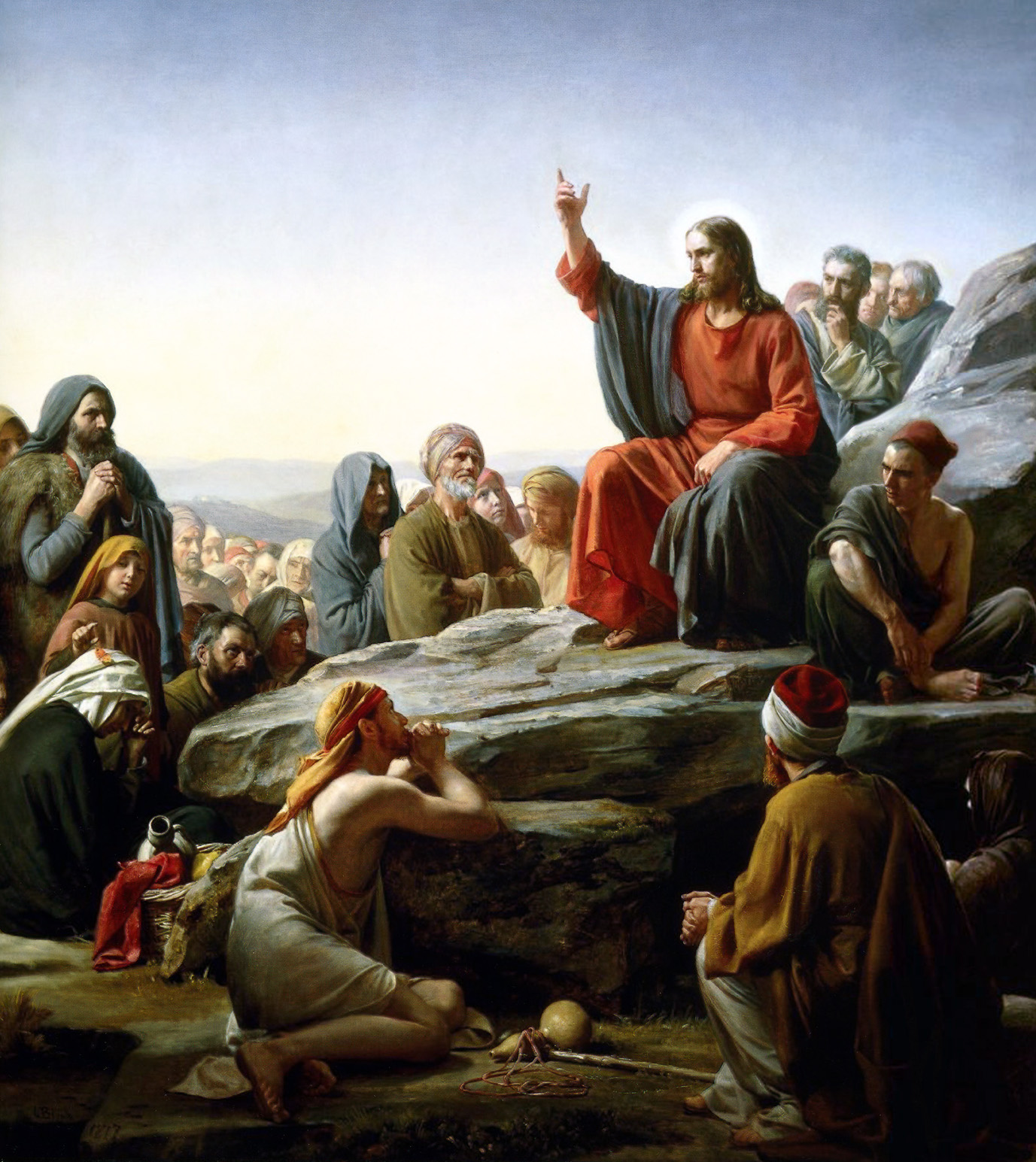
Matthewchapter 18
35 verses · Matthew, by tradition · AD 50 to 65 · The Gospels
“Truly I tell you,” He said, “unless you change and become like little children, you will never enter the kingdom of heaven.
Introduction
Matthew, by tradition, The Gospels, Matthew Overview.
This chapter holds the fourth of the five long teaching sections in Matthew's Gospel, spoken to the disciples in a house in Capernaum. It begins with their question about rank and grows into instruction for the church that would gather in Jesus' name. Matthew wrote it for congregations that had to live together with their failures. Listen for the child Jesus places in the middle of them. Listen also for the careful steps given for dealing with sin, and for the story of a debt that could never be repaid. Read it as the rule of life for a forgiven people.
Context
- Who
- Jewish believers who had to work out how to hold a community together
- What
- Teaching on greatness in the kingdom, causes of stumbling, the lost sheep, dealing with a brother who sins and the parable of the unforgiving servant.
- Where
- A house in Capernaum, on the north shore of the Sea of Galilee.
- When
- Late in the Galilean ministry, about AD 29 on the common dating, before Jesus leaves Galilee for Judea.
- Why
- To teach the disciples how to live together, humble toward one another, careful of the weak, honest about sin and generous in forgiveness.
Historical context
Children had no standing to lose. They were loved, but they were legally and socially at the bottom, no rank, no rights, no honour to trade on. Setting one in the middle of a rank dispute was not sentimental; it was deliberately deflating.
Show the rest of the historical context, 3 more paragraphs
The procedure for handling an offence follows Jewish legal practice closely. The requirement of two or three witnesses comes straight from Deuteronomy, and the final step of treating the unrepentant as an outsider mirrors the synagogue's own discipline, which could exclude a member from the congregation.
The debt in the parable is calculated to be absurd. Ten thousand talents was an unimaginable sum, Josephus records that the entire annual tax revenue of Galilee and Perea together ran to a small fraction of it. No servant could ever have owed it, and that is the joke.
The second debt is real and small: a hundred denarii, about a hundred days' wages for a labourer. Debt slavery was legal, a man, his wife, and his children could be sold to recover what he owed, and the jailers handed the debtor to at the end were expected to squeeze payment out of his family.
Significance
Peter's offer to forgive seven times was generous by the standards of his day; the usual teaching suggested three. The answer effectively removes the counter.
Show the rest of the significance, 1 more paragraph
For scattered congregations already fracturing over grievances, this chapter was the working constitution. Go to the brother privately first. Bring witnesses only if you must. And remember which debt in the story is yours.
The heads below are this chapter's scenes. The numbered points under each are its verses.
Greatest in the Kingdom; the One Sheep That Wandered
Matthew 18:1-2
The disciples ask who is the greatest in the kingdom of heaven. Jesus answers with an object lesson, inviting a little child to stand among them. Matthew Henry and John Gill note that a child in that culture had no status to claim and no rank to defend.
Matthew 18:1
“At the same time came the disciples unto Jesus,.... When the receivers of the half shekel had spoke to Peter about his master's paying it, and Christ and he had conversed about it, by whose orders he had taken up a fish out of the sea, and from it a piece of money, which he had paid for them both; just at this time came the other eleven disciples to the house where Christ and Peter were: saying, who is the greatest in the kingdom of heaven?”
1 more voice on this verseWhat preachers and commentators have said about this verse, in their own words.
Matthew 18:1
“See also Mar 9:33-41; Luk 9:46-50. Who is the greatest in the kingdom, of heaven? - By the kingdom of heaven they meant the kingdom which they supposed he was about to set up - his kingdom as the Messiah. They asked the question because they supposed, in accordance with the common expectation of the Jews, that he was about to set up a temporal kingdom of great splendor, and they wished to know who should have the principal offices, and posts of honor and profit. This was among them a frequent subject of inquiry and controversy.”
a little child to stand among them: A late tradition recorded by Nicephorus named the child Ignatius, later bishop of Antioch, and Adam Clarke and John Gill set it aside as unfounded. Gill thinks the child belonged to the house. Matthew Henry notes that Jesus taught by signs set before the eye, as the prophets did.
Matthew 18:2
And Jesus called a little child unto him,.... One, very likely, that was in the house, and might belong to the master of it, and which was big enough to come to him at his call. Some have thought that this was Ignatius the martyr, but without any foundation. His own words, in his epistle to the church at Smyrna (y), can give no countenance to it; where he says, "for I also know, that after his resurrection he was in the flesh, and I believe that he is."
Matthew 18:3-4
Jesus sets a condition, unless you change and become like little children, you will never enter the kingdom of heaven. It answers the disciples' contest for rank. The child's qualifying trait is dependence, since he brings nothing to secure his place and trusts the one who receives him.
Matthew 18:3
“One whose tender age should express to them the innocence which they should have. But truly He set Himself in the midst of them, a little one who had come not to be ministered unto, but to minister; (Mat. 20:28.) that He might be a pattern of holiness. Others interpret the little one of the Holy Spirit, whom He set in the hearts of His disciples, to change their pride into humility. (Vid. Origen. in loc.) And he said.”
Jerome · written before 420 · Catena Aurea by Aquinaspatristic
whoever humbles himself like this little child: Jerome lists what the disciples were to copy in the child: anger soon dropped, no grudge kept, and words that match the thoughts. Hilary of Poitiers adds that children follow and love their parents. Adam Clarke says humility is the one way up in this kingdom.
Matthew 18:4
“Or otherwise; Whoso shall humble himself as this little child, that is, whoso shall humble himself after My example, he shall enter into the kingdom of heaven. It follows, And whoso receiveth one such little one in my name, receiveth me.”
Jerome · written before 420 · Catena Aurea by Aquinaspatristic
4 more voices on this verse
Matthew 18:4
“Whosoever therefore shall humble himself - So great is the disparity between the kingdom of Christ and the kingdoms of this world, that there is no way of rising to honors in the former, but by humility of mind, and continual self-abasement.”
Adam Clarke · Commentary on the Bible (1810-1826)evangelical
Matthew 18:4
“Note, The humblest Christians are the best Christians, and most like to Christ, and highest in his favour; are best disposed for the communications of divine grace, and fittest to serve God in this world, and enjoy him in another.”
Matthew Henry · Commentary on the Whole Bible (1707-1721)puritan
Matthew 18:4
“The Lord teaches that we cannot enter the kingdom of heaven unless we revert to the nature of children, that is, we must recall into the simplicity of children the vices of the body and mind. He has called children all who believe through the faith of listening. For children follow their father, love their mother, do not know how to wish ill on their neighbor, show no concern for wealth, are not proud, do not hate, do not lie, believe what has been said and hold what they hear as truth.”
Hilary of Poitiers · written before 367 · Commentary on Matthew 18.1patristic
Matthew 18:4
“Hyperichius said, 'The tree of life is high, and humility climbs it.'”
Desert Fathers · written before 500 · The Desert Fathers, Sayings of the Early Christian Monkspatristic
Matthew 18:5-6
welcomes Me: Welcoming a little child like this in My name widens the lesson of verses 2 to 4 to the little ones. It is a thread that runs to 25:40, the least of these brothers of Mine. Against that welcome stands the millstone, a death Rome kept for slaves and traitors.
Matthew 18:5
“And whoso shall receive one such little child,.... Which is to be understood, not literally but metaphorically; meaning not such an one in age, but one, as the Syriac renders it, איך טליא דנא, "that is as this child": like unto it for modesty and humility; one, that is as that, free from pride, ambition, and envy.”
1 more voice on this verse
Matthew 18:5
One such little child - As our Lord in the preceding verses considers a little child an emblem of a genuine disciple, so by the term in this verse he means a disciple only. “Whosoever will receive, i.e. show unto such a child-like, unambitious disciple of mine, any act of kindness for my sake, I will consider it as done to myself.”
Adam Clarke · Commentary on the Bible (1810-1826)evangelical
a large millstone: Jerome ties the warning to the dispute of verse 1. Apostles who strove for the first place could trip the weaker believers who watched them. Henry reads the comparison as a scale, since drowning ends only the body, while the ruin of the one who causes the fall reaches further.
Matthew 18:6
“The sin is so heinous, and the ruin proportionably so great, that he had better undergo the sorest punishments inflicted on the worst of malefactors, which can only kill the body. Hell is worse than the depth of the sea; for it is a bottomless pit, and it is a burning lake.”
Matthew Henry · Commentary on the Whole Bible (1707-1721)puritan
Woe to the world: for the causes of sin holds two things. These stumbling blocks must come, a certainty in a fallen world, but woe to the man through whom they come. The Greek skandalon behind stumbling block is the trigger-stick of a snare, the working part of a trap.
Matthew 18:7
“Woe unto the world because of offences - That is, offences will be the cause of woe or of suffering. Offences, here, mean things that will produce sin: that will cause us to sin, or temptations to induce others to sin. See the notes at Mat 5:29. It must needs be ... - That is, such is the depravity of man that there will be always some who are attempting to make others sin; some people of wickedness endeavoring to lead Christians astray, and rejoicing when they have succeeded in causing them to fall.”
Matthew 18:8-9
cut it off and throw it away: repeats the Sermon at 5:29-30, and both places use hyperbole for the seriousness of sin. The hand, foot or eye pictures anything a man holds dear that leads him into sin. The eternal fire and the fire of hell name final loss.
Matthew 18:8
“So all affection, our whole kindred, are severed from us; lest under cover of duty any believer should be exposed to offence. If, He says, he be united to thee as close as is thy hand, or foot, or eye, and is useful to thee, anxious and quick to discern, and yet causes thee offence, and is by the unmeetness of his behaviour drawing thee into hell; it is better for thee that thou lack his kindred, and his profitableness to thee, than that whilst thou seekest to gain thy kindred or friends, thou shouldest have cause of fallings.”
Jerome · written before 420 · Catena Aurea by Aquinaspatristic
1 more voice on this verse
Matthew 18:8
“Wherefore if thy hand or thy foot,.... The same words are repeated here on occasion of offences, as are spoken by Christ, Mat 5:29 on account of unchaste looks, desires and lusts: giving offence to Christ's disciples, or endeavouring, by any means whatever, to cause them to stumble and fall, is equally gratifying the flesh, and no more to be indulged, than the other, on pain of eternal damnation. See Gill on Mat 5:29, Mat 5:30.”
gouge it out: Early readers also applied the saying to the church. Chromatius of Aquileia took the hand, foot and eye as relatives or unfaithful leaders whose influence leads others astray. Origen pictured the congregation cutting off a member who has turned to sin.
Matthew 18:9
If somebody, in the whole body of the congregations of the church, is industrious and handy for practical action and he changes and his hand causes him to sin, the eye should say to this hand, "I have no need of you." And after it has said it, let him cut it off and throw it from him. All will still be well if his head is still blessed and his feet worthy of his blessed head, so that the head, doing its duty, may not be able to say to the feet, "I have no need of you."
Origen of Alexandria · written before 253 · Commentary on Matthew 13.24patristic
look down on any of these little ones: See that you do not look down on any of these little ones rests on heaven's regard for them. Their angels in heaven always see the face of My Father in heaven. Verse 11 is absent from a number of early manuscripts, likely drawn in from Luke 19:10.
Matthew 18:10
“Probably our Lord means that, in virtue of their charge over His disciples (Heb 1:13; Joh 1:51), the angels have errands to the throne, a welcome there, and a dear familiarity in dealing with "His Father which is in heaven," which on their own matters they could not assume.”
Jamieson, Fausset & Brown · Commentary Critical and Explanatory on the Whole Bible (1871)reformed
Note on the text · Matthew 18:11
A much-loved sentence that the earliest manuscripts of Matthew do not contain, because it belongs, word for word, to Luke 19:10.
The witnesses, and what each reads here
- Codex Sinaiticus and Codex Vaticanus · 4th centuryNo verse 11, verse 10 is followed directly by the parable in verse 12.
- The Byzantine majority of Greek manuscripts · 9th, 15th centuries"For the Son of man is come to save that which was lost."
- Latin and Syriac witnesses · 4th, 7th centuriesDivided; several of the earlier ones lack it.
- Luke 19:10, in every witness · All periods"For the Son of man is come to seek and to save that which was lost." The sentence is unquestioned there.
Matthew 18:11
“For the Son of man is come to save that which was lost--or "is lost." A golden saying, once and again repeated in different forms. Here the connection seems to be, "Since the whole object and errand of the Son of man into the world is to save the lost, take heed lest, by causing offenses, ye lose the saved." That this is the idea intended we may gather from Mt 18:14.”
Jamieson, Fausset & Brown · Commentary Critical and Explanatory on the Whole Bible (1871)reformed
1 more voice on this verse
Matthew 18:11
“This is a reason, First, Why the little ones' angels have such a charge concerning them, and attend upon them; it is in pursuance of Christ's design to save them. Note, The ministration of angels is founded in the mediation of Christ; through him angels are reconciled to us; and, when they celebrated God's goodwill toward men, to it they annexed their own.”
Matthew Henry · Commentary on the Whole Bible (1707-1721)puritan
Matthew 18:12-14
the ninety-nine: The man who leaves the ninety-nine on the hills to search for the one that is lost pictures the regard of verse 10. He rejoices more over that one sheep than over the ninety-nine that did not go astray, as the parable of Luke 15 tells.
Matthew 18:12
“Doth he not leave the ninety and nine, and goeth into the mountains - So our common translation reads the verse; others, Doth he not leave the ninety and nine Upon The Mountains, and go, etc. This latter reading appears to me to be the best; because, in Luk 15:4, it is said, he leaveth the ninety and nine In The Desert. The allusion, therefore, is to a shepherd feeding his sheep on the mountains, in the desert; not seeking the lost one On the mountains.”
Adam Clarke · Commentary on the Bible (1810-1826)evangelical
1 more voice on this verse
Matthew 18:12
“Observe the gradation of the argument; the angels of God are their servants, the Son of God is their Saviour, and, to complete their honour, God himself is their Friend.”
Matthew Henry · Commentary on the Whole Bible (1707-1721)puritan
he rejoices more over that one sheep: Adam Clarke explains the greater joy as the natural gladness over something recovered against expectation. Bede takes it further. He says the restoring of fallen man gives heaven more cause for thanks than the creation of the angels.
Matthew 18:13
“And when he finds the sheep, he lays it on his shoulders rejoicing. He placed the sheep on his shoulders because by taking on human nature he himself bore our sins. And coming home, he calls together his friends and neighbors, saying to them: "Rejoice with me, for I have found my sheep that was lost." Having found the sheep, he returns home because our Shepherd, having restored man, returned to the heavenly kingdom. There he finds friends and neighbors, namely those choirs of angels who are his friends because they continuously guard his will in their steadfastness.”
Gregory the Dialogist · written before 604 · Forty Gospel Homilies, Homily 34patristic
1 more voice on this verse
Matthew 18:13
“He rejoiceth more - It is justly observed by one, on this verse, that it is natural for a person to express unusual joy at the fortunate accomplishment of an unexpected event.”
Adam Clarke · Commentary on the Bible (1810-1826)evangelical
your Father in heaven is not willing: Jerome ties the verse to the warning of verse 10 against despising the little ones, so the parable serves that warning. John Gill calls it the top of the climax. Adam Clarke adds that where a soul is lost, the cause lies in its own choice of darkness.
Matthew 18:14
“It is not the will of your Father - If any soul be finally lost, it is not because God’s will or counsel was against its salvation, or that a proper provision had not been made for it; but that, though light came into the world, it preferred darkness to light, because of its attachment to its evil deeds.”
Adam Clarke · Commentary on the Bible (1810-1826)evangelical
When Your Brother Sins Against You
Matthew 18:15-17
go and confront him privately: If your brother sins against you, the process widens in three stages. Go and confront him privately, then take one or two others along as in Deuteronomy 19:15, then tell it to the church. To regard him as a pagan or a tax collector marks a changed relationship.
Matthew 18:15
“We should not go to a brother who has offended us until we have decided to forgive him from our hearts—no matter how he responds to us.”
2 more voices on this verse
Matthew 18:15
“Next, If this fail, take two or three to witness how just your complaint is, and how brotherly your spirit in dealing with him. Again, If this fail, bring him before the Church or congregation to which both belong. Lastly, If even this fail, regard him as no longer a brother Christian, but as one "without"--as the Jews did Gentiles and publicans.”
Jamieson, Fausset & Brown · Commentary Critical and Explanatory on the Whole Bible (1871)reformed
Matthew 18:15
“These words of the Lord Jesus contain an expression which has often been misapplied. The command to “hear the church” has been so interpreted as to contradict other passages of God’s Word. It has been falsely applied to the authority of the whole visible church in matters of doctrine, and so been made an excuse for the exercise of much ecclesiastical tyranny. But the abuse of Scripture truths must not tempt us to neglect the use of them. We must not turn away altogether from any text, because some have perverted it and made it poison.”
J.C. Ryle · Expository Thoughts on the Gospels: Matthew (1856)Reformed Evangelical
take one or two others along: Albert Barnes gives the witnesses two tasks: to add their weight to the appeal, and to testify later if the case reaches the church. John Chrysostom compares the brother to a physician's stubborn patient. The harder the case, the more care it receives.
Cross references
Matthew 18:16
- QuotingDeuteronomy 19:15“A lone witness is not sufficient to establish any wrongdoing or sin against a man, regardless of what offense he may have committed. A matter must be established by the testimony of two or three witnesses.”
'in the mouth of two or three witnesses' (church discipline)
tell it to the church: Barnes gives two senses of church: the assembly of believers, or the elders who act for it, like the court of elders in a synagogue. Matthew Henry calls this the great question of the verse. John Chrysostom limits the process to a brother within the fellowship, citing 1 Corinthians 5:12.
Matthew 18:17
“If yet he will not hear them, then it must be told to many, that he may be held in abhorrence; so that he who could not be saved by his own sense of shame, may be saved by public disgrace; whence it follows, If he will not hear them, tell it to the Church. That He says, As a heathen and a publican, shows that he is to be more abhorred, who under the name of a believer does the deeds of an unbeliever, than those that are openly gentiles.”
Jerome · written before 420 · Catena Aurea by Aquinaspatristic
1 more voice on this verse
Matthew 18:17
“Tell it to the church - See the notes at Mat 16:18. The church may here mean the whole assembly of believers, or it may mean those who are authorized to try such cases - the representatives of the church, or these who act for the church. In the Jewish synagogue there was a bench of elders before whom trials of this kind were brought. It was to be brought to the church in order that he might be admonished, entreated, and, if possible, reformed. This was, and is always to be, the first business in disciplining an offending brother.”
Matthew 18:18-20
bind on earth: Whatever you bind on earth will be bound in heaven repeats the binding and loosing given to Peter at 16:19. It is now given to the disciples for church discipline. Where two or three gather together in My name, there am I with them answers 1:23, God with us.
Matthew 18:18
“Whatsoever ye shall bind, etc. - Whatever determinations ye make, in conformity to these directions for your conduct to an offending brother, will be accounted just, and ratified by the Lord. See on Mat 16:19 (note); and, to what is there said, the following observations may be profitably added. Οσα εαν δησητε - και οσα εαν λυσητε. Binding and loosing, in this place, and in Mat 16:19, is generally restrained, by Christian interpreters, to matters of discipline and authority.”
Adam Clarke · Commentary on the Bible (1810-1826)evangelical
1 more voice on this verse
Matthew 18:18
“Verily I say unto you,.... To them all, what he had said before to Peter; See Gill on Mat 16:19, what is said here, refers to things and not persons, as there also.”
if two of you on the earth agree: Albert Barnes ties the promise to the discipline of verses 15 to 18. Even two believers acting in agreement carry the authority given to the church. John Chrysostom reads it as one more motive to end quarrels, and agreement in prayer draws the disciples together.
Matthew 18:19
“Again I say unto you, That if two of you ... - This is connected with the previous verses. The connection is this: The obstinate man is to be excluded from the church, Mat 18:17. The care of the church - the power of admitting or excluding members - of organizing and establishing it - is committed to you, the apostles, Mat 18:18. Yet there is not need of the whole to give validity to the transaction.”
two or three gather together in My name: Adam Clarke cites a Jewish saying that the divine presence rests where even two sit discussing the law. Jesus claims that presence for himself. Albert Barnes reads in My name as acting by his authority, or gathering for his service and worship.
Matthew 18:20
“Where two or three are gathered together in my name - That is, to worship me. I am in the midst of them - By my Spirit, to quicken their prayers, guide their counsels, and answer their petitions.”
John Wesley · Explanatory Notes upon the New Testament (1755)evangelical
3 more voices on this verse
Matthew 18:20
“For where two - are gathered together in thy name - There are many sayings among the Jews almost exactly similar to this, such as, Wherever even two persons are sitting in discourse concerning the law, the Divine presence is among them. See much more in Schoettgen.”
Adam Clarke · Commentary on the Bible (1810-1826)evangelical
Matthew 18:20
“For if "in the mouth of three witnesses every word shall stand: " -while, through the benediction, we have the same (three) as witnesses of our faith whom we have as sureties of our salvation too-how much more does the number of the divine names suffice for the assurance of our hope likewise!”
Tertullian · written before 220 · On Baptismpatristic
Matthew 18:20
“WE have, in the verses preceding, the text a mention of the first Church Meeting of which I remember to have found mention in the New Testament. The Savior declares of His assembled people, "Verily I say unto you, whatever you shall bind on earth shall be bound in Heaven: and whatever you shall loose on earth shall be loosed in Heaven." A few Believers, gathered out of the world, have met in the name of the Lord Jesus to attend to the affairs of His household here below. It is a case of discipline.”
Seventy Times Seven and the Unforgiving Servant
Matthew 18:21-22
how many times shall I forgive my brother: Peter's up to seven times was likely meant as generous, since the rabbis commonly taught a limit of three pardons. Jesus answers seventy-seven times. The number echoes Lamech's boast in Genesis 4:24, then Lamech seventy-sevenfold, and reverses it: the old song multiplied revenge, and the kingdom multiplies forgiveness.
Matthew 18:21
In these verses the Lord Jesus deals with a deeply important subject, the forgiveness of injuries. We live in a wicked world, and it is vain to expect that we can escape ill-treatment, however carefully we may behave. To know how to conduct ourselves when we are ill-treated is of great moment to our souls. In the first place, the Lord Jesus lays it down as a general rule that we ought to forgive others to the uttermost. Peter put the question, “How oft shall my brother sin against me and I forgive him? Till seven times?”
J.C. Ryle · Expository Thoughts on the Gospels: Matthew (1856)Reformed Evangelical
2 more voices on this verse
Matthew 18:21
“Then came Peter ... - The mention of the duty Mat 18:15 of seeing a brother when he had offended us, implying that it was a duty to forgive him, led Peter to ask how often this was to be done. Forgive him - To forgive is to treat as though the offence was not committed - to declare that we will not harbor malice or treat unkindly, but that the matter shall be buried and forgotten.”
Matthew 18:21
“And as such insinuations were perhaps made once and again, he wished to know how often and how long he was to stand it. till seven times?--This being the sacred and complete number, perhaps his meaning was, Is there to be a limit at which the needful forbearance will be full?”
Jamieson, Fausset & Brown · Commentary Critical and Explanatory on the Whole Bible (1871)reformed
seventy-seven times!: John Wesley and John Gill both read the figure as a fixed number standing for an unfixed one. Jamieson, Fausset and Brown state the rule it sets: forgiveness sincerely asked is always given. Augustine would forgive a hundred times.
Matthew 18:22
“Seventy times seven - There is something very remarkable in these words, especially if collated with Gen 4:24, where the very same words are used - “If any man kill Lamech, he shall be avenged seventy times seven.” The just God punishes sin in an exemplary manner. Sinful man, who is exposed to the stroke of Divine justice, should be abundant in forgiveness, especially as the merciful only shall find mercy. See the note on Mat 5:7, and on Mat 6:14, Mat 6:15 (note). The sum seventy times seven makes four hundred and ninety.”
Adam Clarke · Commentary on the Bible (1810-1826)evangelical
2 more voices on this verse
Matthew 18:22
“Who, moreover, was able to forgive sins? This is His alone prerogative: for "who remitteth sins but God alone? " and, of course, (who but He can remit) mortal sins, such as have been committed against Himself, and against His temple? For, as far as you are concerned, such as are chargeable with offence against you personally, you are commanded, in the person of Peter, to forgive even seventy times sevenfold.”
Tertullian · written before 220 · On Modestypatristic
Matthew 18:22
“Jesus saith unto him, I say not unto thee, Until seven times; but, Until seventy times seven--that is, so long as it shall be needed and sought: you are never to come to the point of refusing forgiveness sincerely asked.”
Jamieson, Fausset & Brown · Commentary Critical and Explanatory on the Whole Bible (1871)reformed
Matthew 18:23-25
the kingdom of heaven is like a king: Ten thousand talents is the largest sum named in the parables. Older commentators reckon a talent at fifteen to twenty years of a laborer's wages, so the debt could never be repaid. The debt's size stands for what no one could ever pay God.
Matthew 18:23
“Therefore is the kingdom of heaven likened ... - The phrase, “the kingdom of heaven,” here has reference to the church, or to the way in which God will deal with his people. “It shall be in my church as it was with a certain king; or God will deal with the members of his church as a certain king did with his servants.” See the notes at Mat 3:2. This parable (see Mat 13:3) is related to show the duty of forgiving others.”
owing ten thousand talents: Adam Clarke points out the myriad was the highest number the Greeks wrote, so the sum reads as the largest figure a hearer could name. Albert Barnes sets the talent at three thousand shekels. John Gill sees the reckoning as the moment conscience is opened.
Matthew 18:24
“And when he had begun to reckon,.... To open the book of conscience, and to bring to account by some awakening providence, and strong conviction: one was brought unto him; whether he would or no, through the force of an awakened conscience, under guilt and terror; which owed him ten thousand talents; which must be understood, either of gold, or silver: a talent of silver contained 3,000 shekels, as appears from Exo 38:25, and was in value of our money 375l. but a talent of gold was equal to 4,500l. of our (f) money.”
2 more voices on this verse
Matthew 18:24
“Ten thousand talents - Μυριων ταλαντων, a myriad of talents, the highest number known in Greek arithmetical notation. An immense sum, which, if the silver talent be designed, amounts to 4,500,000 sterling; but if the gold talent be meant which is by far the most likely, then the amount is 67,500,000 sterling, a sum equal to the annual revenue of the British empire! See the note on Exo 25:39.”
Adam Clarke · Commentary on the Bible (1810-1826)evangelical
Matthew 18:24
“One was brought who owed him ten thousand talents - According to the usual computation, if these were talents of gold, this would amount to seventy-two millions sterling.”
John Wesley · Explanatory Notes upon the New Testament (1755)evangelical
the master ordered that he be sold: Albert Barnes points to 2 Kings 4:1 and Leviticus 25:39, where a debtor and his family could be sold into service. Remigius of Rheims applies the picture to the sinner. He finds nothing in himself with which to buy his release.
Matthew 18:25
“But forasmuch as he had not to pay,.... Every sinner is insolvent; sinful man has run out the whole stock of nature, and is become a bankrupt, and has nothing to offer by way of composition; nor has he any righteousness to answer for him, nor any works of righteousness which deserve that name: and if he had, these are nothing in point of payment: for a debt of sin cannot be discharged by a debt of obedience; since God has a prior right to the latter; and in paying it, a man does but what is his duty.”
2 more voices on this verse
Matthew 18:25
“His lord commanded him to be sold ... - By the laws of the Hebrews they were permitted to sell debtors, with their wives and children, into servitude for a time sufficient to pay a debt. See 2Ki 4:1; Lev 25:39-46; Amo 8:6.”
Matthew 18:25
The sale of his wife and the rest of his family shows the complete and utter separation from the joys of God. For the sale shows quite clearly alienation from God. Those alienated from God are those who hear those bitter, fearful words, "Depart from me, you workers of iniquity, for I do not know you."
Cyril of Alexandria · written before 444 · FRAGMENT 217patristic
Matthew 18:26-27
the servant fell on his knees before him: and promised, Have patience with me, and I will pay back everything. His master had compassion on him, forgave his debt, and released him, granting a full release where the servant had asked for time. This is the parable's picture of grace.
Matthew 18:26
“Fell down and worshipped him - Προσεκυνει αυτω, crouched as a dog before him, with the greatest deference, submission, and anxiety. Have patience with me - Μακροθυμησον επ’ εμοι, be long-minded towards me - give me longer space. The means which a sinner should use to be saved, are, 1. Deep humiliation of heart - he fell down. 2. Fervent prayer. 3. Confidence in the mercy of God - have patience. 4. A firm purpose to devote his soul and body to his Maker - I will pay thee all.”
Adam Clarke · Commentary on the Bible (1810-1826)evangelical
forgave his debt, and released him: Jamieson, Fausset and Brown trace three steps in the master's act: pity, release from arrest, and a free cancelling of the whole debt. Adam Clarke names that tender pity as the source of salvation. The servant brought nothing to the settlement.
Matthew 18:27
“The lord of that servant was moved with compassion ... - He had pity on him. He saw his distressed condition. He pitied his family. He forgave him the whole debt. This represents the mercy of God to people. “They have sinned.” They owe to God more than can be paid. They are about to be cast off; but God has mercy on them, and, in connection with their prayers, forgives them. We are not to interpret the circumstances of a parable too strictly.”
1 more voice on this verse
Matthew 18:27
“Abundant is the bounty of God, and His clemency to sinners converted, seeing He is ever ready to forgive sins by baptism or penitence, as it follows, But the lord of that servant had mercy upon him, and loosed him, and forgave him the debt.”
Remigius of Rheims · written before 533 · Catena Aurea by Aquinaspatristic
Matthew 18:28-30
a hundred denarii: stands beside ten thousand talents in a contrast of roughly six hundred thousand to one. The fellow servant's plea, Have patience with me, and I will pay you back, repeats the first servant's words almost exactly. His refusal in verse 30 is the parable's plain indictment.
Matthew 18:28
“The God of all releases us from the difficulties of our faults, according to the parable. This is what is signified by the ten thousand talents. But this happens on the proviso that we ourselves release our fellow servants from the hundred denarii, that is, from the few minor faults they have committed against us. The angels who stand over us and are under the same yoke of service as we are make accusations before God. They do not speak to God as if God does not know—for God knows everything.”
Cyril of Alexandria · written before 444 · FRAGMENT 216patristic
2 more voices on this verse
Matthew 18:28
“But the same servant went out, and found one of his fellow servants--Mark the difference here. The first case is that of master and servant; in this case, both are on a footing of equality.”
Jamieson, Fausset & Brown · Commentary Critical and Explanatory on the Whole Bible (1871)reformed
Matthew 18:28
“A hundred pence - Rather denarii. The denarius was a Roman coin, worth about seven-pence halfpenny English. The original word should be retained, as our word penny does not convey the seventh part of the meaning. A hundred denarii would amount to about 3l. 2s. 6d. British, or, if reckoned as some do, at seven-pence three farthings, the sum would be 3l. 4s. 7d. Took him by the throat - Κρατησας αυτον επνιγε.”
Adam Clarke · Commentary on the Bible (1810-1826)evangelical
Origen notes an exact difference in posture: the first servant worshiped the king, while this one only pleaded with an equal. Adam Clarke records that many manuscripts lack the word all in this plea. The Berean text follows those manuscripts.
Matthew 18:29
“And his fellow servant fell down at his feet,.... In the most humble and submissive manner, just as he himself had done a little before at the feet of his Lord: and besought him, saying, have patience with me, and I will pay thee all; using the very same words, in which he had expressed himself to his Lord, and had succeeded.”
2 more voices on this verse
Matthew 18:29
“Observe the exactness of Scripture; the servant who owed many talents fell down, and worshipped the king; he who owed the hundred denarii falling down, did not worship, but besought his fellow servant, saying, Have patience. But the ungrateful servant did not even respect the very words which had saved himself, for it follows, but he would not.”
Origen of Alexandria · written before 253 · Catena Aurea by Aquinaspatristic
Matthew 18:29
“Fell down at his feet - This clause is wanting in several ancient MSS., versions, and fathers. Several printed editions also have omitted it; Griesbach has left it out of the text. Pay thee all - Παντα, all, is omitted by a multitude of MSS., versions, and fathers.”
Adam Clarke · Commentary on the Bible (1810-1826)evangelical
had the man thrown into prison: Adam Clarke applies the two sums. A neighbor's debt to us stands to ours before God as a hundred denarii to ten thousand talents. Augustine says the servant went on to nurse thoughts of punishment against his fellow.
Matthew 18:30
“And he would not, etc. - To the unmerciful, God will show no mercy; this is an eternal purpose of the Lord, which never can be changed. God teaches us what to do to a fellow-sinner, by what He does to us. Our fellow-servant’s debt to us, and ours to God, are as one hundred denarii to ten thousand talents! When we humble ourselves before him, God freely forgives us all this mighty sum! And shall we exact from our brother recompense for the most trifling faults?”
Adam Clarke · Commentary on the Bible (1810-1826)evangelical
Matthew 18:31-35
they were greatly distressed: The fellow servants were distressed and told their master. His words, I forgave all your debt because you begged me, recall what had been granted. The closing words, unless you forgive your brother from your heart, rule out a merely outward reconciliation and tie the chapter's teaching into one demand.
Matthew 18:31
“So when his fellow-servants ... - This is a mere circumstance thrown into the story for the sake of keeping, or making a consistent narrative. It cannot be intended to teach that other Christians should go and tell God what a brother has done; for God well knows all the actions of his children, and does not need us surely to inform him of what is done. It is abusing the Bible, and departing from the design of parables, to press every circumstance, and to endeavor to extract from it some spiritual meaning.”
Remigius of Rheims reads the summons as the call of death that brings each soul to account. Adam Clarke pictures him speechless. The charge of wickedness falls on a man whose own plea had won his freedom.
Matthew 18:32
“It follows, Then his lord called him. He called him by the sentence of death, and bade him pass out of this world, and said unto him, Thou wicked servant, I forgave thee all that debt, because thou prayedst me.”
Remigius of Rheims · written before 533 · Catena Aurea by Aquinaspatristic
2 more voices on this verse
Matthew 18:32
“Then his Lord, after that he had called him,.... Or ordered him to be called, and brought before him, said unto him, O thou wicked servant!”
Matthew 18:32
“His lord, after that he had called him - Alas! how shall he appear! Confounded. What shall he answer? He is speechless!”
Adam Clarke · Commentary on the Bible (1810-1826)evangelical
have had mercy on your fellow servant: Adam Clarke renders it did it not become you also. Mercy suited the master because he is merciful, and it suited the servant because he had been forgiven so much. Remigius of Rheims notes that the servant gives no answer, and reads the silence as the end of every excuse.
Matthew 18:33
“Shouldest not thou also have had compassion - Ουκ εδει και σε, Did it not become thee also? What a cutting reproach! It became Me to show mercy, when thou didst earnestly entreat me, because I am Merciful, It became thee also to have shown mercy, because thou wert so deep in debt thyself, and hadst obtained mercy.”
Adam Clarke · Commentary on the Bible (1810-1826)evangelical
1 more voice on this verse
Matthew 18:33
“He seeks to instruct us, that we should be ready to show clemency to those who have done us harm, especially if they offer amends, and plead to have forgiveness.”
Origen of Alexandria · written before 253 · Catena Aurea by Aquinaspatristic
turned him over to the jailers: Albert Barnes takes the tormentors as prison keepers and holds that torture was used on criminals, with a debtor simply confined. Jamieson, Fausset and Brown read the word as more than jailers, marking the severity the case deserved. The Berean wording carries both senses.
Matthew 18:34
“Delivered him to the tormentors - Not only continued captivity is here intended, but the tortures to be endured in it. If a person was suspected of fraud, as there was reason for in such a case as that mentioned here, he was put to very cruel tortures among the Asiatics, to induce him to confess. In the punishments of China, a great variety of these appear; and probably there is an allusion to such torments in this place. Before, he and all that he had, were only to be sold.”
Adam Clarke · Commentary on the Bible (1810-1826)evangelical
1 more voice on this verse
Matthew 18:34
“And his lord was wroth, and delivered him to the tormentors--more than jailers; denoting the severity of the treatment which he thought such a case demanded. till he should pay all that was due unto him.”
Jamieson, Fausset & Brown · Commentary Critical and Explanatory on the Whole Bible (1871)reformed
My heavenly Father will treat each of you: John Chrysostom and Theophylact both notice that Jesus says My heavenly Father here. A man who withholds mercy, they explain, is unfit to call God his own Father. Albert Barnes takes this verse as the parable's own stated moral.
How this psalm is built
The form: The fourth of the five teaching discourses of Matthew, instruction for the community of disciples closed by the formula When Jesus had finished at 19:1, as Bacon classes it.
The patterns in this chapter
| Device | What it does | Where to see it |
|---|---|---|
| The closing formula of a discourse | The discourse ends at 19:1 with When Jesus had finished saying these things. The same formula closes each of the five discourses of the Gospel, at 7:28, 11:1, 13:53, 19:1 and 26:1, and Bacon took it as the mark of a book built in five parts.Benjamin W. Bacon, Studies in Matthew, 1930. | Matthew 18:1, Matthew 19:1 |
How this chapter is built
1 more paragraph on the patterns
The chapter is the fourth of the five discourses of Matthew, closed at 19:1 by the formula When Jesus had finished (Benjamin W. Bacon, Studies in Matthew, 1930). It opens on the disciples' question about who is greatest and answers it with a child. The first half turns on the little ones: receiving them, causing none of them to stumble, and the shepherd who leaves ninety-nine to find one. The second half turns on the brother who sins: the steps of verses 15 to 17, the binding and loosing, and Peter's question about how often to forgive. The parable of the unforgiving servant closes the discourse with the reason behind all of it.
This site records the readings below for this chapter. Spelling and word-order differences that change no meaning are passed over.
- "The Son of man is come to save that which was lost" Matthew 18:11, at the verse ↑
Keep studying
Studies19
Words12
Subjects1
Sources for this chapter
The summary
Jamieson, Fausset & Brown, Commentary Critical and Explanatory; John Calvin, Commentaries; John Wesley, Explanatory Notes Upon the New Testament and Matthew Henry, Complete Commentary.
The form and classifications
Benjamin W. Bacon, Studies in Matthew, 1930.
The exposition
Adam Clarke, Commentary on the Bible; Albert Barnes; Augustine of Hippo, Catena Aurea by Aquinas; Bede, Catena Aurea by Aquinas; Chromatius of Aquileia, TRACTATE ON MATTHEW 56.2-4; Hilary of Poitiers, Commentary on Matthew 18.1; Jamieson, Fausset & Brown, Commentary Critical and Explanatory on the Whole Bible; Jerome; John Chrysostom; John Gill; John Lightfoot, Horae Hebraicae et Talmudicae on Matthew; John Wesley, Explanatory Notes upon the New Testament; Matthew Henry, Commentary on the Whole Bible; Origen of Alexandria; Remigius of Rheims, Catena Aurea by Aquinas and Theophylact of Ohrid, Commentary on Matthew.