
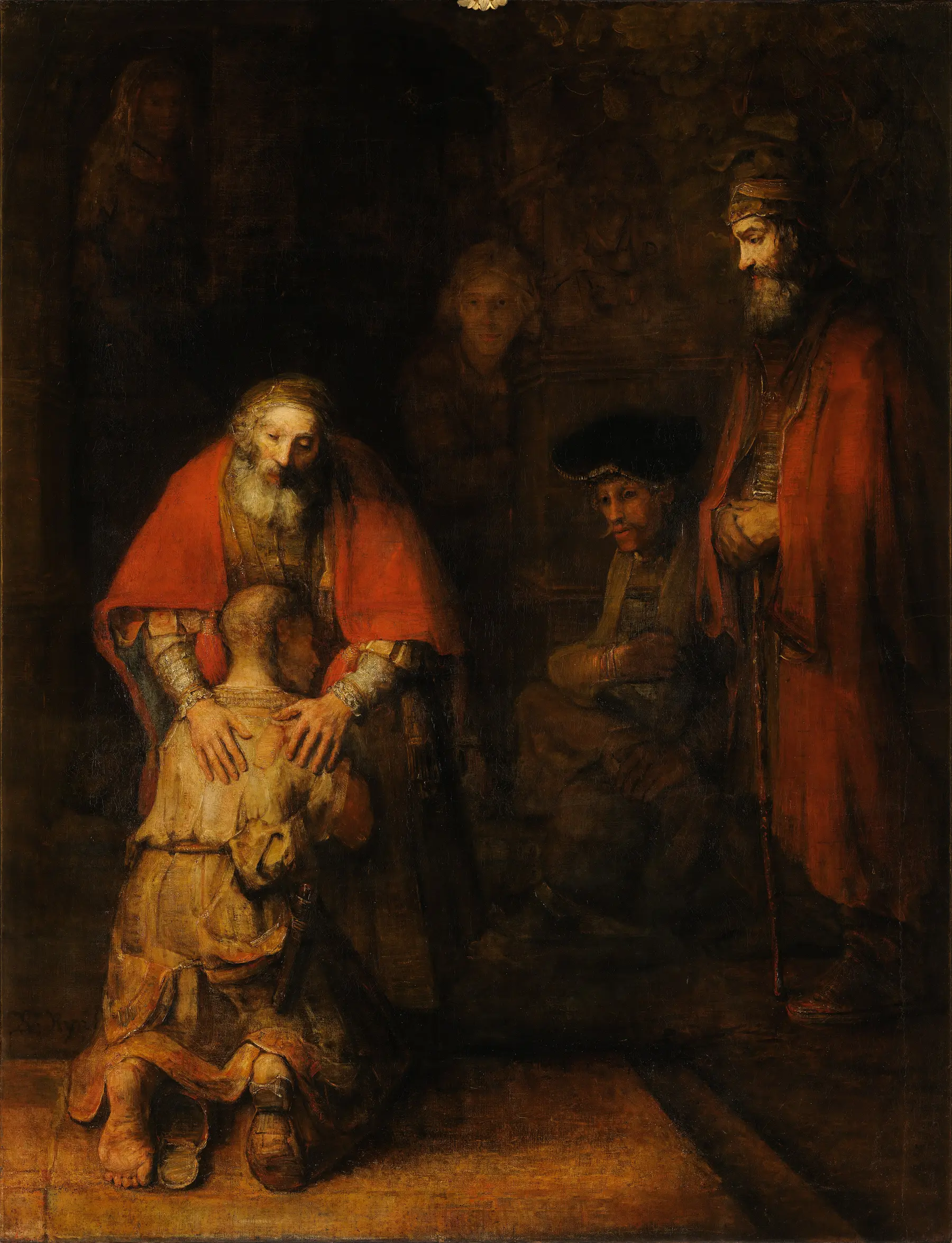
Lukechapter 16
31 verses · Luke · about AD 62 · The Gospels
In Hades, where he was in torment, he looked up and saw Abraham from afar, with Lazarus by his side.
Introduction
Luke, The Gospels, Luke Overview.
Luke wrote this chapter for readers who managed property and knew how an estate was run. It holds two stories about rich men, one told to the disciples and one told within hearing of Pharisees who loved money. Between them stand hard sayings about faithfulness, the Law and marriage. Both stories turn on what a man does with wealth before a reckoning comes. Listen for the word shrewd in the first story and for the great chasm in the second, and ask what each reckoning reveals. The chapter ends on a sentence about Moses, the prophets and someone rising from the dead.
Context
- Who
- A Greek reader who managed property and understood stewards
- What
- Two parables about rich men and a reckoning, with sayings on faithful use of money and on the Law between them.
- Where
- On the road toward Jerusalem, spoken to the disciples with Pharisees listening; no place is named.
- When
- On the road to Jerusalem, about AD 29 to 30.
- Why
- To teach disciples to use present wealth with eternity in view, and to warn that no one can serve both God and money.
Historical context
A steward ran an estate with real legal power to act in his master's name, leasing, collecting, and signing on his behalf. The debts in the parable are commercial quantities: a hundred measures of olive oil is the yield of a substantial grove, and a hundred measures of wheat is the crop of a large field. These are business tenants, not peasants.
Show the rest of the historical context, 3 more paragraphs
How the steward's discount worked has been debated for centuries. One long-standing explanation is that he was cutting out his own commission built into the bills; another is that he was removing hidden interest, since Jewish law forbade charging interest to a fellow Israelite and it was often disguised in the amount recorded. Either reading explains why the master could commend the shrewdness without condoning theft.
The rich man in the second story is described with the markers of extreme wealth: purple, the most expensive dye in the ancient world, made in tiny quantities from sea snails; fine linen from Egypt; and feasting every day, when most people ate meat only at festivals. He also has a gate, meaning a walled property in a city.
Lazarus lies at that gate with dogs licking his sores, street scavengers, not pets, and their attention marks him as helpless. The picture of the afterlife uses the imagery Jewish teaching of the period employed: a place of comfort described as Abraham's side, which is the position of the honoured guest reclining next to the host at a banquet.
Significance
Luke states the moral in the plainest terms he uses anywhere: you cannot serve God and money. And he records that the Pharisees, who loved money, ridiculed him for it.
Show the rest of the significance, 1 more paragraph
The last line of the Lazarus story was aimed straight at the argument Luke's readers were having with the synagogue. They have Moses and the Prophets, let them hear them. If they do not, neither will they be convinced if someone rises from the dead. Written after the resurrection, that sentence is not a hypothetical.
The heads below are this chapter's scenes. The numbered points under each are its verses.
The Shrewd Steward and Unrighteous Mammon
Luke 16:1-2
a rich man whose manager: Jesus tells His disciples of a rich man's manager, an estate steward trusted with the whole business, who was accused of wasting his possessions. The summons decides his dismissal and leaves only the audit: Turn in an account of your management.
Luke 16:1
“His disciples - The word “disciples,” here, is not to be restricted to the twelve apostles or to the seventy. The parable appears to have been addressed to all the professed followers of the Saviour who were present when it was delivered. It is connected with that in the preceding chapter. Jesus had there been discoursing with the scribes and Pharisees, and vindicating his conduct in receiving kindly publicans and sinners. These “publicans and sinners” are here particularly referred to by the word “disciples.” It was with reference to “them” that the whole discourse had arisen.”
1 more voice on this verseWhat preachers and commentators have said about this verse, in their own words.
Luke 16:1
“You proposed a little question about the Gospel of Luke (Chapter 16, verse 1 et seq.): Who is the steward of iniquity who is praised by the voice of the Lord? When I wanted to know the reason for this and from which source it came, I examined the volume of the Gospel, and I found among other things that, as the tax collectors and sinners approached the Saviour to hear him, the Pharisees and scribes murmured, saying, "Why does this one receive sinners and eat with them?" (Luke 15:2).”
Jerome · written before 420 · Letter 121, Chapter 6patristic
Turn in an account of your management: The manager loses his post in one breath. Adam Clarke reads the order to turn in an account as a demand for the books of receipts and payments. Spurgeon applied it to every man, who must give God an account of all he holds.
Luke 16:2
“Give an account of thy, etc. - Produce thy books of receipts and disbursements, that I may see whether the accusation against thee be true or false. The original may be translated, Give up the business, τον λογον, of the stewardship.”
Adam Clarke · Commentary on the Bible (1810-1826)evangelical
1 more voice on this verse
Luke 16:2
“THE first part of this text applies to us all. The second part will apply to each one of us before long. "Give an account of your stewardship," is a command that may be addressed to the ungodly. They are accountable to God for all that they have, or have ever had, or ever shall have. The Law of the Lord is not relaxed because they have sinned—they still remain responsible to God even though they attempt to cast off the yoke of the Almighty.”
Charles Spurgeon · written before 1892 · The Metropolitan Tabernacle Pulpit, Sermon No. 2445: “The Last Sermon for the Year” (lightly modernized text, CCEL edition)Particular Baptist
Luke 16:3-4
The manager weighs his options: I am too weak to dig and too ashamed to beg. He plans to buy future welcome into people's homes with favors done at his master's expense.
Luke 16:3
“Said within himself - Thought, or considered. My lord - My master, my employer. I cannot dig - This may mean either that his employment had been such that he could not engage in agriculture, not having been acquainted with the business, or that he was “unwilling” to stoop to so low an employment as to work daily for his support. “To dig,” here, is the same as to till the earth, to work at daily labor.”
1 more voice on this verse
Luke 16:3
“Then the steward said within himself,.... As the Scribes and Pharisees were wont to do, Mat 3:9 what shall I do? he does not say, what will become of me?”
I know what I will do: The steward's plan turns on the debtors, who will owe him a favor once he is out of work. Adam Clarke notes that such tenants paid their rents in kind, in wheat and oil and other produce. John Gill hears a settled scheme in the words.
Luke 16:4
“I am resolved what to do,.... Or "I know what to do"; I have a scheme in my head, and I am determined to execute it, which will provide for me, and secure me a maintenance: that when I am put out of the stewardship; drove from Jerusalem, and from the temple and the synagogues: they may receive me into their houses; either Jews or Gentiles, after their dispersion.”
1 more voice on this verse
Luke 16:4
“They may receive me - That is, the debtors and tenants, who paid their debts and rents, not in money, but in kind; such as wheat, oil, and other produce of their lands.”
Adam Clarke · Commentary on the Bible (1810-1826)evangelical
Luke 16:5-7
each one of his master’s debtors: The hundred measures of olive oil, roughly nine hundred gallons, became fifty, and the hundred measures of wheat, some twelve hundred bushels, became eighty. Each debtor wrote the new figure himself, each cut generous enough to buy gratitude without drawing instant suspicion.
Luke 16:5
“Called every one - As he was “steward,” he had the management of all the affairs, and, of course, debts were to be paid to him. Debtors - Those who “owed” his master, or perhaps “tenants;” those who rented land of his master.”
Adam Clarke identifies the measure as the bath, the tenth part of a homer by Ezekiel 45:11. John Gill cites the rabbis who used such oil for the grain offerings. The debtor writes fifty with his own hand.
Luke 16:6
“A hundred measures of oil - Ἑκατον βατους, A hundred baths. The בת bath was the largest measure of capacity among the Hebrews, except the homer, of which it was the tenth part: see Eze 45:11, Eze 45:14. It is equal to the ephah, i.e. to seven gallons and a half of our measure. Take thy bill - Thy account - το γραμμα. The writing in which the debt was specified, together with the obligation to pay so much, at such and such times.”
Adam Clarke · Commentary on the Bible (1810-1826)evangelical
The second debtor's cut is a fifth. Albert Barnes takes the measure as the kor, about eight bushels by one table and fourteen by another. Matthew Henry notes that the steward, turned out for dishonesty, goes on dealing dishonestly.
Luke 16:7
“What the Gospel of "the unjust steward" says is also an image of this matter. He says to the debtor [of one hundred measures of wheat], "Take your bill, sit down, and write eighty," and the other things that are related. You see that he said to each man, "Take your bill." It is evident from this that the documents of sin are ours, but God writes documents of justice.”
Origen of Alexandria · written before 253 · Homilies on Genesis 13.4patristic
1 more voice on this verse
Luke 16:7
“How hard is it to find one that confidence can be reposed in! Let God be true, but every man a liar. Though this steward is turned out for dealing dishonestly, yet still he does so.”
Matthew Henry · Commentary on the Whole Bible (1707-1721)puritan
commended the dishonest manager: The master commended the dishonest manager because he had acted shrewdly, praising his foresight apart from his dishonesty. Jesus draws a lesson from a rogue's cleverness as He does elsewhere from an unjust judge.
Luke 16:8
“The lord commended - Viz. the master of this unjust steward. He spoke highly of the address and cunning of his iniquitous servant. He had, on his own principles, made a very prudent provision for his support; but his master no more approved of his conduct in this, than he did in his wasting his substance before.”
Adam Clarke · Commentary on the Bible (1810-1826)evangelical
1 more voice on this verse
Luke 16:8
“And the Lord commended the unjust steward - Namely, in this respect, because he had used timely precaution: so that though the dishonesty of such a servant be detestable, yet his foresight, care, and contrivance, about the interests of this life, deserve our imitation, with regard to the more important affairs of another.”
John Wesley · Explanatory Notes upon the New Testament (1755)evangelical
use worldly wealth to make friends: Jesus applies the parable: use worldly wealth to make friends, so that when it is gone, they will welcome you into eternal dwellings. The saying echoes the feast counsel of chapter 14, where the guests worth inviting are those who cannot repay.
Luke 16:9
“I say unto you - I, Jesus, say to you, my disciples. Make to yourselves friends - Some have understood the word “friends,” here, as referring to the poor; others, to holy angels; and others, to God. Perhaps, however, the word should not be considered as referring to any particular “persons,” but is used in accordance with the preceding parable; for in the application our Saviour uses the “language” appropriated to the conduct of the steward to express the “general” truth that we are to make a proper use of riches.”
1 more voice on this verse
Luke 16:9
For, because He knew that we would make a good use of our substance which we should possess by receiving it from another, He says, "He that hath two coats, let him impart to him that hath none; and he that hath meat, let him do likewise." And, "For I was an hungered, and ye gave Me meat; I was thirsty, and ye gave Me drink; I was naked and ye clothed Me." And, "When thou doest thine alms, let not thy left hand know what thy right hand doeth."
Irenaeus · written before 202 · Irenaeus Against Heresies Book 4patristic
Luke 16:10-12
faithful with very little: Jesus states a rule of character: whoever is faithful with very little will also be faithful with much. He applies it to money, the lesser trust, which tests a man's fitness for true riches.
Luke 16:10
“He that is faithful in that which is least, etc. - He who has the genuine principles of fidelity in him will make a point of conscience of carefully attending to even the smallest things; and it is by habituating himself to act uprightly in little things that he acquires the gracious habit of acting with propriety fidelity, honor, and conscience, in matters of the greatest concern. On the contrary, he who does not act uprightly in small matters will seldom feel himself bound to pay much attention to the dictates of honor and conscience, in cases of high importance.”
Adam Clarke · Commentary on the Bible (1810-1826)evangelical
1 more voice on this verse
Luke 16:10
“He, &c.--a maxim of great pregnancy and value; rising from the prudence which the steward had to the fidelity which he had not, the "harmlessness of the dove, to which the serpent" with all his "wisdom" is a total stranger.”
Jamieson, Fausset & Brown · Commentary Critical and Explanatory on the Whole Bible (1871)reformed
who will entrust you with true riches?: The true riches stand over against worldly wealth. Albert Barnes names them the riches of God's grace, given to men who handle small things honestly. Matthew Henry held that these riches enter the soul and can never be taken away.
Luke 16:11
“Who will commit ... - If you are not faithful in the small matters pertaining to this world, if you do not use aright your property and influence, you cannot expect that God will commit to you the true riches of his grace. Men who are dishonest and worldly, and who do not employ the deceitful mammon as they ought, cannot expect to grow in grace. God does not confer grace upon them, and their being unfaithful in earthly matters is evidence that they “would be” also in much greater affairs, and would likewise “misimprove” the true riches.”
1 more voice on this verse
Luke 16:11
“But spiritual and eternal riches are our own (they enter into the soul that becomes possessed of them) and inseparably; they are a good part that will never be taken away from us. If we make Christ our own, and the promises our own, and heaven our own, we have that which we may truly call our own.”
Matthew Henry · Commentary on the Whole Bible (1707-1721)puritan
the belongings of another: Worldly goods are held in trust for another, and the steward of the parable handled exactly such goods. Adam Clarke reads them as belonging to God and passing from hand to hand. Ambrose added that a man is born without them and leaves without them.
Luke 16:12
“Hereafter, what the faithful have will be their own property, being no longer on probation, but in secure, undisturbed, rightful, everlasting possession and enjoyment of all that is graciously bestowed on us. Thus money is neither to be idolized nor despised: we must sit loose to it and use it for God's glory.”
Jamieson, Fausset & Brown · Commentary Critical and Explanatory on the Whole Bible (1871)reformed
1 more voice on this verse
Luke 16:12
“Riches are foreign to us, because they are something beyond nature, they are not born with us, and they do not pass away with us. But Christ is ours, because He is the life of man. Lastly, He came unto His own.”
Ambrose of Milan · written before 397 · Catena Aurea by Aquinaspatristic
No servant can serve two masters: The last line, You cannot serve both God and money, names the two rival claims. Money stands for the whole system of trust in wealth, and the saying sets the manager parable under one choice.
Luke 16:13
“Not because the Lord is two, but one. For although there are who serve mammon, yet he knoweth no rights of lordship; but has himself placed upon himself a yoke of servitude. There is one Lord, because there is one God. Hence it is evident, that the power of the Father and the Son is one: and He assigns a reason, thus saying, For either he will hate the one, and love the other; or else he will hold to the one, and despise the other.”
Ambrose of Milan · written before 397 · Catena Aurea by Aquinaspatristic
1 more voice on this verse
Luke 16:13
“No servant can serve two masters - The heart will be either wholly taken up with God, or wholly engrossed with the world. See on Mat 6:24 (note).”
Adam Clarke · Commentary on the Bible (1810-1826)evangelical
Scoffing Pharisees; the Law and the Kingdom
Luke 16:14-15
who were lovers of money: The Pharisees, who were lovers of money, were scoffing at Jesus, the word carrying the sense of turning up the nose. Jesus answers that what is prized among men is detestable before God, putting their standing, built partly on visible almsgiving and piety, under judgment.
Luke 16:14
“Being lovers of money, they repeatedly did not judge matters before them according to what was agreeable to the laws of God. On the contrary, they judged inequitably and in opposition to God's will.…Since it says that the Pharisees were lovers of money, they derided Jesus for directing them by his healthful doctrines to praiseworthy conduct and making them want saintly glories. He tells them that it was their duty to sell their possessions and distribute them to the poor.”
Cyril of Alexandria · written before 444 · Commentary on Luke, Homily 110patristic
2 more voices on this verse
Luke 16:14
“They derided him - Or rather, They treated him with the utmost contempt. So we may translate the original words εξεμυκτηριζον αυτον, which literally signifies, in illum emunxerunt - but must not be translated into English, unless, to come a little near it, we say, they turned up their noses at him; and why! Because they were lovers of money, and he showed them that all such were in danger of perdition.”
Adam Clarke · Commentary on the Bible (1810-1826)evangelical
Luke 16:14
“Let us consider this, [1.] As their sin, and the fruit of their covetousness, which was their reigning sin, their own iniquity. Note, Many that make a great profession of religion, have much knowledge, and abound in the exercise of devotion, are yet ruined by the love of the world; nor does any thing harden the heart more against the word of Christ.”
Matthew Henry · Commentary on the Whole Bible (1707-1721)puritan
The Pharisees had just ridiculed the teaching on money. Adam Clarke reads their self-justifying as a claim that they could serve both God and money together. God weighs the heart, and the esteem of men counts for nothing there.
Luke 16:15
“Ye - justify yourselves - Ye declare yourselves to be just. Ye endeavor to make it appear to men that ye can still feel an insatiable thirst after the present world, and yet secure the blessings of another; that ye can reconcile God and mammon, - and serve two masters with equal zeal and affection; but God knoweth your hearts, - and he knoweth that ye are alive to the world, and dead to God and goodness. Therefore, howsoever ye may be esteemed among men, ye are an abomination before him. See the note on Luk 7:29.”
Adam Clarke · Commentary on the Bible (1810-1826)evangelical
The Law and the Prophets: were proclaimed until John, which places him at the hinge between promise and arrival. Everyone forcing his way into the kingdom matches the striving at the narrow door in chapter 13.
Luke 16:16
“The law and the prophets were until John - The law and the prophets continued to be the sole teachers till John came, who first began to proclaim the glad tidings of the kingdom of God: and now, he who wishes to be made a partaker of the blessings of that kingdom must rush speedily into it; as there will be but a short time before an utter destruction shall fall upon this ungodly race.”
Adam Clarke · Commentary on the Bible (1810-1826)evangelical
4 more voices on this verse
Luke 16:16
“Since, then, the law originated with Moses, it terminated with John as a necessary consequence. Christ had come to fulfil it: wherefore "the law and the prophets were" with them "until John." And therefore Jerusalem, taking its commencement from David, and fulfilling its own times, must have an end of legislation when the new covenant was revealed. For God does all things by measure and in order; nothing is unmeasured with Him, because nothing is out of order.”
Irenaeus · written before 202 · Irenaeus Against Heresies Book 4patristic
Luke 16:16
“The law and the prophets were in force until John: from that time the Gospel takes place; and humble upright men receive it with inexpressible earnestness. Not that the Gospel at all destroys the law.”
John Wesley · Explanatory Notes upon the New Testament (1755)evangelical
Luke 16:16
"It is true," saith Christ, "so it was, but now that the kingdom of God is begun to be preached things take a new turn; now blessed are the poor, and the mourners, and the persecuted." The Pharisees, to requite the people for their high opinion of them, allowed them in a cheap, easy, formal religion.
Matthew Henry · Commentary on the Whole Bible (1707-1721)puritan
Luke 16:16
“The law, &c.--(See Mt 11:13). and every man presseth, &c.--Publicans and sinners, all indiscriminately, are eagerly pressing into it; and ye, interested adherents of the mere forms of an economy which is passing away, "discerning not the signs of this time," will allow the tide to go past you and be found a stranded monument of blindness and obstinacy.”
Jamieson, Fausset & Brown · Commentary Critical and Explanatory on the Whole Bible (1871)reformed
a single stroke of a pen: The stroke of a pen is the smallest mark that tells one Hebrew letter from another, and it still stands. Verse 17 follows verse 16 directly, so the arrival of the kingdom stands beside the Law's abiding truth.
Luke 16:17
"More easily, therefore, may heaven and earth pass away-as also the law and the prophets-than that one tittle of the Lord's words should fail." "For," as says Isaiah: "the word of our God shall stand for ever.
Tertullian · written before 220 · Against Marcion Book IVpatristic
1 more voice on this verse
Luke 16:17
“Nay, the precepts of it are explained and enforced by the gospel, and made to appear more spiritual. The ceremonial law is perfected in the gospel colours; not one tittle of that fails, for it is found printed off in the gospel, where, though the force of it is as a law taken off, yet the figure of it as a type shines very brightly, witness the epistle to the Hebrews.”
Matthew Henry · Commentary on the Whole Bible (1707-1721)puritan
Anyone who divorces his wife: Luke places this saying on divorce and remarriage right after the Law's abiding force. Matthew's parallel records an exception for sexual immorality, and 1 Corinthians 7 also bears on it.
Luke 16:18
He had above proposed that the kingdom of God should be preached. When he had said that one tittle cannot fall from the law, he added, "Everyone who puts away his wife, and marries another, commits adultery." The apostle rightly admonishes, saying that this is a great sacrament concerning Christ and the church. You find a marriage that doubtlessly was joined by God, when he himself says, "No man comes to me, unless my Father who sent me has drawn him." He alone could join this marriage. Solomon mystically said, "A wife will be prepared for a man by God."
Ambrose of Milan · written before 397 · Exposition of the Gospel of Lukepatristic
1 more voice on this verse
Luke 16:18
“Putteth away (or divorceth) his wife - See on Mat 5:31, Mat 5:32 (note); Mat 19:9, Mat 19:10 (note); Mar 10:12 (note); where the question concerning divorce is considered at large. These verses, from the 13th to the 18th inclusive, appear to be part of our Lord’s sermon on the mount; and stand in a much better connection there than they do here; unless we suppose our Lord delivered the same discourse at different times and places, which is very probable.”
Adam Clarke · Commentary on the Bible (1810-1826)evangelical
The Rich Man and Lazarus
Luke 16:19-21
dressed in purple and fine linen: A rich man wore purple, among the costliest goods of the ancient world, while a beggar named Lazarus lay at his gate. Lazarus is the only person given a name in any parable Jesus tells.
Luke 16:19
Now, He has not merely related to us a story respecting a poor man and a rich one; but He has taught us, in the first place, that no one should lead a luxurious life, nor, living in worldly pleasures and perpetual feastings, should be the slave of his lusts, and forget God. "For there was," He says, "a rich man, who was clothed in purple and fine linen, and delighted himself with splendid feasts."
Irenaeus · written before 202 · Irenaeus Against Heresies Book 4patristic
3 more voices on this verse
Luke 16:19
“Well, and what harm was there in all this? It is no sin to be rich, no sin to wear purple and fine linen, nor to keep a plentiful table, if a man's estate will afford it.”
Matthew Henry · Commentary on the Whole Bible (1707-1721)puritan
Luke 16:19
“There was a certain rich man - Many have supposed that our Lord here refers to a “real history,” and gives an account of some man who had lived in this manner; but of this there is no evidence. The probability is that this narrative is to be considered as a parable, referring not to any particular case which “had” actually happened, but teaching that such cases “might” happen. The “design” of the narrative is to be collected from the previous conversation.”
Luke 16:19
The parable we have now read, in one respect stands alone in the Bible. It is the only passage of Scripture which describes the feelings of the unconverted after death. For this reason, as well as for many others, the parable deserves especial attention. We learn, firstly, from this parable — that a man's worldly condition is no test of his state in the sight of God. The Lord Jesus describes to us two men — of whom one was very rich, and the other very poor. The one "fared sumptuously every day."
a beggar named Lazarus: Only the poor man in the story has a name. John Wesley notes that Lazarus is the Greek form of Eleazar. Adam Clarke held that the name was given for his good character and glorious end.
Luke 16:20
“Lazarus was lying at the gate in order to draw attention to the cruelty paid to his body and to prevent the rich man from saying, "I did not notice him. He was in a corner. I could not see him. No one announced him to me." He lay at the gate. You saw him every time you went out and every time you came in. When your crowds of servants and clients were attending you, he lay there full of ulcers.”
Jerome · written before 420 · On Lazarus and Divespatristic
2 more voices on this verse
Luke 16:20
“There was a certain beggar named Lazarus - His name is mentioned, because his character was good, and his end glorious; and because it is the purpose of God that the righteous shall be had in everlasting remembrance. Lazarus, לעזר is a contraction of the word אלעזר Eliezar, which signifies the help or assistance of God - a name properly given to a man who was both poor and afflicted, and had no help but that which came from heaven.”
Adam Clarke · Commentary on the Bible (1810-1826)evangelical
Luke 16:20
“And there was a certain beggar named Lazarus, (according to the Greek pronunciation) or Eleazer. By his name it may be conjectured, he was of no mean family, though it was thus reduced.”
John Wesley · Explanatory Notes upon the New Testament (1755)evangelical
Even the dogs came and licked his sores: The crumbs from the table were all Lazarus wanted, and the verse leaves open whether he got them. Adam Clarke thought the rich man likely allowed them, and Ambrose saw in the scene the pride of the wealthy. The dogs were his only company.
Luke 16:21
“And desiring to be fed with the crumbs - And it is likely this desire was complied with, for it is not intimated that he spurned away the poor man from the gate, or that his suit was rejected.”
Adam Clarke · Commentary on the Bible (1810-1826)evangelical
1 more voice on this verse
Luke 16:21
“But the insolence and pride of the wealthy is manifested afterwards by the clearest tokens, for it follows, and no one gave to him. For so unmindful are they of the condition of mankind, that as if placed above nature they derive from the wretchedness of the poor an incitement to their own pleasure, they laugh at the destitute, they mock the needy, and rob those whom they ought to pity.”
Ambrose of Milan · written before 397 · Catena Aurea by Aquinaspatristic
Luke 16:22-23
by the angels to Abraham’s side: The beggar was carried by the angels to Abraham’s side with no funeral recorded, while the rich man died and was buried. In Hades the rich man looked up and saw Lazarus at Abraham’s side, the two positions of life exactly reversed.
Luke 16:22
“And the beggar - Worn out with hunger, and pain, and want of all things, died: and was carried by angels (amazing change of the scene!) into Abraham's bosom - So the Jews styled paradise; the place where the souls of good men remain from death to the resurrection.”
John Wesley · Explanatory Notes upon the New Testament (1755)evangelical
2 more voices on this verse
Luke 16:22
“The rich man also died, and was buried - There is no mention of this latter circumstance in the case of Lazarus; he was buried, no doubt - necessity required this; but he had the burial of a pauper, while the pomp and pride of the other followed him to the tomb. But what a difference in these burials, if we take in the reading of my old MS. Bible, which is supported by several versions: forsothe the riche man is deed: and is buried in helle.”
Adam Clarke · Commentary on the Bible (1810-1826)evangelical
Luke 16:22
"Now, blessed angels," said a good man just expiring, "now come and do your office." (4.) It was carried into Abraham's bosom. The Jews expressed the happiness of the righteous at death three ways:--they to go to the garden of Eden: they go to be under the throne of glory; and they go to the bosom of Abraham, and it is this which our Saviour here makes use of.
Matthew Henry · Commentary on the Whole Bible (1707-1721)puritan
In Hades, where he was in torment: Hades is the Greek name for the place of the dead. Albert Barnes notes that it is used here of the place where the wicked go. Tertullian drew from the verse that Abraham's side and the place of torment are two places.
Luke 16:23
“In hell - The word here translated hell (“Hades”) means literally a dark, obscure place; the place where departed spirits go, but especially the place where “wicked” spirits go. See the Job 10:21-22 notes; Isa 14:9 note. The following circumstances are related of it in this parable: 1. It is “far off” from the abodes of the righteous. Lazarus was seen “afar off.” 2. It is a place of torment. 3. There is a great gulf fixed between that and heaven, Luk 16:26. 4. The suffering is great. It is represented by “torment” in a flame, Luk 16:24.”
2 more voices on this verse
Luke 16:23
“Our answer to this is, that the Scripture itself which dazzles his sight expressly distinguishes between Abraham's bosom, where the poor man dwells, and the infernal place of torment. "Hell" (I take it) means one thing, and "Abraham's bosom" another. "A great gulf" is said to separate those regions, and to hinder a passage from one to the other. Besides, the rich man could not have "lifted up his eyes," and from a distance too, except to a superior height, and from the said distance all up through the vast immensity of height and depth.”
Tertullian · written before 220 · Against Marcion Book IVpatristic
Luke 16:23
“Yet this is not all; he was hard-hearted to God's poor, and therefore he is not only cut off from mercy, but he has judgment without mercy, and falls under a punishment of sense as well as a punishment of loss.”
Matthew Henry · Commentary on the Whole Bible (1707-1721)puritan
The rich man cried out, Father Abraham, have mercy on me, and his first words in the story go to Abraham. He asks only that Lazarus dip the tip of his finger in water and cool his tongue, as if Lazarus were still a servant.
Luke 16:24
“But he receives a meet reward, fire and the torments of hell; the parched tongue; for the tuneful lyre, wailing; for drink, the intense longing for a drop; for curious or wanton spectacles, profound darkness; for busy flattery, the undying worm. Hence it follows, That he may cool my tongue, for I am tormented in the flame.”
Basil of Caesarea · written before 379 · Catena Aurea by Aquinaspatristic
3 more voices on this verse
Luke 16:24
“And he cried and said, father Abraham,.... The Jews used to call Abraham their father, and were proud of their descent from him, Mat 3:9 and so persons are after death represented by them, as speaking to, and discoursing with him; as in the passage cited in the note See Gill on Luk 16:22 to which the following may be added (c); "says R.”
Luke 16:24
“Father Abraham - The Jews considered it a signal honor that Abraham was their “father” - that is, that they were “descendants” from him. Though this man was now in misery, yet he seems not to have abandoned the idea of his relation to the father of the faithful. The Jews supposed that departed spirits might know and converse with each other. See Lightfoot on this place.”
Luke 16:24
“Father Abraham, have mercy on me - It cannot be denied, but here is one precedent in Scripture of praying to departed saints: but who is it that prays, and with what success?”
John Wesley · Explanatory Notes upon the New Testament (1755)evangelical
Luke 16:25-26
remember that during your lifetime: Abraham answers, Child, remember that during your lifetime you received your good things, while Lazarus received bad things. Besides this, a great chasm has been fixed between us and you, so that even those who wish cannot cross.
Luke 16:25
“Son - This is a representation designed to correspond with the word “father.” He was a descendant of Abraham a Jew - and Abraham is represented as calling this thing to his remembrance. It would not lessen his sorrows to remember that he was a “son” of Abraham, and that he ought to have lived worthy of that relation to him. Remember - This is a cutting word in this place. One of the chief torments of hell will be the “remembrance” of what was enjoyed and of what was done in this world.”
1 more voice on this verse
Luke 16:25
“Thou in thy lifetime receivedst thy good things - Thou didst choose and accept of worldly things as thy good, thy happiness. And can any be at a loss to know why he was in torments? This damnable idolatry, had there been nothing more, was enough to sink him to the nethermost hell.”
John Wesley · Explanatory Notes upon the New Testament (1755)evangelical
a great chasm has been fixed: Abraham's second reason is the fixed chasm between the two places. Albert Barnes notes that fixed means made firm and immovable, and Ambrose drew from it that rewards cannot change after death. The rich man asks no more for himself after this.
Luke 16:26
“And besides all this,.... The different circumstances of each, both past and present, which should be observed and considered: between us and you there is a great gulf fixed; as this may regard the state of the Pharisees after death, it intends not the natural distance between heaven and hell; though there may be an allusion to the notions of the Jews concerning that, who on those words in Ecc 7:14. "God hath set the one over against the other", say (f), "this is hell and paradise, what space is there between them? an hand's breadth; R.”
2 more voices on this verse
Luke 16:26
“A great gulf - The word translated “gulf” means chasm, or the broad, yawning space between two elevated objects. In this place it means that there is no way of passing from one to the other. Fixed - Strengthened - made firm or immovable. It is so established that it will never be movable or passable. It will forever divide heaven and hell. Which would pass - We are not to press this passage literally, as if those who are in heaven would “desire” to go and visit the wicked in the world of woe.”
Luke 16:26
“Between the rich and the poor then there is a great gulf, because after death rewards cannot be changed. Hence it follows, So that they who would pass from hence to you cannot, nor come thence to us.”
Ambrose of Milan · written before 397 · Catena Aurea by Aquinaspatristic
Luke 16:27-28
His second request moves from his own relief to his family: send Lazarus to warn my five brothers. Lazarus is still an errand runner in his plan. The five brothers stand for every hearer still able to change course.
Luke 16:27
“Then he said, I pray thee therefore father,.... The Cambridge, copy of Beza's, and the Ethiopic version read, "father Abraham"; finding he could have no redress of his misery, nor any relief for himself, he applies for others: that thou wouldst send him to my father's house; the house of Israel and Jacob, the surviving Jews: and this agrees also with a notion of theirs, that the dead seek for mercy for them (l). The Persic and Ethiopic versions read, "that thou wouldst send Lazarus", &c. whom the one calls Gazarus, and the other Eleazar. (l) T. Bab. Taanith, fol.”
1 more voice on this verse
Luke 16:27
“Then he said--now abandoning all hope for himself. send him to my father's house, &c.--no waking up of good in the heart of the lost, but bitter reproach against God and the old economy, as not warning him sufficiently [TRENCH]. The answer of Abraham is, They are sufficiently warned.”
Jamieson, Fausset & Brown · Commentary Critical and Explanatory on the Whole Bible (1871)reformed
for I have five brothers: The rich man remembers his brothers, and Gregory the Great saw that memory itself as part of his punishment. Albert Barnes takes the number five as a plain detail of the story, while Jerome read the five as the five senses. The concern comes too late for himself.
Luke 16:28
“Your father is Abraham. How can you say, "Send him to my father's house"? You have not forgotten your father. You have not forgotten that your father destroyed you. Since he was your father, you have five brothers: sight, smell, taste, hearing and touch. These are the brothers to whom formerly you were enslaved. Since they were the brothers you loved, you could not love your brother Lazarus. Naturally you could not love him as brother, because you loved them. Those brothers have no love for poverty.”
Jerome · written before 420 · On Lazarus and Dives 86patristic
2 more voices on this verse
Luke 16:28
“Five brethren - The number “five” is mentioned merely to preserve the appearance of verisimilitude in the story. It is not to be spiritualized, nor are we to suppose that it has any hidden or inscrutable meaning. May testify unto them - May bear “witness” to them, or may inform them of what is my situation, and the dreadful consequences of the life that I have led. It is remarkable that he did not ask to go himself. He knew that he could not be released, even for so short a time. His condition was fixed.”
Luke 16:28
“In this matter it should be noted how much is heaped upon the burning rich man for his punishment. For both knowledge and memory are preserved for him unto his punishment. For he recognizes Lazarus whom he despised, and he also remembers his brothers whom he left behind. For his vengeance from the poor man would not be complete if he did not recognize him in retribution. And the punishment in fire would not be complete if he did not fear for his own what he himself suffers.”
Gregory the Dialogist · written before 604 · Forty Gospel Homilies, Homily 40patristic
Abraham points the rich man back to the Scriptures his brothers already hold: They have Moses and the prophets. The answer makes the written word enough warning for anyone willing to receive it.
Luke 16:29
“They have Moses - The writings of Moses. The first five books of the Bible. The prophets - The remainder of the Old Testament. What the prophets had written. Hear them - Hear them speak in the Scriptures. Read them, or hear them read in the synagogues, and attend to what they have delivered.”
Luke 16:30-31
sent to them from the dead: Abraham answers that those deaf to Moses and the prophets will not be persuaded even if someone rises from the dead. The Gospels test this twice, in the raising of Lazarus of Bethany and the resurrection of Jesus, and many witnesses met each with unbelief.
Luke 16:30
“Hence the rich man also replied: "No, my father; but if someone from the dead goes to them, they will believe." To whom a truthful judgment is immediately spoken: "If they do not hear Moses and the prophets, neither will they believe someone who has risen from the dead," because indeed those who despise the words of the law will fulfill the precepts of the Redeemer, who rose from the dead, with greater difficulty the more subtle they are.”
Gregory the Dialogist · written before 604 · Forty Gospel Homilies, Homily 40patristic
1 more voice on this verse
Luke 16:30
“If one went to them from the dead, etc. - Many are desirous to see an inhabitant of the other world, and converse with him, in order to know what passes there. Make way! Here is a damned soul, which Jesus Christ has evoked from the hell of fire! Hear him! Hear him tell of his torments! Hear him utter his regrets! “But we cannot see him.” No: God has, in his mercy, spared you for the present this punishment. How could you bear the sight of this damned spirit? Your very nature would fail at the appearance.”
Adam Clarke · Commentary on the Bible (1810-1826)evangelical
Abraham's last word makes Moses and the prophets the sufficient witness. Irenaeus joined it to John 5:46 and 47, where Jesus says Moses wrote of Him. Jamieson, Fausset and Brown note that a real Lazarus soon came back from the dead, and the Pharisees plotted against Jesus all the more.
Luke 16:31
“But since the writings (literae) of Moses are the words of Christ, He does Himself declare to the Jews, as John has recorded in the Gospel: "If ye had believed Moses, ye would have believed Me: for he wrote of Me. But if ye believe not his writings, neither will ye believe My words." He thus indicates in the clearest manner that the writings of Moses are His words. If, then, [this be the case with regard] to Moses, so also, beyond a doubt, the words of the other prophets are His [words], as I have pointed out.”
Irenaeus · written before 202 · Irenaeus Against Heresies Book 4patristic
3 more voices on this verse
Luke 16:31
“Be persuaded - Be convinced of the truth; of the danger and folly of their way; of the certainty of their suffering hereafter, and be induced to turn from sin to holiness, and from Satan unto God. From this impressive and instructive parable we may learn: 1. That the souls of people do not die with their bodies. 2. That the soul is “conscious” after death; that it does not “sleep,” as some have supposed, until the morning of the resurrection.”
Luke 16:31
“Neither will they be persuaded - Truly to repent: for this implies an entire change of heart: but a thousand apparitions cannot, effect this. God only can, applying his word.”
John Wesley · Explanatory Notes upon the New Testament (1755)evangelical
Luke 16:31
A real Lazarus soon "rose from the dead," but the sight of him by crowds of people, inclined thereby to Christ, only crowned the unbelief and hastened the murderous plots of the Pharisees against the Lord of glory; nor has His own resurrection, far more overpowering, yet won over that "crooked and perverse nation."
Jamieson, Fausset & Brown · Commentary Critical and Explanatory on the Whole Bible (1871)reformed
How this psalm is built
The form: Two parables about a rich man, set at the opening and the close of the chapter, as Henry classes it.
The patterns in this chapter
| Device | What it does | Where to see it |
|---|---|---|
| There was a rich man | Both parables open on the same words, at verse 1 and at verse 19, and both carry a man from ease to a reckoning. In the first the manager is called to give an account and acts before it comes. In the second the reckoning comes after death, when nothing can be changed. Matthew Henry reads the chapter's sayings on money between them as the thread that joins the two.Matthew Henry, Commentary on the Whole Bible, 1710, on Luke 16. | Luke 16:1, Luke 16:19 |
How this chapter is built
1 more paragraph on the patterns
The chapter opens and closes with a parable that begins with the words there was a rich man. Verses 1 to 8 tell of the manager, and verses 9 to 13 draw the lessons on using wealth and end on the saying that no servant can serve two masters. Verses 14 to 18 answer the Pharisees who sneered at that saying. Verses 19 to 31 tell of the rich man and Lazarus and end on Moses and the prophets.
Keep studying
Studies11
Sources for this chapter
The summary
Jamieson, Fausset & Brown, Commentary Critical and Explanatory; John Calvin, Commentaries; John Wesley, Explanatory Notes Upon the New Testament and Matthew Henry, Complete Commentary.
The form and classifications
Matthew Henry, Commentary on the Whole Bible, 1710, on Luke 16.
The exposition
Adam Clarke, Commentary on the Bible; Albert Barnes; Alexander Maclaren, Expositions of Holy Scripture, Luke; Ambrose of Milan, Catena Aurea by Aquinas; Charles Spurgeon, The Metropolitan Tabernacle Pulpit, Sermon No. 2445: “The Last Sermon for the Year” (lightly modernized text, CCEL edition); Gregory the Dialogist, Forty Gospel Homilies, Homily 40; Irenaeus, Irenaeus Against Heresies Book 4; J. C. Ryle, Expository Thoughts on the Gospels, Luke; Jamieson, Fausset & Brown, Commentary Critical and Explanatory on the Whole Bible; Jerome; John Gill; John Wesley, Explanatory Notes upon the New Testament; Matthew Henry, Commentary on the Whole Bible and Tertullian, Against Marcion Book IV.