
Joshuachapter 3
17 verses · BSBJoshua book hub →
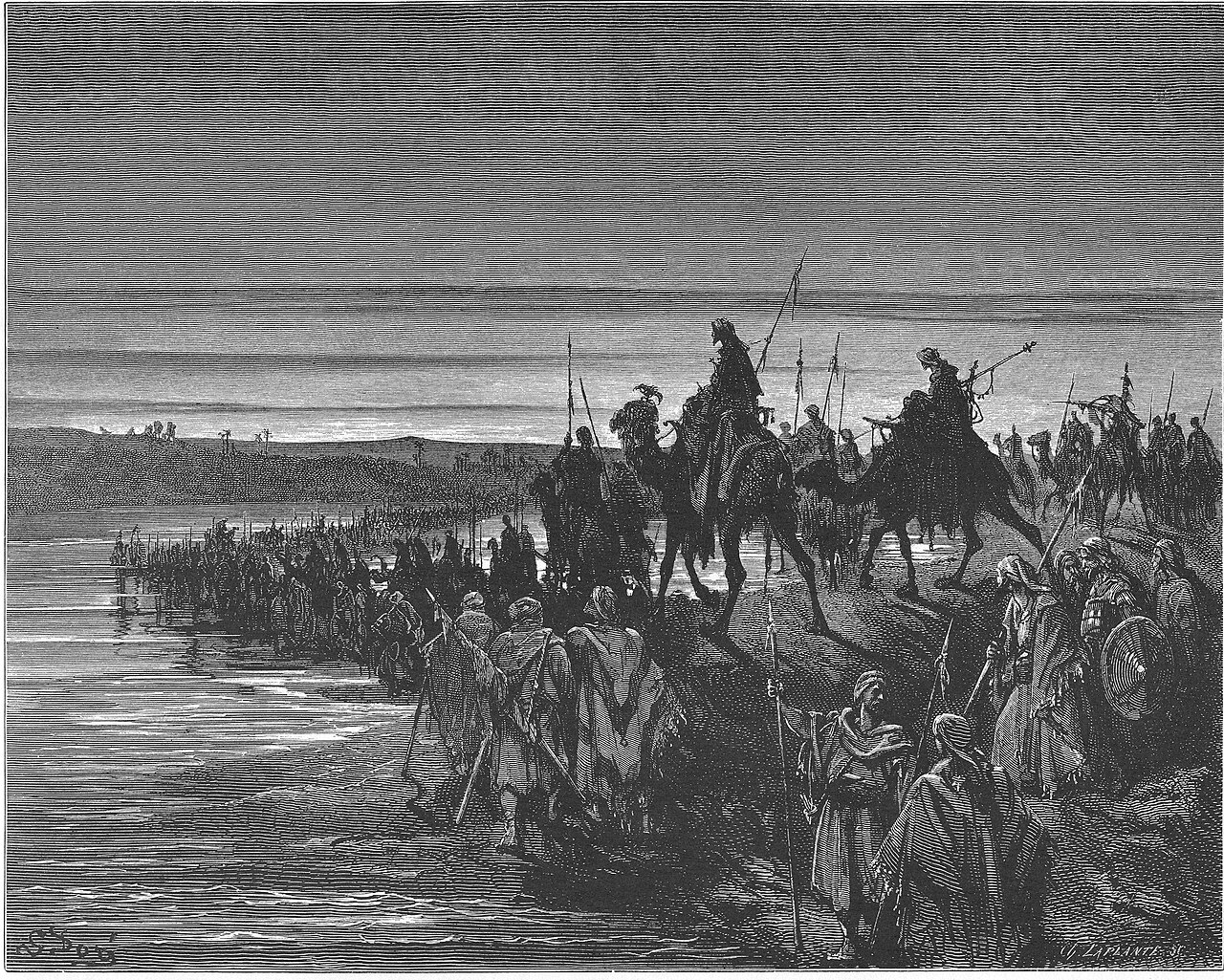
The Israelites Cross the Jordan River, Gustave Doré, Doré's English Bible (1866), public domain
Key verse
Early the next morning Joshua got up and left Shittim with all the Israelites. They went as far as the Jordan, where they camped before crossing over.
It stands in Follow the ark: you have not passed this way before, verses 1 to 6.
The chapter
Chapter summary
The crossing. The people sanctify themselves ('to-morrow Jehovah will do wonders among you') and follow the ark at two thousand cubits' distance, since they have not passed this way before. Jordan is at flood stage in the days of harvest, yet the instant the priests' feet dip in the brim, the waters stand and rise up in a heap far off at Adam beside Zarethan, and the flow toward the Arabah and the Salt Sea is cut off. The priests stand firm on dry ground in the midst of Jordan while all Israel passes clean over, and Joshua is magnified in their sight as Moses was.
Context
History · Joshua · Joshua overview
Where the chapter sits
Joshua 3 falls in Entry into the Land (chapters 1–5). Commissioning of Joshua; Rahab and the spies; Jordan crossing; memorial stones at Gilgal; circumcision and Passover; the Captain of the LORD's host.
Crossing the Jordan. The ark of the covenant goes before; the waters stand in a heap.
After it: Conquest campaigns, chapters 6–12.
The whole shape of Joshua→The world behind this chapter
Joshua 3The history
The Jordan in spring is not the modest stream a visitor sees today. Snowmelt from Hermon and the winter rains push it over its banks throughout the harvest weeks, flooding the thicket of tamarisk and willow along the channel. The text says so plainly: the Jordan overflows all its banks all the days of harvest.
The rest of the history, and what it meant to them
The ark went first, carried by the priests, with a gap of about two thousand cubits, roughly half a mile, between it and the people. The distance was so that everyone could see where they were going, since they had not passed this way before. It also kept the ark visibly separate and untouchable.
The water is described as piling up at a town called Adam, near Zarethan, well upstream. That is a real place on a stretch where the river runs through high marl banks. Collapses of those banks have dammed the Jordan in recorded history, an event in 1927 stopped the flow for over twenty hours, so the mechanism named in the text is one the valley actually produces. The text's interest is in the timing: it happened the moment the priests' feet touched the water.
Israel crossed on dry ground while the priests stood still in the middle of the riverbed. The whole nation, with its livestock and belongings, moving across a riverbed in a single day, is a logistical picture worth pausing on.
What it meant to them
This was the public credential of the new leader. God tells Joshua that today he will begin to exalt him in the sight of all Israel, so that they will know he is with him as he was with Moses.
For the first hearers, the parallel with the sea was unmistakable. The generation that had only heard the story from their parents now had one of their own, and the same God stood in the middle of the water while they walked through.
Sources cited
- John H. Walton, Victor H. Matthews & Mark W. Chavalas, The IVP Bible Background Commentary: Old Testament
- K. A. Kitchen, On the Reliability of the Old Testament
The structure of this chapter
The heads below are this chapter's scenes. The numbered points under each are its verses.
A. Follow the ark: you have not passed this way before
1. (vv. 1-2)
Joshua 3:1
“I will pass to Joshua the son of Nun, who was previously called Ause, or better, as in the Hebrew, Hoshea, that is, Savior. For he, according to the epistle of Jude, saved the people of Israel and led them forth out of Egypt and brought them into the land of promise.”
Jerome· written before 420· Against Jovinianus 1.21· Joshua 3:1patristic
Joshua 3:1, 2 more voicesWhat preachers and commentators have said about this verse, in their own words.
Joshua 3:1
“And Joshua rose early in the morning,.... The morning after the spies had returned and made their report; which, as Kimchi rightly observes, was the ninth of Nisan; for on the morrow, which was the tenth, the people passed over Jordan, see Jos 3:”
John Gill· Exposition of the Old Testament (1748-1763)· Joshua 3:1reformed
Joshua 3:1
“The acacia groves” (Exo 25:5 note) of Shittim on both sides of Jordan line the upper terraces of the valley (compare 2Ki 6:4). They would be in this part at some six miles distance from the river itself.
Albert Barnes· Notes, Explanatory and Practical, on the Old and New Testaments (1832-1869)· Joshua 3:1evangelical
Joshua 3:2
“After three days - These three days are probably to be thus understood: As soon as Joshua took the command of the army, he sent the spies to ascertain the state of Jericho; as we have seen Jos 1:12. They returned at the end of three days, or rather on the third day, and made their report.”
Read the whole quotation
It was at this time, immediately on the return of the spies, that he made the proclamation mentioned here; in consequence of which the people immediately struck their tents, and marched forward to Jordan.
Adam Clarke· Commentary on the Bible (1810-1826)· Joshua 3:2evangelical
a.Shittim is the camp of Numbers 25:1, where Israel went after the daughters of Moab, and Joshua 2:1 sent the spies out of that same place. The nation leaves it, lodges at the river and waits three days, which is the interval Joshua 1:11 had already named when the officers were told to prepare victuals. Micah 6:5 later treats the two ends of this move as one act of God, from Shittim unto Gilgal, so the stretch that begins in this verse was remembered whole.
2. (vv. 3-4)
Joshua 3:3
“Go after it - Towards Jordan, to go over it in such a manner as I am about to describe. 'Till this time the ark went in the middle of the cloudy pillar, now it goes in the front. Probably the pillar of fire and cloud was still hovering over the ark.”
John Wesley· Explanatory Notes upon the Old Testament (1765)· Joshua 3:3evangelical
Joshua 3:4
“About two thousand cubits - This distance they were to keep, 1. For the greater respect, because the presence of the ark was the symbol and pledge of the Divine presence. 2.”
Read the whole quotation
That the ark, which was to be their pilot over these waters, might be the more conspicuous which it could not have been had the people crowded upon it.
Adam Clarke· Commentary on the Bible (1810-1826)· Joshua 3:4evangelical
Joshua 3:4, 1 more voice
Joshua 3:4
“Two thousand cubits - A thousand yards, at which distance from it the Israelites seem to have been encamped in the wilderness. And because they generally went from their tents to the ark to worship God, especially on the sabbath-days; hence it hath been conceived, that a sabbath-day's journey reached only to two thousand cubits.”
John Wesley· Explanatory Notes upon the Old Testament (1765)· Joshua 3:4evangelical
a.The people are told to move when the ark moves and to keep about a thousand yards behind it. The verse gives its own reason, that ye may know the way by which ye must go, for ye have not passed this way heretofore, so the gap is about sight rather than danger, since a chest on men's shoulders cannot be seen from the back of a camp that size unless the ground in front of it is kept clear. Adam Clarke reads reverence for the sign of God's presence alongside that, and John Wesley notes that the later Jewish measure of a sabbath day's walk was fixed at the same two thousand cubits.
3. (vv. 5-6)
Joshua 3:5
“Sanctify yourselves - What was implied in this command we are not informed; but it is likely that it was the same as that given by Moses, Exo 19:10-14.”
Read the whole quotation
They were to wash themselves and their garments, and abstain from every thing that might indispose their minds from a profitable attention to the miracle about to be wrought in their behalf.
Adam Clarke· Commentary on the Bible (1810-1826)· Joshua 3:5evangelical
Joshua 3:6
“Spake unto the priests, saying, Take up the ark - It is remarkable that the priests, not the Levites, whose ordinary business it was were employed to carry the ark on this occasion. Calmet conjectures that this was because it was probably carried without being wrapped up in its curtains, as it always was when the Levites carried it.”
Read the whole quotation
Though it was the business of the Levites, the sons of Kohath, to carry the ark; yet on certain occasions the priests alone performed this office. 1. In the present case. 2. When they encompassed Jericho, Jos 6:6.
Adam Clarke· Commentary on the Bible (1810-1826)· Joshua 3:6evangelical
a.Exodus 19:10-11 has Moses sanctify the people to day and to morrow against the third day, when the Lord came down on the mountain, and the same word is paired with the same to morrow here. Sanctify yourselves falls once more in this book, at 7:13 after the defeat at Ai, where it goes before a search for the accursed thing instead of before a wonder. The ark is carried by priests rather than by the Kohathites of Numbers 4:15, and Adam Clarke notes that priests carry it again at the circuit of Jericho in 6:6.
B. The waters shall stand in one heap
1. (vv. 7-8)
Joshua 3:7
“This day will I begin to magnify thee - One cause why the miracle now to be narrated was performed is here suggested.”
Read the whole quotation
As Moses was declared to he sent immediately from God with an extraordinary commission by the miracles which he worked, more especially that of dividing the Red Sea in two parts, so was Joshua both sent and accredited in a like manner. (Compare Jos 1:5, and Jos 4:14.) Other reasons are given in Jos 3:10; Jos 5:1.
Albert Barnes· Notes, Explanatory and Practical, on the Old and New Testaments (1832-1869)· Joshua 3:7evangelical
Joshua 3:7, 1 more voice
Joshua 3:7
“Some have observed that it was at the banks of Jordan that God began to magnify Joshua, and at the same place he began to magnify our Lord Jesus as Mediator; for John was baptizing at Bethabara, the house of passage, and there it was that when our Saviour was baptized it was proclaimed concerning him…”
Read the whole quotation
This is my beloved Son.
Matthew Henry· Commentary on the Whole Bible (1707-1721)· Joshua 3:7puritan
Joshua 3:8
“The brink - Hebrew. to the extremity, so far as the river then spread itself, which was now more than ordinary, ver. 15.”
Read the whole quotation
In Jordan - Within the waters of Jordan, in the first entrance into the river; Where they stood for a season, 'till the river was divided, and then they went into the midst of it, and there abode 'till all the people were passed over.
John Wesley· Explanatory Notes upon the Old Testament (1765)· Joshua 3:8evangelical
Joshua 3:8, 2 more voices
Joshua 3:8
“Ye shall stand still in Jordan - The priests proceeded first with the ark, and entered into the bed of the river the course of which was immediately arrested, the waters collecting above the place where the priests stood, while the stream fell off towards the Dead Sea…”
Read the whole quotation
so that the whole channel below where the priests were standing became dry.
Adam Clarke· Commentary on the Bible (1810-1826)· Joshua 3:8evangelical
Joshua 3:8
“And thou shalt command the priests that bear the ark of the Lord,....”
John Gill· Exposition of the Old Testament (1748-1763)· Joshua 3:8reformed
a.Joshua 1:5 gave him the promise in these exact words, as I was with Moses, so I will be with thee, and this verse says the public proof of it starts today. Joshua 4:14 reports the result in the same vocabulary, that the Lord magnified Joshua in the sight of all Israel and they feared him as they feared Moses all his days. The instrument is a river, which is what accredited Moses at the sea, and Joshua's own part in it is to tell priests to stand still in the water.
2. (vv. 9-11)
Joshua 3:9
“The premonitory address of Joshua, taken in connection with the miraculous result exactly as he had described it, would tend to increase and confirm their faith in the God of their fathers as not a dull, senseless, inanimate thing like the idols of the nations, but a Being of life, power, and activity to defend them and work for them.”
Read the whole quotation
THE WATERS OF JORDAN ARE DIVIDED.
Jamieson, Fausset & Brown· Commentary Critical and Explanatory on the Whole Bible (1871)· Joshua 3:9reformed
Joshua 3:9, 1 more voice
Joshua 3:9
“And Joshua said unto the children of Israel, come hither,.... Very probably to the door of the tabernacle: and hear the words of the Lord your God; which he was about to deliver to them as from him, and in his name.”
John Gill· Exposition of the Old Testament (1748-1763)· Joshua 3:9reformed
Joshua 3:10
“Ye shall know - By experience and sensible evidence. The living God - Not a dull, dead, senseless God, such as the gods of the nations are; but a God of life, and power, and activity to watch over you, and work for you. Among you - Is present with you to strengthen and help you.”
John Wesley· Explanatory Notes upon the Old Testament (1765)· Joshua 3:10evangelical
Joshua 3:10, 3 more voices
Joshua 3:10
“Hereby ye shall know that the living God is among you - The Israelites were apt to be discouraged, and to faint at even the appearance of danger; it was necessary, therefore, that they should have the fullest assurance of the presence and assistance of God in the important enterprise on which they were now entering.”
Adam Clarke· Commentary on the Bible (1810-1826)· Joshua 3:10evangelical
Joshua 3:10
“The living God - Compare the marginal reference. The gods of the pagan are “dead idols.” On the names of the seven nations, see Gen 10:16, etc., note.”
Albert Barnes· Notes, Explanatory and Practical, on the Old and New Testaments (1832-1869)· Joshua 3:10evangelical
Joshua 3:10
“And Joshua said,....”
John Gill· Exposition of the Old Testament (1748-1763)· Joshua 3:10reformed
Joshua 3:11
“Some observe an accent in the original, which they think directs us to translate it somewhat more emphatically, Behold the ark of the covenant, even the ark of the Lord, or even of the covenant of the Lord of all the earth. (3.) They are told that the ark should pass before them into Jordan.”
Matthew Henry· Commentary on the Whole Bible (1707-1721)· Joshua 3:11puritan
a.The living God has fallen once before in Scripture, at Deuteronomy 5:26 of the voice out of the fire, and the next man to use the title is David in front of Goliath at 1 Samuel 17:26. The seven nations listed here are the seven of Deuteronomy 7:1 in a different order, so the list is a standing formula rather than a survey of who was waiting across the river. The Lord of all the earth is rarer still: it falls twice in this chapter, at verses 11 and 13, and only once more in the whole King James Bible, at Zechariah 6:5.
3. (vv. 12-13)
Joshua 3:12
“Now therefore take ye twelve men,.... For what end and purpose is not mentioned.”
John Gill· Exposition of the Old Testament (1748-1763)· Joshua 3:12reformed
Joshua 3:13
“Cut off - The waters which now are united now shall be divided, and part shall flow down the channel towards the dead sea, and the other part that is nearer the spring of the river, and flows down from it, shall stand still. An heap - Being as it were congealed, as the Red-Sea was, Exod.”
Read the whole quotation
xv, 8, and so kept from overflowing the country.
John Wesley· Explanatory Notes upon the Old Testament (1765)· Joshua 3:13evangelical
a.Twelve men are chosen and no reason is given for them, an omission John Gill points out, and chapter 4 supplies the answer when they lift twelve stones out of the riverbed. The condition in verse 13 is exact: the water is cut off as soon as the soles of the priests' feet rest in it, so nothing moves until men walk into a river in flood. Stand upon an heap is Red Sea vocabulary, since Exodus 15:8 says the floods stood upright as an heap and Psalm 78:13 says it again, and the phrase upon an heap falls in the King James Bible only here and at verse 16.
C. Priests' feet touch Jordan at flood stage
1. (vv. 14-16)
Joshua 3:14
“But as seen in harvest, it is twice as broad; and in ancient times, when the hills on the right and left were much more drenched with rain and snow than since the forests have disappeared, the river must, from a greater accession of water, have been broader still than at harvest-time in the present day.”
Jamieson, Fausset & Brown· Commentary Critical and Explanatory on the Whole Bible (1871)· Joshua 3:14reformed
Joshua 3:14, 4 more voices
Joshua 3:14
“And it came to pass, when the people removed from their tents to pass over Jordan,.... Which they had pitched very near it, upon their removal from Shittim, and in which they had lodged the night past: and the priests bearing the ark of the covenant before the people; at the distance of two thousand cubits.”
John Gill· Exposition of the Old Testament (1748-1763)· Joshua 3:14reformed
Joshua 3:14
“5 And Joshua said unto the people, Sanctify yourselves: for to morrow the L ORD will do wonders among you. 6 And Joshua spake unto the priests, saying, Take up the ark of the covenant, and pass over before the people. And they took up the ark of the covenant, and went before the people.”
Matthew Henry· Commentary on the Whole Bible (1707-1721)· Joshua 3:14puritan
Joshua 3:14
“Joshua son of Nun made the Jordan River stop, but only as long as the ark was in the water. As soon as the people had crossed to the other side and the ark had come through, he gave the river back its usual flow again.”
Read the whole quotation
The bottom of the deep in the Red Sea was denuded of water when the sea was driven back to either side by the Spirit, but the duration of the marvel was the passage of the army through the deep on the dry strip. But after that the surface of the sea became one again, and the temporary gap was flooded over. So this remains a unique event which occurred in such a way that the marvel did not lose credibility because of the passage of time, since it continues to be testified to by visible traces.
Gregory of Nyssa· written before 395· THE LIFE OF GREGORY THE WONDERWORKER 7.55· Joshua 3:14patristic
Joshua 3:14
“And do not imagine that these deeds are only in former times and nothing so great as this is brought forth in you who are now the hearer of them. For all things are fulfilled in you according to a mystical reckoning.”
Read the whole quotation
Indeed you who long to draw near to the hearing of the divine law have recently forsaken the darkness of idolatry and are now for the first time forsaking Egypt.
Origen of Alexandria· written before 253· HOMILIES ON JOSHUA 4.1· Joshua 3:14patristic
Joshua 3:15
“Jordan overfloweth all his banks - Rather “is full up to all his banks,” i. e. “brim-full.” This remark strikingly illustrates the suddenness and completeness, not less than the greatness, of the marvel. The Jordan River flows at the bottom of a deep valley, which descends to the water’s edge on either side in two, occasionally in three, terraces.”
Read the whole quotation
Within the lowest of these the stream, ordinarily less than 100 feet wide in this lower part of its course, is confined.
Albert Barnes· Notes, Explanatory and Practical, on the Old and New Testaments (1832-1869)· Joshua 3:15evangelical
Joshua 3:15, 1 more voice
Joshua 3:15
“All the time of harvest - This is meant not of wheat-harvest, but of the barley-harvest, as is manifest from their keeping the passover at their first entrance, chap. v, 10, which was kept on the fourteenth day of the first month, when they were to bring a sheaf of their first-fruits, which were of barley.”
John Wesley· Explanatory Notes upon the Old Testament (1765)· Joshua 3:15evangelical
Joshua 3:16
“When swollen "in time of harvest," it flows with a vastly accelerated current. the people passed over right against Jericho--The exact spot is unknown; but it cannot be that fixed by Greek tradition--the pilgrims' bathing-place--both because it is too much to the north, and the eastern banks are there sheer precipices ten or fifteen feet high.”
Jamieson, Fausset & Brown· Commentary Critical and Explanatory on the Whole Bible (1871)· Joshua 3:16reformed
Joshua 3:16, 1 more voice
Joshua 3:16
“Adam - The city Adam being more obscure, is described by its nearness to a more known place, then eminent, but now unknown. The meaning is, that the waters were stopped in their course at that place, and so kept at a distance from the Israelites whilst they passed over.”
Read the whole quotation
Against Jericho - Here God carried them over, because this part was, 1.
John Wesley· Explanatory Notes upon the Old Testament (1765)· Joshua 3:16evangelical
a.Harvest is the detail that makes the timing hard rather than convenient, because Jordan overfloweth all his banks then; John Wesley reads it as the barley harvest, since chapter 5 has them keeping the passover on the fourteenth day of the first month a few days later. The water stops at a named place, the city Adam beside Zaretan, roughly sixteen miles upstream, so the account fixes a location it had no need to supply. Readers differ over the mechanism. Some point to the recorded blockings of the Jordan by bank collapses at that same reach, in 1267 and again in July 1927, and read a fall of earth timed to the moment the priests stepped in; others read a direct holding of the water, and the text gives the place and the hour and no mechanism at all.
2. (v. 17)
Joshua 3:17
“And the priests that bare the ark of the Lord stood firm on dry ground in the midst of Jordan,.... Which for its breadth Mr. Maundrell, the above mentioned traveller, says (c) might be about twenty yards over, and its depth exceeded his height; but Dr.”
Read the whole quotation
Shaw (d), a later traveller still, says,"the river Jordan is by far the most considerable river, excepting the Nile, either of the coast of Syria, or of Barbary.
John Gill· Exposition of the Old Testament (1748-1763)· Joshua 3:17reformed
Joshua 3:17, 1 more voice
Joshua 3:17
“The miraculous passage to the holy land through Jordan is not less pregnant with typical meaning than that through the Red Sea (compare 1Co 10:1-2).”
Albert Barnes· Notes, Explanatory and Practical, on the Old and New Testaments (1832-1869)· Joshua 3:17evangelical
a.stood firm on dry ground: Dry ground is the Red Sea wording of Exodus 14:16 and 14:22, and after this verse it falls next at 2 Kings 2:8, where Elijah crosses this same river on it. The priests do not cross with the nation. They stand in the middle of the channel until every person is over, which keeps the ark between the people and the water for the whole length of the crossing, and 4:18 says the river returns the moment their feet come up on the bank. Albert Barnes sets the passage beside 1 Corinthians 10:1-2, where Paul reads the sea crossing the same way.
This page carries no textual note on Joshua 3. Where this site has examined a place the manuscripts differ, the examination is in the manuscripts room. Every place this site examines →
This page draws on 10 works. Open the list of works
This page draws on Adam Clarke; Albert Barnes; Gregory of Nyssa, THE LIFE OF GREGORY THE WONDERWORKER 7.55; Jamieson, Fausset & Brown; Jerome, Against Jovinianus 1.21; John Gill; John Wesley, Explanatory Notes upon the Old Testament (1765); Keil and Delitzsch, Biblical Commentary on the Old Testament: Joshua, Judges, Ruth; Matthew Henry and Origen of Alexandria, HOMILIES ON JOSHUA 4.1.