
Joshua 3:12
in Joshua 3Now choose twelve men from the tribes of Israel, one from each tribe.
BSB
The same verse in ASV and KJV ▾
ASV
Now therefore take you twelve men out of the tribes of Israel, for every tribe a man.
KJV
Now therefore take you twelve men out of the tribes of Israel, out of every tribe a man.
⋯
This verse in Joshua 3
Commentary
5 notes on this verseNow therefore take ye twelve men,.... For what end and purpose is not mentioned.
This site's exposition
choose twelve men from the tribes of Israel
on Joshua 3:12-13
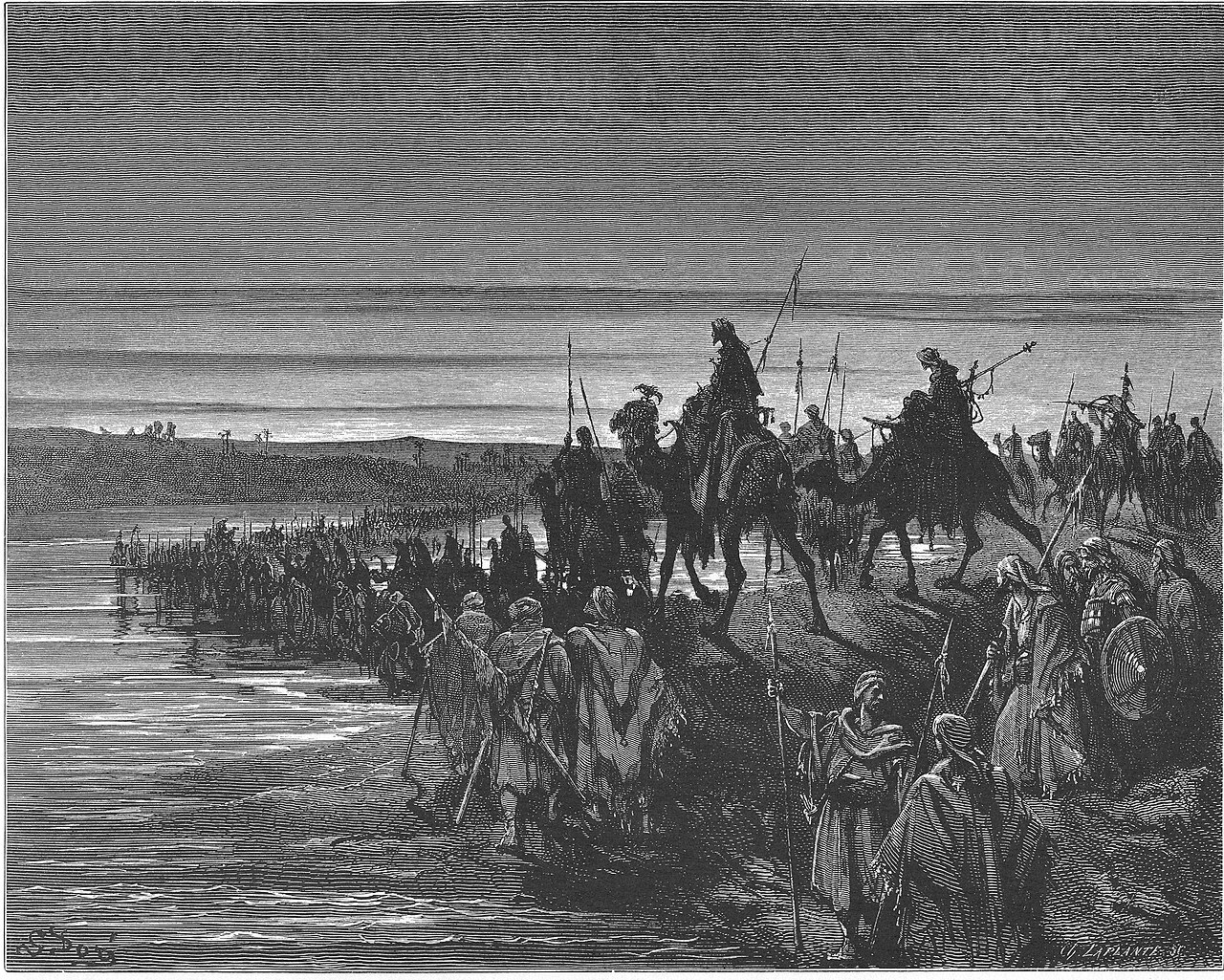
Twelve men are chosen with no reason given, as Gill points out, and chapter 4 supplies it. The water is cut off as soon as the priests’ feet touch it. To “stand up in a heap” is Red Sea language, from Exodus 15:8 and Psalm 78:13.
The record, by era
The Puritans and the Awakening1 voice
Here we have a short and plain account of the dividing of the river Jordan, and the passage of the children of Israel through it. The story is not garnished with the flowers of rhetoric (gold needs not to be painted), but it tell us, in short, matter of fact. That this river was now broader and deeper than usually it was at other times of the year,
The Nineteenth Century2 voices
A commentator
Jamieson, Fausset & Brown1802–1910
Commentary Critical and Explanatory on the Whole Bible (1871)
proposed
The premonitory address of Joshua, taken in connection with the miraculous result exactly as he had described it, would tend to increase and confirm their faith in the God of their fathers as not a dull, senseless, inanimate thing like the idols of the nations, but a Being of life, power, and activity to defend them and work for them. THE WATERS OF JORDAN ARE DIVIDED.
Take you twelve men - See the note on Jos 4:2.
How the passage was read
What the Jewish commentators add
Take for yourselves twelve men. Prepare them to be available to fulfil that which I will command them when you finally cross the Jordan.
1 more on this passage, in their own words ▾
The waters that descend from above. Coming down from the heights which is the way of all flowing rivers.
This section is reception history: how the passage was read and kept in the Jewish tradition. Where a reading parts from an essential of the Christian faith, the section says so at that point.
Texts and citation data: Sefaria; each excerpt follows its version’s licence. 5 further sources are cited on this chapter that carry no English text this site may quote or only restate the verse.
The words behind it
13 Hebrew wordsEvery Hebrew word of this verse in the order it stands, with what it means and the door to its own study. The last column counts the times a word stands in the whole Bible: the rarer the word, the more the places it appears belong together.
| Hebrew | Sound | Meaning | Word study | In the Bible |
|---|---|---|---|---|
| וְעַתָּ֗ה | veatah | and therefore | H6258 → | 433 times |
| קְח֤וּ | kechu | take | H3947 → | 966 times |
| לָכֶם֙ | lakhem | for <the> yourselves | ||
| שְׁנֵ֣י | shenei | two [plus] | H8147 → | 768 times |
| עָשָׂ֣ר | ʾasar | ten | H6240 → | 338 times |
| אִ֔ישׁ | ʾish | man | H376 → | 1663 times |
| מִשִּׁבְטֵ֖י | mishivtei | from [the] tribes of | H7626 → | 190 times |
| יִשְׂרָאֵ֑ל | yisrael | Israel | H3478 → | 2507 times |
| אִישׁ־ | ʾish- | a man | H376 → | 1663 times |
| אֶחָ֥ד | ʾechad | one | H259 → | 971 times |
| אִישׁ־ | ʾish- | a man | H376 → | 1663 times |
| אֶחָ֖ד | ʾechad | one | H259 → | 971 times |
| לַשָּֽׁבֶט׃ | lashavet | to the tribe | H7626 → | 190 times |
וְעַתָּ֗הand therefore
veatahH6258 →433 times
קְח֤וּtake
kechuH3947 →966 times
לָכֶם֙for <the> yourselves
lakhem
שְׁנֵ֣יtwo [plus]
sheneiH8147 →768 times
עָשָׂ֣רten
ʾasarH6240 →338 times
אִ֔ישׁman
ʾishH376 →1663 times
מִשִּׁבְטֵ֖יfrom [the] tribes of
mishivteiH7626 →190 times
יִשְׂרָאֵ֑לIsrael
yisraelH3478 →2507 times
אִישׁ־a man
ʾish-H376 →1663 times
אֶחָ֥דone
ʾechadH259 →971 times
אִישׁ־a man
ʾish-H376 →1663 times
אֶחָ֖דone
ʾechadH259 →971 times
לַשָּֽׁבֶט׃to the tribe
lashavetH7626 →190 times
A shaded row is a word that stands 400 times or fewer in the Bible.
The walk
8 stopsEach card is a verse this one points to, and under it the verses that one points to in turn. Where several paths arrive at the same place, that place is listed first: the text keeps returning to it.
Through
Joshua 4:9Joshua also set up twelve stones in the middle of the Jordan, in the place where the priests who carried the ark of the covenant stood. And the stones are there to this day.
it leads to
- 1 Samuel 7:12
Afterward, Samuel took a stone and set it up between Mizpah and Shen. He named it Ebenezer, saying, “Thus far the LORD has helped us.”
- 1 Samuel 7:12
Through
Joshua 4:2“Choose twelve men from among the people, one from each tribe,
it leads to
- 1 Kings 18:31
And Elijah took twelve stones, one for each tribe of the sons of Jacob, to whom the word of the LORD had come and said, “Israel shall be your name.”
- Matthew 10:1–5
And calling His twelve disciples to Him, Jesus gave them authority over unclean spirits, so that they could drive them out and heal every disease and sickness.
- Numbers 1:4–15
And one man from each tribe, the head of each family, must be there with you.
- Deuteronomy 1:23
The plan seemed good to me, so I selected twelve men from among you, one from each tribe.
- Numbers 34:18
Appoint one leader from each tribe to distribute the land.
- 1 Kings 18:31
Through
Joshua 4:4So Joshua summoned the twelve men he had appointed from the Israelites, one from each tribe,
it leads to
- Joshua 4:2
“Choose twelve men from among the people, one from each tribe,
- Mark 3:14–19
He appointed twelve of them, whom He designated as apostles, to accompany Him, to be sent out to preach,
- Joshua 4:2
Where this verse is studied
About Joshua
This page draws on Adam Clarke, Commentary on the Bible; Jamieson, Fausset & Brown, Commentary Critical and Explanatory on the Whole Bible; John Gill, Exposition of the Old Testament (1748-1763); John Gill, Exposition of the Old Testament; Keil and Delitzsch, Biblical Commentary on the Old Testament: Joshua, Judges, Ruth and Matthew Henry, Commentary on the Whole Bible.