
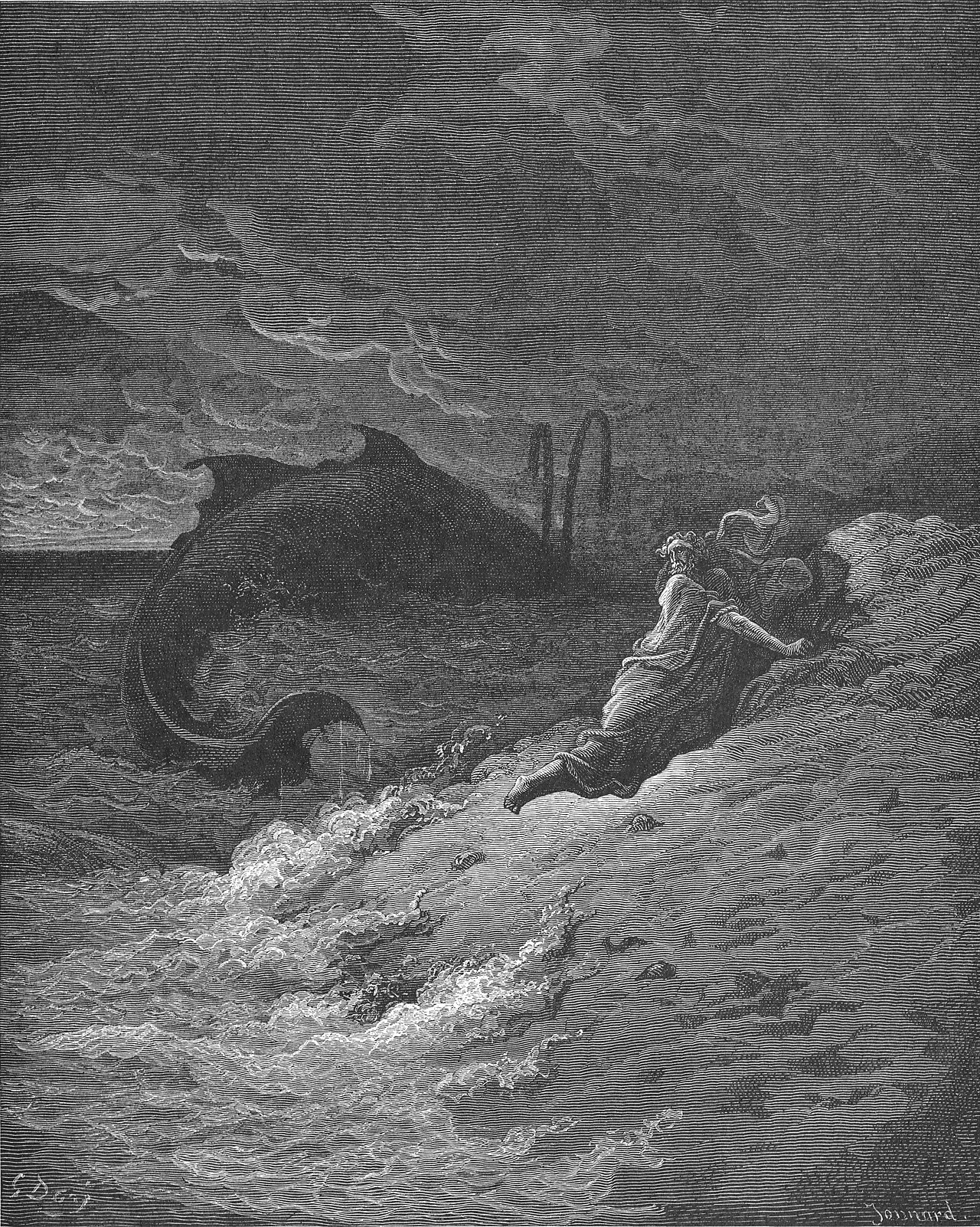
Jonahchapter 2
10 verses · Jonah, by tradition · 8th century BC · The Twelve
From inside the fish, Jonah prayed to the LORD his God,
Introduction
Jonah, by tradition, The Twelve, Jonah Overview.
This chapter is the prayer of the book, set in the middle of a prose story. It is written in the language of Israel's temple songs, and a hearer who knew the Psalms would recognise line after line of it. The one praying is the same prophet who ran from his commission, and he prays from a place with no way out. Listen for where the prayer places the speaker, and for the direction in which he turns his face. Notice also that the prayer gives thanks for a rescue before the story reports one. It teaches how Israel prayed when it had nowhere else to go.
Context
- Who
- People who knew what it was to pray from a place with no exit
- What
- A psalm of thanksgiving prayed by Jonah from inside the great fish, closed by one line of narrative that returns him to dry land.
- Where
- Inside the great fish in the depths of the sea, and at the close on the shore.
- When
- The three days and three nights after the storm of chapter 1, in the reign of Jeroboam II, about 793 to 753 BC.
- Why
- To show the LORD hearing a disobedient servant who calls to Him from the depths, and to confess that salvation belongs to the LORD.
Historical context
This chapter is a psalm, not a narrative. It uses the vocabulary of Israel's temple songs, the deep, the floods, the weeds, the pit, Sheol, the holy temple, and reads like the prayers in the Psalter almost line for line.
Show the rest of the historical context, 4 more paragraphs
Sheol in Hebrew thought was the realm of the dead, and Jonah says he cried "out of the belly of hell" and that God brought his life up from corruption. He is not describing discomfort. He is describing death.
"I will look again toward thy holy temple" is the detail that grounds it. Israelites prayed facing the temple in Jerusalem, Solomon had asked God to hear prayers made toward that house, and Daniel opened his windows toward it in Babylon. Jonah, in the sea, in the dark, orients himself the same way.
The prayer is almost entirely past tense. He thanks God for the rescue before he is on dry land, which is why it reads as a song rather than a plea.
The last line is the turn: "Salvation is of the LORD." That sentence, from a runaway prophet in the belly of a fish, is the theological center of the book.
Significance
To Israel this said God's mercy reaches the bottom. Jonah was not rescued because he repented well; the fish was already prepared before he prayed.
Show the rest of the significance, 1 more paragraph
It also set up the punchline of the whole book. The man who sings so beautifully about undeserved rescue is about to be furious that God gives the same thing to Nineveh.
This chapter in Jewish lifeWhat this chapter is in Jewish life and reading.
What is done
The prayer from the deep is read aloud in the synagogue on the Day of Atonement, at the afternoon service, as part of the whole book. The site's table in src/lib/hebraic/readings.ts records that reading and cites Babylonian Talmud Megillah 31a for it. Probed for this lane, the table printed parashot 0 and haftarah 0 for this chapter, so it is heard on no Sabbath.
The numbering of this chapter differs between a Hebrew Bible and an English one, and a reader following along will meet it. The corpus numbers by the Hebrew text, which opens this chapter with the verse of the appointed fish. That verse is 1:17 in the Berean Standard Bible. Every later verse of the chapter stands one number higher in the corpus than on this page. The corpus's 2:3 is the Berean 2:2, and the chapter ends at 2:11 in the corpus and at 2:10 here. The references below are the corpus's own.
How it is read
The commentators agree that the fish is a miracle and differ on how to say so. Ibn Ezra reasons from the body. He writes that "no one can survive in the belly of a fish even for an hour, so if this is the duration, it must have been a miracle" (Ibn Ezra on Jonah 2:1:2). Ibn Ezra, Radak and Metzudat David are quoted in this card from the Sefaria Community Translation, CC0. Radak places the miracle in the timing, since God appointed the fish "at the moment that Jonah was cast into the sea". He then reports Rabbi Tarfon in Pirkei de Rabbi Eliezer, that the fish was appointed from the six days of creation (Radak on Jonah 2:1:1, the same translation). At the end of the chapter Ibn Ezra reads the command to the fish as a figure of speech. He writes that "this is a metaphor. God caused it to do God's will" (Ibn Ezra on Jonah 2:11:1, the same translation).
Rashi explains why the prayer comes only now. He reports from Pirké d'Rabbi Eliezer that the first fish was a male with room inside, so that Jonah did not think to pray. God moved him into a female full of embryos, and there, crowded, he prayed. Rashi points to the form of the word for fish in the second verse as the sign of it (Rashi on Jonah 2:1:1, The Judaica Press complete Tanach with Rashi, translated by A. J. Rosenberg, CC-BY). A bracketed note in the same edition, credited to Sod Mesharim, ties the appointing verb to the manna.
The prayer itself Rashi reads line by line. The belly of the fish is "to me as the grave" (Rashi on Jonah 2:3:1). At the fifth verse Jonah first says he is dead and driven from God's sight. He then answers himself. "I saw that You have kept me alive all these days. I know that I will continue to gaze upon Your Holy Temple" (Rashi on Jonah 2:5:1 and 2:5:2). At the sixth Rashi follows Jonathan's Targum. Jonah is shown the Red Sea and Israel's crossing, "for the fish’s two eyes were like two windows, and he would look and see everything in the sea" (Rashi on Jonah 2:6:1). The vows at the end are vows of peace offerings and thanksgiving offerings (Rashi on Jonah 2:10:1).
On one line Rashi sets two readings side by side and states no verdict. Those who keep worthless futilities are the nations of the world who worship idols, and they abandon the fear of God from whom their kindness comes. That is Jonathan's rendering. Pirké d'Rabbi Eliezer reads the same line as the sailors, "who abandoned their kindness that they were bestowing upon the idols and proselytized" (Rashi on Jonah 2:9:1 and 2:9:2). Shorter notes stand at Rashi on Jonah 2:2:1, 2:4:1, 2:7:1, 2:7:2 and 2:8:1.
Eight notes on this chapter stand without an English text. Ibn Ezra on Jonah 2:2:1, 2:3:1, 2:4:1 and 2:6:1, Rashi on Jonah 2:2:2 and Radak on Jonah 2:11:1 are marked linked because Sefaria holds no English version of the ref. Malbim on Jonah 2:8:1 and 2:10:1 are marked linked because the licence Sefaria reports does not permit keeping the text.
What the rabbis say
The corpus carries forty rabbinic locators on this chapter and the text of none, so each is cited here and none is quoted. On the appointed fish, the corpus's first verse, it holds Bereshit Rabbah 56:1, Bereshit Rabbati, Parashat Bereshit 17, Devarim Rabbah 2:17, Ein Yaakov, Nedarim 6:12 and Esther Rabbah 9:2. It holds Midrash Lekach Tov, Genesis 22:4:3 and Midrash Sekhel Tov, Bereshit 22:4:1 there as well. On the second, the prayer from the belly of the fish, it holds Midrash Aggadah, Genesis 41:1:2, Midrash Tannaim on Deuteronomy 3:23:20 and Taanit 15a:11.
On the third verse, the cry from the belly of the grave, the corpus holds Ein Yaakov (Glick Edition), Eiruvin 2:3 and 2:4 and Ein Yaakov, Eiruvin 2:5 and 2:6. It holds Eruvin 19a:13 and 19a:17 and Jerusalem Talmud Taanit 2:9:2 there as well. On the fourth, the breakers and the waves, it holds Mekhilta DeRabbi Shimon Ben Yochai 15:5, Mekhilta DeRabbi Yishmael, Tractate Shirah 5:3 and Midrash Lekach Tov, Exodus 15:5:1. It holds Midrash Sekhel Tov, Shemot 15:21:16 and 15:8:3, Midrash Tanchuma, Bereshit 7:11 and Yalkut Shimoni on Torah 246:6 there too. Most of that run stands on the song at the sea in Exodus 15, which is the passage Rashi says Jonah was shown. On the fifth the corpus holds Midrash Lekach Tov on Lamentations 3:54:1.
On the eighth verse, the prayer reaching the holy temple, the corpus holds Bereshit Rabbah 24:4, Jerusalem Talmud Berakhot 9:2:9, Kohelet Rabbah 1:6:1, Midrash Tehillim 61:2 and Pirkei DeRabbi Eliezer 10:10. On the ninth it holds Midrash Lekach Tov, Leviticus 20:15:1. On the tenth, the vows, it holds Midrash Lekach Tov, Deuteronomy 23:23:1, Midrash Tehillim 95:1 and Pirkei DeRabbi Eliezer 10:9. On the eleventh, the fish spitting Jonah onto dry land, it holds Bekhorot 8a:10, Bereshit Rabbah 20:3 and 5:5, Bereshit Rabbati, Parashat Bereshit 55, Devarim Rabbah 2:29 and Jerusalem Talmud Berakhot 9:1:15. What each of them teaches is a saying of the rabbis, and is reported as theirs wherever this site quotes one.
Sources: Ibn Ezra, Ibn Ezra on Jonah 2:1:2 and 2:11:1, the Sefaria Community Translation, reported CC0; Ibn Ezra on Jonah 2:2:1, 2:3:1, 2:4:1 and 2:6:1, cited by ref because the corpus carries no English text; Radak, Radak on Jonah 2:1:1, the Sefaria Community Translation, reported CC0; Radak on Jonah 2:11:1, cited by ref because the corpus carries no English text; Rashi, Rashi on Jonah 2:1:1 to 2:10:1, The Judaica Press complete Tanach with Rashi, translated by A. J. Rosenberg, reported CC-BY; Rashi on Jonah 2:2:2, cited by ref because the corpus carries no English text; Malbim, Malbim on Jonah 2:8:1 and 2:10:1, cited by ref because the licence Sefaria reports does not permit keeping the text; The Sefaria corpus, scripts/data/sources/sefaria/jonah/2.json, the 40 Talmud and Midrash locators of this chapter, numbered by the Hebrew text; The site's own files, src/lib/hebraic/readings.ts, the festival reading for Jonah citing Babylonian Talmud Megillah 31a, probed for this chapter and printing parashot 0 and haftarah 0.
The heads below are this chapter's scenes. The numbered points under each are its verses.
I cried out of the belly of Sheol and he heard me
Jonah 2:1-2
From inside the fish, Jonah prayed to the LORD his God: Jonah prays from inside the fish. He says, "From the belly of Sheol I called for help, and You heard my voice," using Sheol, the place of the dead. Gill and Henry both note that the prayer is built almost entirely from the language of the Psalms.
Jonah 2:1
“Then - (“And”) Jonah prayed, i. e., when the three days and nights were passed, he uttered this devotion. The word “prayed” includes thanksgiving, not petition only. It is said of Hannah that she “prayed” 1Sa 2:1; but her canticle is all one thanksgiving without a single petition. In this thanksgiving Jonah says how his prayers had been heard, but prays no more. God had delivered him from the sea, and be thanks God, in the fish’s belly, as undisturbed as in a Church or an oratory, secure that God, who had done so much, would fulfill the rest.”
1 more voice on this verseWhat preachers and commentators have said about this verse, in their own words.
Jonah 2:1
“Faith enables Jonah now to feel this; just as the returning prodigal says of the Father, from whom he had wandered, "I will arise and go to my Father" (Lu 15:18). out of the fish's belly--Every place may serve as an oratory. No place is amiss for prayer. Others translate, "when (delivered) out of the fish's belly." English Version is better.”
Jamieson, Fausset & Brown · Commentary Critical and Explanatory on the Whole Bible (1871)reformed
The prayer speaks of the rescue as already given, which marks it as a psalm of thanksgiving. Jamieson, Fausset and Brown trace this line to Psalm 120:1. Sheol is the grave, and Jonah speaks as a man already there.
Jonah 2:2
“Out of the belly of hell - Among the Hebrews שאול sheol means the grave, any deep pit, the place of separate spirits, etc. Here the prophet represents himself as in the bottom of the sea; for so sheol must be understood in this place.”
Adam Clarke · Commentary on the Bible (1810-1826)evangelical
2 more voices on this verse
Jonah 2:2
“There is a hell in the other world, out of which there is no crying to God with any hope of being heard; but, whatever hell we may be in the belly of in this world, we may thence cry to God. When Christ lay, as Jonah, three days and three nights in the grave, though he prayed not, as Jonah did, yet his very lying there cried to God for poor sinners, and the cry was heard.”
Matthew Henry · Commentary on the Whole Bible (1707-1721)puritan
Jonah 2:2
“But in this state of despair Jonah even gathered courage, and was able to retake himself directly to God. It was a wonderful and almost incredible example of faith. Let us then learn to weigh well what is here said; for when the Lord heavily afflicts us, it is then a legitimate and seasonable time for prayer.”
John Calvin · Commentaries (1554)reformed
Cast into the deep, weeds wrapped about my head
Jonah 2:3-4
For You cast me into the deep: Jonah says "You cast me into the deep" and names the LORD as the one who threw him in. The breakers and waves describe a drowning. Keil and Calvin mark the next line, "yet I will look once more toward Your holy temple," as the turn of the whole psalm.
Jonah 2:3
“Whatever deeps we are cast into, it is God that casts us into them, and he it is who, after he has killed, has power to cast into hell. He was cast into the midst of the seas--the heart of the seas (so the word is), and thence Christ borrows that Hebrew phrase, when he applies it to his own lying so long in the heart of the earth.”
Matthew Henry · Commentary on the Whole Bible (1707-1721)puritan
Jonah had fled from the presence of the LORD, and now he fears he has lost it. Jamieson, Fausset and Brown hear Psalm 31:22 and read its second half as a resolve to pray toward the temple with the eye of faith. The flight is reversed.
Jonah 2:4
Rather, I think, "Though cast out of Thy sight, I will still with the eye of faith once more look in prayer towards Thy temple at Jerusalem, whither, as Thy earthly throne, Thou hast desired Thy worshippers to direct their prayers."
Jamieson, Fausset & Brown · Commentary Critical and Explanatory on the Whole Bible (1871)reformed
1 more voice on this verse
Jonah 2:4
“I am cast out of thy sight - See Psa 31:22. Thy holy temple - Then Jerusalem was not yet destroyed, for the temple was standing.”
Adam Clarke · Commentary on the Bible (1810-1826)evangelical
Jonah 2:5-6
The waters engulfed me to take my life: The waters close over Jonah. He goes down to "the roots of the mountains," which Barnes and Wesley read as poetic language for the place of the dead. Against that stands the turn of the verse: "But You raised my life from the pit, O LORD my God!"
Jonah 2:5
“The waters compassed me about, even to the soul,.... Either when he was first cast into the sea, which almost suffocated him, and just ready to take away his life, could not breathe for them, as is the case of a man drowning; or these were the waters the fish drew into its belly, in such large quantities, that they compassed him about, even to the endangering of his life there.”
2 more voices on this verse
Jonah 2:5
“If, however, any one imagine it impossible that men should survive for such a length of time, and that Elias was not caught up in the flesh, but that his flesh was consumed in the fiery chariot, let him consider that Jonah, when he had been cast into the deep, and swallowed down into the whale's belly, was by the command of God again thrown out safe upon the land.”
Irenaeus · written before 202 · Against Heresies Book Vpatristic
Jonah 2:5
“And this also is borrowed from David's complaint, Ps. lxix. The waters have come in unto my soul. When without are fightings it is no marvel that within are fears.”
Matthew Henry · Commentary on the Whole Bible (1707-1721)puritan
To the roots of the mountains I descended: This is the lowest point of the book's descent, below the sea to the foundations of the earth, with the earth's bars shut behind him. Matthew Henry says he seemed cut off from any hope of return. Then the verse turns.
Jonah 2:6
“I went down to the bottoms of the mountains - This also may be literally understood. The fish followed the slanting base of the mountains, till they terminated in a plain at the bottom of the great deep. The earth with her bars - He represents himself as a prisoner in a dungeon, closed in with bars which he could not remove, and which at first appeared to be for ever, i.e., the place where his life must terminate.”
Adam Clarke · Commentary on the Bible (1810-1826)evangelical
2 more voices on this verse
Jonah 2:6
“The earth was so shut and locked, so barred and bolted, against him, that he was quite cut off from any hope of ever returning to it. Thus helpless, thus hopeless, did Jonah's case seem to be. Those whom God contends with the whole creation is at war with.”
Matthew Henry · Commentary on the Whole Bible (1707-1721)puritan
Jonah 2:6
“Compare Ps 18:7, "the foundations of the hills" (Ps 18:15). earth with her bars was about me--Earth, the land of the living, is (not "was") shut against me. for ever--so far as any effort of mine can deliver me. yet hast thou brought up my life from corruption--rather, "Thou bringest . . . from the pit" [MAURER].”
Jamieson, Fausset & Brown · Commentary Critical and Explanatory on the Whole Bible (1871)reformed
Salvation belongs to the LORD: and the fish lets him go
As my life was fading away, I remembered the LORD: "My prayer went up to You, to Your holy temple" repeats the temple of verse 4, a man inside a fish praying toward a house. Clarke and Jamieson, Fausset and Brown tie this to Solomon's prayer, "the prayer that Your servant prays toward this place" (1 Kings 8:29).
Jonah 2:7
“For a time troubles shut out hope; but faith revived when Jonah "remembered the Lord," what a gracious God He is, and how now He still preserves his life and consciousness in his dark prison-house. into thine holy temple--the temple at Jerusalem (Jon 2:4). As there he looks in believing prayer towards it, so here he regards his prayer as already heard.”
Jamieson, Fausset & Brown · Commentary Critical and Explanatory on the Whole Bible (1871)reformed
2 more voices on this verse
Jonah 2:7
"When my soul fainted within me I remembered the LORD." LXX: 'when my spirit failed in me, I remembered the Lord'. Although I hoped for no aid, he says, the memory of the Lord saved me, according to this passage: "I remembered the Lord and I rejoiced" [Ps. 76:4], and in another passage, "I remembered former days and I remembered the days of eternity" [Ps. 76:6]. I had lost all hope of finding a way out: my body was so frail in the intestines of the whale that I could not hope for my life.
Jerome · written before 420 · Commentary on Jonah, Chapter 2patristic
Jonah 2:7
“When my sold fainted - , literally “was covered, within me,” was dizzied, overwhelmed. The word is used of actual faintness from heat, Jon 4:8. thirst, Amo 8:13. exhaustion, Isa 51:20. when a film comes over the eyes, and the brain is, as it were, mantled over. The soul of the pious never is so full of God, as when all things else fade from him. Jonah could not but have remembered God in the tempest; when the lots were east; when he adjudged himself to be east forth.”
Jonah 2:8-9
Those who cling to worthless idols: The prayer turns to idolatry, "Those who cling to worthless idols forsake His loving devotion," with the sailors' gods behind the line. Jonah vows, "I will fulfill what I have vowed," while still inside the fish. The last line, "Salvation is from the LORD!", gives the theme of the book.
Jonah 2:8
“They that observe lying vanities forsake their own mercy. They that worship idols, who are nothing, mere vanity and lies, and deceive those that serve them, these forsake the God of their lives, and of their mercies; and so do all such who serve divers lusts and pleasures, and pursue the vanities of this life; and also those who follow the dictates of carnal sense and reason, to the neglect of the will of God, and obedience to his commands; which was Jonah's case, and is, I think, chiefly intended.”
1 more voice on this verse
Jonah 2:8
“As the Psalmist (Ps 144:2) styles Him, "my goodness"; God who is to me all beneficence. Compare Ps 59:17, "the God of my mercy," literally, "my kindness-God." Jonah had "forsaken His own mercy," God, to flee to heathen lands where "lying vanities" (idols) were worshipped.”
Jamieson, Fausset & Brown · Commentary Critical and Explanatory on the Whole Bible (1871)reformed
The psalm ends in the language of the temple, a sacrifice of thanks and a vow kept. Its last line is the confession of the whole book. Spurgeon says Jonah learned this good theology in a strange college, in the belly of the fish.
Jonah 2:9
"But I will sacrifice unto you with the voice of thanksgiving; I will pay that that I have vowed. Salvation is of the LORD." LXX: 'but I will sacrifice to you with the voice of praise and the action of thanksgiving. I will pay all that I have vowed to you, Lord, in salutation.' Those who keep their vanities have abandoned their mercy. But I who have been eaten for the sake of the safety of the multitude, will offer you sacrifices with the voice of praise and thanksgiving, offering myself.
Jerome · written before 420 · Commentary on Jonah, Chapter 2patristic
3 more voices on this verse
Jonah 2:9
“But (And) with the voice of thanksgiving will I (would I fain) sacrifice unto Thee; what I have vowed, I would pay - He does not say, I will, for it did not depend upon him. Without a further miracle of God, he could do nothing. But he says, that he would nevermore forsake God. The law appointed sacrifices of thanksgiving; Lev 7:12-15. these he would offer, not in act only, but with words of praise.”
Jonah 2:9
“His sin for which God pursued him was fleeing from the presence of the Lord, the folly of which he is now convinced of, and promises not only that he will never again look towards Tarshish, but that he will again look towards the temple, and will go from strength to strength till he appear before God there.”
Matthew Henry · Commentary on the Whole Bible (1707-1721)puritan
Jonah 2:9
“So Jehoshaphat (2Ch 20:21) appointed singers to praise the Lord in front of the army before the battle with Moab and Ammon, as if the victory was already gained. God honors such confidence in Him. There is also herein a mark of sanctified affliction, that he vows amendment and thankful obedience (Ps 119:67).”
Jamieson, Fausset & Brown · Commentary Critical and Explanatory on the Whole Bible (1871)reformed
And the LORD commanded the fish: The LORD who appointed the fish now commands it, and the creature obeys the word of God where the prophet had not. It "vomited Jonah onto dry land," which ends the water of the chapter. Gill and Wesley note that the text records no act of Jonah's in his release.
Jonah 2:10
"And the LORD spoke unto the fish, and it vomited out Jonah upon the dry land." LXX: 'and he ordered the whale to vomit Jonah out onto the dry land'. That which we read above as being about Jonah, the Lord prayed for in the stomach of the whale about which Job speaks in an unclear way: "let he who curses this day curse him, he who will capture the great whale" [Job. 3:8 LXX].
Jerome · written before 420 · Commentary on Jonah, Chapter 2patristic
Keep studying
Studies6
People and groups1
Words9
Trails1
Sources for this chapter
The summary
Jamieson, Fausset & Brown, Commentary Critical and Explanatory; John Calvin, Commentaries; John Wesley, Notes on the Old Testament and Matthew Henry, Complete Commentary.
The form and classifications
Jamieson, Fausset & Brown, Commentary Critical and Explanatory on the Whole Bible, 1871, on Jonah 2:2.
The exposition
Adam Clarke, Commentary on the Bible; Albert Barnes, Notes on the Old Testament; Carl Friedrich Keil, The Twelve Minor Prophets; Charles Spurgeon, The New Park Street Pulpit, Sermon No. 131; Edward Bouverie Pusey, The Minor Prophets: A Commentary; Jamieson, Fausset & Brown, Commentary Critical and Explanatory on the Whole Bible; John Calvin, Commentaries on the Twelve Minor Prophets; John Gill, Exposition of the Old Testament; John Wesley, Explanatory Notes upon the Old Testament and Matthew Henry, Commentary on the Whole Bible.