
Jonah 2:5
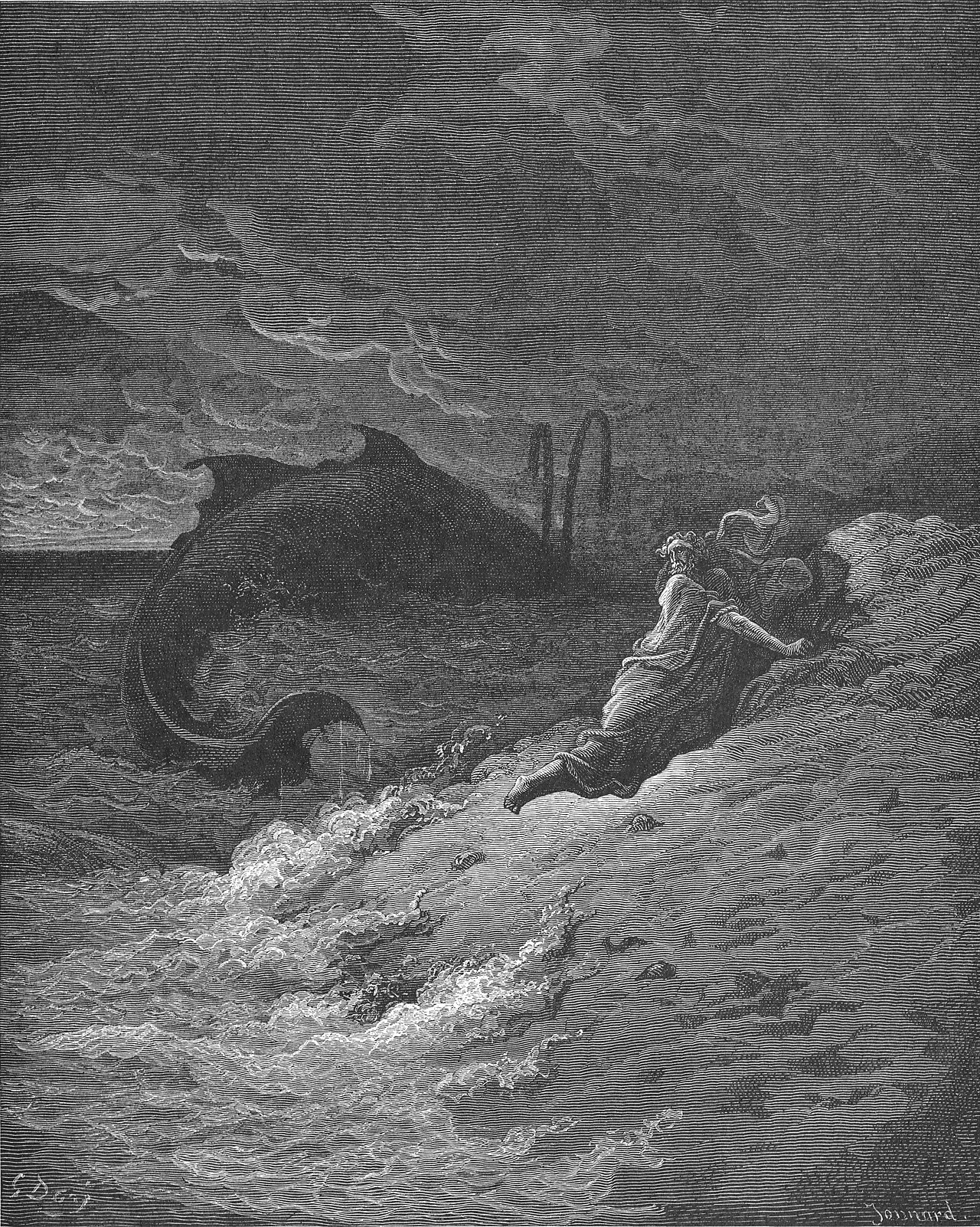
in Jonah 2The waters engulfed me to take my life; the watery depths closed around me; the seaweed wrapped around my head.
BSB
The same verse in ASV and KJV ▾
ASV
The waters compassed me about, even to the soul; The deep was round about me; The weeds were wrapped about my head.
KJV
The waters compassed me about, even to the soul: the depth closed me round about, the weeds were wrapped about my head.
⋯
This verse in Jonah 2
Commentary
11 notes on this verseIf, however, any one imagine it impossible that men should survive for such a length of time, and that Elias was not caught up in the flesh, but that his flesh was consumed in the fiery chariot, let him consider that Jonah, when he had been cast into the deep, and swallowed down into the whale's belly, was by the command of God again thrown out safe upon the land.
This site's exposition
The waters compassed me about, even to the soul
on Jonah 2:5-6
The waters compassed me about, even to the soul, and the weeds wrapped about his head, place Jonah at the sea floor rather than merely tossed on its surface, the picture of a man already drowned rather than one still swimming. Going down to the bottoms of the mountains, the earth's bars closing on him for ever, describes the grip of the place of the dead itself, and against that finality stands the one line that reverses it, yet hast thou brought up my life from corruption, O Lord my God. Barnes and Wesley both read the bars of the earth as ordinary poetic language for the place of the dead rather than a claim about the fish's own anatomy, the miracle lying in the deliverance rather than in biology.
The record, by era
The Church Fathers2 voices
"the weeds were wrapped about my head. I went down to the bottoms of the mountains; the earth with her bars was about me for ever:" LXX: 'my head has penetrated to the base of mountains; I descended to into the earth whose bars are eternal bonds'. No one doubts that the ocean covered Jonah's head, that he went down to the roots of mountains and came to the depths of the earth by which as bars and columns by the will of God the earthly sphere is supported. This earth about which is said elsewhere, "I consolidated her columns" [Ps. 74:4]. With regard to the Lord Saviour, according to the two editions, this seems to me to be what is meant. His heart and his head, that is the spirit that he thought worthy to take with a body for our safety, went down to the base of the mountains which were covered by waves; they were restrained by the will of God, the deep covered them, they were parted by the majesty of God. His spirit then went down into hell, into those places to which in the last of the mud, the spirits of sinners were held, so too the psalmist says: "they will go down to the depths of the earth, they will be the lot of wolves" [Ps. 62:10.11]. These are the bars of the earth and like the locks of a final prison and tortures, which do not let the captive spirits out of hell. This is why the Septuagint has translated this is a pertinent way: "eternal bonds", that is, wanting to keep in all those whom it had once captured. But our Lord, about which we read these lines of Cyrus in Isaiah: "I will break the bronze bars, I will crack the iron bars" [Is. 45:2], He went down to the roots of the mountains, and was enclosed by eternal bars to free all the prisoners.
"The waters compassed me about, even to the soul: the depth closed me round about," LXX: 'the water ran about me up to my spirit; the last depth closed around me'. These waters, near to the deep, which cycle and slide about the earth, which drag much mud with them, tend to kill not the body but the soul, for they are friendly to the body and warmed by its desires. This is why, according to that which I have said above, the Lord says in the psalm, "save me, Lord, because the waters have penetrated even to my soul" [Ps. 68:2], and in another passage, "my soul has passed a torrent" [Ps. 123:5], and, "let not the well press its mouth on me" [Ps. 68:16], let hell not imprison me! Let it not refuse me an exit! I freely made the descent; so let me make the ascent back again freely. I became a captive voluntarily, I ought to free the captives so that this verse is fulfilled: "ascending into the higher parts he led the captives" [Eph. 4:8]. For those who were beforehand captives in death, he brought them to life again. We must heed certain wicked forces in the deep, or the specific powers in torture and supplication; demons, in the Gospel, ask not to be forced to go to them [Mt. 8:30; Mk. 5:10; Lk. 8:31]. This is why "the darkness was over the deep" [Gen. 1,2]. Sometimes the deep is taken to mean the sacraments in a deeper sense, the judgements of God: "the judgements of the Lord are a great abyss" [Ps. 35:7], and "the deep cries out to the deep in a cry of your cataracts." [Ps. 41:8]
The Medieval Church1 voice
Jonah either says this wishfully, or with a certain trust he promises himself that he will return to Jerusalem and see the temple of the Lord.
The Puritans and the Awakening2 voices
The waters compassed me about, even to the soul,.... Either when he was first cast into the sea, which almost suffocated him, and just ready to take away his life, could not breathe for them, as is the case of a man drowning; or these were the waters the fish drew into its belly, in such large quantities, that they compassed him about, even to the endangering of his life there.
And this also is borrowed from David's complaint, Ps. lxix. The waters have come in unto my soul. When without are fightings it is no marvel that within are fears.
4 more voices on this verse
The Puritans and the Awakening1 voice
Faith corrected and controlled the surmises of fear and distrust. Here was a fierce struggle between sense and faith, but faith had the last word and came off a conqueror. In trying times, the issue will be good at last, providing our faith do not fail; it was therefore the continuance of that in its vigour that Christ secured to Peter.
The Nineteenth Century3 voices
A commentator
Jamieson, Fausset & Brown1802–1910
Commentary Critical and Explanatory on the Whole Bible (1871)
proposed
even to the soul--that is, threatening to extinguish the animal life. weeds--He felt as if the seaweeds through which he was dragged were wrapped about his head.
quarantine:debris (2026-07-29) — starts-lowercase
The waters compassed me about even to the soul - So as to seem to deprive me of life. I had no hope left. The weeds were wrapped about my head - This may be understood literally also. He found himself in the fish’s stomach, together with sea weeds, and such like marine substances, which the fish had taken for its aliment.
A commentator
Albert Barnes1798–1870
Notes, Explanatory and Practical, on the Old and New Testaments (1832-1869)
proposed
The waters compassed me about even to the soul - Words which to others were figures of distress (Psa 69:2. See the introduction to Jonah), “the waters have come even to the soul,” were to Jonah realities. Sunk in the deep seas, the water strove to penetrate at every opening. To draw breath, which sustains life, to him would have been death.
How the passage was read
What the Jewish commentators add
On the verses either side of this one
all Your breakers and Your waves —All the breakers of the sea, since it breaks and parts the sea. [from Jonathan ]
This section is reception history: how the passage was read and kept in the Jewish tradition. Where a reading parts from an essential of the Christian faith, the section says so at that point.
Texts and citation data: Sefaria; each excerpt follows its version’s licence. 3 further sources are cited on this chapter that carry no English text this site may quote or only restate the verse.
The words behind it
9 Hebrew wordsEvery Hebrew word of this verse in the order it stands, with what it means and the door to its own study. The last column counts the times a word stands in the whole Bible: the rarer the word, the more the places it appears belong together.
| Hebrew | Sound | Meaning | Word study | In the Bible |
|---|---|---|---|---|
| אֲפָפ֤וּנִי | ʾafafuni | they have encompassed me | H661 → | |
| מַ֙יִם֙ | mayim | waters | H4325 → | |
| עַד־ | ʾad- | to | H5704 → | 1261 times |
| נֶ֔פֶשׁ | nefesh | [the] neck | H5315 → | 754 times |
| תְּה֖וֹם | tehom | [the] deep | H8415 → | |
| יְסֹבְבֵ֑נִי | yesoeveni | it surrounds me | H5437 → | |
| ס֖וּף | suf | rush[es] | H5488 → | |
| חָב֥וּשׁ | chavush | [is] wrapped round | H2280 → | |
| לְרֹאשִֽׁי׃ | leroshi | to head my | H7218 → | 599 times |
אֲפָפ֤וּנִיthey have encompassed me
ʾafafuniH661 →
מַ֙יִם֙waters
mayimH4325 →
עַד־to
ʾad-H5704 →1261 times
נֶ֔פֶשׁ[the] neck
nefeshH5315 →754 times
תְּה֖וֹם[the] deep
tehomH8415 →
יְסֹבְבֵ֑נִיit surrounds me
yesoeveniH5437 →
ס֖וּףrush[es]
sufH5488 →
חָב֥וּשׁ[is] wrapped round
chavushH2280 →
לְרֹאשִֽׁי׃to head my
leroshiH7218 →599 times
A shaded row is a word that stands 400 times or fewer in the Bible.
The walk
8 stopsEach card is a verse this one points to, and under it the verses that one points to in turn. Where several paths arrive at the same place, that place is listed first: the text keeps returning to it.
Through
Psalms 40:2He lifted me up from the pit of despair, out of the miry clay; He set my feet upon a rock, and made my footsteps firm.
it leads to
- Psalms 37:23
The steps of a man are ordered by the LORD who takes delight in his journey.
- Psalms 119:133
Order my steps in Your word; let no sin rule over me.
- Psalms 27:5
For in the day of trouble He will hide me in His shelter; He will conceal me under the cover of His tent; He will set me high upon a rock.
- Matthew 7:24–25
Therefore everyone who hears these words of Mine and acts on them is like a wise man who built his house on the rock.
- Psalms 61:2
From the ends of the earth I call out to You whenever my heart is faint. Lead me to the rock that is higher than I.
- Psalms 37:23
Through
Lamentations 3:54The waters flowed over my head, and I thought I was going to die.
it leads to
- Jonah 2:3–5
For You cast me into the deep, into the heart of the seas, and the current swirled about me; all Your breakers and waves swept over me.
- Ezekiel 37:11
Then He said to me, “Son of man, these bones are the whole house of Israel. Look, they are saying, ‘Our bones are dried up, and our hope has perished; we are cut off.’
- Psalms 18:4
The cords of death encompassed me; the torrents of chaos overwhelmed me.
- Jonah 2:3–5
Where this verse is studied
On this page
Studies1
About Jonah
This page draws on 10 works. Open the list of works
This page draws on Adam Clarke, Commentary on the Bible; Albert Barnes, Notes on the Old Testament; Albert Barnes, Notes, Explanatory and Practical, on the Old and New Testaments (1832-1869); Haimo of Auxerre, Commentary (church-history corpus); Irenaeus, Against Heresies Book V; Jamieson, Fausset & Brown, Commentary Critical and Explanatory on the Whole Bible; Jerome, Commentary on Jonah, Chapter 2; John Gill, Exposition of the Old Testament (1748-1763); John Wesley, Explanatory Notes upon the Old Testament and Matthew Henry, Commentary on the Whole Bible.