
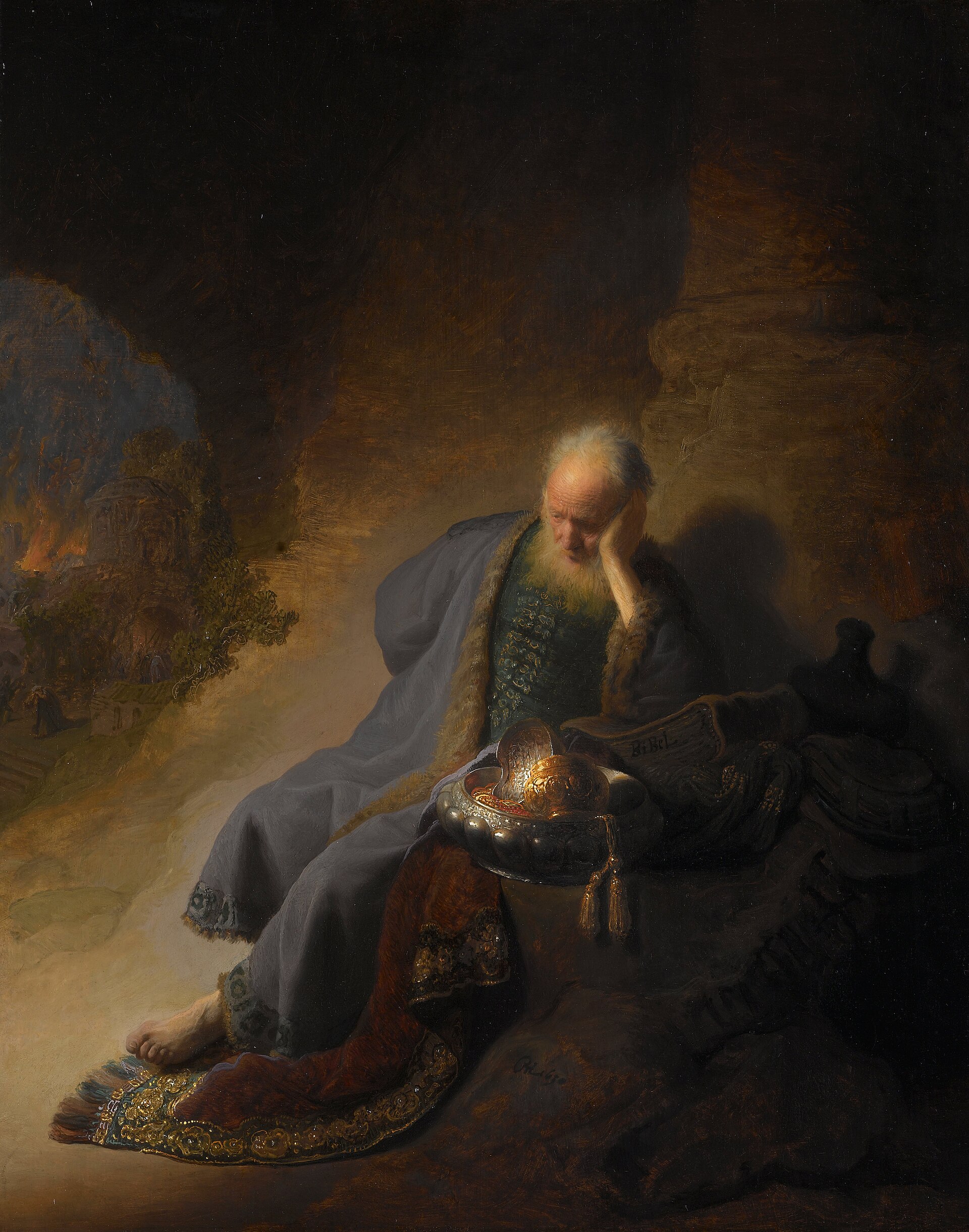
Jeremiahchapter 9
26 verses · Jeremiah, written by Baruch · 7th to 6th century BC · The Prophets
Oh, that my head were a spring of water, and my eyes a fountain of tears! I would weep day and night over the slain daughter of my people.
Introduction
Jeremiah, written by Baruch, The Prophets, Jeremiah Overview.
Jeremiah spoke these words in Jerusalem to households that would soon be burying their own dead. The chapter carries on the grief of the one before it, and the prophet wishes he could weep day and night. In that world mourning was a skill, and the women who led it were sent for when a death had come. Listen for the language of bows and arrows used for speech, and for the three kinds of men who are told what not to boast of. Listen at the end for the neighbours Judah is set among. Read it as a funeral held for a city still standing.
Context
- Who
- Households that would soon need those mourners for their own dead
- What
- A lament over Jerusalem and a call for mourners, with the word on the one boast God allows and the judgment on the uncircumcised in heart.
- Where
- Jerusalem and the towns of Judah, with Egypt, Edom, Ammon and Moab named at the close.
- When
- The chapter carries no date; it continues the sermons that follow the temple sermon, usually placed in the reign of Jehoiakim.
- Why
- To prepare the people for the grief that was coming, and to show where true standing before God is found.
Historical context
Mourning was a trade. Skilled women were hired to lead the wailing at a funeral, they knew the chants, taught them to their daughters, and set the rhythm the family followed. Their arrival was the public signal that a death had occurred. Summoning the skilled women here is a call to book the funeral before anyone has died.
Show the rest of the historical context, 3 more paragraphs
The chapter's picture of speech is a weapon shop. The tongue is a drawn bow, words are arrows shot from ambush, and a man speaks peace to a neighbour with a trap set behind his back. In a society where deals were sealed by spoken word before witnesses rather than by signature, a lying tongue broke the whole economy.
One line trades on a fact travellers knew. Egypt, Edom, Ammon, Moab and the desert tribes practised circumcision too, Greek writers noted the Egyptian custom with some surprise. So the mark Judah trusted in was not even unique to them. It made them like their neighbours, not different from them.
The closing boast-list would have sounded like a résumé being read aloud: the wise man, the strong man, the rich man. Those were the three ways up in that world, and all three are struck out.
Significance
First hearers were being told to rehearse their own funeral. The mourning women are being called while the city is still standing.
Show the rest of the significance, 1 more paragraph
Then the ground shifts under the whole national identity. Being circumcised in the flesh puts them in the same list as Moab. The only boast left standing is knowing the God who practises steadfast love and justice on the earth, and that boast is available to anyone.
This chapter in Jewish lifeWhat this chapter is in Jewish life and reading.
What is done
Two verses of this chapter close a Haftarah. The site's table in src/lib/hebraic/readings.ts records Jeremiah 7:21 to 8:3 and 9:22 to 9:23 as the Haftarah of Tzav (Leviticus 6:1 to 8:36), in both rites. The reading leaps from the burial scene of chapter 8 to the verses on the wise man's boast, so that it ends on knowing the Lord.
The verse numbers here are the table's, which follow the Hebrew count. The Hebrew count runs one behind an English Bible in this chapter, so these two verses stand as 9:23 and 9:24 in the Berean Standard Bible.
How it is read
Rashi is the one commentator on this chapter whose English the corpus carries, quoted here from The Judaica Press complete Tanach with Rashi, translated by A. J. Rosenberg, which Sefaria reports as CC-BY.
Rashi reads the tongue bent like a bow as a treacherous bow trodden with the foot to string it (Rashi on Jeremiah 9:2:1). On the deadly arrow he gives two readings of one word: drawn, or cutting like a blade. He names Menahem and the Targum of Jonathan for the second (Rashi on Jeremiah 9:7:1).
On the verses read as the close of the Haftarah, Rashi reads the wise man's boast as a rebuke: "Behold, you have rejected My words, so what wisdom do you have?" (Rashi on Jeremiah 9:22:1). On the circumcised and uncircumcised he reads the verse to include "even an uncircumcised heart" (Rashi on Jeremiah 9:24:1).
The corpus numbers by the Hebrew text. Hebrew 9:1 to 9:25 is 9:2 to 9:26 in an English Bible, so every verse number in this row is one lower than the English one.
The corpus carries eight further notes on this chapter without an English text, each marked linked because Sefaria holds no English version of the ref. They stand cited and unquoted at Radak on Jeremiah 9:8:1, 9:12:1, 9:13:1, 9:15:1, 9:16:1, 9:17:1, 9:19:1 and 9:21:1.
What the rabbis say
The corpus carries 40 rabbinic locators on the verses of this chapter, 9 in the Talmud and 31 in the Midrash. It carries the text of none, so each is cited by ref here and never quoted or paraphrased. The verse numbers are the Hebrew ones the corpus prints.
On verse 1 it holds Bamidbar Rabbah 1:2, Eikhah Rabbah 3:7 and Midrash Tanchuma Buber, Bamidbar 2:3. On verse 2 it holds Bamidbar Rabbah 16:4, Bereshit Rabbah 70:4 and Bereshit Rabbati, Parashat Vayishlach 26. On verse 3 it holds Sifrei Devarim 304:1. On verse 4 it holds Aggadat Bereshit 64:2, Ein Yaakov (Glick Edition), Yevamot 6:11 and Ein Yaakov, Yevamot 6:13. On verse 6 it holds Tanna DeBei Eliyahu Rabbah 18:7. On verse 7 it holds Aggadat Bereshit 3:1 and Arakhin 15b:14.
On verse 8 it holds Otzar Midrashim, Chuppah of Eliyahu, Chuppat Eliyahu Rabbah 32. On verse 9 it holds Berakhot 56b:10 and Eikhah Rabbah, Petichta 34. On verse 10 it holds Midrash Tehillim 50:1. On verse 11 it holds Bava Metzia 85a:23 and Eikhah Rabbah, Petichta 2. On verse 12 it holds Aggadat Bereshit 71:2 and Bava Metzia 85b:1. On verse 15 it holds Midrash Lekach Tov on Lamentations 2:3:1 and Midrash Lekach Tov on Lamentations 2:5:1. On verse 16 it holds Midrash Tehillim 119:33 and Pesikta DeRav Kahana 15:4.
On verse 17 it holds Midrash Sekhel Tov, Bereshit 24:61:3. On verse 18 it holds Eikhah Rabbah, Petichta 8 and Midrash Aggadah, Deuteronomy 1:1:7. On verse 19 it holds Jerusalem Talmud Moed Katan 3:9:1 and Moed Katan 28b:3. On verse 20 it holds Bava Kamma 60b:5 and Eikhah Rabbah 1:37. On verse 21 it holds Tractate Semachot 8:9. On verse 22 it holds Arakhin 10b:16 and Bamidbar Rabbah 22:7. On verse 23 it holds Bamidbar Rabbah 10:1 and Bereshit Rabbah 35:3.
On verse 25 it holds Bereshit Rabbah 46:5 and Ein Yaakov, Nedarim 3:12. On verse 26 it holds Pirkei DeRabbi Eliezer 29:6.
Sources: Rashi, Rashi on Jeremiah 9:1:1 to 9:24:1, The Judaica Press complete Tanach with Rashi, translated by A. J. Rosenberg, reported CC-BY; Radak, Radak on Jeremiah 9:8:1, 9:12:1, 9:13:1, 9:15:1, 9:16:1, 9:17:1, 9:19:1 and 9:21:1, cited by ref because the corpus carries no English text; The Sefaria corpus, scripts/data/sources/sefaria/jeremiah/9.json, the 40 Talmud and Midrash locators on the verses of this chapter; The site's own files, src/lib/hebraic/readings.ts, probed for Jeremiah 9: a Haftarah use, and no festival reading for the book.
The heads below are this chapter's scenes. The numbered points under each are its verses.
Oh That My Head Were Waters: a Lodging Place in the Desert
Jeremiah 9:1-3
Oh, that my head were a spring of water: The chapter opens with the prophet's own extremity, “Oh, that my head were a spring of water, and my eyes a fountain of tears”. The charge that follows, “They bend their tongues like bows; lies prevail over truth in the land”, names the sin behind the tears.
Jeremiah 9:1
“Oh that my head were waters, and mine eyes a fountain of tears,.... Or, "who will give to my head water, and to mine eyes a fountain of tears?" as the Septuagint, Vulgate Latin, and Arabic versions. The prophet wishes that his head was turned and dissolved into water, and that tears might flow from his eyes as water issues out from a fountain; and he suggests, that could this be, it would not be sufficient to deplore the miserable estate of his people, and to express the inward grief and sorrow of his mind on account of it.”
2 more voices on this verseWhat preachers and commentators have said about this verse, in their own words.
Jeremiah 9:1
“This verse is joined in the Hebrew to the preceding chapter. But any break at all here interrupts the meaning. A fountain - Rather, “a reservoir,” in which tears had been stored up, so that the prophet might weep abundantly.”
Jeremiah 9:1
“Blessed are those that mourn, for they shall be comforted hereafter; but let them expect that while they are here the clouds will still return after the rain. While we find our hearts such fountains of sin, it is fit that our eyes should be fountains of tears.”
Matthew Henry · Commentary on the Whole Bible (1707-1721)puritan
a traveler’s lodge in the wilderness: Clarke describes the lodges of the desert as bare walls with no food or furniture, shelter from wild beasts and little more. Jeremiah would take that over life among his people. Jerome sets the wish beside Jesus asking how long he must bear with his generation.
Jeremiah 9:2
“O that I had in the wilderness - In the eastern countries there are no such inns or houses of entertainment as those in Europe. There are in different places public buildings called caravanserais, where travelers may lodge: but they are without furniture of any kind, and without food. Indeed they are often without a root being mere walls for a protection against the wild beasts of the desert.”
Adam Clarke · Commentary on the Bible (1810-1826)evangelical
1 more voice on this verse
Jeremiah 9:2
“Now, to justify his willingness to leave them, he shows, 1. What he himself had observed among them. (1.) He would not think of leaving them because they were poor and in distress, but because they were wicked. [1.] They were filthy: They are all adulterers, that is, the generality of them are, ch.”
Matthew Henry · Commentary on the Whole Bible (1707-1721)puritan
Clarke says the lies of the false prophets killed like arrows. The people believed no danger was near, made no defence and met the sword. From evil to evil, in Jerome's reading, runs from idol to idol, or from siege to captivity.
Jeremiah 9:3
“They bend their tongues like their bow for lies - And their lies are such that they as fully take away life as the keenest arrow shot from the best strung bow. The false prophets told the people that there was no desolation at hand: the people believed them; made no preparation for their defense; did not return to the Lord; and the sword came and destroyed them. They are not valiant for the truth - They are bold in sin, and courageous to support their lies; but the truth they neither patronize nor support.”
Adam Clarke · Commentary on the Bible (1810-1826)evangelical
Jeremiah 9:4-6
Deceit has reached the family, for “every brother deals craftily”, and the Hebrew verb echoes the name Jacob, which Genesis 27:36 ties to his cheating. The unit closes with the plainest charge, “You dwell in the midst of deception”, so deceit is the place where Judah lives.
Jeremiah 9:4
"For every brother will utterly supplant, and every friend will walk deceitfully. And a man shall mock his brother, and they will not speak the truth, for they have bent their tongue like a bow for lies and not for truth." But often a pretended patience excites to anger more keenly than words, and a spiteful silence exceeds the most awful insults in words. The wounds of enemies are more easily borne than the deceitful blandishment of mockers, as is well said by the prophet.
John Cassian · written before 435 · CONFERENCE 2:16.18patristic
they wear themselves out committing iniquity: Gregory writes that deceit is heavy labour: the liar fears being found out, hunts for defences and lives on suspicion. Truth is easy to tell. Clarke calls iniquity a drudgery that wears out the one committing it.
Jeremiah 9:5
“And weary themselves to commit iniquity - O, what a drudgery is sin! and how much labor must a man take in order to get to hell! The tenth part of it, in working together with God, would bring him to the gate of glory.”
Adam Clarke · Commentary on the Bible (1810-1826)evangelical
1 more voice on this verse
Jeremiah 9:5
The insincere are to be admonished to learn how heavy is the labor of deception. They endure it with guilt. They are afraid of being found out. They are ever seeking dishonest defenses. They are agitated by fearful suspicions. But there is nothing safer to defend than sincerity, nothing easier to say than truth. For, when obliged to defend its deceit, the heart is wearied with hard labor. For it is written, "The labor of their own lips shall cover them."
Gregory the Dialogist · written before 604 · The Book of Pastoral Rule, Part III, Chapter XIpatristic
You dwell in the midst of deception: Gill reads the verse as the LORD speaking to Jeremiah himself about the people he lived among. The warning taught the prophet caution with neighbours who could not be trusted. Deceit and refusing to know the LORD go together here.
Jeremiah 9:6
“Thine habitation is in the midst of deceit,.... In the midst of a people of deceit, as Kimchi and Ben Molech. These are the words of the Lord to the prophet, showing what a people he dwelt among, and had to do with; how cautiously and prudently he should act; how little they were to be trusted to and depended upon; and what little hope there was of bringing them to true repentance, since there was so much deceit and hypocrisy among them.”
Jeremiah 9:7-9
I will refine them and test them: The words “I will refine them and test them” answer the deceit with the metalworker's remedy. The question “what else can I do because of the daughter of My people” states the LORD's own reluctance. The line “Their tongues are deadly arrows” returns to the chapter's opening charge.
Jeremiah 9:7
OBSERVE, here, that God represents Himself as greatly concerned to know what to do with His people. Of course, He speaks after the manner of men, for, as the infinitely wise God, knowing all things from the beginning, Jehovah knew what He would do. But yet, in order that we may understand something of the workings of the Divine mind, He represents Himself as brought to a non-plus and saying, in the words of our text, "How shall I deal with the daughter of My people?"
Charles Spurgeon · written before 1892 · The Metropolitan Tabernacle Pulpit, Sermon No. 2274: “God's People Melted and Tried” (lightly modernized text, CCEL edition)Particular Baptist
2 more voices on this verse
Jeremiah 9:7
“Try them - By melting them, I will bring upon them, the fire of the Chaldean war, that shall purge away those deceits in which they trust, that the remnant may be purified. For how - I have tried all other means.”
John Wesley · Explanatory Notes upon the Old Testament (1765)evangelical
Jeremiah 9:7
“Behold, I win melt them - I will put them in the furnace of affliction, and see if this will be a means of purging away their dross. See on Jer 6:27 (note).”
Adam Clarke · Commentary on the Bible (1810-1826)evangelical
Their tongues are deadly arrows: Gill notes that the Hebrew word behind deadly may mean drawn out, like an arrow from a quiver, while the Septuagint reads wounding. The second half gives the method, peace spoken aloud and an ambush planned within. Jerome applies it to teachers who wound with smooth words.
Jeremiah 9:8
“Their tongue is as an arrow shot out,.... As an arrow out of a bow, which moves swiftly, and comes with great force; or, "drawn out" (u); as out of a quiver. The word is used of gold, and rendered "beaten gold", 1Ki 10:16, gold drawn out into plates; and here of an arrow drawn out of a quiver; and so it is interpreted in the Talmud (w); or is "wounding", as the Septuagint, or "slaying" (x); denoting the mischief and injury done to the characters of men, by a deceitful, detracting, and calumniating tongue.”
The Targum, as Gill reports, adds that the LORD will bring evil on them, and it reads the vengeance as done according to his pleasure. The nation of deceit and lies has earned it. Both questions expect yes.
Jeremiah 9:9
“Shall I not visit them for these things? saith the Lord,.... The Targum adds, "to bring evil upon them.'' Shall not my soul be avenged on such a nation as this? the Targum is, "or of a people whose works are such, shall I not take vengeance according to my pleasure?'' See Gill on Jer 5:9.”
Wormwood and Gall; Jerusalem Made a Heap of Ruins
Jeremiah 9:10-11
a weeping and wailing for the mountains: The words “I will take up a weeping and wailing for the mountains” turn the coming devastation into a funeral for the land itself. Jerusalem becomes “a heap of rubble, a haunt for jackals”, the city built for worship now home to the wild.
Jeremiah 9:10
“For the mountains will I take up a weeping and wailing,.... Because of the desolation of them; because no pasture upon them, nor flocks feeding there; or "concerning" them, as the Arabic version; or "upon" them (y), in order to cause the lamentation to be heard the further; but the former sense seems best, as appears by what follows. The Septuagint, Syriac, and Arabic versions, read it as an exhortation to others, "take up a weeping": but they are the words of the prophet, declaring what he would do.”
1 more voice on this verse
Jeremiah 9:10
“Both the fowl of the heavens and the beast are fled - The land shall be so utterly devastated, that neither beast nor bird shall be able to live in it.”
Adam Clarke · Commentary on the Bible (1810-1826)evangelical
a haunt for jackals: The Hebrew word is tannim, which the King James renders dragons and Clarke identifies as jackals, animals that live on what larger beasts leave. Gill notes that the sentence falls on every city of Judah along with Jerusalem. Nothing is spared.
Jeremiah 9:11
“And I will make Jerusalem heaps,.... That is, the walls and houses of it shall be thrown down, and become heaps of stones and rubbish: and a den of dragons; only inhabited by wild beasts: and I will make the cities of Judah desolate, without inhabitant; so that the calamity would be universal; not only Jerusalem, but all the cities of the land, would be destroyed, forsaken, and uninhabited.”
1 more voice on this verse
Jeremiah 9:11
“A den of dragons - תנים tannim is supposed to mean here jackals; the chakal is a beast frequent in the east, an attendant on the lion, the refuse of whose prey he devours. It is an animal that seems to have been bred originally between the wolf and the dog. The original is sometimes interpreted, dragons, whales, etc.”
Adam Clarke · Commentary on the Bible (1810-1826)evangelical
Jeremiah 9:12-14
Who is the man wise enough to understand this?: The question “Who is the man wise enough to understand this” tests wisdom by whether it can read the moment. The LORD answers in verse 13, “It is because they have forsaken My law, which I set before them”. They have “gone after the Baals, as their fathers taught them”.
Jeremiah 9:12
“Rather, "Who is a wise man? (that is, Whosoever has inspired wisdom, 2Pe 3:15); let him understand this (weigh well the evils impending, and the causes of their being sent); and he to whom the mouth of the Lord hath spoken (that is, whosoever is prophetically inspired), let him declare it to his fellow countrymen," if haply they may be roused to repentance, the only hope of safety.”
Jamieson, Fausset & Brown · Commentary Critical and Explanatory on the Whole Bible (1871)reformed
2 more voices on this verse
Jeremiah 9:12
“What is the matter, that such a change is made with this land? It used to be a land that God cared for, and he had his eyes upon it for good ( Deut. xi. 12 ), but it is now a land that he has forsaken and that his face is against.”
Matthew Henry · Commentary on the Whole Bible (1707-1721)puritan
Jeremiah 9:12
“Who is the wise man - To whom has God revealed these things? He is the truly wise man. But it is to his prophet alone that God has revealed these things, and the speedy fulfillment of the predictions will show that the prophet has not spoken of himself.”
Adam Clarke · Commentary on the Bible (1810-1826)evangelical
they have forsaken My law: No wise man answers the question of verse 12, so the LORD answers it himself, as Gill observes. The Law had been set before them plainly, in a form easy to understand. Gill adds that the Septuagint has the LORD address the prophet.
Jeremiah 9:13
“And the Lord saith,.... The Septuagint version adds, "to me"; there being no wise and understanding man, nor prophet (b), to take up this affair, and open the cause of it, therefore the Lord undertakes it himself: the question was put to them, but they not answering it, the Lord does it, because they have forsaken my law, which I set before them; in a plain and easy manner, so as to be readily understood; yet this they attended not unto, but forsook it, neglected it, and cast it behind their backs.”
Gill counts the teaching of the fathers as a weight added to the sin, carried on from one generation to the next. He calls the Baals they followed the idols of the nations. The stubbornness of their hearts led the way.
Jeremiah 9:14
“But have walked after the imagination of their own heart,.... What their own hearts devised, chose, and were best pleased with; See Gill on Jer 7:24, and after Baalim; the idols of the Gentiles; these they served and worshipped, and not the true God: which their fathers taught them; which was so far from excusing them, that it was an aggravation of their sin, that they had continued in their wicked ways and idolatrous practices, from age to age, from one generation to another.”
Jeremiah 9:15-16
I will feed this people wormwood: The LORD will “feed this people wormwood and give them poisoned water to drink”, a judgment that reaches the body's most basic need. The words “I will send a sword after them until I have finished them off” show that scattering is only part of the sentence.
Jeremiah 9:15
“I will feed them - with wormwood - They shall have the deepest sorrow and heaviest affliction. They shall have poison instead of meat and drink.”
Adam Clarke · Commentary on the Bible (1810-1826)evangelical
I will scatter them among the nations: Wesley limits the sword to those appointed for destruction, and he notes that the people were never wholly finished off. Henry adds that scattering them among nations their fathers had never known hid no one from the LORD. The sword would find them.
Jeremiah 9:16
“And yet, though they are scattered so as that they will not know where to find one another. God will know where to find them all out ( Ps. xxi. 8 ) with that evil which still pursues impenitent sinners: I will send a sword after them, some killing judgment or other, till I have consumed them; for when God judges he will overcome, when he pursues he will overtake.”
Matthew Henry · Commentary on the Whole Bible (1707-1721)puritan
1 more voice on this verse
Jeremiah 9:16
“A sword - But I will follow them with the sword, 'till they be destroyed, such of them as were appointed for destruction; for otherwise, they were not all consumed, a full end was not to be made.”
John Wesley · Explanatory Notes upon the Old Testament (1765)evangelical
Call the Mourning Women: Death Climbs In at the Windows
Jeremiah 9:17-22
summon the wailing women: The call to “summon the wailing women” and “send for the most skillful among them” names the professional mourners, whose trade was grief on command. Yet “the sound of wailing is heard from Zion” before they arrive, and the women are told “Teach your daughters to wail”.
Jeremiah 9:17
“Women - Who were hired to tear their hair, and beat their breasts, with other mourning postures, a foolish custom which has obtained in most ages and countries. Cunning - Such as are most skilful in it.”
John Wesley · Explanatory Notes upon the Old Testament (1765)evangelical
take up a lament over us: Matthew Henry reads the call as a rebuke: the people were too hardened to weep for themselves, so the trade of grief had to start. The mourners are asked to come quickly. Tears were meant to spread from them to everyone.
Jeremiah 9:18
“Let those therefore do it now whose trade it is. Or, rather, it intimates the extreme sottishness and stupidity of the people, that laid not to heart the judgments they were under, nor, even when there was so much blood shed, could find in their hearts to shed a tear.”
Matthew Henry · Commentary on the Whole Bible (1707-1721)puritan
Jerome notes that the mourners give the reason for their own ruin in the same breath. Jamieson, Fausset and Brown hear Leviticus 18:28 fulfilled, the land casting out a people who defiled it. The shame is the loss of home.
Jeremiah 9:19
The cry of "the mourning women." spoiled--laid waste. dwellings cast us out--fulfilling Le 18:28; CALVIN translates, "The enemy have cast down our habitations."
Jamieson, Fausset & Brown · Commentary Critical and Explanatory on the Whole Bible (1871)reformed
Teach your daughters to wail: The women are told to open their ears before they open their mouths. Matthew Henry notes that everyone will have grief of their own, so no one will be free to mourn for a neighbour. Clarke hears a lament meant to last until the captivity ends.
Jeremiah 9:20
“Teach your daughters - This is not a common dirge that shall last only till the body is consigned to the earth; it must last longer; teach it to your children, that it may be continued through every generation, till God turn again your captivity.”
Adam Clarke · Commentary on the Bible (1810-1826)evangelical
death has climbed in through our windows: Death is pictured climbing through windows the people thought were barred, which Gill takes as the Chaldeans scaling walls and houses. Clarke follows the figure from the streets into homes and palaces. Ambrose later applied it to the eye as the window of the soul.
Jeremiah 9:21
“Amid so many passions of this body of ours, amid so many enticements of this world, who indeed can keep his footstep safe and undefiled? The eye looks back and leads the mind's perception astray, the ear hears and turns one's attention away, a whiff of fragrance hinders thought, a kiss of the mouth introduces guilt, a touch kindles the fire of passion. "Death has entered in through the window," the prophet said. Your eye is your window.”
Ambrose of Milan · written before 397 · Flight from the World 1:3patristic
3 more voices on this verse
Jeremiah 9:21
“For death is come up into our windows - Here Death is personified, and represented as scaling their wall; and after having slain the playful children without, and the vigorous youth employed in the labors of the field, he is now come into the private houses, to destroy the aged and infirm; and into the palaces, to destroy the king and the princes.”
Adam Clarke · Commentary on the Bible (1810-1826)evangelical
Jeremiah 9:21
“For death is come up into our windows,.... Their doors being shut, bolted, and barred, they thought themselves safe, but were not; the Chaldeans scaled their walls, broke in at the tops of their houses, or at their windows, and destroyed them: for the invasion of the enemy, and the manner of their entrance into them, seem to be described.”
Jeremiah 9:21
“Death - The unavoidableness of the ruin is expressed metaphorically, alluding to the storming of a city, wherein there is no respect had to sex, youth, or age.”
John Wesley · Explanatory Notes upon the Old Testament (1765)evangelical
like newly cut grain behind the reaper: Jerome notes that the Hebrew word behind Declare is written dbr without vowels, and it can be read as word, as pestilence or as speak. Clarke pictures death as the reaper, with no binder following to gather the fallen. The field is left as it lies.
Jeremiah 9:22
“Speak, thus saith the Lord,.... These are the words of the Lord to Jeremiah, to go on with his prophecy in his name; so the Targum, "prophesy, thus saith the Lord:'' even the carcasses of men shall fall as dung upon the open field; or, "upon the face of the field" (f); this shows the reason why the women are called to mourning, because the men would fall by the sword in the open field, and there lie and rot, and become dung upon it.”
2 more voices on this verse
Jeremiah 9:22
“And as the handful after the harvestman - The reapers, after having cut enough to fill their hand, threw it down; and the binders, following after, collected those handfuls, and bound them in sheaves. Death is represented as having cut down the inhabitants of the land, as the reapers do the corn; but so general was the slaughter, that there was none to bury the dead, to gather up these handfuls; so that they lay in a state of putrescence, as dung upon the open field.”
Adam Clarke · Commentary on the Bible (1810-1826)evangelical
Jeremiah 9:22
“As the handful - They shall be no more regarded than a few scattered ears that drop out of the reapers hand, which either lie on the ground and are eaten by birds, or trod to dirt by beasts.”
John Wesley · Explanatory Notes upon the Old Testament (1765)evangelical
Let Him That Glorieth Glory in Knowing the LORD
Jeremiah 9:23-24
The verse names the three usual grounds of boasting, wisdom, strength and riches, and refuses all three at once. The alternative is stated plainly, “let him who boasts boast in this, that he understands and knows Me”. Paul draws on this wording at 1 Corinthians 1:31 and 2 Corinthians 10:17.
Jeremiah 9:23
“Ahithophel was befooled, and counsellors are often led away spoiled. But, if a man's policies fail him, yet surely he may gain his point by might and dint of courage. No: Let not the strong man glory in his strength, for the battle is not always to the strong.”
Matthew Henry · Commentary on the Whole Bible (1707-1721)puritan
1 more voice on this verse
Jeremiah 9:23
“To the end of Jer. 10 the prophet urges upon the people the practical conclusion to be drawn from God’s righteous dealings with them. The three things on which men most pride themselves are shown in this verse to have proved vain.”
Wesley divides the three: loving devotion toward his people, justice in punishing the wicked, and righteousness in dealing uprightly with both. Jamieson, Fausset and Brown stress on the earth, the LORD at work in human affairs. He delights in these.
Jeremiah 9:24
“But let him that glorieth - To glory in a thing is to depend on it as the means or cause of procuring happiness. But there can be no happiness but in being experimentally acquainted with that God who exercises loving-kindness, judgment, and righteousness in the earth. He who has God’s mercy for his portion may well exult; for he need not fear the power of any adversary. Sometimes the ancient heathen poets uttered sentiments of morality far beyond their dispensation.”
Adam Clarke · Commentary on the Bible (1810-1826)evangelical
3 more voices on this verse
Jeremiah 9:24
“We may glory in this, that, wherever we are, we have an acquaintance with an interest in a God that exercises lovingkindness, and judgment, and righteousness in the earth, that is not only just to all his creatures and will do no wrong to any of them, but kind to all his children and will protect them and provide for them.”
Matthew Henry · Commentary on the Whole Bible (1707-1721)puritan
Jeremiah 9:24
“Faithfulness to His promises to preserve the godly, as well as stern execution of judgment on the ungodly, is included in "righteousness." in the earth--contrary to the dogma of some philosophers, that God does not interfere in terrestrial concerns (Ps 58:11). in these . . .”
Jamieson, Fausset & Brown · Commentary Critical and Explanatory on the Whole Bible (1871)reformed
Jeremiah 9:24
“Exercise - Kindness, as it relates to his own people; judgment, in punishing the wicked; righteousness, as he deals justly and uprightly with both.”
John Wesley · Explanatory Notes upon the Old Testament (1765)evangelical
Cross references
Jeremiah 9:24
- Quoted in1 Corinthians 1:31Therefore, as it is written: “Let him who boasts boast in the Lord.”
'He that glorieth, let him glory in the Lord' ('as it is written')
- Quoted in2 Corinthians 10:17Rather, “Let him who boasts boast in the Lord.”
'He that glorieth, let him glory in the Lord'
Jeremiah 9:25-26
I will punish all who are circumcised yet uncircumcised: The LORD will punish “all who are circumcised yet uncircumcised” and names Egypt, Judah, Edom, Ammon and Moab together. The last line is the reversal, “the whole house of Israel is uncircumcised in heart”. Paul draws the same distinction at Romans 2:28-29, between outward circumcision and circumcision of the heart.
Jeremiah 9:25
“Behold, the days come, saith the Lord,.... Or, "are coming" (h); it seems to respect the time after the Babylonish captivity, when the punishment after threatened took place, and not before: that I will punish all them that are circumcised with the uncircumcised; Jews and Gentiles together. The circumcised.”
2 more voices on this verse
Jeremiah 9:25
“All them which are circumcised ... - Rather, “all circumcised in uncircumcision,” i. e., all who though outwardly circumcised have no corresponding inward purity.”
Jeremiah 9:25
“Note, The Judge of all the earth is impartial, and none shall fare the better at his bar for any external advantages, but he will render to every man, circumcised or uncircumcised, according to his works. The condemnation of impenitent sinners that are baptized will be as sure as, nay, and more severe than, that of impenitent sinners that are unbaptized.”
Matthew Henry · Commentary on the Whole Bible (1707-1721)puritan
who clip the hair of their temples: Clarke reports that the Vulgate and Targum read the phrase as peoples who cut their hair short. Blayney takes them as the Arabians of the great desert, and Gill, after Kimchi, names the Kedarenes. Judah stands in their company.
Jeremiah 9:26
“All that are in the utmost corners - כל קצוצי פאה col ketsutsey pheah. These words have been variously understood. The Vulgate translates: Omnes qui attonsi sunt in comam; “All who have their hair cut short.” The Targum, Septuagint, Syriac, and Arabic have understood it nearly in the same way; and so our margin. Others think that the insular or peninsular situation of the people is referred to. Dr. Blayney thinks the Arabians are meant, who dwelt in the great desert, between Mesopotamia and Palestine.”
Adam Clarke · Commentary on the Bible (1810-1826)evangelical
2 more voices on this verse
Jeremiah 9:26
“They are heathens in their hearts, strangers to God, and enemies in their minds by wicked works. Their hearts are disposed to idols, as the hearts of the uncircumcised Gentiles are. Note, The seals of the covenant, though they dignify us, and lay us under obligations, will not save us, unless the temper of our minds and the tenour of our lives agree with the covenant.”
Matthew Henry · Commentary on the Whole Bible (1707-1721)puritan
Jeremiah 9:26
“The novelty of the expression may perhaps deter not only the Jews but even some of our brothers. For Paul, who introduces "circumcision of the heart," seems to assume things that are impossible. For how shall it be possible that a member be circumcised that, covered by the internal viscera, lies hidden even from the view of people? Let us return, therefore, to the words of the prophets that, with the aid of your prayers, these matters about which we are inquiring might become clear.”
Origen of Alexandria · written before 253 · Homilies on Genesis 3patristic
Keep studying
Studies5
People and groups1
Sources for this chapter
The summary
Jamieson, Fausset & Brown, Commentary Critical and Explanatory; John Calvin, Commentaries; John Wesley, Notes on the Old Testament and Matthew Henry, Complete Commentary.
The exposition
Adam Clarke, Commentary on the Bible; Albert Barnes, Notes on the Old Testament; Ambrose of Milan, FLIGHT FROM THE WORLD 1:3; Carl Friedrich Keil, The Prophecies of Jeremiah; Gregory the Dialogist, The Book of Pastoral Rule, Part III, Chapter XI; Jamieson, Fausset & Brown, Commentary Critical and Explanatory on the Whole Bible; Jerome, Commentary on Jeremiah; John Calvin, Commentary on Jeremiah and Lamentations; John Gill; John Wesley, Explanatory Notes upon the Old Testament and Matthew Henry, Commentary on the Whole Bible.