
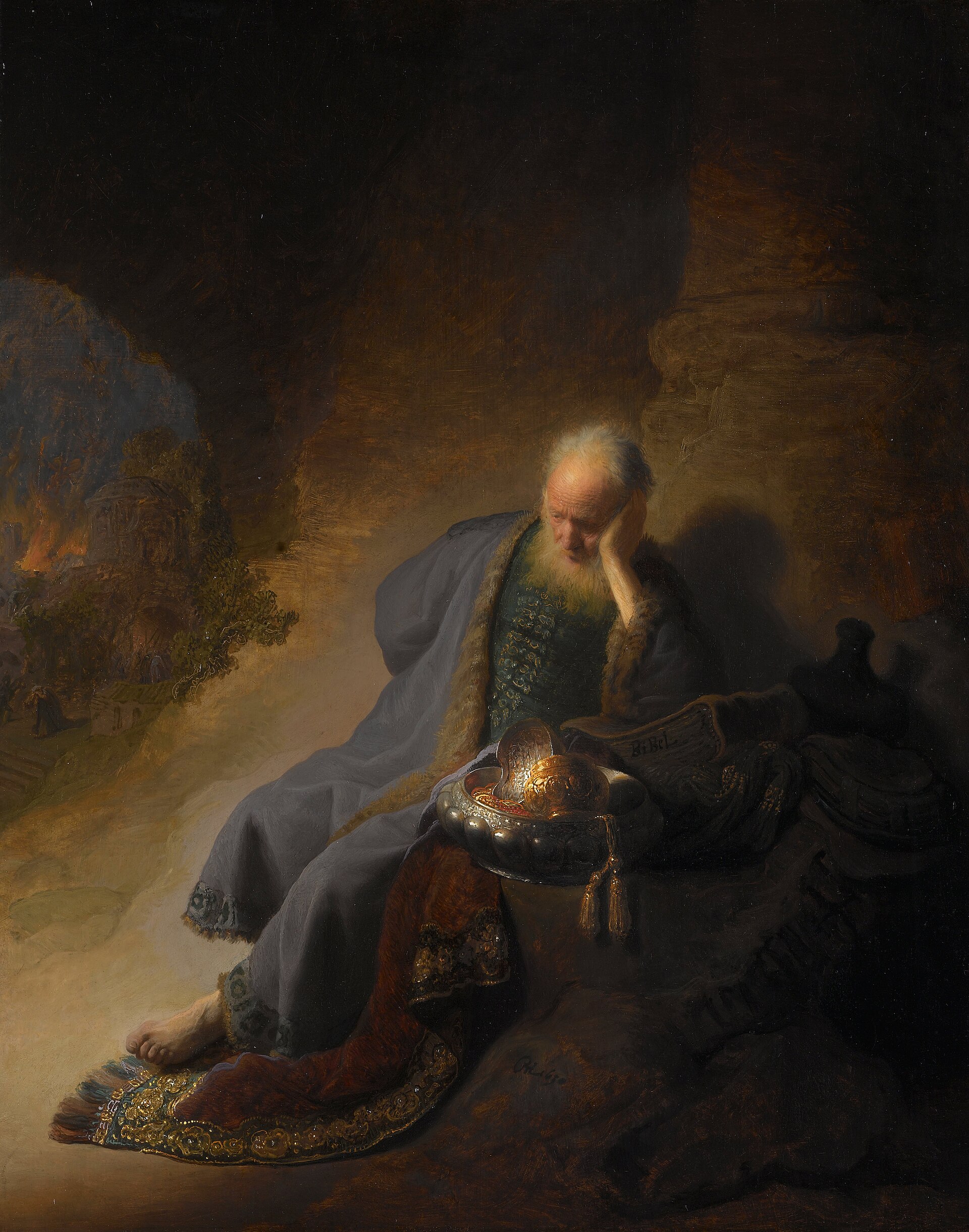
Jeremiahchapter 30
24 verses · Jeremiah, written by Baruch · 7th to 6th century BC · The Prophets
How awful that day will be! None will be like it! It is the time of Jacob’s distress, but he will be saved out of it.
Introduction
Jeremiah, written by Baruch, The Prophets, Jeremiah Overview.
Jeremiah was told to write these words in a book, and this chapter opens the part of Jeremiah often called the Book of Consolation. It was given in the last years before Jerusalem fell, and it was meant to be read after the fall. Its first hearers were about to lose their city, their king and their land. The chapter speaks in poetry and moves between wound and healing. Listen for the language of injury and medicine, and for the day of trouble that ends in rescue. Read it as a message kept for people who would need it when nothing around them agreed with it.
Context
- Who
- A people about to lose everything, handed a document to open later
- What
- A written collection of promises that the LORD will bring Israel and Judah back from captivity, heal their wounds and rebuild their city.
- Where
- Written in Jerusalem and addressed to Israel and Judah in their lands of exile.
- When
- The last years of the kingdom, about 588 to 586 BC, written to be read after the fall of Jerusalem.
- Why
- To give a people facing ruin a written word that God would save them and punish the nations that scattered them.
Historical context
The chapter begins with an instruction to write all these words in a book. That is deliberate archiving. Words spoken in a doomed city vanish with it; words written on a scroll can be carried into exile, copied, and read to a generation born a long way from home.
Show the rest of the historical context, 3 more paragraphs
The images of injury are medical. Your hurt is incurable, your wound is grievous, there is no one to plead your cause, no medicine for your sore, and then the reversal, I will restore health to you and heal your wounds. In that world a wound was cleaned, dressed with oil and resin, and bound. To say no one binds it up is to say the patient has been abandoned.
One line names a period the rest of Scripture returns to: that day is great, so that none is like it, a time of trouble for Jacob, but he shall be saved out of it. Read in the traditional framework this looks past the Babylonian disaster to a still-future distress for Israel, ended by the LORD's own deliverance and followed by the reign of David's king, the same sequence the prophets and the book of Revelation lay out.
The chapter also promises the return of ordinary life: a city rebuilt on its own mound, a palace where it used to stand, thanksgiving and the sound of merrymakers, and a ruler who comes from among their own people rather than being installed by an empire.
Significance
For first hearers the point of writing it down was that they would need it when nothing around them agreed with it. This is a document meant to outlive the city it was written in.
Show the rest of the significance, 1 more paragraph
The heart of it is a reversal they would have thought impossible: the God who is bringing this on them is the same one who says I am with you to save you, and I will make a full end of all the nations among whom I scattered you, but of you I will not make a full end.
This chapter in Jewish lifeWhat this chapter is in Jewish life and reading.
What is done
The site's own table in src/lib/hebraic/readings.ts, probed for this lane, printed no weekly portion and no Haftarah from this chapter, and no festival reading for the book. That table carries the Haftarah of each of the fifty-four weekly portions and the books read whole at the feasts, and it carries nothing for the special Sabbaths or the fast days. This card therefore names no public reading of the chapter and leaves that question to a source that holds those readings.
The corpus joins the chapter to the weeks of the Torah portions through the works arranged by portion. Under the tenth verse it carries Midrash Tanchuma Buber, Vayikra 17:1.
How it is read
Rashi is the one commentator on this chapter whose English the corpus carries, quoted here from The Judaica Press complete Tanach with Rashi, translated by A. J. Rosenberg, which Sefaria reports as CC-BY. Every quotation of it is held to fifty words or fewer because the translation is modern, and his headwords, which carry the verse in that translation's wording, are never quoted.
Rashi opens the book of comfort with the reason for writing it down. The prophet might ask why he should write "since they all will perish, and no one will read it", and the answer is that days are coming (Rashi on Jeremiah 30:3:1). The sound of trembling in the fifth verse he reads two ways. "Some interpret this as alluding to the tidings of Babylon", and the Midrash Aggadah reads it as the war of Gog and Magog (Rashi on Jeremiah 30:5:1). The day of the seventh verse gets the same two readings: "The day of the assassination of Belshazzar and the downfall of Babylon. Another explanation: the day of the downfall of Gog" (Rashi on Jeremiah 30:7:1).
The promise that follows he reads as release: "The yoke of the heathens will be removed from Israel" (Rashi on Jeremiah 30:8:1). Israel need not fear "Because of all the evils that you will see befalling Babylon in whose midst you are" (Rashi on Jeremiah 30:10:1). The discipline in measure of the eleventh verse is discipline "according to the law of the Torah" (Rashi on Jeremiah 30:11:1). At the incurable wound he gives the thought of the onlookers: "No one thinks that you will have salvation" (Rashi on Jeremiah 30:13:1).
The rebuilding in the eighteenth verse he glosses in two words, the palace being "The Temple" (Rashi on Jeremiah 30:18:1). The word that opens the sixteenth verse he calls "an expression denoting an oath" (Rashi on Jeremiah 30:16:1). The ruler of the twenty-first verse he renders literally as "his mighty one" (Rashi on Jeremiah 30:21:1). The ninth verse, where Israel serves David their king, carries a note by Radak in the corpus with no English text, and it is cited without a quotation.
The corpus carries eight further notes on this chapter without an English text. Each is marked linked because Sefaria holds no English version of the ref, so each is cited here and none is quoted. The notes of Radak are cited at Radak on Jeremiah 30:1:1, 30:2:1, 30:4:1, 30:9:1 and 30:15:1. The notes of Metzudat David are cited at Metzudat David on Jeremiah 30:20:1, 30:22:1 and 30:24:1.
What the rabbis say
The corpus carries forty rabbinic locators on this chapter and the text of none, so each is cited and linked here rather than quoted. On the third verse it holds Midrash Tannaim on Deuteronomy 23:7:4 and Yalkut Shimoni on Torah 933:21. On the fourth verse it holds Midrash Lekach Tov, Deuteronomy 1:1:3 and Sifrei Devarim 1:3. On the fifth verse it holds Pesikta Rabbati 27:1. On the sixth verse it holds Ein Yaakov (Glick Edition), Sanhedrin 11:51, Jerusalem Talmud Chagigah 2:1:15, Jerusalem Talmud Kiddushin 1:8:5 and Jerusalem Talmud Sheviit 6:1:5. On the seventh verse it holds Devarim Rabbah 2:11, Jerusalem Talmud Taanit 1:1:13, Midrash Aggadah, Exodus 23:22:4 and Midrash Lekach Tov, Exodus 2:23:2.
On the eighth verse it holds Ein Yaakov, Kiddushin 4:5. On the ninth verse it holds Ein Yaakov (Glick Edition), Sanhedrin 11:52, Jerusalem Talmud Berakhot 2:4:11, Midrash Lekach Tov, Genesis 49:8:1 and Midrash Sekhel Tov, Bereshit 49:27:21. On the tenth verse it holds Ein Yaakov (Glick Edition), Taanit 1:15, Ein Yaakov, Taanit 1:16, Midrash Tanchuma Buber, Vayikra 17:1 and Midrash Tanchuma, Vayetzei 2:1. On the eleventh verse it holds Midrash Lekach Tov on Lamentations 3:22:1, Midrash Lekach Tov, Deuteronomy 32:36:1 and Midrash Lekach Tov, Genesis 11:6:6. On the fourteenth verse it holds Pesikta DeRav Kahana 16:6.
On the seventeenth verse it holds Aggadat Bereshit 67:3, Bereshit Rabbah 38:14 and Eikhah Rabbah 1:26. On the eighteenth verse it holds Midrash Lekach Tov, Genesis 25:27:4, Midrash Mishlei 23:1 and Midrash Sekhel Tov, Bereshit 25:34:21. On the nineteenth verse it holds Midrash Sekhel Tov, Bereshit 21:6:2. On the twentieth verse it holds Bava Batra 8b:11, Ein Yaakov (Glick Edition), Bava Batra 1:9 and Ein Yaakov, Bava Batra 1:9. On the twenty-first verse it holds Aggadat Bereshit 18:1, Bereshit Rabbah 71:5 and Ein Yaakov (Glick Edition), Gittin 5:6.
The corpus also prints one locator anchored past the chapter's last verse, the twenty-fourth, cited here with the anchor it gives. It prints Kiddushin 70b:13 at Jeremiah 30:25. What each of them teaches is a saying of the rabbis, and is reported as theirs wherever this site quotes one. The quotations wait on a fetch that carries the text.
Sources: Rashi, Rashi on Jeremiah 30:3:1 to 30:21:1, The Judaica Press complete Tanach with Rashi, translated by A. J. Rosenberg, reported CC-BY; Radak, Radak on Jeremiah 30:1:1, 30:2:1, 30:4:1, 30:9:1 and 30:15:1, cited by ref because the corpus carries no English text; Metzudat David, Metzudat David on Jeremiah 30:20:1, 30:22:1 and 30:24:1, cited by ref because the corpus carries no English text; The Sefaria corpus, scripts/data/sources/sefaria/jeremiah/30.json, the 40 Talmud and Midrash locators of this chapter; The site's own files, src/lib/hebraic/readings.ts, printing no portion and no Haftarah for this chapter and no festival reading for this book.
The heads below are this chapter's scenes. The numbered points under each are its verses.
Write All the Words in a Book: the Time of Jacob's Trouble
Jeremiah 30:1-4
This is the word that came: The chapter opens with a command, “Write in a book all the words that I have spoken to you.” The promise that follows names both houses together, “My people Israel and Judah.” The Book of Consolation opens as a document meant to outlast the exile it describes.
This time Jeremiah writes the message down. Jamieson, Fausset and Brown say a written book could be read by the people wherever they were scattered. Adam Clarke takes the book to be chapters 30 and 31, as any finished piece of writing could be called a book in Hebrew.
Jeremiah 30:2
“Write thee all the words that I have spoken unto thee in a book - The book here recommended I believe to be the thirtieth and thirty-first chapters; for among the Hebrews any portion of writing, in which the subject was finished, however small, was termed ספר sepher, a Book, a treatise or discourse.”
Adam Clarke · Commentary on the Bible (1810-1826)evangelical
restore from captivity My people Israel and Judah: Both Israel and Judah are named. Adam Clarke notes that the ten tribes of Israel had gone into captivity long before Judah. He reads the promise to restore them to the land in two stages: the return after seventy years, and a fuller one under the Messiah.
Jeremiah 30:3
“The days come - First, After the conclusion of the seventy years. Secondly, Under the Messiah. That I will bring again the captivity of Israel - The ten tribes, led captive by the king of Assyria, and dispersed among the nations. And Judah - The people carried into Babylon at two different times; first, under Jeconiah, and, secondly, under Zedekiah, by Nebuchadnezzar.”
Adam Clarke · Commentary on the Bible (1810-1826)evangelical
concerning Israel and Judah: The heading repeats the two names on purpose. John Gill argues that a return from Babylon alone would say little about the ten tribes of Israel, so the words reach further. He adds that the words may be read as spoken to Israel and Judah as well as about them.
Jeremiah 30:4
“And these are the words that the Lord spake concerning Israel, and concerning Judah. Which follow in this chapter and the next; first concerning Israel, the ten tribes; and then concerning the two tribes of Judah and Benjamin, even concerning all Israel; whereas, if this prophecy only respects the return from the captivity in Babylon, there is very little in it which concerns the ten tribes, or but a very few of them. The words may be rendered, "unto Israel, and unto Judah"; as being the persons to whom they were directed, as well as were the subjects of them.”
Jeremiah 30:5-7
Yes, this is what the LORD: Verse 7 holds judgment and rescue in one breath: “It is the time of Jacob’s distress, but he will be saved out of it.” Later Jewish and Christian readers alike took the phrase as a name for the nation's final ordeal before deliverance.
Jeremiah 30:5
“Better, as in the margin. The prophet places his hearers in the center of Babylon, and describes it as convulsed with terror as the armies of Cyrus draw near. The voice of trembling is the war-cry of the advancing host: while fear and no peace implies that even among the exiles there is only alarm at the prospect of the city, where they had so long dwelt, being destroyed.”
Can a male give birth?: The question mocks the men of the nation. Barnes places the scene in Babylon, with the armies of Cyrus drawing near and terror heard in every cry. Matthew Henry reads the pale faces as the color of sickness, like jaundice.
Jeremiah 30:6
“All faces shall be turned into paleness. The word signifies not only such paleness as arises from a sudden fright, but that which is the effect of a bad habit of body, the jaundice, or the green sickness.”
Matthew Henry · Commentary on the Whole Bible (1707-1721)puritan
It is the time of Jacob’s distress: The day is awful beyond compare, yet Jacob will be saved out of it. Rescue comes inside the distress. Barnes takes the day as the fall of Babylon, a time of danger for the Jews living there, as armies of that age were brutal.
Jeremiah 30:7
“That day - i. e., the day of the capture of Babylon. It is even the time of Jacob’s trouble - Rather, and it is a time of trouble to Jacob, i. e., of anxiety to the Jews, for the usages of war were so brutal that they would be in danger when the enemy made their assault.”
Jeremiah 30:8-9
On that day, declares the LORD: The promise reverses the yoke: “I will break the yoke off their necks and tear off their bonds, and no longer will strangers enslave them.” The freed nation will “serve the LORD their God and David their king, whom I will raise up for them.”
Jeremiah 30:8
“I will break his yoke - That is, the yoke of Nebuchadnezzar. Of him - Of Jacob, (Jer 30:7), viz., the then captive Jews.”
Adam Clarke · Commentary on the Bible (1810-1826)evangelical
David their king, whom I will raise up: The king to be raised up is a son of David. Adam Clarke reports that the Targum reads the verse as obeying the Lord their God and the Messiah, the Son of David. Jerome finds this David in Luke 1, where a people freed from enemies serve God without fear.
Jeremiah 30:9
“But they shall serve the Lord their God, and David their King - This must refer to the times of the Messiah and hence the Chaldee has, “They shall obey the Lord their God, וישת מאון למשיחה בר דוד veyishta meun limschicha bar David, and they shall obey the Messiah, the Son of David.” This is a very remarkable version; and shows that it was a version, not according to the letter, but according to their doctrine and their expectation.”
Adam Clarke · Commentary on the Bible (1810-1826)evangelical
2 more voices on this verse
Jeremiah 30:9
“This is the David of whom the Gospel speaks: "It will be granted to us, that, liberated from our enemies, we may serve him without fear in holiness and justice all of our days." For, just as the first Adam and the second Adam are described according to the truth of the body, so also with David and the Lord and Savior. For, since everything that Mary gave to the Lord according to the flesh came from David, whatever was of the seed of David also took its origin and conception from the Holy Spirit.”
Jerome · written before 420 · Six Books on Jeremiah 6:5.2-3patristic
Jeremiah 30:9
“But - Either this must be understood of the kingdom of Christ, under which the Jews that received him were made spiritually free: or there is a time yet to come, when this ancient people of God shall be restored to a farther civil liberty than they have enjoyed ever since the captivity of Babylon.”
John Wesley · Explanatory Notes upon the Old Testament (1765)evangelical
Jeremiah 30:10-11
As for you, O Jacob My: “O Jacob My servant, do not be afraid” answers the terror of verse 5. The promise sets Israel apart: “Though I will completely destroy all the nations to which I have scattered you, I will not completely destroy you.” Discipline remains, “Yet I will discipline you justly.”
Jeremiah 30:10
“These two verses are considered by some very similar in style to the last 27 chapters of Isaiah. The contrast, however, between the full end made with the pagan, and the certainty that Israel shall never so perish, is one of Jeremiah’s most common topics. Jer 30:11 In measure - See the Jer 10:24 note.”
I will discipline you justly: The nations that held Israel will come to an end, while Israel is kept alive. Barnes calls this contrast one of Jeremiah's most common themes, and he points to the plea for measured correction at 10:24. The punishment is real, yet it has a limit.
Jeremiah 30:11
“Though I make a full end of all nations - Though the Persians destroy the nations whom they vanquish, yet they shall not destroy thee.”
Adam Clarke · Commentary on the Bible (1810-1826)evangelical
Thy Bruise Is Incurable: Yet I Will Restore Health to Thee
Jeremiah 30:12-17
For this is what the LORD: The diagnosis is stated plainly, “Your injury is incurable; your wound is grievous.” Verse 14 names the cause, “your great iniquity and your numerous sins.” Verse 17 answers the wound with the LORD's promise, “I will restore your health and heal your wounds,” reversing the word spoken against her.
Jeremiah 30:12
“Thy bruise is incurable - אנוש anush, desperate, not incurable; for the cure is promised in Jer 30:17, I will restore health unto thee, and I will heal thee of thy wounds.”
Adam Clarke · Commentary on the Bible (1810-1826)evangelical
There is no one to plead your cause: Judah stands like a patient with no advocate and no healer. Wesley reads the point as a warning that no quick cure was coming, whatever the false prophets promised. Jamieson, Fausset and Brown, on verse 16, see the Lord taking up the cause that no one else would plead.
Jeremiah 30:13
“That thou mayest be bound up - Others put a stop after “cause,” and translate, For binding thy wound, healing plaster thou hast none.”
1 more voice on this verse
Jeremiah 30:13
“No medicine - The prophet's design was to convince them, that there was no present remedy, but patience, though their false prophets might promise a cure.”
John Wesley · Explanatory Notes upon the Old Testament (1765)evangelical
All your lovers have forgotten you: Judah's lovers are the nations that once sought her as an ally, as Barnes explains, pointing to 22:20 and 27:3. Those allies have now walked away. The Lord Himself struck the blow, and the reason given is Judah's great iniquity.
Jeremiah 30:14
“For the multitude ... - Or, Because of the multitude of thine iniquity, Because thy sins are strong. Judah’s lovers are the nations which once sought her alliance (see Jer 22:20; Jer 27:3).”
Why do you cry out over your wound?: The question meets a complaint that the punishment is too harsh. Jamieson, Fausset and Brown, citing Calvin, say the cry comes too late, for the season of repentance had passed. The verse repeats the cause from verse 14 word for word: great iniquity and numerous sins.
Jeremiah 30:15
“Translate it: Why criest thou because of thy breaking? Because thy pain is grievous? Because of the multitude of thine iniquity, Because thy sins are strong, I have done these things unto thee.”
1 more voice on this verse
Jeremiah 30:15
“Why criest thou--as if God's severity was excessive. Thou hast no reason to complain, for thine affliction is just. Thy cry is too late, for the time of repentance and mercy is past [CALVIN].”
Jamieson, Fausset & Brown · Commentary Critical and Explanatory on the Whole Bible (1871)reformed
all who devour you will be devoured: The word nevertheless turns the chapter from wound to rescue. John Gill prefers that rendering: though Judah had sinned greatly, her foes would still be punished. Adam Clarke traces the pattern: Babylon, which devoured Judah, was devoured by the Medes and Persians, and they in turn by the Greeks.
Jeremiah 30:16
“Therefore all they that devour thee shall be devoured,.... Thus rendering the words, they are to be connected with Jer 30:10; and all between to be put into a parenthesis: but rather, in connection with the preceding words, they should be rendered "nevertheless", or "notwithstanding" (y); though they had sinned at so great a rate, and were so much afflicted and chastened by the Lord, yet their enemies should not go unpunished, and mercy in the issue would be showed to them.”
2 more voices on this verse
Jeremiah 30:16
“They that devour thee - The Chaldeans. Shall be devoured - By the Medes and Persians. All that prey upon thee will I give for a prey - The Assyrians were destroyed by the Babylonians; the Babylonians, by the Medes and Persians; the Egyptians and Persians were destroyed by the Greeks, under Alexander. All these nations are now extinct, but the Jews, as a distinct people, still exist.”
Adam Clarke · Commentary on the Bible (1810-1826)evangelical
Jeremiah 30:16
“Therefore--connected with Jer 30:13, because "There is none to plead thy cause . . . therefore" I will plead thy cause, and heal thy wound, by overwhelming thy foes. This fifteenth verse is inserted to amplify what was said at the close of Jer 30:14.”
Jamieson, Fausset & Brown · Commentary Critical and Explanatory on the Whole Bible (1871)reformed
they call you an outcast, Zion: Jamieson, Fausset and Brown read outcast as a wife sent away by her husband, comparing Isaiah 62:4. The scorn of others becomes the reason for the Lord's care. The wound called incurable in verse 12 is the one He heals.
Jeremiah 30:17
“Outcast--as a wife put away by her husband (Isa 62:4, contrasted with Jer 30:12). Zion--alluding to its Hebrew meaning, "dryness"; "sought after" by none, as would be the case with an arid region (Isa 62:12). The extremity of the people, so far from being an obstacle to, will be the chosen opportunity of, God's grace.”
Jamieson, Fausset & Brown · Commentary Critical and Explanatory on the Whole Bible (1871)reformed
The City Rebuilt on Her Own Heap; a Ruler from the Midst
Jeremiah 30:18-22
This is what the LORD says: The rebuilding is concrete: “the city will be rebuilt on her own ruins, and the palace will stand in its rightful place.” The unit closes with the formula, “And you will be My people, and I will be your God,” the words that anchor the new covenant.
Jeremiah 30:18
“The city shall be builded upon her own heap - Be re-edified from its own ruins. See the book of Nehemiah, passim. And the palace shall remain - Meaning, the king’s house shall be restored; or, more probably, the temple shall be rebuilt; which was true, for after the Babylonish captivity it was rebuilt by Nehemiah, etc. By the tents, distinguished from the dwelling-places of Jacob, we may understand all the minor dispersions of the Jews, as well as those numerous synagogues found in large cities.”
Adam Clarke · Commentary on the Bible (1810-1826)evangelical
2 more voices on this verse
Jeremiah 30:18
“Thus saith the Lord, I will bring again the captivity of Jacob's tents,.... That is, the captives of Israel, the inhabitants of them; alluding to the patriarchs, Abraham, Isaac, and Jacob, dwelling in tents, and to the Israelites in the wilderness; and fitly expresses the present unsettled state of the Jews: and have mercy on his dwelling places; by restoring Israel, or Jacob's posterity, to their dwelling places in Jerusalem, and other places rebuilt by them and for them.”
Jeremiah 30:18
“A type of these events previously occurred in Zerubbabel and Ezra, when the people returned and the city was begun to be built on its heights and religion observed in the temple, all of which are contained in Ezra's own book.”
Jerome · written before 420 · Six Books on Jeremiah 6:9.3-6patristic
Thanksgiving will proceed from them: Jamieson, Fausset and Brown note that the Hebrew word for thanksgiving includes confession, praise that owns what God truly is. Spurgeon hears the whole book change its tone in this chapter, from weeping to celebration. A people made few will multiply.
Jeremiah 30:19
“I will multiply them - They shall be very numerous; even where at present they have but tents. I will also glorify them - I will put honor upon them every where, so that they shall be no longer contemptible. This will be a very great change, for they are now despised all over the earth.”
Adam Clarke · Commentary on the Bible (1810-1826)evangelical
their congregation will be established before Me: The restored nation gathers again as a congregation before the Lord. Adam Clarke reads this as the people raising their own children again and meeting for worship once more. The oppressors who scattered them will answer for it.
Jeremiah 30:20
Their children also - They shall have the education of their own children as formerly. And their congregation - Their religious assemblies. Shall be established - Being, in the latter days, incorporated with those “who serve the Lord their God, and worship the Messiah, the son of David.”
Adam Clarke · Commentary on the Bible (1810-1826)evangelical
Their leader will be one of their own: Israel's ruler will come from its own people. Adam Clarke points to Zerubbabel and Nehemiah, governors after the return, while Gill and the Targum read the leader as the Messiah. Matthew Henry sees Christ drawing near to God as priest for His people, which no one dares on his own.
Jeremiah 30:21
“But it looks further, to Christ, to him as Mediator. Note, (1.) The proper work and office of Christ, as Mediator, is to draw near and approach unto God, not for himself only, but for us, and in our name and stead, as the high priest of our profession. The priests are said to draw nigh to God, Lev. x.”
Matthew Henry · Commentary on the Whole Bible (1707-1721)puritan
2 more voices on this verse
Jeremiah 30:21
“Their nobles shall be of themselves - Strangers shall not rule over them; and - Their governor shall proceed from the midst of them - Both Nehemiah and Zerubbabel, their nobles and governors after the return from Babylon, were Jews.”
Adam Clarke · Commentary on the Bible (1810-1826)evangelical
Jeremiah 30:21
I MENTIONED in the reading that there is a very remarkable change of tone in the Book of Jeremiah, at the 30th chapter. You read on through the 29 chapters and you hear nothing but "a weeping and wailing," while the Prophet stands before you, girt with sackcloth, bidding Israel, "lament and howl: for the fierce anger of the Lord is not turned back from us." When you come to the middle of the 30th chapter, all is changed—you have left the dungeon for the pleasant meads and you hear "thanksgiving and the voice of them that make merry."
you will be My people: This line is the promise of the Law, the Lord as their God and Israel as His people, repeated at 7:23 and 11:4. It returns at 31:33 in the new covenant. Jerome, on verse 18, sees the city rebuilt under Zerubbabel and Ezra as a first picture of this bond.
Jeremiah 30:22
“Ye shall be my people - The old covenant shall be renewed.”
Adam Clarke · Commentary on the Bible (1810-1826)evangelical
Jeremiah 30:23-24
Behold, the storm of the LORD: The chapter ends in nearly the words of chapter 23. “The fierce anger of the LORD will not turn back until He has fully accomplished the purposes of His heart.” The closing line, “In the days to come you will understand this,” aims the whole oracle forward.
Jeremiah 30:23
“Compare the marginal reference. These verses would more appropriately be attached to the next chapter, for which they form a suitable introduction.”
1 more voice on this verse
Jeremiah 30:23
“Vengeance upon God's foes always accompanies manifestations of His grace to His people. continuing--literally, "sojourning," abiding constantly; appropriately here in the case of Babylon, which was to be permanently destroyed, substituted for "whirling itself about" ("grievous" in English Version) (see on Jer 23:19,20), where the temporary downfall of Judea is spoken of.”
Jamieson, Fausset & Brown · Commentary Critical and Explanatory on the Whole Bible (1871)reformed
In the days to come: These lines repeat 23:20 almost word for word, where the storm fell on the false prophets. John Gill reads the purposes of the Lord's heart as twofold, grace to His people and wrath on their enemies. Full understanding waits for later days.
Jeremiah 30:24
“The fierce anger of the Lord shall not return,.... This explains what is meant by the continuing whirlwind in Jer 30:23; until he hath done it; his whole will and pleasure; brought Babylon to ruin, and destroyed all the antichristian powers: and until he hath performed the intents of his heart; in a way of grace and mercy to his people, and in a way of wrath and vengeance on their enemies: in the latter day ye shall consider it; this prophecy, and understand it; and see it wholly and fully accomplished.”
Keep studying
Sources for this chapter
The summary
Jamieson, Fausset & Brown, Commentary Critical and Explanatory; John Calvin, Commentaries; John Wesley, Notes on the Old Testament and Matthew Henry, Complete Commentary.
The exposition
Adam Clarke, Commentary on the Bible; Albert Barnes; Carl Friedrich Keil, The Prophecies of Jeremiah; Charles Spurgeon, The Metropolitan Tabernacle Pulpit, Sermon No. 1673; Jamieson, Fausset & Brown, Commentary Critical and Explanatory on the Whole Bible; Jamieson, Fausset and Brown, Commentary Critical and Explanatory on the Whole Bible; Jerome; John Calvin, Commentary on Jeremiah and Lamentations; John Gill; John Wesley, Explanatory Notes upon the Old Testament and Matthew Henry, Commentary on the Whole Bible.