
Jeremiah 30:5
in Jeremiah 30Yes, this is what the LORD says: “A cry of panic is heard—a cry of terror, not of peace.
BSB
The same verse in ASV and KJV ▾
ASV
For thus saith Jehovah: We have heard a voice of trembling, of fear, and not of peace.
KJV
For thus saith the Lord; We have heard a voice of trembling, of fear, and not of peace.
⋯
This verse in Jeremiah 30
Commentary
6 notes on this verseA commentator
Albert Barnes1798–1870
Notes, Explanatory and Practical, on the Old and New Testaments (1832-1869)
Better, as in the margin. The prophet places his hearers in the center of Babylon, and describes it as convulsed with terror as the armies of Cyrus draw near. The voice of trembling is the war-cry of the advancing host: while fear and no peace implies that even among the exiles there is only alarm at the prospect of the city, where they had so long dwelt, being destroyed.
This site's exposition
a voice of trembling, of fear, and not of peace
on Jeremiah 30:5-7
The nation's fear is described in the rawest terms, a voice of trembling and not of peace, men gripped like a woman in labor, every face gone pale, language of terror rather than of comfort. Yet the verse turns on itself: alas, for that day is great, so that none is like it, but he shall be saved out of it, judgment and rescue held in one breath. The phrase the time of Jacob's trouble became, in later Jewish and Christian reading alike, a name for the nation's final ordeal before deliverance, a use the commentators trace directly to this verse.
The record, by era
The Church Fathers1 voice
(Verse 4 and following) And these are the words that the Lord spoke to Israel and Judah, for this is what the Lord says: We have heard the voice of terror (or fear), and there is no peace. Inquire and see if a male gives birth. Why then do I see every man with his hand on his loins like a woman in labor, and all faces have turned pale? First, sadness is announced, so that after the magnitude of evils, joy may follow.
The Puritans and the Awakening2 voices
For thus saith the Lord,....
No marvel that when without are fightings within are fears. The men, even the men of war, shall be quite overwhelmed with the calamities of their nation, shall sink under them, and yield to them, and shall look like women in labour, whose pains come upon them in great extremity and they know that they cannot escape them,
The Nineteenth Century1 voice
We have heard a voice of trembling - This may refer to the state and feelings of the people during the war which Cyrus carried on against the Babylonians. Trembling and terror would no doubt affect them, and put an end to peace and all prosperity; as they could not tell what would be the issue of the struggle, and whether their state would be better or worse should their present masters fall in the conflict. This is well described in the next verse, where men are represented as being, through pain and anguish, like women in travail. See the same comparison Isa 13:6-8.
The words behind it
10 Hebrew wordsEvery Hebrew word of this verse in the order it stands, with what it means and the door to its own study. The last column counts the times a word stands in the whole Bible: the rarer the word, the more the places it appears belong together.
| Hebrew | Sound | Meaning | Word study | In the Bible |
|---|---|---|---|---|
| כִּי־ | ki- | for | H3588 → | 4482 times |
| כֹה֙ | khoh | thus | H3541 → | 577 times |
| אָמַ֣ר | ʾamar | he says | H559 → | 5305 times |
| יְהוָ֔ה | yahweh | Yahweh | H3068 → | 6520 times |
| ק֥וֹל | kol | a sound of | H6963 → | 506 times |
| חֲרָדָ֖ה | charadah | fear | H2731 → | |
| שָׁמָ֑עְנוּ | shamaenu | we have heard | H8085 → | 1159 times |
| פַּ֖חַד | pachad | dread | H6343 → | 49 times |
| וְאֵ֥ין | veein | and there not | H369 → | 789 times |
| שָׁלֽוֹם׃ | shalom | [is] peace | H7965 → | 236 times |
כִּי־for
ki-H3588 →4482 times
כֹה֙thus
khohH3541 →577 times
אָמַ֣רhe says
ʾamarH559 →5305 times
יְהוָ֔הYahweh
yahwehH3068 →6520 times
ק֥וֹלa sound of
kolH6963 →506 times
חֲרָדָ֖הfear
charadahH2731 →
שָׁמָ֑עְנוּwe have heard
shamaenuH8085 →1159 times
פַּ֖חַדdread
pachadH6343 →49 times
וְאֵ֥יןand there not
veeinH369 →789 times
שָׁלֽוֹם׃[is] peace
shalomH7965 →236 times
A shaded row is a word that stands 400 times or fewer in the Bible.
The walk
8 stopsEach card is a verse this one points to, and under it the verses that one points to in turn. Where several paths arrive at the same place, that place is listed first: the text keeps returning to it.
Through
Isaiah 5:30In that day they will roar over it, like the roaring of the sea. If one looks over the land, he will see darkness and distress; even the light will be obscured by clouds.
it leads to
- Isaiah 8:22
Then they will look to the earth and see only distress and darkness and the gloom of anguish. And they will be driven into utter darkness.
- Joel 2:10
Before them the earth quakes; the heavens tremble. The sun and moon grow dark, and the stars lose their brightness.
- Jeremiah 4:23–28
I looked at the earth, and it was formless and void; I looked to the heavens, and they had no light.
- Isaiah 8:22
Through
Amos 8:10I will turn your feasts into mourning and all your songs into lamentation. I will cause everyone to wear sackcloth and every head to be shaved. I will make it like a time of…
it leads to
- Jeremiah 6:26
O daughter of my people, dress yourselves in sackcloth and roll in ashes. Mourn with bitter wailing, as you would for an only son, for suddenly the destroyer will come upon us.
- Zechariah 12:10
Then I will pour out on the house of David and on the people of Jerusalem a spirit of grace and prayer, and they will look on Me, the One they have pierced. They…
- Jeremiah 48:37
For every head is shaved and every beard is clipped; on every hand is a gash, and around every waist is sackcloth.
- Ezekiel 7:18
They will put on sackcloth, and terror will overwhelm them. Shame will cover all their faces, and all their heads will be shaved.
- Job 20:23
When he has filled his stomach, God will vent His fury upon him, raining it down on him as he eats.
- Jeremiah 6:26
About Jeremiah
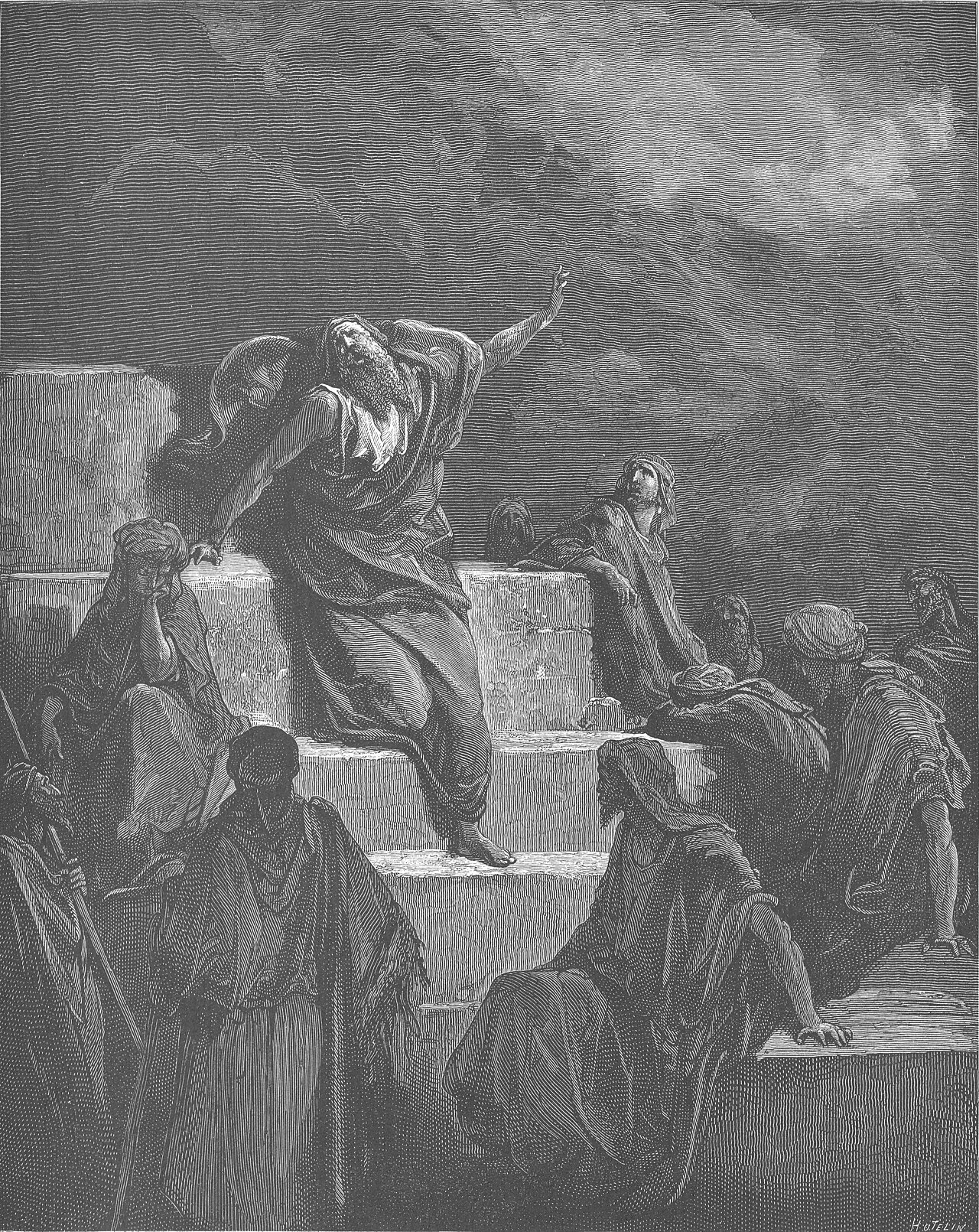
This page draws on Adam Clarke, Commentary on the Bible; Albert Barnes, Notes, Explanatory and Practical, on the Old and New Testaments (1832-1869); Jamieson, Fausset and Brown, Commentary Critical and Explanatory on the Whole Bible; Jerome, Commentary on Jeremiah; John Gill, Exposition of the Old Testament; John Gill, Exposition of the Old Testament (1748-1763) and Matthew Henry, Commentary on the Whole Bible.