
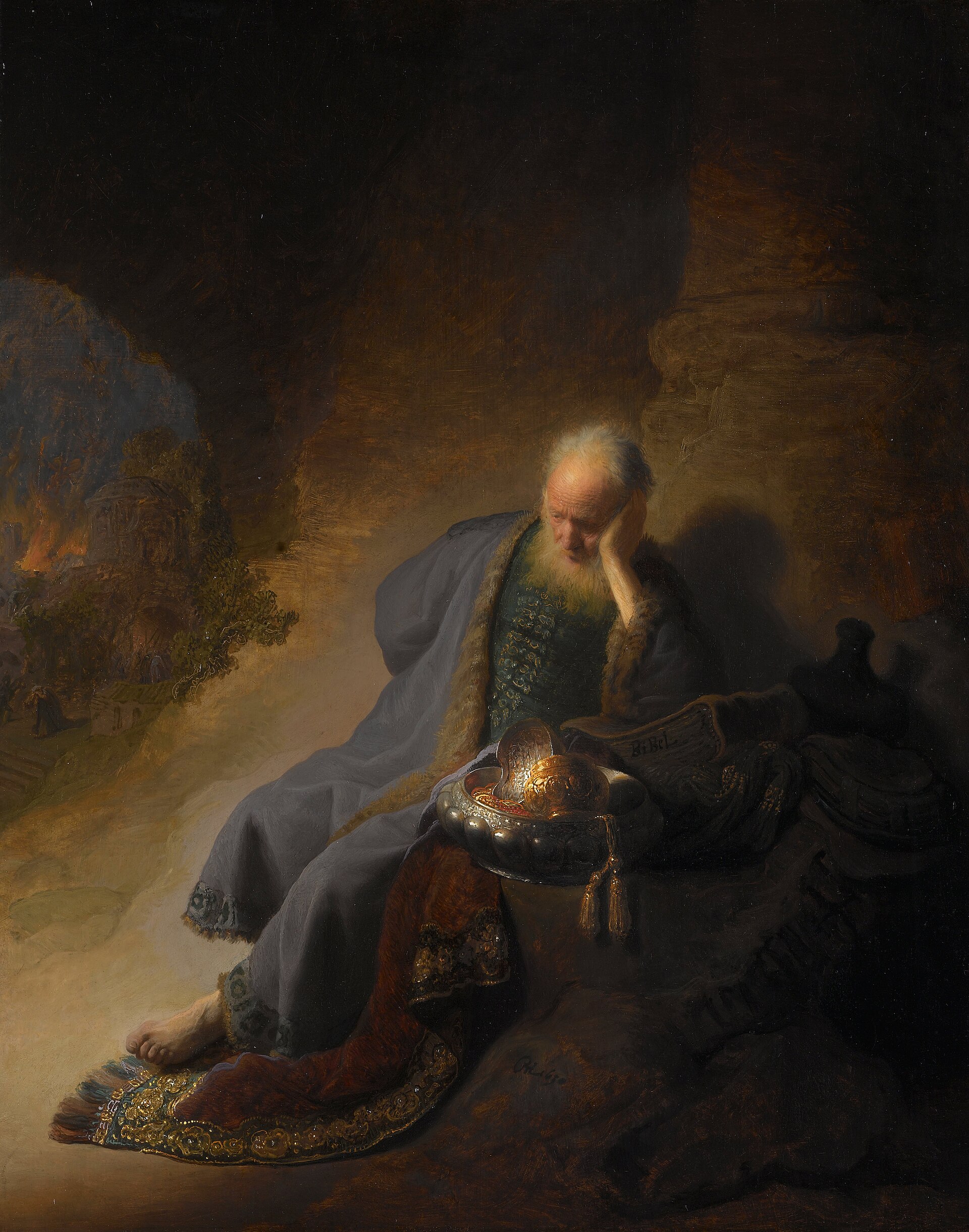
Jeremiahchapter 16
21 verses · Jeremiah, written by Baruch · 7th to 6th century BC · The Prophets
But for now I will send for many fishermen, declares the LORD, and they will catch them. After that I will send for many hunters, and they will hunt them down on every mountain and hill, even from the clefts of the rocks.
Introduction
Jeremiah, written by Baruch, The Prophets, Jeremiah Overview.
Jeremiah lived this chapter as much as he spoke it, in the years before Jerusalem fell. In his world a man was expected to marry and raise sons, and every family gathered for weddings, funerals and feasts. God asks him to stand apart from all of it so that his life becomes the message. Listen for what he is forbidden to do and for the reason given each time. Then listen for a promise set in the middle of the warnings, about a rescue greater than the one from Egypt. Notice how far the chapter's hope reaches before it closes.
Context
- Who
- A community whose entire social life ran through births, burials and banquets
- What
- God's command that Jeremiah stay unmarried and keep away from funerals and feasts, with the reasons, the promise of a return, and the coming judgment.
- Where
- The homes of Judah, their houses of mourning and their houses of feasting.
- When
- The last decades of the kingdom of Judah, about 609 to 597 BC.
- Why
- To make the prophet's own life a sign of the loss about to fall on every home in Judah.
Historical context
Marriage and children were not optional in that culture. A man without sons had no one to carry his name, work his land, or bury him, and childlessness was widely read as a misfortune from God. Being told not to marry in that society was closer to being told to disappear.
Show the rest of the historical context, 3 more paragraphs
Funeral custom is described in detail because the prophet is banned from all of it. Mourners tore their clothes, went barefoot, shaved the head or cut the beard, and in some places gashed their skin, a practice the Law forbade but which kept happening. Neighbours brought the bread of mourners to a house where no cooking was done, and passed the cup of consolation to the bereaved. All of that is cancelled.
The threat that the dead will not be buried or lamented is the heaviest curse in the chapter. Proper burial in the family tomb was the last duty a household owed, and to be left on the ground was the fate of enemies and criminals.
The chapter also names hunting practice: God will send for many fishermen to net them and many hunters to drive them off every mountain and out of the clefts of the rocks. Ancient hunts worked exactly that way, beaters sweeping ground toward waiting nets.
Significance
For the first hearers, the prophet's empty house was the sermon. Whole streets were about to have no weddings and no funerals, because there would be no one left to hold either.
Show the rest of the significance, 1 more paragraph
Yet the same chapter contains one of the most hopeful lines in the book: a day is coming when people will no longer swear by the God who brought Israel out of Egypt, but by the God who brought them back out of the north country. The exile has not happened yet and the return is already being described as the greater rescue.
This chapter in Jewish lifeWhat this chapter is in Jewish life and reading.
What is done
The end of this chapter is read aloud in the synagogue. The site's table in src/lib/hebraic/readings.ts records Jeremiah 16:19 to 17:14 as the Haftarah of Bechukotai (Leviticus 26:3 to 27:34), in both rites. The Torah portion closes Leviticus with the blessings and the curses of the covenant, and the Haftarah opens on the nations coming to the Lord from the ends of the earth.
How it is read
Rashi is the one commentator on this chapter whose English the corpus carries, quoted here from The Judaica Press complete Tanach with Rashi, translated by A. J. Rosenberg, which Sefaria reports as CC-BY.
On the house of mourning Rashi records a custom. Breaking bread for the mourners "alludes to the practice of giving a meal to the mourners in the city square" with the blessing over the bread (Rashi on Jeremiah 16:7:1). On the fifth verse he reports the Sifrei, and the reading of the rabbis that the word means a mourner (Rashi on Jeremiah 16:5:1).
The fishers and the hunters he reads in two stages. The first take the people within the city, and the second hunt the survivors in the mountains (Rashi on Jeremiah 16:16:1). He reads the oath of the fourteenth verse as a promise of redemption: "Although you betrayed Me, I have an oath that I will redeem you" (Rashi on Jeremiah 16:14:1).
The corpus carries fourteen further notes on this chapter without an English text, each marked linked because Sefaria holds no English version of the ref. They stand cited and unquoted at Radak on Jeremiah 16:1:1, 16:2:1, 16:3:1, 16:4:1, 16:10:1, 16:12:1, 16:15:1, 16:17:1 and 16:20:1. The same holds for Metzudat David on Jeremiah 16:2:1, 16:3:1, 16:4:1, 16:9:1 and 16:11:1.
What the rabbis say
The corpus carries 40 rabbinic locators on the verses of this chapter, 7 in the Talmud and 33 in the Midrash. It carries the text of none, so each is cited by ref here and never quoted or paraphrased. The verse numbers are the Hebrew ones the corpus prints.
On verse 4 it holds Bamidbar Rabbah 9:49, Ein Yaakov (Glick Edition), Sanhedrin 6:15, Ein Yaakov, Sanhedrin 6:13, Midrash Sekhel Tov, Bereshit 23:20:5 and Sanhedrin 46b:14. On verse 5 it holds Bava Batra 10a:11, Devarim Rabbah 3:7, Eikhah Rabbah 1:23, Ein Yaakov (Glick Edition), Bava Batra 1:18 and Ein Yaakov (Glick Edition), Ketubot 6:9. On verse 7 it holds Eikhah Rabbah 4:7, Introductions to Amoraic Literature, Part II (Notes and Interpretations for Chapters of the Talmud), Baba Batra, Chapter I 309 and Otzar Midrashim, Midrash Shelosha v'Arba'ah 2:12.
It also holds Pirkei DeRabbi Eliezer 17:7 there. On verse 11 it holds Eikhah Rabbah, Petichta 2, Jerusalem Talmud Chagigah 1:7:4 and Pesikta DeRav Kahana 15:5. On verse 12 it holds Midrash Tanchuma Buber, Vayetzei 14:1. On verse 13 it holds Bereshit Rabbati, Parashat Vayishlach 26, Eikhah Rabbah 1:51, Ein Yaakov (Glick Edition), Sanhedrin 11:52, Pesikta DeRav Kahana 13:13 and Pesikta DeRav Kahana 16:6.
On verse 14 it holds Bava Kamma 16b:19, Jerusalem Talmud Berakhot 1:6:11, Mekhilta DeRabbi Yishmael, Tractate Pischa 16:10, Mekhilta DeRabbi Yishmael, Tractate Pischa 16:11 and Mekhilta DeRabbi Yishmael, Tractate Pischa 16:19. On verse 15 it holds Midrash Lekach Tov, Genesis 50:25:1. On verse 16 it holds Tractate Soferim 7:4. On verse 17 it holds Mekhilta DeRabbi Yishmael, Tractate Vayehi Beshalach 3:9. On verse 18 it holds Midrash Tannaim on Deuteronomy 32:35:2, Otzar Midrashim, Midrashim on Missing and Extra Letters 2:5, Sifrei Devarim 325:2 and Yalkut Shimoni on Torah 946:10.
On verse 19 it holds Mekhilta DeRabbi Shimon Ben Yochai 14:4, Mekhilta DeRabbi Shimon Ben Yochai 14:5, Mekhilta DeRabbi Shimon Ben Yochai 15:2 and Mekhilta DeRabbi Yishmael, Tractate Shirah 3:2. On verse 21 it holds Vayikra Rabbah 24:1.
Sources: Rashi, Rashi on Jeremiah 16:5:1 to 16:21:1, The Judaica Press complete Tanach with Rashi, translated by A. J. Rosenberg, reported CC-BY; Metzudat David, Metzudat David on Jeremiah 16:2:1, 16:3:1, 16:4:1, 16:9:1 and 16:11:1, cited by ref because the corpus carries no English text; Radak, Radak on Jeremiah 16:1:1, 16:2:1, 16:3:1, 16:4:1, 16:10:1, 16:12:1, 16:15:1, 16:17:1 and 16:20:1, cited by ref because the corpus carries no English text; The Sefaria corpus, scripts/data/sources/sefaria/jeremiah/16.json, the 40 Talmud and Midrash locators on the verses of this chapter; The site's own files, src/lib/hebraic/readings.ts, probed for Jeremiah 16: a Haftarah use, and no festival reading for the book.
The heads below are this chapter's scenes. The numbered points under each are its verses.
Take Thee No Wife, Enter No House of Mourning
Jeremiah 16:1-4
Then the word of the LORD came to me: The command “You must not marry or have sons or daughters in this place” makes Jeremiah’s own life a sign of a ruin. The children born here will die of diseases, unmourned and unburied, their corpses “food for the birds of the air and beasts of the earth”.
Jeremiah 16:1
“The word of the Lord came unto me, saying. The Targum is, the word of prophecy from the Lord: whether this is a new prophecy, or the former continued, is not certain; the latter seems probable. This introduction is omitted in the Septuagint and Arabic versions.”
The LORD forbids Jeremiah to marry. Barnes notes that marriage was a duty among the Jews, so the command marked a coming disaster great enough to set aside ordinary duties. Gill adds that the prophet would bear the distress alone more easily than with a wife and sons and daughters.
Jeremiah 16:2
“Elijah lived a virgin life; so also did Elisha and many of the sons of the prophets. To Jeremiah the command came: "You will not take a wife." He had been sanctified in his mother's womb, and now he was forbidden to take a wife because the captivity was near. The apostle gives the same counsel in different words: "I think, therefore, that this is good by reason of the present distress, namely, that it is good for a person to be as he is." What is this distress that does away with the joys of wedlock?”
Jerome · written before 420 · LETTER 22.21patristic
1 more voice on this verse
Jeremiah 16:2
“Thou shall not take thee a wife,.... Not because it was unlawful; for it was lawful for prophets to marry, and they did; but because it was not advisable, on account of the calamities and distresses which were coming upon the nation; which would be more bearable by him alone, than if he had a wife, which would increase his care, concern, and sorrow.”
For this is what the LORD says concerning: The word covers sons, daughters, mothers and fathers alike. Barnes compares the present distress of 1 Corinthians 7:26, a time when it was wise to refrain from marriage. Matthew Henry adds that a father with a wife and children in this land cannot flee as a single man can.
Jeremiah 16:3
“As for those that have wives and children, 1. They will have such a clog upon them that they cannot flee from those deaths. A single man may make his escape and shift for his own safety, when he that has a wife and children can neither find means to convey with them nor find in his heart to go and leave them behind him.”
Matthew Henry · Commentary on the Whole Bible (1707-1721)puritan
Gill reads them as sicknesses that waste a man slowly. Adam Clarke links the dung on the ground to 8:2 and the food for the birds to 7:33. Calvin asks whether Jeremiah stayed unmarried and answers that the command may have come to him in a vision.
Jeremiah 16:4
“They shall die of grievous deaths,.... Such as the sword, famine, and pestilence. The Targum particularly adds famine. It may be rendered, "deaths of diseases, or sicknesses" (u); such as are brought on by long sickness and lingering distempers; by which a man consumes gradually, as by famine, and is not snatched away at once; and which are very grievous to bear.”
1 more voice on this verse
Jeremiah 16:4
“This is the import of this prophecy. It may however be asked, whether the Prophet was unmarried? But this has nothing to do with the subject, for he received this command in a vision; and though he might not have been unmarried, he might still have proclaimed this prophecy, that God had forbidden him to marry and to beget children.”
John Calvin · Commentaries (1554)reformed
Jeremiah 16:5-9
a house where there is a funeral meal: Jeremiah may not enter “a house where there is a funeral meal”, because the LORD has removed “My peace, My loving devotion, and My compassion”. The dead will be past counting. Verse 9 names the sounds of a wedding, “the voices of the bride and bridegroom”, to announce their silence.
Jeremiah 16:5
“Enter not - Do not go to comfort such as mourn for any relations dead, (for their feastings upon those occasions were upon a consolatory account) those that die are most happy, for I will take away the peace of this people, and deprive them of all my mercy and loving-kindness.”
John Wesley · Explanatory Notes upon the Old Testament (1765)evangelical
Gill reads great and small as the wealthy and poor alike. Barnes notes that the Law forbade mourners to cut themselves or shave the head, yet the customs had stayed in use. Adam Clarke ties them to the ways of the heathen that Judah took up with its idols.
Jeremiah 16:6
“Nor cut themselves - A custom of the heathen forbidden to the Jews, Lev 19:28; Deu 14:1, and which appears now to have prevailed among them; because, having become idolaters, they conformed to all the customs of the heathen. They tore their hair, rent their garments, cut their hands, arms, and faces. These were not only signs of sorrow but were even supposed to give ease to the dead, and appease the angry deities.”
Adam Clarke · Commentary on the Bible (1810-1826)evangelical
1 more voice on this verse
Jeremiah 16:6
“He had little reason to lament those who died now just before the judgments entered which he saw at the door, but rather to think those happy who were seasonable taken away from the evil to come. This was to be a type of what was coming, when there should be such universal confusion that all neighbourly friendly offices should be neglected.”
Matthew Henry · Commentary on the Whole Bible (1707-1721)puritan
No food will be offered to comfort: Friends sent food and wine to a house of mourning, as Jamieson, Fausset and Brown and Wesley both explain. A cup of consolation was that gift of wine. In the coming judgment no one will bring it.
Jeremiah 16:7
“Tear themselves - Better as in the margin; “break broad for them.” It was customary upon the death of a relative to fast, and for the friends and neighbors after a decent delay to come and comfort the mourner, and urge food upon him 2Sa 12:17; food was also distributed at funerals to the mourners, and to the poor. Cup of consolation - Marginal reference note.”
2 more voices on this verse
Jeremiah 16:7
“Deal bread - It was a custom among them, when they had any friend, that had lost his relations, to send them some meat (for among the Hebrew all things they ate were called bread) and then to go and sup with them, and speak comfortably to them. The cup - They were also wont to send wine, that they might forget their sorrows; this is called, The cup of consolation.”
John Wesley · Explanatory Notes upon the Old Testament (1765)evangelical
Jeremiah 16:7
“Neither shall men tear themselves,.... Either their flesh, or their clothes: or, "stretch out" (y); that is, their hands, and clap them together, and wring them, as persons in great distress do: or "divide", or "break", or "deal unto them" (z); that is, bread, as at their funeral feasts.”
You must not enter a house: Adam Clarke takes this house as a funeral banquet held to comfort the family of the dead. Matthew Henry reads it as a feast of mirth, set aside while God called the people to weeping and fasting. The prophet was to live out the warning he gave.
Jeremiah 16:8
“Thou shalt not also go into the house of feasting - Funeral banquets were made to commemorate the dead, and comfort the surviving relatives; and the cup of consolation, strong mingled wine, was given to those who were deepest in distress, to divert their minds and to soothe their sorrows. These kinds of ceremonies were common among almost all the nations of the world on funeral occasions. The Canaanites, the Jews, the Persians, Arabians, New Zealanders, Huns, etc., etc.”
Adam Clarke · Commentary on the Bible (1810-1826)evangelical
1 more voice on this verse
Jeremiah 16:8
“God called aloud to weeping, and mourning, and fasting; he was coming forth against them in his judgments; and it was time for them to humble themselves; and it well became the prophet who gave them the warning to give them an example of taking the warning, and complying with it, and so to make it appear that he did himself believe it.”
Matthew Henry · Commentary on the Whole Bible (1707-1721)puritan
For this is what the LORD of Hosts: The loss will come in their own lifetime. Matthew Henry notes that the people would not heed the prophets, so the voices of bride and bridegroom will be heard no more. Gill reads the title LORD of Hosts as the power to do what he threatens.
Jeremiah 16:9
“The voice of God's prophets was not heard, was not heeded, among them, and therefore no longer shall the voice of the bridegroom and of the bride, of the songs that used to grace the nuptials, be heard among them. Causes of Divine Judgments.”
Matthew Henry · Commentary on the Whole Bible (1707-1721)puritan
Why Hath the LORD Pronounced All This Great Evil?
Jeremiah 16:10-13
When you tell these people all these things: When the people ask “What is our guilt”, the answer indicts the present generation beyond the fathers, “you have done more evil than your fathers”. The sentence fits the sin, exile to a land they have not known, where they will serve other gods day and night.
Jeremiah 16:10
“Note, It is amazing to see how hardly sinners are brought to justify God and judge themselves when they are in trouble, and to own the iniquity and the sin that have procured them the trouble.”
Matthew Henry · Commentary on the Whole Bible (1707-1721)puritan
Then you are to answer them: The answer traces the ruin to the fathers, who forsook the LORD and served other gods. Barnes reads the sentence as the fruit of idolatry kept up through many generations until the nation fell into apostasy. The next verse lays the heavier charge on the sons.
Jeremiah 16:11
“The severe sentence passed upon them is the consequence of idolatry persisted in through many generations until it has finally deepened into national apostasy.”
And you have done more evil: Each generation added to the sin of the one before. Adam Clarke notes the sins of the fathers came on the children who followed their example and grew worse. Matthew Henry reads the stubborn heart as the rule they chose to live by, to avoid hearing God and his prophets.
Jeremiah 16:12
“And ye have done worse than your fathers - The sins of the fathers would not have been visited on the children, had they not followed their example, and become even worse than they.”
Adam Clarke · Commentary on the Bible (1810-1826)evangelical
So I will cast you out: Jamieson, Fausset and Brown observe that the sin of Judah at home becomes its punishment in exile. They chose other gods in their own land, and in the land of their captors they will serve other gods by force. Barnes hears irony in the closing words.
Jeremiah 16:13
“There is a mixture of mercy and judgment in these verses, and it is hard to know to which to apply some of the passages here--they are so interwoven, and some seem to look as far forward as the times of the gospel. God will certainly execute judgment upon them for their idolatries.”
Matthew Henry · Commentary on the Whole Bible (1707-1721)puritan
Fishers and Hunters; the Nations Come from the Ends of the Earth
Jeremiah 16:14-15
the days are coming, declares the LORD: A new oath replaces the old. People will no longer swear by the LORD “who brought the Israelites up out of the land of Egypt”. The return from exile becomes the greater exodus by which later generations recall his power, a homecoming set inside a chapter of judgment.
Jeremiah 16:14
“These two verses, by promising a deliverance greater than that from Egypt, implied also a chastisement more terrible than the bondage in the iron furnace there. Instead of their being placed in one land, there was to be a scattering into the north and many other countries, followed finally by a restoration.”
1 more voice on this verse
Jeremiah 16:14
“They are cast out, but they are not cast off, they are not cast away. They shall be brought up from the land of the north, the land of their captivity, where they are held with a strong hand, and from all the lands whither they are driven, and where they seemed to be lost and buried in the crowd; nay, I will bring them again into their own land, and settle them there.”
Matthew Henry · Commentary on the Whole Bible (1707-1721)puritan
Instead they will say: Gill names the land of the north as Babylon. Jamieson, Fausset and Brown take the return from Babylon as the first meaning, and a final return from every land as the full one. Matthew Henry finds more pardoning mercy in this return than in the exodus from Egypt.
Jeremiah 16:15
“But the Lord liveth,.... Or they shall swear by the living Lord; or declare his power, as the Targum: "that brought up the children of Israel from the land of the north"; that is, from Babylon, which lay north of Judea. The Jews (d) gather from hence, that the land of Israel was higher than all other lands, because it is said, that "brought up", or "caused to ascend"; as out of the land of Egypt as before, so out of all other lands.”
2 more voices on this verse
Jeremiah 16:15
“The land of the north - Chaldea: and their deliverance thence will be as remarkable as the deliverance of their fathers from the land of Egypt.”
Adam Clarke · Commentary on the Bible (1810-1826)evangelical
Jeremiah 16:15
“In this there was more of pardoning mercy (the most glorious branch of divine mercy) than in that; for their captivity in Babylon had more in it of the punishment of sin than their bondage in Egypt; and therefore that which comforts Zion in her deliverance out of Babylon is this, that her iniquity is pardoned, Isa. xl.”
Matthew Henry · Commentary on the Whole Bible (1707-1721)puritan
Jeremiah 16:16-18
I will send for many fishermen: The LORD sends “many fishermen” and then “many hunters” to catch Israel on every mountain and hill, “even from the clefts of the rocks”. Fishermen and hunters are the two ways of capture, net and chase. The double repayment answers a land defiled and an inheritance filled with abominations.
Jeremiah 16:16
"He rains on the wicked snares." Without any doubt, it is the Lord who contrives snares for sinners, in order to entrap those who abuse their freedom and to compel them to tread the right path under his bridle, thereby making it possible for them to advance through him who says, "I am the way." Wherefore, in Jeremiah, the Lord sends fishers and hunters to spread nets for the lost fish tossed about in whirlpools and to hunt down and save the beasts that wander through mountains and hills.
Jerome · written before 420 · Homilies on the Psalms 60 (Ps 10)patristic
2 more voices on this verse
Jeremiah 16:16
“I will send for many fishers - for many hunters - I shall raise up enemies against them some of whom shall destroy them by wiles, and others shall ruin them by violence. This seems to be the meaning of these symbolical fishers and hunters.”
Adam Clarke · Commentary on the Bible (1810-1826)evangelical
Jeremiah 16:16
“It is remarkable, the same image is used in a good sense of the Jews' restoration, implying that just as their enemies were employed by God to take them in hand for destruction, so the same shall be employed for their restoration (Eze 47:9, 10).”
Jamieson, Fausset & Brown · Commentary Critical and Explanatory on the Whole Bible (1871)reformed
For My eyes are on all their ways: Here the LORD gives the reason the fishers and hunters of verse 16 find the people in every hiding place. His eye stayed on them, as Matthew Henry notes, while they paid God no regard. Barnes adds that the judgment rests on full knowledge.
Jeremiah 16:17
“For "my eyes," he says, "are upon all their ways." Upon such as these, who make their haunts in the mountains and in the hills and in the clefts of the rocks, upon all their ways God has his eyes. "And they were not hidden from my face," such as these; for the wicked are hidden from the face of God.”
Origen of Alexandria · written before 253 · Homilies on Jeremiah 16patristic
And I will first repay them double: Wesley reads double as full measure, a punishment given before the return from exile. Barnes reads it as twofold, sin being both a duty left undone and a wrong done. Adam Clarke takes the carcasses as the lifeless idols.
Jeremiah 16:18
The following words are going to produce a struggle for us. For whether we understand them as consequent, we shall take careful thought concerning the recompense of sins; or whether they seem not to be consequent upon the things previously set forth concerning those fished up and hunted, in that way too they cast us into no ordinary struggle. For he says: "And I will first repay double their iniquities and their sins, whereby they profaned my land with the carcasses of their abominations and with their lawlessnesses, with which they filled my inheritance."
Origen of Alexandria · written before 253 · Homilies on Jeremiah 16patristic
1 more voice on this verse
Jeremiah 16:18
“I will recompense - Before I will restore them, I will plentifully punish them, (for so double here signifies, not the double of what their sins deserve.) Defiled - By their idolatry, blood and cruelty.”
John Wesley · Explanatory Notes upon the Old Testament (1765)evangelical
Jeremiah 16:19-21
O LORD, my strength and my fortress: Jeremiah breaks into the oracle with a confession of faith. He sees the nations coming to confess that their fathers “inherited nothing but lies, worthless idols of no benefit at all”. The chapter closes on the LORD’s resolve, “then they will know that My name is the LORD”.
Jeremiah 16:19
“The Gentiles shall come - Even the days shall come when the Gentiles themselves, ashamed of their confidence, shall renounce their idols, and acknowledge that their fathers had believed lies, and worshipped vanities. This may be a prediction of the calling of the Gentiles by the Gospel of Christ; if so, it is a light amidst much darkness. In such dismal accounts there is need of some gracious promise relative to an amended state of the world.”
Adam Clarke · Commentary on the Bible (1810-1826)evangelical
Can man make gods for himself?: Jamieson, Fausset and Brown hear Jeremiah's own protest against idols. A creature who makes a god, in their words, is a contradiction in terms. Matthew Henry hears the nations of verse 19 turning from the worship that cheated their fathers.
Jeremiah 16:20
“Shall a man make gods unto himself? - Can any be so silly, and so preposterously absurd? Yes, fallen man is capable of any thing that is base, mean, vile, and wicked, till influenced and converted by the grace of Christ.”
Adam Clarke · Commentary on the Bible (1810-1826)evangelical
This time the LORD will make his power known by judgment. Barnes counts the burning of Jerusalem and the exile to Babylon as the greatest display of the hand of God. Matthew Henry sees in the return from exile a figure of the salvation the Messiah would bring.
Jeremiah 16:21
“Note, So stupid are we that nothing less than the mighty hand of divine grace, known experimentally, can make us know rightly the name of God as it is revealed to us. Their deliverance out of captivity shall be a type and figure of this great salvation to be wrought out by the Messiah, who shall gather together in one the children of God that were scattered abroad.”
Matthew Henry · Commentary on the Whole Bible (1707-1721)puritan
1 more voice on this verse
Jeremiah 16:21
“This once - Whether we consider the greatness of the national disgrace and suffering caused by it, or its effect upon the mind of the Jews, the burning of Jerusalem by Nebuchadnezzar, followed by the captivity of the people at Babylon, stands out as the greatest manifestation of God’s “hand” in all His dealings with them.”
Keep studying
Studies1
Places1
Sources for this chapter
The summary
Jamieson, Fausset & Brown, Commentary Critical and Explanatory; John Calvin, Commentaries; John Wesley, Notes on the Old Testament and Matthew Henry, Complete Commentary.
The exposition
Adam Clarke, Commentary on the Bible; Albert Barnes; Carl Friedrich Keil, The Prophecies of Jeremiah; Jamieson Fausset and Brown, Commentary Critical and Explanatory on the Whole Bible; Jamieson, Fausset & Brown, Commentary Critical and Explanatory on the Whole Bible; John Calvin; John Gill; John Wesley, Explanatory Notes upon the Old Testament and Matthew Henry, Commentary on the Whole Bible.