
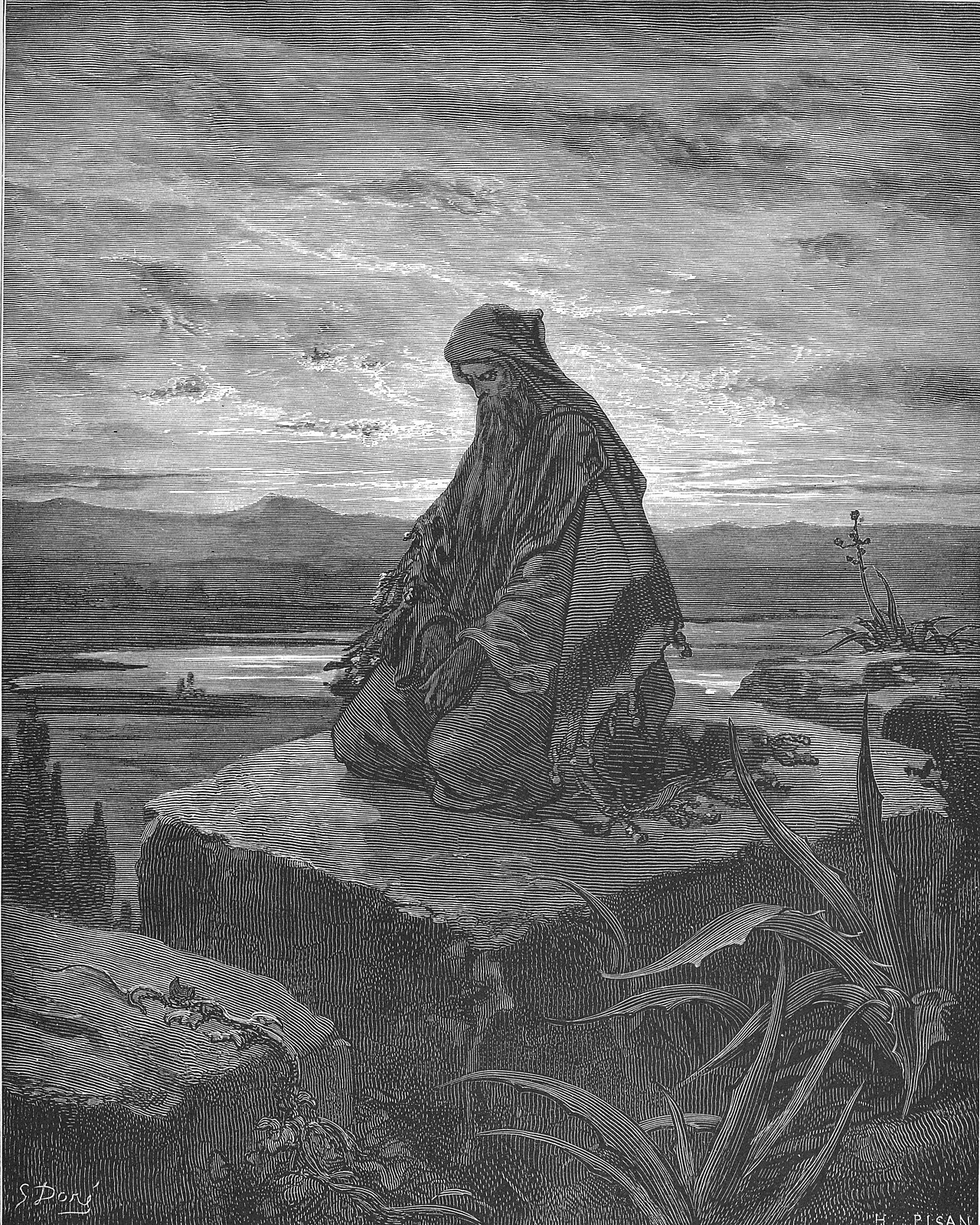
Isaiahchapter 59
21 verses · Isaiah · 8th century BC · The Prophets
He put on righteousness like a breastplate, and the helmet of salvation on His head; He put on garments of vengeance and wrapped Himself in a cloak of zeal.
Introduction
Isaiah, The Prophets, Isaiah Overview.
Isaiah wrote this for people who suspected that God had grown deaf. The chapter begins by answering that suspicion and naming the real barrier. It moves from charge to confession to a scene of the LORD arming for battle. The voice changes from the prophet to the people, who confess in their own words. Listen for the pictures of a spider's web and a blind man feeling for a wall. Listen also for what the LORD sees when He looks for someone to intervene. The chapter ends with a covenant promise for the people's descendants.
Context
- Who
- People who suspected God had gone deaf
- What
- A charge that sin has separated the people from God, their confession of it, and the LORD's coming to redeem those who turn.
- Where
- Judah and Jerusalem, with pictures from the loom, the dark street and the armoury.
- When
- Spoken about 700 to 690 BC on the site's reading, with a promise reaching into the future.
- Why
- To show that the LORD is able to save, and that when no one else could help, He acted Himself.
Historical context
The chapter answers a specific suspicion with a physical picture: the LORD's hand is not shortened that it cannot save, nor his ear heavy that it cannot hear. A short arm cannot reach, and a heavy ear cannot hear, those are the two failures being denied. The problem is a wall, and the wall is built of what they have done.
Show the rest of the historical context, 4 more paragraphs
The weaving image is the sharpest thing in the chapter. They hatch adders' eggs and weave the spider's web, and then the verdict: their webs will not become garments, nor will they cover themselves with their works. A spider's web is real weaving, fine, patterned, skilled, and completely useless as cloth. Anyone who had watched a woman at a loom understood the insult exactly.
The blindness section is a description of walking home in the dark: we grope for the wall like the blind, we grope as if we had no eyes; we stumble at noonday as in the twilight. Then the sounds, we all growl like bears and moan sadly like doves.
The confession that follows is unusual because it is in the first person plural and it is itemized: transgressing and lying against the LORD, departing from our God, speaking oppression and revolt, conceiving and uttering from the heart words of falsehood. Justice is described as standing far off, truth fallen in the street, and the man who turns away from evil making himself a target.
The last section is a soldier arming, and the pieces are named as clothing: righteousness put on like a breastplate, a helmet of salvation on his head, garments of vengeance for clothing, and zeal wrapped around him like a cloak. Paul would later hand that same armor to ordinary believers in his letter to Ephesus.
Significance
The reason God arms himself is stated in one line, and it is a devastating comment on the leadership of the day: he saw that there was no man, and wondered that there was no intercessor; therefore his own arm brought salvation.
Show the rest of the significance, 1 more paragraph
For hearers who had been waiting for someone to stand in the gap, the answer was that nobody would, and that God would not therefore abandon the case. He does it himself.
This chapter in Jewish lifeWhat this chapter is in Jewish life and reading.
What is done
The site's own table in src/lib/hebraic/readings.ts, probed for this lane, printed no weekly portion and no Haftarah from this chapter, and no festival reading for the book. That table carries the Haftarah of each of the fifty-four weekly portions and the books read whole at the feasts, and it carries nothing for the special Sabbaths or the fast days. This card therefore names no public reading of the chapter and leaves that question to a source that holds those readings.
The corpus joins the chapter to the weeks of the Torah portions through the works arranged by portion. Under the tenth verse it carries Midrash Tanchuma Buber, Beha'alotcha 5:1. Under the fifteenth verse it carries Bereshit Rabbati, Parashat Bereshit 93. Under the nineteenth verse it carries Midrash Tanchuma Buber, Bechukotai 5:1.
How it is read
Two commentators on this chapter carry English in the corpus. Rashi is quoted from The Judaica Press complete Tanach with Rashi, translated by A. J. Rosenberg, which Sefaria reports as CC-BY, and every quotation of it is held to fifty words or fewer because the translation is modern. Ibn Ezra is quoted from the version Sefaria titles Commentary of Ibn Ezra on Isaiah - trans. by M. Friedlander, 1873, which it reports as Public Domain.
Ibn Ezra reads the chapter as one part of a whole. The prophet goes on reproving those in exile, and he closes with the covenant of the twenty-first verse: "Thus all these chapters are well connected together in one whole". Rashi opens with the same answer to the exile's complaint: "Your failure to be delivered is not due to the shortness of My hand" (Ibn Ezra on Isaiah 59:1:1; Rashi on Isaiah 59:1:1).
The sins of the middle verses are read closely. The webs of the sixth verse are, for Ibn Ezra, deeds like a spider's web that do not last (Ibn Ezra on Isaiah 59:6:1). Rashi reads the justice far from us of the ninth verse as the people's own cry, that God does not judge to avenge them on their enemies (Rashi on Isaiah 59:9:1). At the twelfth verse Ibn Ezra marks the change of speaker: "The repenting Israelites are now represented by the prophet as speaking" (Ibn Ezra on Isaiah 59:12:1). The man who was not there in the sixteenth verse Rashi reads as no righteous man to stand in the breach (Rashi on Isaiah 59:16:1).
The last two verses carry two short notes of Rashi that the tradition keeps close. On the redeemer who comes to Zion: "As long as Zion is in ruins, the redeemer has not yet come". On the covenant that follows: "for even in their exile, My Torah shall not be forgotten from them" (Rashi on Isaiah 59:20:1 and 59:21:1).
What the rabbis say
The corpus carries forty rabbinic locators on this chapter and the text of none, so each is cited and linked here rather than quoted. On the first verse it holds Eikhah Rabbah 1:23, Midrash Tehillim 42:4 and Pesikta DeRav Kahana 17:2. On the second verse it holds Aggadat Bereshit 23:2, Ein Yaakov (Glick Edition), Sanhedrin 7:8, Ein Yaakov, Sanhedrin 7:21 and Mekhilta DeRabbi Yishmael, Tractate Pischa 11:21. On the third verse it holds Ein Yaakov (Glick Edition), Shabbat 20:3, Ein Yaakov, Shabbat 20:3, Pesikta Rabbati 33:1 and Shabbat 139a:10. On the eighth verse it holds Tractate Kallah Rabbati 3:4.
On the tenth verse it holds Aggadat Bereshit 70:2, Bamidbar Rabbah 15:5 and Midrash Tanchuma Buber, Beha'alotcha 5:1. On the thirteenth verse it holds Ein Yaakov (Glick Edition), Shabbat 16:9, Mekhilta DeRabbi Yishmael, Tractate Bachodesh 7:12 and Midrash Sekhel Tov, Bereshit 49:26:1. On the fourteenth verse it holds Midrash Tannaim on Deuteronomy 16:19:5. On the fifteenth verse it holds Aggadat Bereshit 1:1, Bereshit Rabbati, Parashat Bereshit 93 and Ein Yaakov (Glick Edition), Sanhedrin 11:41. On the sixteenth verse it holds Ein Yaakov (Glick Edition), Sanhedrin 11:48, Midrash Lekach Tov, Deuteronomy 32:36:1 and Midrash Tehillim 71:2.
On the seventeenth verse it holds Bava Batra 9b:1, Chagigah 12b:12 and Devarim Rabbah 2:37. On the eighteenth verse it holds Mekhilta DeRabbi Yishmael, Tractate Vayehi Beshalach 7:1, Midrash Lekach Tov on Lamentations 3:64:1 and Midrash Lekach Tov, Exodus 14:26:2. On the nineteenth verse it holds Berakhot 56b:9, Midrash Sekhel Tov, Bereshit 40:6:2 and Midrash Tanchuma Buber, Bechukotai 5:1. On the twentieth verse it holds Bereshit Rabbah 38:14, Eikhah Rabbah 1:26 and Eikhah Rabbah 1:33. On the twenty-first verse it holds Bava Metzia 85a:18, Ein Yaakov, Bava Metzia 7:9 and Midrash Lekach Tov, Genesis 25:26:3. What each of them teaches is a saying of the rabbis, and is reported as theirs wherever this site quotes one. The quotations wait on a fetch that carries the text.
Sources: Rashi, Rashi on Isaiah 59:1:1 to 59:21:1, The Judaica Press complete Tanach with Rashi, translated by A. J. Rosenberg, reported CC-BY; Ibn Ezra, Ibn Ezra on Isaiah 59:1:1 to 59:12:1, Commentary of Ibn Ezra on Isaiah - trans. by M. Friedlander, 1873, reported Public Domain; The Sefaria corpus, scripts/data/sources/sefaria/isaiah/59.json, the 40 Talmud and Midrash locators of this chapter; The site's own files, src/lib/hebraic/readings.ts, printing no portion and no Haftarah for this chapter and no festival reading for this book.
The heads below are this chapter's scenes. The numbered points under each are its verses.
Your Iniquities Have Separated You from Your God
Isaiah 59:1-2
Surely the arm of the LORD is not too short to save: The chapter opens by answering a doubt about the power of God: “Surely the arm of the LORD is not too short to save”. The fault lies in the relationship: “your iniquities have built barriers between you and your God”. The charge is laid on the people's sin.
Isaiah 59:1
“Behold, the Lord’s hand is not shortened - On the meaning of this phrase, see the notes at Isa 50:2. Neither his ear heavy, that it cannot hear - On the meaning of this phrase, see the notes at Isa 6:10.”
1 more voice on this verseWhat preachers and commentators have said about this verse, in their own words.
Isaiah 59:1
“Behold, the hand of Jehovah is not shortened. This discourse closely resembles the preceding one; for, after having torn off the mask from hypocrites, who vainly boasted of themselves, and after having shown that the punishment inflicted on them was just, he now replies to other objections. Hypocrites are wont to accuse God either of weakness or of excessive severity.”
John Calvin · Commentaries (1554)reformed
your iniquities have built barriers between you: Barnes gives the Hebrew verb as badal, used for the veil that divided the holy place from the Most Holy Place in Exodus 26:33. Chrysostom hears the same barrier in the dividing wall of Ephesians 2:14. Sin and iniquity cut off Jew and Gentile alike from God.
Isaiah 59:2
“His face - For פנים panim, faces, I read panaiv, his face. So the Syriac, Septuagint, Alexandrian, Arabic, and Vulgate. פני panai, MS. Forte legendum פני panai, nam מ mem, sequitur, et loquitur Deus; confer cap. Isa 58:14. “We should perhaps read פני panai; for מ mem follows, and God is the speaker.” - Secker. I rather think that the speech of God was closed with the last chapter, and that this chapter is delivered in the person of the prophet. - L.”
Adam Clarke · Commentary on the Bible (1810-1826)evangelical
1 more voice on this verse
Isaiah 59:2
“Hence we infer that our sins alone deprive us of the grace of God, and cause separation between us and him; for what the Prophet testifies as to the men of his time is applicable to all ages; since he pleads the cause of God, against the slanders of wicked men.”
John Calvin · Commentaries (1554)reformed
Isaiah 59:3-4
For your hands are stained with blood: The charge runs through the body given to sin: “your lips have spoken lies, and your tongue mutters injustice”. Verse 4 widens it to the courts: “No one calls for justice”. A system meant to correct wrong does the opposite, for “they conceive mischief and give birth to iniquity”.
Isaiah 59:3
“For your hands are defiled with blood - The prophet proceeds here more particularly to specify the sins of which they were guilty; and in order to show the extent and depth of their depravity, he specifies the various members of the body - the hands, the fingers, the lips, the tongue, the feet as the agents by which people commit iniquity. See a similar argument on the subject of depravity in Rom 3:13-15, where a part of the description which the prophet here gives is quoted by Paul, and applied to the Jews in his own time.”
1 more voice on this verse
Isaiah 59:3
“For your hands are defiled with blood, and your fingers with iniquity,.... From a general charge, the prophet proceeds to a particular enumeration of sins they were guilty of; and idolatry not being mentioned, as Jerom observes, shows that the prophecy belongs to other times than Isaiah's, when that sin greatly prevailed.”
No one calls for justice: Barnes and Jamieson, Fausset & Brown read calls for justice as the bringing of a lawsuit, and Barnes finds suits filed to injure a neighbour. Clarke explains the closing image as a mischief conceived in the mind and given birth in word or deed. Henry sets it beside James 1:15.
Isaiah 59:4
“They conceive mischief, and bring forth iniquity - There is a curious propriety in this mode of expression; a thought or purpose is compared to conception; a word or act, which is the consequence of it, to the birth of a child. From the third to the fifteenth verse inclusive may be considered a true statement of the then moral state of the Jewish people; and that they were, in the most proper sense of the word, guilty of the iniquities with which they are charged.”
Adam Clarke · Commentary on the Bible (1810-1826)evangelical
2 more voices on this verse
Isaiah 59:4
Now those who meditate evil, we say, do not [think] truth but falsehood, and not righteousness but iniquity, for their tongue learns to speak lies. They have done evil and have not ceased that they might repent. For, persevering with delight in wicked actions, they hasten thereto without turning back, even treading under foot the commandment with regard to neighbors, and instead of loving them, they devise evil against them, as the saint testifies, saying, "And those who seek my evil have spoken vanity and imagined deceit all the day."
Athanasius of Alexandria · written before 373 · Festal Letters 11:4patristic
Isaiah 59:4
“Though it is in pain perhaps that the iniquity is brought forth, through the oppositions of Providences and the checks of their own consciences, yet, when they have compassed their wicked purpose, they look upon it with as much pride and pleasure as if it were a man-child born into the world; thus, when lust has conceived, it bringeth forth sin, Jam. i.”
Matthew Henry · Commentary on the Whole Bible (1707-1721)puritan
Isaiah 59:5-6
They hatch the eggs of vipers and weave a spider’s web: “They hatch the eggs of vipers and weave a spider’s web” pairs two works that look purposeful and yield only harm. Verse 6 draws the lesson: “Their cobwebs cannot be made into clothing, and they cannot cover themselves with their works”. Work built on iniquity gives no covering.
Isaiah 59:5
“They hatch cockatrice’ eggs - Margin, ‘Adders’.’ On the meaning of the word rendered here ‘cockatrice,’ see the notes at Isa 11:8. Some poisonous serpent is intended, probably the adder, or the serpent known among the Greeks as the basilisk, or cerastes. This figurative expression is designed to show the evil nature and tendency of their works. They were as if they should carefully nourish the eggs of a venomous serpent. Instead of crushing them with the foot and destroying them, they took pains to hatch them, and produce a venomous race of reptiles.”
1 more voice on this verse
Isaiah 59:5
“Though the viper is viviparous (from which "vi-per" is derived), yet during gestation, the young are included in eggs, which break at the birth [BOCHART]; however, metaphors often combine things without representing everything to the life.”
Jamieson, Fausset & Brown · Commentary Critical and Explanatory on the Whole Bible (1871)reformed
Their cobwebs cannot be made into clothing: Henry reads the verse as a ledger of profit and loss, their deeds wounding the innocent and bringing nothing to the doers. Barnes likens their vain formality and false opinions to a spider's web, as useless for salvation as cobwebs for clothing. Aquinas makes the webs their counsels.
Isaiah 59:6
“Their webs shall not become garments - The spider’s web is unfit for clothing; and the idea here is, that their works are as unfit to secure salvation as the attenuated web of a spider is for raiment. The sense is, says Vitringa, that their artificial sophisms avail nothing in producing true wisdom, piety, virtue, and religion, or the true righteousness and salvation of people, but are airy speculations. The works of the self-righteous and the wicked; their vain formality, their false opinions, their subtle reasonings, and their traditions, are like the web of the spider.”
Isaiah 59:7-8
Their feet run to evil: “Their feet run to evil; they are swift to shed innocent blood”, and “The way of peace they have not known”. Paul gathers these lines at Romans 3:15-17 into his list of universal sin. The paths they made are “crooked paths; no one who treads on them will know peace”.
Isaiah 59:7
“Their feet run to evil - In accordance with the design of the prophet to show the entireness of their depravity, he states that all their members were employed in doing evil. In Isa 59:3-6. he had remarked that depravity had extended to their hands, their fingers, their lips, and their tongue; he here states that their feet also were employed in doing evil. Instead of treading the paths of righteousness, and hastening to execute purposes of mercy and justice, they were employed in journeyings to execute plans of iniquity.”
Cross references
Isaiah 59:7
- Quoted inRomans 3:15“Their feet are swift to shed blood;
'Their feet are swift to shed blood' (sin catena)
ConnectionsRomans 3:15
They have turned them into crooked paths: Barnes and Jamieson, Fausset & Brown take the way of peace in every direction at once, peace with God, with conscience and with neighbours. Aquinas notes the justice in the outcome. Those who denied others peace find none on their own paths.
Isaiah 59:8
“Whosoever goeth therein shall not know peace “Whoever goeth in them knoweth not peace” - For בה bah, singular, read בם bam, plural, with the Septuagint, Syriac, Vulgate, and Chaldee. The ה he is upon a rasure in one MS. Or, for נתיבתיהם nethibotheyhem, plural, we must read נתיבתם nethibatham, singular, as it is in an ancient MS., to preserve the grammatical concord. - L.”
Adam Clarke · Commentary on the Bible (1810-1826)evangelical
1 more voice on this verse
Isaiah 59:8
“There is no judgment in their goings; they have not any sense of justice in their dealings; it is a thing they make no account of at all, but can easily break through all its fences if they stand in the way of their malicious covetous designs.”
Matthew Henry · Commentary on the Whole Bible (1707-1721)puritan
We Grope for the Wall Like the Blind at Noonday
Isaiah 59:9-11
Therefore justice is far from us: The charge becomes confession: “We hope for light, but there is darkness”. The pictures turn to bodily helplessness: “Like the blind, we feel our way along the wall”. Jamieson, Fausset and Brown mark the shift from you to we as the point where the oracle becomes a shared confession.
Isaiah 59:9
“Therefore is judgment far from us - This is the confession of the people that they were suffering not unjustly on account of their crimes. The word ‘judgment’ here is evidently to be taken in the sense of vengeance or vindication. The idea is this, ‘we are subjected to calamities and to oppressions by our enemies.”
among the vigorous we are like the dead: Barnes and Jamieson, Fausset & Brown hear the curse of Deuteronomy 28:29 fulfilled here, where the disobedient grope at midday like the blind. Jamieson, Fausset & Brown read the Hebrew behind the vigorous as fat or fertile places, a match for midday. Relief should come at midday, and darkness remains.
Isaiah 59:10
“We stumble at noon day as in the night “We stumble at mid-day, as in the twilight” - I adopt here an emendation of Houbigant, נשגגה nishgegah, instead of the second, נגששה negasheshah, the repetition of which has a poverty and inelegance extremely unworthy of the prophet, and unlike his manner. The mistake is of long standing, being prior to all the ancient versions. It was a very easy and obvious mistake, and I have little doubt of our having recovered the true reading in this ingenious correction.”
Adam Clarke · Commentary on the Bible (1810-1826)evangelical
We all growl like bears: Barnes gives the Hebrew verb for growl as hamah, used of a snarling dog, cooing doves and roaring waves. Henry and Gill hear loud grief and silent grief. Jamieson, Fausset & Brown call the far-off salvation retribution in kind for the destruction in their paths in verse 7.
Isaiah 59:12-13
For our transgressions are multiplied before You: “For our transgressions are multiplied before You, and our sins testify against us” moves the confession from feeling to counting. Verse 13 traces the sins to their root: “rebelling and denying the LORD”. The list runs from deed to word to thought, and it ends in the heart.
Isaiah 59:12
“Our sins testify against us - Hebrew, ‘Answer against us.’ The idea is, that their past lives had been so depraved that they became witnesses against them (compare the notes at Isa 3:9). We know them - We recognize them as our sins, and we cannot conceal from ourselves the fact that we are transgressors.”
turning away from our God: Barnes reads denying the LORD as a people who professed to be his while their hearts served idols. Wesley notes that their fraud against men came from the heart, while their worship of God came only from the lips. Henry notes the righteous few joined the confession too.
Isaiah 59:13
“Uttering - That is, first contriving in their heart false accusations, false worship to the dishonour of God; laying the contrivances and uttering them. From the heart - And when they dealt with men in ways of fraud, it was from the heart, but when they spake with God it was but from the lip.”
John Wesley · Explanatory Notes upon the Old Testament (1765)evangelical
Isaiah 59:14-15
So justice is turned away: “For truth has stumbled in the public square, and honesty cannot enter” pictures the place of judgment, where elders once heard cases, emptied of truth. “So justice is turned away, and righteousness stands at a distance”, and the reward is reversed: “whoever turns from evil becomes prey”.
Isaiah 59:14
“And judgment is turned away backward, and justice standeth afar off,.... Jarchi interprets this of the vengeance of God, and his righteousness in his judgments, not immediately executed; but it is to be understood of the want of judgment and justice being done among men; and therefore are represented as persons turned back, and standing afar off, rejected, neglected, and discouraged.”
1 more voice on this verse
Isaiah 59:14
“Justice standeth afar off - צדקה tsedakah, righteousness, put here, says Kimchi, for alms to the poor. This casts some light on Mat 6:1: “Take heed that you do not your alms,” ελεημοσυνην. But the best copies have δικαιοσυνην, righteousness; the former having been inserted in the text at first merely as the explanation of the genuine and original word.”
Adam Clarke · Commentary on the Bible (1810-1826)evangelical
whoever turns from evil becomes prey: Barnes gives the Hebrew for missing as adar, the word for what is left behind or lacking in 1 Samuel 30:19. Wesley records another rendering of prey, mocked as mad. Jamieson, Fausset & Brown see in the LORD's displeasure an evil so deep that only God himself could mend it.
Isaiah 59:15
“Faileth - All things are amiss, neither judgment or justice, or truth, is to be found among us. A prey - Or, as some render it, is accounted mad, is laughed at.”
John Wesley · Explanatory Notes upon the Old Testament (1765)evangelical
1 more voice on this verse
Isaiah 59:15
“Yea, truth faileth - That is, it is not to be found, it is missing. The word used here (from עדר ‛âdar) means “to be left, to remain” 2Sa 17:22; then “to be missing or lacking” 1Sa 30:19; Isa 40:26. Here it means that truth had no existence there.”
He Put On Righteousness as a Breastplate; a Redeemer Comes to Zion
He saw that there was no man: “He saw that there was no man” is the hinge of the chapter, the LORD looking for someone to stand between His people and judgment. Finding none, He acts alone: “So His own arm brought salvation”, the arm verse 1 said is not too short. Isaiah 63:5 repeats the words.
Isaiah 59:16
“And wondered that there was no intercessor - This and the following verses some of the most eminent rabbins understand as spoken of the Messiah. Kimchi says that Rabbi Joshua ben Levi proposes this objection: “It is written, ‘Behold, he will come in the clouds of heaven as the son of man,’ Dan 7:13; and elsewhere it is written, ‘He cometh lowly, and riding upon an ass,’ Zec 9:9. How can these texts be reconciled?”
Adam Clarke · Commentary on the Bible (1810-1826)evangelical
He put on righteousness like a breastplate: With no one to intercede, the LORD arms Himself: “He put on righteousness like a breastplate, and the helmet of salvation on His head”. Paul draws on this verse for the armor, the breastplate of righteousness at Ephesians 6:14 and the helmet of salvation at 1 Thessalonians 5:8.
Isaiah 59:17
“For he put on righteousness - That is, God the Redeemer. The prophet here introduces him as going forth to vindicate his people clad like an ancient warrior. In the declaration that he ‘put on righteousness,’ the essential idea is, that he was pure and holy. The same image is used by the prophet in another figure in Isa 11:5 (see the note at that place). As a breastplate - The breastplate was a well-known piece of ancient armor, designed to defend the breast from the darts and the sword of an enemy.”
1 more voice on this verse
Isaiah 59:17
“Zeal - For his own honour, and for his own people. The sum of all these expressions is, to describe both the cause and effect together; the cause was righteousness and zeal in God, the effect, salvation to his people, and vengeance on his enemies.”
John Wesley · Explanatory Notes upon the Old Testament (1765)evangelical
ConnectionsEphesians 6:14
Isaiah 59:18-19
So He will repay according to their deeds: “So He will repay according to their deeds”, and the reach is as wide as the offense. Verse 19 carries the same reach west and east: “So shall they fear the name of the LORD where the sun sets”. He comes “like a raging flood”.
Isaiah 59:18
“According to their deeds, accordingly he will repay “He is mighty to recompense; he that is mighty to recompense will requite” - The former part of this verse, as it stands at present in the Hebrew text, seems to me to be very imperfect, and absolutely unintelligible. The learned Vitringa has taken a great deal of pains upon it after Cocceius, who he says is the only one of all the interpreters, ancient or modern, who has at all understood it, and has opened the way for him.”
Adam Clarke · Commentary on the Bible (1810-1826)evangelical
He will come like a raging flood: Jerome's text matches the Berean, the one who comes driven like a river, and Henry reports readers who took it as a narrow river. Barnes notes that the older English rendering, where the LORD's Spirit lifts a standard, departs from every ancient version. Spurgeon calls the Hebrew hard to interpret.
Isaiah 59:19
“Some read it, He shall come (the name of the Lord, and his glory, before foreseen of the Messiah promised) like a straight river, the Spirit of the Lord lifting him up for an ensign. Christ by the preaching of his gospel shall cover the earth with the knowledge of God as with the waters of a flood, the Spirit of the Lord setting up Christ as a standard to the Gentiles, ch. xi.”
Matthew Henry · Commentary on the Whole Bible (1707-1721)puritan
1 more voice on this verse
Isaiah 59:19
“His glory - The glorious God. The rising of the sun - The eastern parts. When - At what time soever the devil, or his instruments shall make violent irruptions upon the church.”
John Wesley · Explanatory Notes upon the Old Testament (1765)evangelical
Paul quotes “The Redeemer will come to Zion” at Romans 11:26 for his words that all Israel will be saved, joined there with Isaiah 27:9. The verse names Jacob as the one to whom the Redeemer comes. His citation treats the promise as still standing when he wrote Romans.
Isaiah 59:20
Unto them that turn from transgression in Jacob “And shall turn away iniquity from Jacob” - So the Septuagint and St. Paul, Rom 11:26, reading instead of לשבי leshabey and ביעקב beyaacob, והשיב veheshib and מיעקב meyaacob. The Syriac likewise reads והשיב veheshib; and the Chaldee, to the same sense, ולהשיב ulehashib. Our translators have expressed the sense of the present reading of the Hebrew text: “And unto them that turn from transgression in Jacob.”
Adam Clarke · Commentary on the Bible (1810-1826)evangelical
2 more voices on this verse
Isaiah 59:20
“The Redeemer - Christ, of whom the apostle expounds it, Rom. xi, 26, the prophets usually concluding their promises of temporal deliverances with the promises of spiritual, especially such, of which the temporal were evident types.”
John Wesley · Explanatory Notes upon the Old Testament (1765)evangelical
Isaiah 59:20
“The Septuagint translates "for the sake of Zion." Paul applies this verse to the coming restoration of Israel spiritually. them that turn from-- (Ro 11:26). "shall turn away ungodliness from Jacob"; so the Septuagint, Paul herein gives the full sense under inspiration.”
Jamieson, Fausset & Brown · Commentary Critical and Explanatory on the Whole Bible (1871)reformed
Cross references
Isaiah 59:20
- Quoted inRomans 11:26“And so all Israel will be saved, as it is written: “The Deliverer will come from Zion; He will remove godlessness from Jacob.”
'There shall come out of Sion the Deliverer' ('as it is written')
ConnectionsRomans 11:26
“As for Me, this is My covenant with them” makes the promise permanent, for “My Spirit will not depart from you”. The covenant binds Spirit and word across three generations, “your children and grandchildren”. Henry takes it as spoken to the prophetic office and through it to the nation.
Isaiah 59:21
“My covenant - What I have promised, to them that turn from their iniquity. My words - Which thou hast uttered by virtue of my spirit. Of thy seed - A promise of the perpetual presence of his word and spirit with the prophets, apostles, and teachers of the church to all ages.”
John Wesley · Explanatory Notes upon the Old Testament (1765)evangelical
1 more voice on this verse
Isaiah 59:21
“This covenant is here said to be made with them, that is, with those that turn from transgression; for those that cease to do evil shall be taught to do well. But the promise is made to a single person-- My Spirit that is upon thee, being directed either, [1.] To Christ as the head of the church, who received that he might give.”
Matthew Henry · Commentary on the Whole Bible (1707-1721)puritan
Keep studying
People and groups1
Places1
Words12
Subjects1
Sources for this chapter
The summary
Jamieson, Fausset & Brown, Commentary Critical and Explanatory; John Calvin, Commentaries; John Wesley, Notes on the Old Testament and Matthew Henry, Complete Commentary.
The exposition
Adam Clarke, Commentary on the Bible; Albert Barnes; Charles Spurgeon, The Metropolitan Tabernacle Pulpit, Sermon No. 718: “The Standard Uplifted In The Face Of The Foe” (lightly modernized text, CCEL edition); Franz Delitzsch, Biblical Commentary on the Prophecies of Isaiah; Jamieson, Fausset & Brown, Commentary Critical and Explanatory on the Whole Bible; Jamieson, Fausset and Brown, Commentary Critical and Explanatory on the Whole Bible; Jerome, Commentary on Isaiah; John Calvin, Commentary on the Book of the Prophet Isaiah; John Chrysostom, HOMILIES ON EPHESIANS 5; John Gill; John Wesley, Explanatory Notes upon the Old Testament; Matthew Henry, Commentary on the Whole Bible and Thomas Aquinas, Commentary on Isaiah.