
Genesischapter 11
32 verses · Moses, by tradition · 15th to 13th century BC · The Law
In Jewish life
The reading
Weekly portion 2 of 54
נֹחַ Noach, Genesis 6:9 to 11:32
Read with it: Isaiah 54:1 to 55:5 in Ashkenazi use, and Isaiah 54:1 to 54:10 in Sephardi use.
The verse numbers here are the ones a Hebrew Bible carries, which differ from an English Bible by a verse or two in several places. The Sephardi reading is named only where this site records a difference; communities vary beyond what is listed. What these books are, and how a Christian reader meets them →
What is done
This chapter closes the second portion of the annual cycle, and the portion ends with its last verse (src/lib/hebraic/readings.ts). A congregation hears the tower, the line of Shem and the death of Terah as the end of one Sabbath's reading. The call of Abram opens the next portion on the Sabbath after it. The card above carries the portion and the prophetic reading set beside it.
How it is read
Rashi is quoted here from the public domain Rosenbaum and Silbermann edition. Radak and Sforno are quoted from the CC-BY translation of Eliyahu Munk, HaChut Hameshulash.
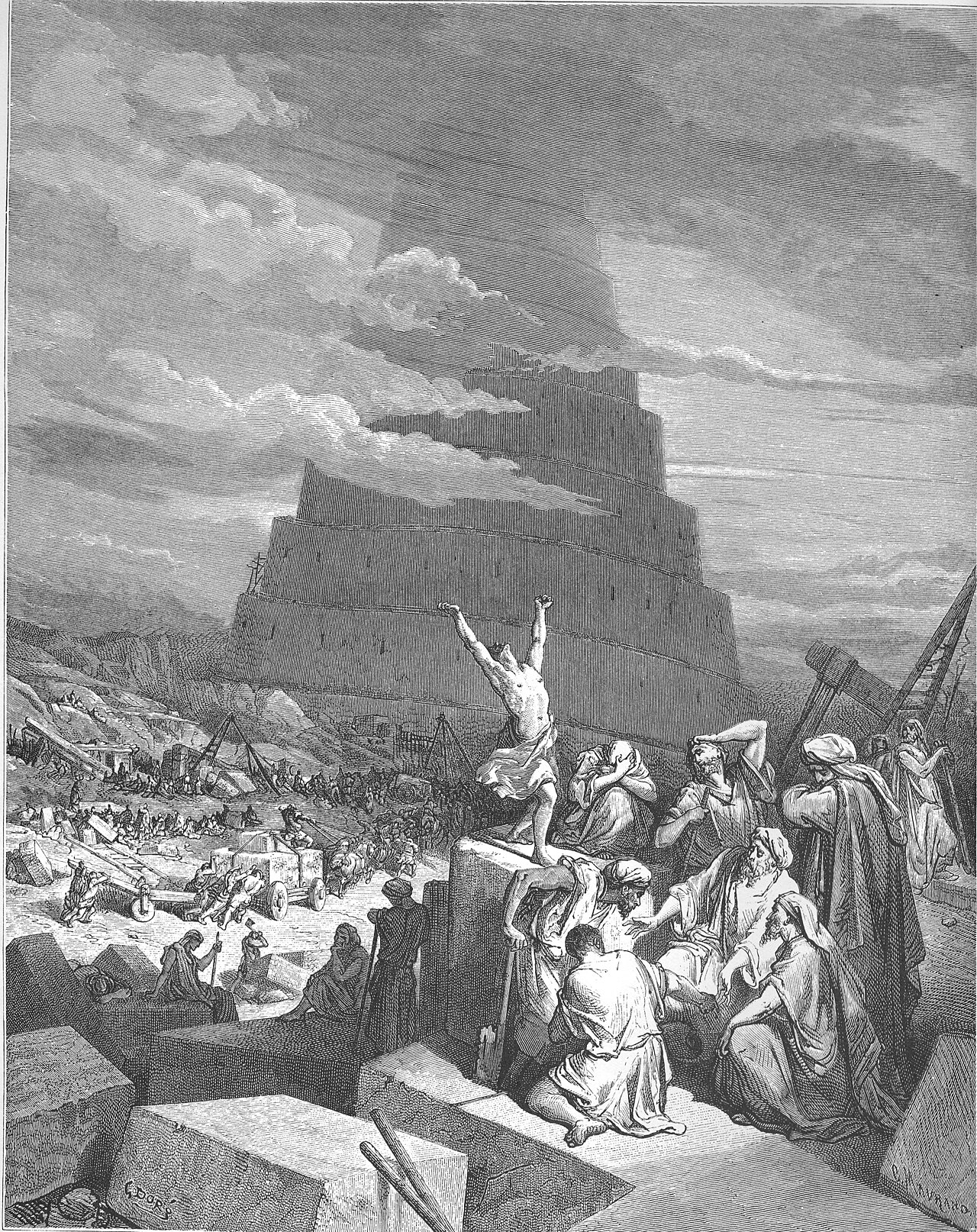
Rashi reads the one language of the first verse as Hebrew (Rashi on Genesis 11:1:1, citing Midrash Tanchuma, Noach 19). On the one speech he gives three readings of the plan the builders made. The first is open war on heaven. The second turns the words toward the One in the universe. The third takes the word as sharp speech. The builders reckoned that the sky shook once in every one thousand six hundred and fifty six years, and set out to prop it up (Rashi on Genesis 11:1:2).
He reads the coming down of God in the fifth verse as a lesson for judges rather than a need of God. A judge is to see the case and understand it before he calls a defendant guilty (Rashi on Genesis 11:5:1). On the plural of the seventh verse he answers as he answered at the making of man. God took counsel with the court of heaven out of His meekness (Rashi on Genesis 11:7:1, citing Sanhedrin 38b). A Christian reader takes that plural as a word spoken within God, and the two readings are named here with their holders.
Sforno reads the line of Shem by what the text leaves out. The chapter records no death for these generations, where the generations before the flood each ended with one, because this line runs toward something rather than toward an ending (Sforno on Genesis 11:11:1). Radak reads the generations of Terah as proof that grandsons are counted as offspring (Radak on Genesis 11:27:1). On the thirtieth verse he holds that the barrenness is stated so plainly to mark the birth of Isaac as a miracle twice over, in the bearing and in the age (Radak on Genesis 11:30:1).
Ibn Ezra carries three comments on this chapter that the corpus holds by reference alone, because the licence Sefaria reports for the English version keeps the text out. They are Ibn Ezra on Genesis 11:2:1, 11:4:1 and 11:26:1.
What the rabbis say
Rashi carries the best known traditional insights of this chapter, and each stands here as what the rabbis taught.
The builders feared being scattered. Rashi reports that the thing they feared came on them, in the words of Proverbs 10:24 (Rashi on Genesis 11:8:1, citing Sanhedrin 107b and Midrash Tanchuma, Noach 18). He reports the ruling that the generation of the dispersion has no portion in the world to come (Rashi on Genesis 11:9:1, citing Sanhedrin 107b). He then reports the question the rabbis asked beside it. The generation of the flood was drowned although it never stretched out a hand against God, and this generation did so and lived on. The answer given is that the men of the flood were robbers who quarrelled among themselves.
The insight this chapter is best known for is the furnace at Ur. Rashi reports the Midrash that Terah accused his son Abram before Nimrod of smashing his idols, and that Nimrod threw Abram into a fiery furnace. Haran waited to see the end, saying that he would side with whoever won. When Abram came out alive Haran said he was on the side of Abram, and they threw Haran into the furnace and he was burned (Rashi on Genesis 11:28:1, citing Genesis Rabbah 38:13). This is why the text says he died in the presence of his father.
On the names of the twenty ninth verse Rashi reports that Iscah is Sarah. She was called Iscah because "she could see the future by holy inspiration", and because people looked at her beauty (Rashi on Genesis 11:29:1, citing Megillah 14a). He reports that the death of Terah is written before the departure of Abram although Terah lived sixty years beyond it (Rashi on Genesis 11:32:1).
The corpus records forty places where the Midrash and the Talmud cite this chapter, thirty four under Midrash and six under Talmud, with the locator for each one and no text. Bereshit Rabbah reads the second verse at 38:7, the third at 38:8, the sixth at 26:4, the seventh at 38:10 and the ninth at 38:11. It reads the tenth verse at 37:7, the twelfth at 24:3, the fifteenth at 58:7 and the twenty sixth at 39:7. It reads the twenty seventh verse at 30:4 and 38:12, the twenty eighth at 38:13 and the twenty ninth at 38:14 and 45:1.
Bamidbar Rabbah reads the fourth verse at 21:23, the tenth at 2:21, the twenty sixth at 14:12, the twenty eighth at 2:26 and the thirtieth at 9:10. Aggadat Bereshit reads the fifth verse at 16:1, the eighth at 8:3 and the thirtieth at 53:3. Eikhah Rabbah reads the second verse at Petichta 23, Seder Olam Rabbah reads the seventeenth at 2:2, and the Mekhilta of Rabbi Yishmael reads the sixth at Tractate Shirah 5:9.
The Talmud is cited at Avodah Zarah 53b:13 on the first nine verses, at Avodah Zarah 19a:1 on the fourth and at Bava Batra 91a:16 on the thirty first. Avot DeRabbi Natan is cited at 12:7 on the tower as a whole and at 34:6 on the fifth verse, and its second recension at 37:1 on the seventh.
The text, verse by verse
Each word shows the Hebrew, the English under it, how it sounds and its Strong’s number. A rule between verses marks where the Hebrew manuscripts end a paragraph.
A Tower with Its Top in Heaven
Ibn Ezra on Genesis 11:1
When the word one in the feminine is in the absolute it is vocalized with a segol beneath the alef ( echat ).
Read it in full at Sefaria · Ibn Ezra's commentary on the Pentateuch, tran. and annot. by H. Norman Strickman and Arthur M. Silver. Menorah Pub., 1988-2004
Ramban on Genesis 11:2
Rashi comments: “They journeyed from where they were then dwelling, as it is written above, And their dwelling was from Mesha, as thou goest toward Sephar, unto the mountain of the east. 333 Above,:30.
Read it in full at Sefaria · Commentary on the Torah by Ramban (Nachmanides). Translated and annotated by Charles B. Chavel. New York, Shilo Pub. House, 1971-1976
From Shem Down to Abram
Ibn Ezra on Genesis 11:26
[AND BEGOT ABRAM.] Abraham was born in a place called Ur of the Chaldees.
Read it in full at Sefaria · Ibn Ezra's commentary on the Pentateuch, tran. and annot. by H. Norman Strickman and Arthur M. Silver. Menorah Pub., 1988-2004
Terah Leaves Ur for Haran
Hebrew words in this chapter
The 40 most used Hebrew words of the chapter, counted by lemma. The article, the object marker, the negatives and the common prepositions are left out.
| Word | Sense here | Uses | Strong’s |
|---|---|---|---|
| יָלַדyâlad | and he fathered | 27 | H3205 |
| שָׁנֶהshâneh | year | 26 | H8141 |
| חָיָהchâyâh | and he lived | 16 | H2421 |
| בֵּןbên | son | 15 | H1121 |
| מֵאָהmêʼâh | hundred | 10 | H3967 |
| בַּתbath | daughter | 9 | H1323 |
| תֶּרַחTerach | Terah | 9 | H8646 |
| אֶרֶץʼerets | land | 8 | H776 |
| נָחוֹרNâchôwr | Nahor | 8 | H5152 |
| שְׁלוֹשִׁיםshᵉlôwshîym | thirty | 7 | H7970 |
| שָׁםshâm | there | 6 | H8033 |
| אַבְרָםʼAbrâm | Abram | 6 | H87 |
| הָרָןHârân | Haran | 6 | H2039 |
| שָׂפָהsâphâh | language | 5 | H8193 |
| יְהֹוָהYᵉhôvâh | yahweh | 5 | H3068 |
| אֶחָדʼechâd | one | 4 | H259 |
| שֵׁםshêm | name | 4 | H8034 |
| פָּנִיםpânîym | face | 4 | H6440 |
| אַרְפַּכְשַׁדʼArpakshad | arphaxad | 4 | H775 |
| שֶׁלַחShelach | Shelah | 4 | H7974 |
| Word | Sense here | Uses | Strong’s |
|---|---|---|---|
| אַרְבַּעʼarbaʻ | four | 4 | H702 |
| עֵבֵרʻÊbêr | Eber | 4 | H5677 |
| פֶּלֶגPeleg | Peleg | 4 | H6389 |
| רְעוּRᵉʻûw | Reu | 4 | H7466 |
| שְׂרוּגSᵉrûwg | Serug | 4 | H8286 |
| אִשָּׁהʼishshâh | wives | 4 | H802 |
| אָמַרʼâmar | and they said | 3 | H559 |
| יָהַבyâhab | to give | 3 | H3051 |
| בָּנָהbânâh | to build | 3 | H1129 |
| עִירʻîyr | a city | 3 | H5892 |
| עָשָׂהʻâsâh | to make | 3 | H6213 |
| פּוּץpûwts | to scatter | 3 | H6327 |
| שֵׁםShêm | Shem | 3 | H8035 |
| חָמֵשׁchâmêsh | five | 3 | H2568 |
| תֵּשַׁעtêshaʻ | nine | 3 | H8672 |
| אָבʼâb | father | 3 | H1 |
| שָׂרַיSâray | Sarai | 3 | H8297 |
| יָשַׁבyâshab | and they dwelt | 2 | H3427 |
| אִישׁʼîysh | each | 2 | H376 |
| רֵעַrêaʻ | neighbor | 2 | H7453 |
Keep studying
Studies8
Sources for this chapter
The Hebrew text
STEP Bible, the tagged Hebrew text and its English glosses and James Strong, Strong's Exhaustive Concordance.
In Jewish life
Rashi, Rashi on Genesis 11, in Pentateuch with Rashi's commentary by M. Rosenbaum and A. M. Silbermann, 1929 to 1934, public domain; Radak, Radak on Genesis 11:27:1 and 11:30:1, in HaChut Hameshulash, translated by Eliyahu Munk, CC-BY; Sforno, Sforno on Genesis 11:11:1, in HaChut Hameshulash, translated by Eliyahu Munk, CC-BY; Ibn Ezra, his three comments on Genesis 11, cited by reference; the licence Sefaria reports for the English version keeps the text out of the corpus; The Midrash and the Talmud, the forty locators on Genesis 11 in scripts/data/sources/sefaria/genesis/11.json and MannaFest, the annual cycle table at src/lib/hebraic/readings.ts.
The rabbinic texts
Ramban, Commentary on the Torah by Ramban (Nachmanides). Translated and annotated by Charles B. Chavel. New York, Shilo Pub. House, 1971-1976; Ibn Ezra, Ibn Ezra's commentary on the Pentateuch, tran. and annot. by H. Norman Strickman and Arthur M. Silver. Menorah Pub., 1988-2004 and Sefaria, texts and citation data.