
Danielchapter 1
21 verses · KJVDaniel book hub →
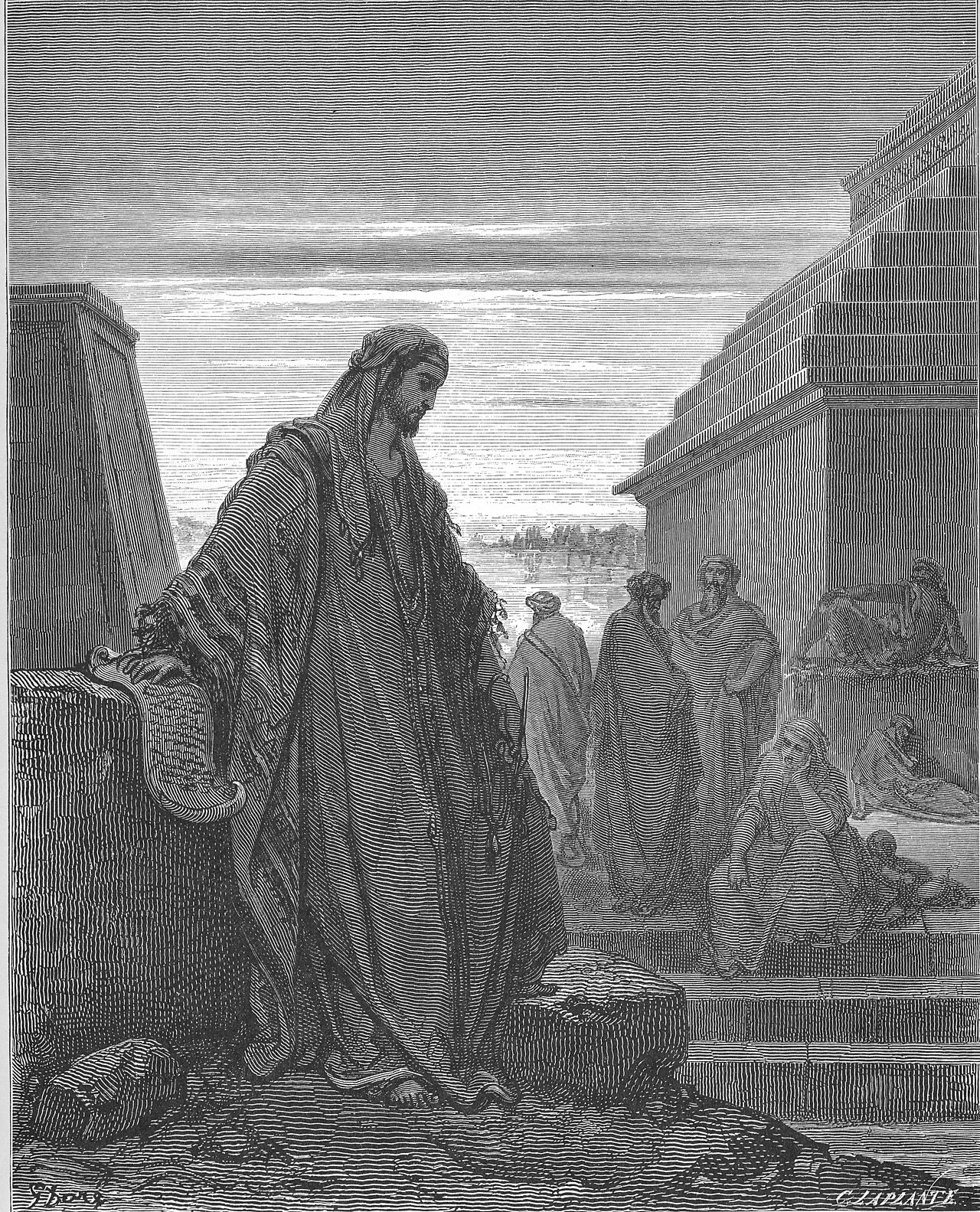
Daniel among the Exiles, Gustave Doré, Doré's English Bible (1866), public domain
Key verse
In the third year of the reign of Jehoiakim king of Judah came Nebuchadnezzar king of Babylon unto Jerusalem, and besieged it.
It stands in Carried to Babylon and given new names, verses 1 to 7.
The chapter
Chapter summary
Nebuchadnezzar besieges Jerusalem and carries off both temple vessels and promising youths, to be taught the learning and the tongue of the Chaldeans. Four are renamed for Babylonian gods (Daniel, Hananiah, Mishael and Azariah becoming Belteshazzar, Shadrach, Meshach and Abed-nego) and the renaming is not resisted. The food is. 'But Daniel purposed in his heart that he would not defile himself with the king's dainties,' and asks a ten-day trial of vegetables and water; at its end their countenances are fairer than all who ate the royal portion. God gives the four knowledge and skill, and Daniel understanding in all visions and dreams; the king finds them ten times better than all his magicians.
Context
Prophecy · Daniel · Daniel overview
Where the chapter sits
Daniel 1 falls in Court narratives (chapters 1–6). The exile to Babylon; the king's dream of the statue (2); the fiery furnace (3); Nebuchadnezzar's madness and restoration (4); Belshazzar's feast (5); the lions' den (6).
The exile and the diet. Four Hebrew youths at Nebuchadnezzar's court; the ten-day test.
After it: Apocalyptic visions, chapters 7–12.
The whole shape of Daniel→The world behind this chapter
Daniel 1The history
In 605 BC Babylon's crown prince Nebuchadnezzar smashed Egypt's army at Carchemish and inherited the whole corridor of land from the Euphrates down to the Egyptian border. Judah came with it. Nebuchadnezzar took a first group of hostages from Jerusalem, not laborers, but boys from the royal and noble families. Daniel was one of them.
The rest of the history, and what it meant to them
Taking the sons of a conquered king's court was standard empire management. Raise them in your capital, teach them your language, feed them from your kitchen, and in twenty years you have loyal administrators who know the home country from the inside. Assyria had done it before Babylon; Persia would do it after.
The curriculum named here is real: "the learning and the tongue of the Chaldeans." That meant cuneiform, which took years to master, the sign lists, the omen collections, the astronomical diaries, the legal and medical texts. Thousands of these tablets have been dug up, so we know exactly what these boys were being made to read.
The name changes were part of the erasing. Daniel means "God is my judge"; Belteshazzar points to Bel, Babylon's own god. Hananiah, Mishael, and Azariah all carry the name of Israel's God inside them; Shadrach, Meshach, and Abednego do not. The empire was renaming them into itself.
The food is where they drew the line. Royal rations were a privilege, palace records list exactly who got meat, oil, and wine from the king's table, and a ration tablet from Babylon even names King Jehoiachin of Judah among the recipients. Refusing that table was refusing a favor, in public, in front of the man responsible for their heads.
What it meant to them
For a Jewish reader this chapter answers the first question exile raises: is it over? The temple was still standing, but the best of Judah's next generation was now being trained to serve the empire that would burn it.
The answer here is quiet and stubborn. They learn the Chaldean books. They wear the Babylonian names. They serve the Babylonian king. But they decide in advance what they will not eat, and God gives them favor and understanding inside the very system built to absorb them. Faithfulness did not require escape. It required a line drawn early, before the pressure came.
Sources cited
- D. J. Wiseman, Chronicles of Chaldaean Kings (626–556 B.C.) in the British Museum
- D. J. Wiseman, Nebuchadrezzar and Babylon
- K. A. Kitchen, On the Reliability of the Old Testament
The structure of this chapter
The heads below are this chapter's scenes. The numbered points under each are its verses.
A. Carried to Babylon and given new names
1. (vv. 1-2)
Daniel 1:1
“In the third year of the reign of Jehoiakim king of Judah came Nebuchadnezzar king of Babylon unto Jerusalem - This event occurred, according to Jahn (“History of the Hebrew Commonwealth”), in the year 607 b.c., and in the 368th year after the revolt of the ten tribes. According to Usher, it was in the 369th year of the revolt, and 606 b.c. The computation of Usher is the one generally received, but the difference of a year in the reckoning is not material. Compare Michaelis, Anmerkung, zu 2 Kon. xxiv.”
Daniel 1:2
“Part of the vessels of the house of God - He took the richest and finest of them for the service of his god Bel, and left what were necessary for carrying on the public worship of Jehovah, (for he did not attempt to alter the civil or religious constitution of Judea); for leaving Jehoiakim on the throne, he only laid the land under tribute. The Chaldeans carried these sacred vessels away at three different times. 1. In the war spoken of in this place. 2. In the taking of Jerusalem and Jeconiah a few months after, 2Ki 24:13.”
Adam Clarke· Commentary on the Bible (1810-1826)evangelical
2 more voices on this verse
Daniel 1:2
“It is probable that the treasures of the king's house were rifled, as was foretold, but particular mention is made of the taking away of the vessels of the sanctuary because we shall find afterwards that the profanation of them was that which filled up the measure of the Chaldeans' iniquity, ch.”
Matthew Henry· Commentary on the Whole Bible (1707-1721)puritan
Daniel 1:2
“Here Daniel marks the time in which he was led into captivity together with his companions, namely, in the third year of Jehoiakim A difficult question arises here, since Nebuchadnezzar began to reign in the fourth year of Jehoiakim.”
John Calvin· Commentaries (1554)reformed
came Nebuchadnezzar: The third year of Jehoiakim's reign fixes the book's clock at the first of Judah's three deportations, and the chronological question raised against Jeremiah 25's fourth year is named by the bench as a matter of Babylonian versus Judean regnal counting rather than contradiction. The vessels of the house of God carried to Shinar and shelved in the house of his god read as Babylon's own theology of conquest, one god's plunder is another god's trophy, and the notes return to those same vessels in chapter five. The Lord gave Jehoiakim into his hand: the verb the text chooses is sovereignty's own, judgment moving through an empire's ambition.
2. (vv. 3-5)
Daniel 1:3
“And the king spake unto Ashpenaz, the master of his eunuchs,.... That is, Nebuchadnezzar king of Babylon spake to this officer of his, whose name was Ashpenaz; which, according to Saadiah, signifies a man of an angry countenance; but Hillerus (e) derives it from the Arabic word "schaphan", as designing one that excels in wit and understanding; for which reason he might have the command of the eunuchs, many of which the eastern princes had about them, particularly to wait upon their women, or to educate youth, as the Turks have now; though, as R.”
1 more voice on this verse
Daniel 1:3
“Of the eunuchs - These were chief among the king's servants; and they are called eunuchs, because many of them were such. And of the princes - Here was fulfilled what the prophet Isaiah had foretold, Isaiah xxxix, 7.”
John Wesley· Explanatory Notes upon the Old Testament (1765)evangelical
Daniel 1:4
“Children - ילדים yeladim, youths, young men; and so the word should be rendered throughout this book. Skilled in all wisdom - Rather, persons capable of every kind of literary accomplishment, that they might be put under proper instruction. And as children of the blood and of the nobles mere most likely, from the care usually taken of their initiatory education, to profit most by the elaborate instruction here designed, the master of the eunuchs, the king’s chamberlain, was commanded to choose the youths in question out of such.”
Adam Clarke· Commentary on the Bible (1810-1826)evangelical
1 more voice on this verse
Daniel 1:4
“Nay, we do not find that he ordered them to be taught the religion of the Chaldeans, by which it appears That he was at this time no bigot; if men were skilful and faithful, and fit for his business, it was not material to him what religion they were of, provided they had but some religion.”
Matthew Henry· Commentary on the Whole Bible (1707-1721)puritan
Daniel 1:5
“And the king appointed them - Calvin supposes that this arrangement was resorted to in order to render them effeminate, and, by a course of luxurious living, to induce them gradually to forget their own country, and that with the same view their names were changed. But there is no evidence that this was the object.”
unto Ashpenaz: Ashpenaz the master of the eunuchs receives Nebuchadnezzar's order for youths of Israel's own royal and noble line, chosen for a body without blemish and a mind trained in every science the empire prized. The king's meat and the king's wine were themselves a mark of high favor at a Babylonian table, and the three years of nourishing set the length of Daniel's own coming test. Gill reads the aim as assimilation by kindness rather than force, a gentler conquest of the mind to match the harder conquest already made of the land.
3. (vv. 6-7)
Daniel 1:6
“Now among these - There were no doubt several noble youths from other provinces: but the four mentioned here were Jews, and are supposed to have all been of royal extraction.”
Adam Clarke· Commentary on the Bible (1810-1826)evangelical
Daniel 1:7
“Gave names - That is, other names, relating to the idol-gods. Belteshazzar - So Daniel had the name of Belteshazzar, from the great Babylonian idol Baal or Bell. This was by the king's command, and herein he put forth an act: of his sovereignty.”
John Wesley· Explanatory Notes upon the Old Testament (1765)evangelical
children of Judah: Among the children of Judah brought in stand the four the book will follow, Daniel, Hananiah, Mishael, and Azariah, each carrying a name that confesses the God of Israel in some form of El or Jah. The prince of the eunuchs renames every one of them after the gods of Babylon, Belteshazzar honoring Bel by the bench's reading, an act of empire as old as conquest itself. Clarke and Henry both read the renaming as Babylon's claim on the men's very identity, the first assault the narrative records, quieter than the meat and wine but aimed at the same surrender.
B. Purposed in his heart: ten days of vegetables
1. (vv. 8-10)
Daniel 1:8
“But Daniel - would not defile himself - I have spoken of this resolution in the introduction. The chief reasons why Daniel would not eat meat from the royal table were probably these three: - 1. Because they ate unclean beasts, which were forbidden by the Jewish law. 2. Because they ate, as did the heathens in general, beasts which had been strangled, or not properly blooded. 3. Because the animals that were eaten were first offered as victims to their gods.”
Adam Clarke· Commentary on the Bible (1810-1826)evangelical
Daniel 1:10
“And the prince of the eunuchs said unto Daniel, I fear my lord the king - He was apprehensive that if Daniel appeared less healthful, or cheerful, or beautiful, than it was supposed he would under the prescribed mode of life, it would be construed as disobedience of the commands of the king on his part, and that it would be inferred that the wan and emaciated appearance of Daniel was caused by the fact that the food which had been ordered had not been furnished, but had been embezzled by the officer who had it in charge.”
purposed in his heart: Daniel purposed in his heart before the request was even made, the text's own emphasis: the resolve comes first, and the negotiation with Ashpenaz follows as its outworking rather than its cause. The bench reads the king's food and wine as likely offered first to idols, so that eating it meant more than diet, a table shared with Babylon's gods; Wesley and Gill both note that a defiled conscience, once yielded on a small point, rarely holds on a large one. The prince of the eunuchs fears for his own head under a king he cannot resist, which sets up Daniel's proposal as a solution offered rather than a demand pressed.
2. (vv. 11-14)
Daniel 1:11
“Then said Daniel to Melzar, whom the prince of the eunuchs had set over Daniel ... - Margin, or, the “steward.” It is not easy to determine whether the word here used (מלצר meltsâr) is to be regarded as a proper name, or the name of an office. It occurs nowhere else, except in Dan 1:16, applied to the same person. Gesenius regards it as denoting the name of an office in the Babylonian court - master of the wine, chief butler. Others regard it as meaning a treasurer. The word is still in use in Persia.”
Daniel 1:12
“Give us pulse to eat - הזרעים hazzeraim, seeds or grain, such as barley, wheat, rye, and peas, etc. Though a vegetable diet might have produced that healthiness of the system in general, and of the countenance particularly, as mentioned here; yet we are to understand that there was an especial blessing of God in this, because this spare diet was taken on a religious account.”
Adam Clarke· Commentary on the Bible (1810-1826)evangelical
Daniel 1:13
“Then let our countenances be looked upon - One of the “objects” to be secured by this whole trial was to promote their personal beauty, and their healthful appearance Dan 1:4-5, and Daniel was willing that the trial should be made with reference to that, and that a judgment should be formed from the observed effect of their temperate mode of life. The Hebrew word rendered countenance (מראה mar'eh) is not limited to the “face,” as the word countenance is with us.”
Daniel 1:14
“And so Scripture says, "And the chief eunuch heard them and tested them for ten days and after the end of the ten days their appearances appeared better and stronger in body compared to the boys who ate at the table of the king." [Daniel 1:14-15] And so these boys, though nourished with bread and water alone, were equipped with heavenly wisdom, and they had grace beyond all the boys their same age.”
Hippolytus of Rome· written before 235· Commentary on Daniel 1.12.1-2patristic
to Melzar: Daniel takes his proposal to Melzar, the steward set immediately over the four, and asks for a ten-day trial rather than an outright refusal, pulse to eat and water to drink in place of the king's provision. The request is modest and measurable, an appeal to be judged by the plainest evidence, our countenances as they appear before thee, rather than by argument. Melzar's consent, given for ten days only, is a small risk on his part matched by a much larger act of trust on theirs, and the bench notes the wisdom of asking for a test rather than a permanent exemption.
3. (vv. 15-16)
Daniel 1:15
“By this it appears that man lives not by bread alone; pulse and water shall be the most nourishing food if God speak the word. See what it is to keep ourselves pure from the pollutions of sin; it is the way to have that comfort and satisfaction which will be health to the navel and marrow to the bones, while the pleasures of sin are rottenness to the bones.”
Matthew Henry· Commentary on the Whole Bible (1707-1721)puritan
Daniel 1:16
“Thus Melzar took away the portion of their meat ... - Doubtless permanently. The experiment had been satisfactory, and it was inferred that if the course of temperance could be practiced for ten days without unhappy results, there would be safety in suffering it to be continued. We may remark on this: I. That the experiment was a most important one, not only for the object then immediately in view, but for furnishing lessons of permanent instruction adapted to future times.”
2 more voices on this verse
Daniel 1:16
“Thus Melzar took away the portion of their meat,....”
Daniel 1:16
“Here is a great example of temperance and contentment with mean things; and (as Epicurus said) "he that lives according to nature will never be poor, but he that lives according to opinion will never be rich." This wonderful abstemiousness of these young men in the days of their youth contributed to the fitting of them, 1.”
Matthew Henry· Commentary on the Whole Bible (1707-1721)puritan
at the end of ten days: the test resolves in the plainest possible terms, their countenances fairer and fatter in flesh than the very children who ate the king's rich provision, and Melzar's caution is answered by evidence itself. Pulse and water, the bench notes, out-perform luxury not by natural nutrition alone but by the same hand that fed Israel manna in a wilderness; the miracle is dressed as a health report. Melzar takes away the rich portion from that day and continues them on pulse, the small covenant kept without another word recorded on either side.
C. Ten times better than all the king's magicians
1. (vv. 17-18)
Daniel 1:17
“As for these four children - On the word “children,” see the notes at Dan 1:4. Compare Dan 1:6. God gave them knowledge and skill - See the notes at Dan 1:9. There is no reason to suppose that in the “knowledge and skill” here referred to, it is meant to be implied that there was anything miraculous, or that there was any direct inspiration.”
Daniel 1:18
“Now at the end of the days that the king had said he should bring them in,.... That is, at the end of three years; which was the time appointed for their education, and when they were to be brought before the king for his examination and approbation: then the prince of the eunuchs brought them in before Nebuchadnezzar; even all the young men that were taken from among the children of Israel and Judah, as well as the four children before and after mentioned, appears by what follows. This was done by Asphenaz, and not Melzar.”
2 more voices on this verse
Daniel 1:18
“Now at the end of the days ... - After three years. See Dan 1:5. The prince of the eunuchs brought them in - Daniel, his three friends, and the others who had been selected and trained for the same purpose.”
Daniel 1:18
“Now at the end of the days - That is, at the end of three years, Dan 1:5.”
Adam Clarke· Commentary on the Bible (1810-1826)evangelical
these four children: As for these four children, the text credits God rather than the diet or the discipline for what follows, knowledge and skill in all learning and wisdom given to all four, and to Daniel alone the further gift of understanding in all visions and dreams, the ability the rest of the book will run on. The distinction matters to the bench, Clarke among them: the four stand equal in the schoolroom, but one of them is marked from this verse for the prophetic office the others never carry. The end of the days set by the king now arrives, and the prince of the eunuchs brings them in to be examined by Nebuchadnezzar himself.
2. (vv. 19-21)
Daniel 1:19
“He could do it, being a man of parts and learning himself, else he would not have come to be so great; and he would do it, for it is the wisdom of princes, in the choice of the persons they employ, to see with their own eyes, to exercise their own judgment, and not trust too much to the representation of others.”
Matthew Henry· Commentary on the Whole Bible (1707-1721)puritan
Daniel 1:20
“And in all matters of wisdom and understanding - Margin, “of.” The Hebrew is, “Everything of wisdom of understanding.” The Greek, “In all things of wisdom “and” knowledge.” The meaning is, in everything which required peculiar wisdom to understand and explain it. The points submitted were such as would appropriately come before the minds of the sages and magicians who were employed as counselors at court. He found them ten times better - Better counselors, better informed. Hebrew, “ten “hands” above the magicians;” that is, ten “times,” or “many” times.”
1 more voice on this verse
Daniel 1:20
“He was soon aware of something extraordinary in these young men, and, which gave him a surprising satisfaction, was soon aware that a little of their true divinity was preferable to a great deal of the divination he had been used to.”
Matthew Henry· Commentary on the Whole Bible (1707-1721)puritan
Daniel 1:21
“And Daniel continued even unto the first year of king Cyrus - When the proclamation was issued by him to rebuild the temple at Jerusalem, Ezr 1:1. That is, he continued in influence and authority at different times during that period, and, of course, during the whole of the seventy years captivity.”
the king communed: with them himself, and the verdict is unanimous and immediate, none like the four is found among all who were gathered, so they stand before Nebuchadnezzar as his own household rather than as prisoners newly arrived. Examined in every matter of wisdom and understanding, they are found ten times better than all the magicians and astrologers of the kingdom, a margin the bench reads as deliberately overstated to make the point that Babylon's own arts cannot rival what God gave. The chapter closes on Daniel continued even unto the first year of king Cyrus, a lifespan bracketing the whole captivity, the last verse quietly promising the reader that this man survives to see the end of the empire that took him.
This page carries no textual note on Daniel 1. Where this site has examined a place the manuscripts differ, the examination is in the manuscripts room. Every place this site examines →
Sources for this chapter
The summary
Jamieson, Fausset & Brown, Commentary Critical and Explanatory; John Calvin, Commentaries; John Wesley, Notes on the Old Testament and Matthew Henry, Complete Commentary.
The exposition
Adam Clarke, Commentary on the Bible; Albert Barnes, Notes on the Book of Daniel; Carl Friedrich Keil, Biblical Commentary on the Book of Daniel; John Gill, Exposition of the Old Testament; John Wesley, Explanatory Notes upon the Old Testament; Matthew Henry, Commentary on the Whole Bible and Robert Jamieson, A. R. Fausset, and David Brown, Commentary Critical and Explanatory on the Whole Bible.
Keep studying
On this page
Studies6