
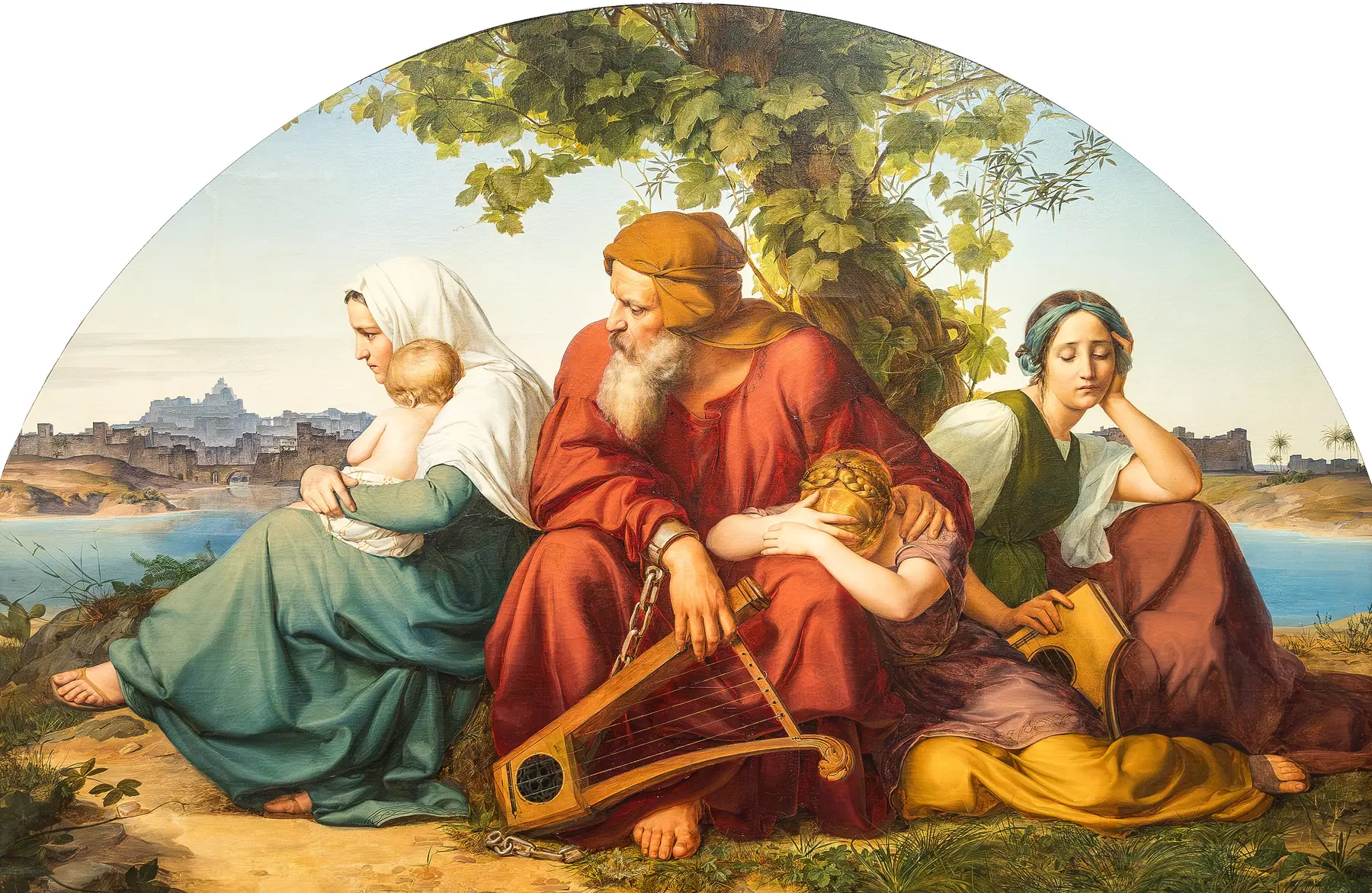
2 Kingschapter 22
20 verses · Jeremiah, by tradition · 6th century BC · History
Then Hilkiah the high priest said to Shaphan the scribe, “I have found the Book of the Law in the house of the LORD!” And he gave it to Shaphan, who read it.
Introduction
Jeremiah, by tradition, History, 2 Kings Overview.
This chapter was written for exiles who remembered Josiah as the best of their last kings. It opens a reform that runs through the next chapter, and it begins with building repairs and ordinary accounts in the temple. A scroll found during the work changes the direction of the reign. Listen for how the king responds when the law is read to him, and for the answer a prophetess gives the men he sends. Notice that her word holds both judgment and mercy, and ask which part applies to whom.
Context
- Who
- Judeans who had lived two generations without hearing the covenant read aloud
- What
- An account of the start of Josiah's reign, the finding of the Book of the Law in the temple, and Huldah's word about Judah and its king.
- Where
- The temple in Jerusalem during its repair, and the house of Huldah the prophetess in the Second District of the city.
- When
- Josiah reigned about 640 to 609 BC, and the scroll was found in his eighteenth year, about 622 BC.
- Why
- To show a king who humbled himself when he heard the law, and to establish that the judgment on Judah stood even when its king repented.
Historical context
The chapter is Josiah's, a king who came to the throne at eight after his father was murdered in the palace. The men around him are named: Hilkiah the high priest, Shaphan the scribe, and Huldah, a prophetess married to the keeper of the wardrobe.
Show the rest of the historical context, 4 more paragraphs
The time is the eighteenth year of the reign, about 622 BC. 2 Chronicles 34:3 to 8 places the start of his seeking in his eighth year and the purging of idols in his twelfth. So this chapter marks the finding of the book rather than the beginning of the work.
The place is the temple during building repairs, and then a house in the Second District of Jerusalem. The occasion is an audit, with silver collected at the temple door being counted and handed to the men repairing the building.
A first hearer knew how a temple repair was run and would have caught the repetition, since the chain of hands here is the one Joash set up a century earlier at 12:9. He also knew what tearing clothes meant, since Scripture uses it both for grief and for repentance.
The identity of the scroll is the one thing the chapter withholds, and the text says only that it was the Book of the Law.
Significance
For Judah this chapter said that a book could stop a kingdom in its place. The king hears words read aloud and tears his clothes, and everything in the next chapter follows from that moment.
Show the rest of the significance, 1 more paragraph
It also set the limit of what repentance could do, since Huldah gives the place a sentence that nothing lifts and the king an answer to his own weeping. And it put a woman at the centre of the kingdom's most serious hour, consulted by the king's own high priest.
This chapter in Jewish lifeWhat this chapter is in Jewish life and reading.
How it is read
Three things in this chapter draw the classical comment: what the scroll was, why the king sent to a woman, and what the promise of peace could mean for a king who died in battle.
On the first, Rashi reads the finding as a recovery rather than a discovery. The scroll "was hidden under a layer of stones where they had concealed it when Achaz burned the Torah". The Metsudah edition's note adds from the parallel account that this was the scroll Moses himself wrote at the end of his life (Rashi on II Kings 22:8:1, the Metsudah Tanach series of Lakewood, N.J, CC-BY). When the king tears his clothes and sends to enquire, Rashi explains what he had just heard read: the verse about the LORD bringing the nation and its king away into exile. The note at that verse carries Radak's fuller version of the same reading. The scroll was found rolled open at that section, which deals with the exile of both kingdoms and their king, and the priest sent it to be read to the king in the hope that he would find some way to lift what was coming (Rashi on II Kings 22:13:1).
On the second, the corpus carries the question openly and gives two answers rather than one. Rashi asks why the king sent to the prophetess and not to Jeremiah, and gives the reason his teachers gave, "because a woman is more merciful than a man". Then he gives the other answer beside it, that Jeremiah was not there because he had gone to bring back the ten tribes, with the Talmud at Megillah 14b behind it (Rashi on II Kings 22:14:1). Both stand in the corpus and neither is put above the other here.
Where she was found draws a longer note, and it is the one place in these twelve chapters where the corpus touches the building of the Temple itself. Rashi carries the Targum rendering the phrase as the study house, and then records that there is a gate in the Temple court called the Gate of Huldah in the Mishnah at Middot. Others, he says, read the word as outside the wall, between the double walls of the city. The same comment carries an annotation naming her as teaching the Oral Law to the elders of the generation, and expounding the book of Deuteronomy and the repeated matters of the Torah in public (Rashi on II Kings 22:14:2). What that annotation reports is the tradition of a woman teaching publicly in the days of the last kings of Judah, and it is reported here as the tradition it is.
On the third, Rashi meets the difficulty head on. The prophetess promises the king that he will be gathered to his grave in peace, and the next chapter has him killed at Megiddo. Rashi asks the question in three words, and what is the peace, and answers it from the rest of her own sentence, that his eyes will not see the destruction of the house, with the Talmud at Moed Katan 28b behind the reading. The note at that verse carries Radak's version of the same answer, that he is counted as having died in peace because he died while Israel still lived in peace and before the destruction began (Rashi on II Kings 22:20:1). This site carries the same question under its own difficulties with its holders, and the classical Jewish answer stands here beside them.
Metzudat David, Radak and Malbim comment across this chapter at further verses, and the corpus carries those refs with the reason that Sefaria holds no English version of them, so they stand here cited and unquoted: Metzudat David on II Kings 22:4:1, 22:5:1, 22:6:1, 22:7:1, 22:9:1, 22:10:1, 22:11:1, 22:16:1, 22:18:1 and 22:19:1; Radak on II Kings 22:4:1, 22:5:1, 22:8:1, 22:11:1, 22:12:1, 22:13:1, 22:16:1 and 22:20:1; and Malbim on II Kings 22:18:1. Both Metzudat David and Radak stand on the eleventh verse, where the king tears his clothes at the reading, and what either makes of it waits on a fetch that carries the text.
What the rabbis say
The corpus carries thirty-two rabbinic locators for this chapter and the text of none, so each is cited and linked here rather than quoted. Eleven of them stand on the fourteenth verse, where the prophetess is sought out, and they are the largest group the rabbis left on any verse of these last four chapters: Ein Yaakov (Glick Edition), Megillah 1:30, Ein Yaakov, Megillah 1:37, the Babylonian Talmud at Megillah 14b:5, 14b:11 and 14b:12, Otzar Midrashim, Midrashim on Missing and Extra Letters 1:28, Pirkei DeRabbi Eliezer 33:9, Seder Olam Rabbah 21:2, Sifrei Bamidbar 78:1, Sifrei Zuta 10:29:1, and Tractate Semachot 14:10, with Megillah 14b:10 on the verse after it. A reader who wants to know what the rabbis made of a woman prophesying to a king will find them gathered there.
Eight stand on the twentieth verse, the promise of a peaceful grave: Ein Yaakov (Glick Edition), Moed Katan 3:18, Ein Yaakov, Moed Katan 3:35, Midrash Tannaim on Deuteronomy 33:7:15, the Babylonian Talmud at Moed Katan 28b:21 and 28b:22, Pirkei DeRabbi Eliezer 34:5, Sifrei Devarim 348:9, and Yalkut Shimoni on Torah 954:4.
Six stand at the opening, on the king's age and his walking in the way of David: Jerusalem Talmud Sanhedrin 11:5:2, Pirkei DeRabbi Eliezer 17:14 and Seder Olam Rabbah 24:2 on the first verse, and Ein Yaakov (Glick Edition), Shabbat 5:10, Ein Yaakov, Shabbat 5:15 and Shabbat 56b:16 on the second.
The rest follow the reading of the scroll. On the tenth verse, where it is read before the king, Jerusalem Talmud Megillah 4:1:2 and Sukkah 38b:6. On the eleventh, Jerusalem Talmud Sotah 7:4:6. On the twelfth, where the king gives his command to the five men, Otzar Midrashim, Baraita of Rabbi Pinchas Ben Yair 1:36. On the sixteenth, Ein Yaakov, Sukkah 3:7. On the nineteenth, where the king's heart was tender, Sukkah 38b:7. What each of them teaches is a saying of the rabbis, and is reported as theirs wherever this site quotes one. The quotations wait on a fetch that carries the text.
Sources: Rashi, Rashi on II Kings 22:8:1, 22:13:1, 22:14:1, 22:14:2 and 22:20:1, The Metsudah Tanach series, Lakewood, N.J, CC-BY; Radak, Radak, the readings the Metsudah edition carries at II Kings 22:13:1 and 22:20:1, and his own refs at 22:4:1, 22:5:1, 22:8:1, 22:11:1, 22:12:1, 22:13:1, 22:16:1 and 22:20:1, cited by ref because the corpus carries no English text; Metzudat David, Metzudat David on II Kings 22:4:1, 22:5:1, 22:6:1, 22:7:1, 22:9:1, 22:10:1, 22:11:1, 22:16:1, 22:18:1 and 22:19:1, cited by ref because the corpus carries no English text; Malbim, Malbim on II Kings 22:18:1, cited by ref because the corpus carries no English text; The Sefaria corpus, scripts/data/sources/sefaria/2-kings/22.json, the 32 Talmud and Midrash locators of this chapter.
The heads below are this chapter's scenes. The numbered points under each are its verses.
Josiah at eight; money counted out to the workmen
2 Kings 22:1-2
Josiah was eight years old: Josiah takes the throne at eight, after two of Judah's most idolatrous kings, and the text credits no regent or teacher for what follows. Verse 2 measures him against David, and "he did not turn aside to the right or to the left" is Deuteronomy's phrase for covenant loyalty.
2 Kings 22:1
“Josiah was eight years old when he began to reign,.... And must be born when his father was but sixteen, for Amon lived but twenty four years, 2Ki 21:19, and he reigned thirty and one years in Jerusalem; and so must die at thirty nine years of age: and his mother's name was Jedidah, the daughter of Adaiah of Boscath; a city of the tribe of Judah; see Gill on Jos 15:39.”
1 more voice on this verseWhat preachers and commentators have said about this verse, in their own words.
2 Kings 22:1
“Solomon says, Woe unto thee, O land! when thy king is a child; but happy art thou, O land! when thy king is such a child. Our English Israel had once a king that was such a child, Edward VI. Josiah, being young, had not received any bad impressions from the example of his father and grandfather, but soon saw their errors, and God gave his grace to take warning by them.”
Matthew Henry · Commentary on the Whole Bible (1707-1721)puritan
did not turn aside: Matthew Henry sets Josiah beside earlier kings of Judah who began well and later turned aside, as Joash and Amaziah did. Henry names the two errors on either hand as superstition and profaneness. John Gill reads the phrase as one even path.
2 Kings 22:2
“And he did that which was right in the sight of the Lord,.... In the affair of religious worship especially, as well as in other things: and walked in all the ways of David his father; in his religious ways, in which he never departed from his God: and turned not aside to the right hand or to the left; but kept an even, constant, path of worship and duty, according to the law of God.”
1 more voice on this verse
2 Kings 22:2
“Nothing is too hard for that grace to do. He walked in a good way, and turned not aside (as some of his predecessors had done who began well) to the right hand nor to the left. There are errors on both hands, but God kept him in the right way; he fell neither into superstition nor profaneness.”
Matthew Henry · Commentary on the Whole Bible (1707-1721)puritan
2 Kings 22:3-5
sent the scribe, Shaphan son of Azaliah: In his eighteenth year Josiah sends Shaphan to have Hilkiah the high priest count the money. By 2 Chronicles 34:3 to 8 his seeking began in his eighth year and the purge of idols in his twelfth. The eighteenth year marks the finding of the book, well into the reform.
2 Kings 22:3
“In the eighteenth year - This is the date of the finding of the Book of the Law and of the Passover (marginal reference, and 2Ki 23:23), but is not meant to apply to all the various reforms of Josiah as related in 2 Kings 23:4-20. The true chronology of Josiah’s reign is to be learned from 2Ch 34:3-8; 2Ch 35:1. From these places it appear that at least the greater part of his reforms preceded the finding of the Book of the Law.”
1 more voice on this verse
2 Kings 22:3
“He began much sooner to seek the Lord (as appears, 2 Chron. xxxiv. 3 ), but it is to be feared the work of reformation went slowly on and met with much opposition, so that he could not effect what he desired and designed, till his power was thoroughly confirmed.”
Matthew Henry · Commentary on the Whole Bible (1707-1721)puritan
Albert Barnes traces Hilkiah the high priest as father or grandfather of Seraiah, the high priest, and as an ancestor of Ezra the scribe. Adam Clarke reckons the gifts had gathered for ten years. This count put them to use.
2 Kings 22:4
“That he may sum the silver - As Josiah began to seek the Lord as soon as he began to reign, we may naturally conclude that the worship of God that was neglected and suppressed by his father, was immediately restored; and the people began their accustomed offerings to the temple. Ten years therefore had elapsed since these offerings began; no one had, as yet, taken account of them; nor were they applied to the use for which they were given, viz., the repairing the breaches of the temple.”
Adam Clarke · Commentary on the Bible (1810-1826)evangelical
the supervisors of those doing: Albert Barnes finds two ranks of workers here. The supervisors held the contract and oversaw the whole repair of the temple. They paid the workmen below them, the carpenters, builders and masons named in verse 6.
2 Kings 22:5
“And let them deliver it into the hand of the doers of the work, that have the oversight of the house of the Lord,....”
1 more voice on this verse
2 Kings 22:5
“See the marginal reference. The “doers” of the first part of the verse are the contractors, or overseers, who undertook the general superintendence; they are to be distinguished from a lower class of “doers,” the actual laborers, carpenters, and masons of the latter portion of the verse. Which is in the house of the Lord - Rather, “who are,” etc.; i. e., the persons who were actually employed in the temple.”
2 Kings 22:6-7
The money pays three trades, "the carpenters, builders, and masons." Verse 7 asks for no accounting "since they work with integrity," the same terms used of Joash's overseers at 2 Kings 12:15. The repeated formula makes faithful stewardship the standing rule for temple work across two very different reigns.
2 Kings 22:6
“Unto carpenters, and builders, and masons,.... Who were employed, some in mending the woodwork, and others in repairing the stone walls and to buy timber and hewn stone to repair the house; not only money was to be given them for their workmanship, but to buy timber and stone to work with.”
The Chronicler names four of the men at 2 Chronicles 34:12, the Levites Jahath, Obadiah, Zechariah and Meshullam, as Albert Barnes points out. Matthew Henry praised the workmen for their integrity. He thought an account of the money put into their hands would have shown their honesty to all.
2 Kings 22:7
“They dealt faithfully - Compare the marginal reference. The names of these honest overseers are given in Chronicles 2Ch 34:12.”
I have found the book of the law: and the king rends his clothes
2 Kings 22:8-9
Hilkiah reports the find in the middle of a money errand, a book found without a search. Some commentators take the scroll for Moses' own copy, others for the copy laid beside the ark and lost under Ahaz, Manasseh or Amon. The text does not say which.
2 Kings 22:8
“I have found the book of the law - Was this the autograph of Moses? It is very probable that it was, for in the parallel place; 2Ch 34:14, it is said to be the book of the law of the Lord by Moses.”
Adam Clarke · Commentary on the Bible (1810-1826)evangelical
1 more voice on this verse
2 Kings 22:8
“It was the temple copy which, had been laid (De 31:25, 26) beside the ark in the most holy place. During the ungodly reigns of Manasseh and Amon--or perhaps under Ahaz, when the temple itself had been profaned by idols, and the ark also (2Ch 35:3) removed from its site; it was somehow lost, and was now found again during the repair of the temple [KEIL].”
Jamieson, Fausset & Brown · Commentary Critical and Explanatory on the Whole Bible (1871)reformed
have paid out the money: Albert Barnes takes the Hebrew verb to mean emptied out, with the collection chest of 2 Kings 12:9 poured out and its silver counted. Shaphan reports the errand done before he mentions the book. The king hears of the money first and the law second.
2 Kings 22:9
“Have gathered - Rather, “have poured out” or “emptied out.” The allusion probably is to the emptying of the chest in which all the money collected had been placed 2Ki 12:9.”
2 Kings 22:10-11
Josiah tears his clothes when he hears "the words of the Book of the Law" read. Tearing the clothes marks grief elsewhere in Scripture, as with Reuben over Joseph and Job at his losses. It also marks repentance, as with Ahab at 1 Kings 21:27, and both senses meet here.
2 Kings 22:10
“And Shaphan showed the king,.... Further related to him what follows: saying, Hilkiah the high priest hath delivered me a book; but did not say what book it was: and Shaphan read it before the king; part of it; and it is thought by Kimchi and Ben Gersom that he particularly read the reproofs and threatenings in the book of Deuteronomy; they suppose that Hilkiah read those to Shaphan, and directed him to read them to the king, that he might take into consideration a further reformation.”
he tore his clothes: Deuteronomy 17:18-19 required each king to write out his own copy of this law and read from it all his life. Josiah hears it read aloud by his scribe. The torn clothes mark a king who learns how far the throne of Judah had drifted from that command.
2 Kings 22:11
“He rent his clothes - Partly grief and horror, like Reuben Gen 37:29 and Job Job 1:20, partly in repentance, like Ahab 1Ki 21:27.”
1 more voice on this verse
2 Kings 22:11
“If Josiah had seen and read it before, which seems more probable, yet the great reverence which he justly bare to the original book, and the strange, and remarkable, and seasonable finding of it, had awakened and quickened him to a more serious and diligent consideration of all the passages contained in it. And what a providence was this, that it was still preserved!”
John Wesley · Explanatory Notes upon the Old Testament (1765)evangelical
2 Kings 22:12-14
commanded Hilkiah the priest: The king sends a delegation of five to inquire of the LORD. They go to Huldah the prophetess, though Jeremiah had been prophesying five years, and the text gives no reason for the choice. Adam Clarke notes that Jeremiah likely lived at Anathoth, away from the city.
2 Kings 22:12
“And the king commanded Hilkiah the priest,.... The high priest, as he is called, 2Ki 22:4. and Ahikam the son of Shaphan; whether the same with Shaphan the scribe, before mentioned, or another of the same name, is not certain: and Achbor the son of Michaiah; who is called Abdon, the son of Micah, 2Ch 34:20. and Shaphan the scribe; who brought and read the book to the king: and Asahiah, a servant of the king's; that waited on him constantly: saying; as follows.”
In this period, to inquire of the LORD meant to seek a prophet, and Barnes notes the Urim and Thummim had fallen out of use. Josiah lays the wrath on the fathers. Barnes takes this to mean the law had been lost only recently.
2 Kings 22:13
“Enquire of the Lord - As inquiry by Urim and Thummim had ceased - apparently because superseded by prophecy - this order was equivalent to an injunction to seek the presence of a prophet (compare 2Ki 3:11; 1Ki 22:5). Because our fathers have not hearkened - Josiah, it will be observed, assumes that preceding generations had had full opportunity of hearing and knowing the Law. He thus regards the loss as comparatively recent (compare 2Ki 22:8 note).”
1 more voice on this verse
2 Kings 22:13
“It is a sign that God has mercy in store for a people when he magnifies his law among them and makes that honourable, and furnishes them with means for the increase of scripture-knowledge. The translating of the scriptures into vulgar tongues was the glory, strength, and joy of the Reformation from Popery.”
Matthew Henry · Commentary on the Whole Bible (1707-1721)puritan
Huldah's word: thine eyes shall not see all the evil
Huldah the prophetess: Albert Barnes sets Huldah the prophetess beside Miriam at Exodus 15:20 and Deborah at Judges 4:4. She lived in the Second District of Jerusalem. Jerome held it the rule of Scripture, when holy men fail, to praise women to the reproach of men.
2 Kings 22:14
“Her husband Shallum was grandson of one Harhas, "keeper of the wardrobe." If this means the priestly wardrobe, [Harhas] must have been a Levite. But it probably refers to the royal wardrobe. she dwelt . . . in the college--rather, "in the Misnah," taking the original word as a proper name, not a school or college, but a particular suburb of Jerusalem.”
Jamieson, Fausset & Brown · Commentary Critical and Explanatory on the Whole Bible (1871)reformed
2 more voices on this verse
2 Kings 22:14
“We need not wonder that Huldah, the prophet and wife of Shallum, was consulted by Josiah, king of Judah, when the captivity was approaching and the wrath of the Lord was falling on Jerusalem: since it is the rule of Scripture, when holy men fail, to praise women to the reproach of men.”
Jerome · written before 420 · Against Jovinianus 1.25patristic
2 Kings 22:14
“Went unto Huldah the prophetess - This is a most singular circumstance: At this time Jeremiah was certainly a prophet in Israel, but it is likely he now dwelt at Anathoth and could not be readily consulted; Zephaniah also prophesied under this reign, but probably he had not yet begun; Hilkiah was high priest, and the priest’s lips should retain knowledge.”
Adam Clarke · Commentary on the Bible (1810-1826)evangelical
2 Kings 22:15-17
Because the people "have forsaken Me and burned incense to other gods," the LORD's wrath "will not be quenched," and she names no condition. Josiah's reform does not reverse it, and 23:26 to 27 says the LORD did not turn from His great wrath afterward.
2 Kings 22:15
“And she said unto them,.... The king's messengers: thus saith the Lord God of Israel; being immediately inspired by him, she spake in his name, as prophets did: tell the man that sent you to me; which may seem somewhat rude and unmannerly to say of a king; but when it is considered she spake not of herself, but representing the King of kings and Lord of lords, it will be seen and judged of in another light.”
I am about to bring calamity: The words the king had read are the covenant curses of Leviticus 26 and Deuteronomy 28, as Albert Barnes and John Gill identify them. The parallel at 2 Chronicles 34:24 speaks of the curses written in that book. Barnes holds that Josiah heard only part of it.
2 Kings 22:16
“Thus saith the Lord, behold, I will bring evil upon this place, and upon the inhabitants of it,.... Destruction to the place, and captivity to the inhabitants of it: even all the words of the book which the king of Judah hath read; particularly what is contained in Lev 26:14, even all the curses in it, as in 2Ch 34:24.”
1 more voice on this verse
2 Kings 22:16
“All the words of the book - The “words” here intended are no doubt the threatenings of the Law, particularly those of Lev. 26:16-39 and Deut. 28:15-68. Josiah had probably only heard a portion of the Book of the Law; but that portion had contained those awful denunciations of coming woe. Hence, Josiah’s rending of his clothes 2Ki 22:11, and his hurried message to Huldah.”
burned incense to other gods: Burning incense to other gods was the favoured idolatry of the day, offered to Baal on the rooftops, as Albert Barnes observes. Manasseh had built its altars in the temple courts. Adam Clarke reads the wrath that will not be quenched as a decree already gone forth against this place.
2 Kings 22:17
“Have burned incense - In the marginal reference the corresponding phrase is: “have served other gods, and worshipped them.” Its alteration to “have bnrned incense” points to the fact that the favorite existing idolatry was burning incense on the housetops to Baal Jer 19:13; Jer 32:29 and to the host of heaven 2Ki 21:3.”
2 Kings 22:18-20
The oracle turns to Josiah's own act, and the LORD has heard him. He will be "gathered to your grave in peace," his eyes spared the calamity to come. In 23:29 Pharaoh Neco kills him at Megiddo, yet verse 20 ties the peace to what his eyes will not see.
2 Kings 22:18
“But to the king of Judah, which sent you to inquire of the Lord,.... That is, with respect to him, or what may concern him: thus shall ye say unto him; carry back this message to him as from the Lord he desired to inquire of: thus saith the Lord God of Israel, as touching the words which thou hast heard: read out of the law, concerning the destruction of the land, and its inhabitants therein threatened.”
1 more voice on this verse
2 Kings 22:18
“7 Howbeit there was no reckoning made with them of the money that was delivered into their hand, because they dealt faithfully. 8 And Hilkiah the high priest said unto Shaphan the scribe, I have found the book of the law in the house of the L ORD .”
Matthew Henry · Commentary on the Whole Bible (1707-1721)puritan
because your heart was tender: The LORD names the torn clothes of verse 11 and adds the weeping, which the account of the palace scene left unrecorded. Hezekiah received the same assurance about his tears at 20:5. Adam Clarke limits the hearing to a delay of the calamity past Josiah's lifetime.
2 Kings 22:19
“Because thine heart was tender - Because thou hast feared the Lord, and trembled at his word and hast wept before me, I have heard thee, so far that these evils shall not come upon the land in thy lifetime.”
Adam Clarke · Commentary on the Bible (1810-1826)evangelical
gathered to your grave in peace: Albert Barnes dates Josiah's death at Megiddo to 608 BC and the calamity from Babylon to three years later. The king was gathered to his fathers before it came. Augustine cited this promise as evidence that the dead are spared the sight of the calamity that falls on the living.
2 Kings 22:20
“Thou shalt be gathered into thy grave in peace - During thy life none of these calamities shall fall upon the people, and no adversary shall be permitted to disturb the peace of Judea, and thou shalt die in peace with God. But was Josiah gathered to the grave in peace? Is it not said, 2Ki 23:29, that Pharaoh-nechoh slew him at Megiddo?”
Adam Clarke · Commentary on the Bible (1810-1826)evangelical
1 more voice on this verse
2 Kings 22:20
“This is promised to Josiah here: Thou shalt go to thy grave in peace, which refers not to the manner of his death (for he was killed in a battle), but to the time of it; it was a little before the captivity in Babylon, that great trouble, in comparison with which the rest were as nothing, so that he might be truly said to die in peace that did not live to share in that.”
Matthew Henry · Commentary on the Whole Bible (1707-1721)puritan
How this psalm is built
The form: Narrative built around a document, a temple repair account that becomes a discovery scene and then an oracle delivered in two parts, as Albert Barnes, with Matthew Henry classes it.
The patterns in this chapter
| Device | What it does | Where to see it |
|---|---|---|
| The words of the Book of the Law | The scroll is named at verse 8, read at verse 10, heard at verse 11, inquired of at verse 13 and quoted back by Huldah at verse 16, and the chapter measures every person in it by what they do when it is read. The site's exposition note on 22:10 to 11, which cites Barnes with Wesley, observes that the king's clothes tear at what he hears rather than at who found it, and that Wesley allows Josiah may already have known parts of the law without the force the reading carried.John Wesley, Explanatory Notes upon the Old Testament, 1765, cited by the site's exposition note on 2 Kings 22:10 to 11. | 2 Kings 22:8, 2 Kings 22:10, 2 Kings 22:11, 2 Kings 22:13, 2 Kings 22:16 |
| Tell the man who sent you | Huldah opens at verse 15 with no royal title for a king whose own high priest is standing in her house, and the site's exposition note on 22:15 to 17, which cites Gill with Barnes, reads the phrase as a prophet answering rather than a courtier. The address changes at verse 18, where the oracle turns and speaks of the king of Judah by his office, and the two forms of address mark the two halves of the word.John Gill, Exposition of the Old Testament, 1748 to 1763, cited by the site's exposition note on 2 Kings 22:15 to 17. | 2 Kings 22:15, 2 Kings 22:18 |
| The oracle in two halves | Verses 16 and 17 are unconditional on the place, calamity coming according to all the words of the book, wrath kindled and unquenched. Verses 18 to 20 turn on the king's own act, a tender heart, a humbling, torn clothes and weeping, and promise that his eyes will not see it. The site's exposition note on 22:15 to 17 records that nothing Josiah does afterward reverses the first half, and points to 23:26 and 23:27, where the book states plainly that the LORD did not turn from the fierceness of His anger even after the reform.Albert Barnes, Notes on the Old Testament, cited by the site's exposition note on 2 Kings 22:15 to 17. | 2 Kings 22:16, 2 Kings 22:17, 2 Kings 22:19, 2 Kings 22:20, 2 Kings 23:26 |
| Five men sent, and the chain of hands | Verse 12 names five men rather than one: the high priest, two of Shaphan's own circle in Ahikam and Achbor, Shaphan the scribe himself, and a royal servant. It is a delegation heavy enough to carry the weight of what was found. The money in verses 4 to 7 moves through a chain of hands with the same care, from the doorkeepers to the high priest to the supervisors to the workmen, and verse 7 closes the account with no audit at all, since they work with integrity. The site's exposition note on 22:6 to 7, which cites Gill with Keil, records that the phrase is the one used of Joash's overseers at 12:15, a century earlier.Keil, The Books of the Kings, cited by the site's exposition note on 2 Kings 22:6 to 7. | 2 Kings 22:4, 2 Kings 22:5, 2 Kings 22:7, 2 Kings 22:12, 2 Kings 12:15 |
The historical value
11 more paragraphs on the patterns
The chapter's detail about how a temple was repaired is the kind a later writer would have no reason to invent. The funding chain of verses 4 to 7 matches the arrangement Joash set up at 12:9 to 15 a century earlier, down to the clause about no reckoning being taken. The site's exposition note on verses 6 and 7 records the repetition and reads it as the standing rule for temple work across two very different reigns.
The address given for Huldah is a real quarter of the city. The Berean text gives it as the Second District, the Mishneh, an area of Jerusalem the text bothers to record along with her husband's office. The site's exposition note on verses 12 to 14, which cites Clarke with Jamieson, Fausset and Brown, observes that the delegation goes to her rather than to Jeremiah, already five years in his calling by Jeremiah 1:1 to 2, or to Zephaniah, and that the text gives no reason. Clarke notes only that Jeremiah likely lived at Anathoth and was not readily at hand.
The date the site's historical layer carries for the finding of the scroll is about 622 BC, and the dossier's own timeline entry, The scroll found, anchors it at 2 Kings 22:8 with Huldah consulted and Josiah's reform following.
The debated concept
What scroll Hilkiah found is the chapter's standing question, and the commentators divide. The site's exposition note on verses 8 and 9 sets out the positions without settling them. Some hold it an autograph of Moses. Others hold it the temple copy laid beside the ark at Deuteronomy 31:25 to 26 and lost sometime under Ahaz, Manasseh or Amon. The note records that the text itself does not say which. Rashi's reading belongs with the second group and is more specific, that the scroll lay hidden under a layer of stones where it was concealed when Ahaz burned the Torah, and he cites 2 Chronicles 34:14 for the claim that this was the scroll Moses wrote at the end of his life.
The promise of peace to a king who died in battle is the chapter's other question, and the dossier carries it with two positions, their holders and a door. Huldah's word at verse 20 is that Josiah will be gathered to his grave in peace and that his eyes will not see the calamity, and at 23:29 Neco kills him at Megiddo. The first position, which the dossier calls the traditional reading and attributes to Keil and Delitzsch and most conservative commentators, takes in peace as peace from the coming destruction and points to the honoured burial of 23:30. The second is held by readers who note that 2 Chronicles 35:21 to 22 has Josiah refusing a word sent through Neco and going into the fight disguised, which frames the death as a step taken against warning. The dossier records that both readings agree on the part of the word the narrative confirms without qualification, since Josiah did not live to see Jerusalem fall. The door is /featured/huldah. Rashi, at 22:20, carries the same solution as the first position in Radak's name, that Josiah is counted as having died in peace because he died while Israel was still living in peace and before the destruction began.
Why a prophetess rather than a prophet is the third, and the Jewish commentary answers it where the Christian commentators record the silence. Rashi at 22:14 gives two reasons from the Rabbis, that a woman is more merciful than a man and might therefore plead for the decree to be changed, and that Jeremiah was away.
The divine connection
The chapter turns on a document doing what a document cannot do by itself. Josiah hears words read aloud and tears his clothes, and the site's exposition note on verses 10 and 11 sets the act between its two senses in Scripture, grief and horror as for Reuben and for Job, and repentance as for Ahab at 1 Kings 21:27, and lets both stand together.
Huldah's answer states the rule the rest of the book works by. The place is judged according to all the words of the book, and the man who humbled himself is answered in his own case. The site's exposition note on verses 18 to 20 names both halves and records that the peace promised sits beside the plain report of a death at Megiddo, and that both stand as written.
The chapter also opens a thread the next chapter closes. The site's exposition note on verses 1 and 2 records that Josiah is the king named by the man of God from Judah three centuries earlier at 1 Kings 13:2, and that the fulfilment stays open until 23:16.
Keep studying
Studies8
Places1
Sources for this chapter
The summary
Jamieson, Fausset & Brown, Commentary Critical and Explanatory; John Wesley, Notes on the Old Testament and Matthew Henry, Complete Commentary.
The form and classifications
Albert Barnes, reading 2 Chronicles 34:3 to 8 into the sequence, Notes on the Old Testament, cited by the site's exposition note on 2 Kings 22:3 to 5; Albert Barnes, with Matthew Henry, Notes on the Old Testament and Commentary on the Whole Bible, 1710, cited together by the site's exposition note on 2 Kings 22:3 to 5 and Rashi, Rashi on II Kings 22:8:1, the Metsudah Tanach series, Lakewood, fetched from Sefaria under CC-BY.
The exposition
Adam Clarke, Commentary on the Bible; Albert Barnes; Augustine of Hippo, On the Care of the Dead 13.16; Berean Standard Bible, Deuteronomy 17:18-19; Jamieson, Fausset & Brown, Commentary Critical and Explanatory on the Whole Bible; Jerome, Against Jovinianus 1.25; John Gill; John Wesley, Explanatory Notes upon the Old Testament; Keil, The Books of the Kings and Matthew Henry, Commentary on the Whole Bible.