
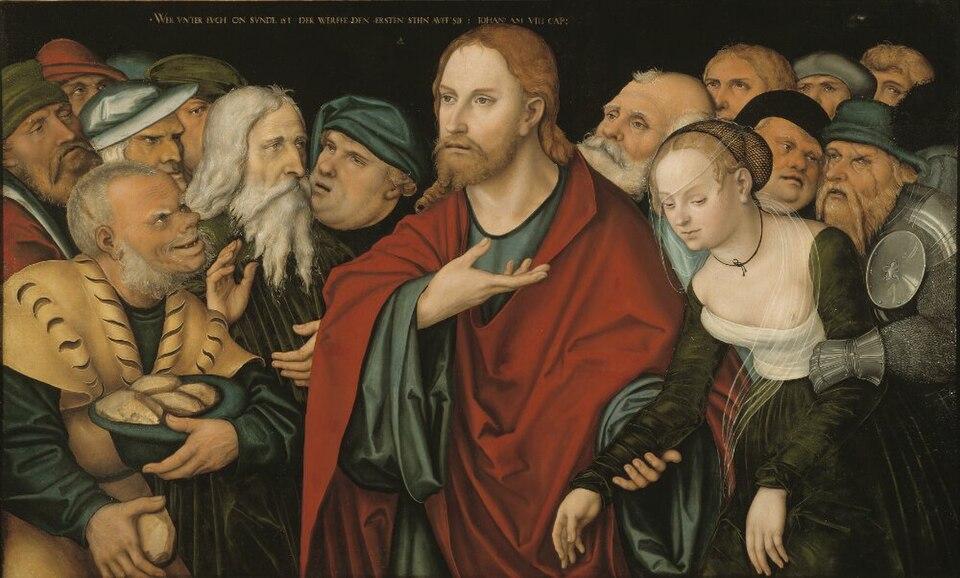
Workshop of Lucas Cranach the Elder, Christ and the Woman Taken in Adultery, after 1537. Public domain.
John 7:53 to 8:11 · Story · Featured Study
The Woman Caught in Adultery
The scribes and Pharisees brought Jesus a woman caught in adultery and asked what He would say about stoning her.
When they continued to question Him, He straightened up and said to them, “Let him who is without sin among you be the first to cast a stone at her.”
- Where
- The Temple, Mount of Olives
- Who
- Jesus of Nazareth
Jesus wrote on the ground twice, and the account never says what He wrote.
Summary
In the temple courts Jesus answered the woman's accusers with one sentence, and they left one by one. No one remained to condemn her, and Jesus did not condemn her either.
- The papyri of John and the great Greek Bibles made before about AD 360 do not have the account.
- The Berean Standard Bible prints it after John 7:52 with a note that some early manuscripts leave it out.
- Readers differ on whether John wrote it and on whether it stands as Scripture.
The Test in the Temple Courts
The scribes and Pharisees set the Law of Moses before Jesus as a trap.
Jesus had come to Jerusalem for the Feast of Tabernacles (John 7:2). The chief priests had already sent officers to arrest Him (John 7:32).
If a man commits adultery with another man’s wife—with the wife of his neighbor—both the adulterer and the adulteress must surely be put to death.The Law the accusers cited names the man as well, yet they brought only the woman.
Augustine wrote that Jesus could not say, Let her not be stoned, without seeming to speak against the law. Nor would He say, Let her be stoned, since He came to seek what was lost.
The Morning, Step by Step
The account runs from an evening when each man went home to a morning in the temple courts.
The morning moves from the charge to the release in eight steps.
- EveningEach man goes home, and Jesus goes to the Mount of Olives.John 7:53
- DawnJesus teaches the people who gather to Him in the temple courts.John 8:2
- The chargeThe scribes and Pharisees stand the woman before Him and cite the Law of Moses.John 8:3 to 5
- The first writingJesus stoops and writes on the ground.John 8:6
- The answerHe straightens up and answers them with one sentence.John 8:7
- The second writingHe stoops again and writes.John 8:8
- The leavingThe accusers go away one by one, the older ones first.John 8:9
- The releaseNo accuser is left, and Jesus speaks to the woman.John 8:10
Each step of the account in the order John 7:53 to 8:11 gives it.
The leaving, The release
What Jesus Wrote on the Ground
Readers since Jerome have offered three answers to what Jesus wrote.
The sins of the accusersJerome, Against the Pelagians 2.17
Jerome held that Jesus wrote the sins of the accusers and of all mortals. He drew the reading from Jeremiah 17:13, where those who turn away from the LORD are written in the dust.
The Lawgiver writing againAugustine of Hippo, Tractates on John 33
Augustine recalled that the law was written with the finger of God on stone. He held that the Lord now wrote on the ground because He was seeking fruit.
A silence aimed at the accusers' consciencesJohn Wesley, Explanatory Notes upon the New Testament (1755); Jamieson, Fausset and Brown (1871)
Wesley read the silent writing as a call to the accusers' consciences and a sign that Jesus had come to save the world. Jamieson, Fausset and Brown held that He stooped the second time so that the accusers could slip away without meeting His eye.
How the Church First Knew It
A third-century book from Syria, then Eusebius and Jerome, each knew a story of this woman.
The Didascalia Apostolorum urges bishops to forgive the penitent, and it sets this woman before them as the pattern of mercy. Raymond Brown wrote that it shows the story was known in Syria in the second century, though not necessarily as Scripture.
Eusebius of Caesarea reported a story of this kind from Papias, a bishop of Hierapolis in the second century. The Gospel according to the Hebrews also contained it, Eusebius wrote. Brown wrote that we cannot be certain the story Papias told is this one.
Jerome's report, from the early fifth century, tells where the account stood in the Bibles of his day.
“In the Gospel, according to John, there is found in many of both the Greek as well as the Latin copies, the story of the adulteress who was accused before the Lord.”
Jerome · Against the Pelagians 2.17 · on John 7:53Patristic
The Account in the Manuscripts
Most later copies of John carry the account, and many of them mark it as doubtful.
A manuscript is a copy made by hand, and a papyrus or a codex is a manuscript on papyrus or in book form. Samuel Tregelles counted the account in more than 300 later Greek copies when he wrote in 1854. He also found that those copies differ in their wording far more than copies of other passages do.
The oldest copies of John pass over the account, and later copies set it in five different spots.
| Witness | Kind and date | What it does with the account |
|---|---|---|
| Papyrus 66 (Bodmer II) | Greek papyrus book of John, dated by its handwriting between about AD 200 and 350 | Leaves it out |
| Papyrus 75 (Bodmer XIV and XV) | Greek papyrus book of Luke and John, dated by its handwriting between about AD 175 and 350 | Leaves it out |
| Codex Sinaiticus | Greek Bible, about AD 330 to 360 | Leaves it out |
| Codex Vaticanus | Greek Bible, about AD 300 to 350 | Leaves it out |
| Codex Washingtonianus | Greek Gospels, about AD 350 to 450 | Leaves it out |
| Codex Alexandrinus | Greek Bible, about AD 400 to 440 | Its leaves here are lost, and the lost leaves had no room for the account |
| Codex Bezae | Greek and Latin Gospels and Acts, late fourth or fifth century | Carries it after John 7:52, the first known manuscript in Greek to do so |
| The oldest Syriac and the Sahidic Coptic versions | Early translations into Syriac and Coptic | Leave it out |
| Jerome's Latin Vulgate | A Latin translation made by Jerome | Carries it |
| The standard Greek text | Manuscripts made from about AD 900 on | Carries it after John 7:52, often marked with asterisks or obeli |
| Family 13 | A family of later Greek copies | Places it after Luke 21:38 |
| Minuscules 1, 565 and others | Later Greek copies, with some Armenian copies | Place it after John 21:25 |
| Minuscule 225 and several Georgian copies | A later Greek copy and copies of the Georgian version | Place it after John 7:36, or after John 7:44 |
Codex Bezae, The oldest Syriac and the Sahidic Coptic versions, Jerome's Latin Vulgate, The standard Greek text, Family 13, Minuscules 1, 565 and others, Minuscule 225 and several Georgian copies
Bruce Metzger listed these witnesses in his Textual Commentary of 1971. He added that no Greek Church Father before Euthymius Zigabenus in the twelfth century comments on the passage. An asterisk or an obelus is a mark in the margin, and copyists used it to show that they doubted a passage they still copied.
Metzger judged the account a piece of oral tradition from the Western church, which copyists set where it seemed to interrupt John least. A majority of the committee of the United Bible Societies' Greek text chose to keep it after John 7:52. They printed it in double square brackets, in deference to its age.
Read the variant: The Woman Caught in Adultery, witness by witness
Released From the Sentence
Readers since Augustine have asked whether Jesus excused the woman's sin.
Augustine wrote that the Lord condemned the sin and spared the person. He pointed to the command that follows the release in John 8:11. A patron of sin, he said, would have told her to live as she pleased.
Jamieson, Fausset and Brown observed that Jesus spoke no words of pardon over her. Ryle warned against reading the account as making light of the seventh commandment.
John's Gospel teaches the same mercy in passages outside the disputed verses, at John 3:17 and John 12:47.
For God did not send His Son into the world to condemn the world, but to save the world through Him.Jesus states here why the Son was sent into the world.
Is the Account Part of John?
Readers since Augustine have given the account three different standings, each with its holders and an objection.
Part of John from the start, removed by some copyistsAugustine of Hippo, On Adulterous Marriages 2.7.6; Edward F. Hills, The King James Version Defended (4th ed., 1984)
“Some men of slight faith, or, rather, some hostile to true faith, fearing, as I believe, that liberty to sin with impunity is granted their wives, remove from their scriptural texts the account of our Lord's pardon of the adulteress, as though he who said, ‘From now on, sin no more,’ granted permission to sin, or as though the woman should not have been cured by the divine physician by the remission of that sin in order not to offend others who are equally unclean.”
Augustine of Hippo · On Adulterous Marriages 2.7.6 · on John 7:53Patristic
Edward Hills defended the account as part of John. He pointed to Codex Bezae, to the Old Latin copies and to Jerome's report of many Greek and Latin copies. J. C. Ryle wrote that readers in every age had doubted whether John wrote it, but that their doubts could not easily be proved.
The objection: Tregelles answered that Augustine's guess cannot explain why so many early translations in so many lands lack the account. Fenton Hort, as Metzger quotes him, asked why copyists would also drop the three verses of time and place before it.
Added later from early tradition, and received as ScriptureBruce M. Metzger, A Textual Commentary on the Greek New Testament (1971); Raymond E. Brown, The Gospel According to John I to XII (1966)
Metzger held that John did not write the account, yet that it bears all the marks of a true event. Brown judged it a later insertion and an ancient story. He explained that the Roman Catholic Church counts it canonical because Jerome took it into the Vulgate. It also entered the Byzantine text and the King James Bible.
The objection: Tregelles held that a passage which was not Scripture from the beginning cannot be made Scripture later, any more than the Apocrypha can.
A true story outside the canonSamuel P. Tregelles, An Account of the Printed Text of the Greek New Testament (1854)
Tregelles accepted the account as a true story of the Lord, handed down through more than one channel. He did not believe it to be a divine record, and he traced it to Papias rather than to John.
The objection: Brown answered that for many churches canonicity rests on long acceptance and use. By that measure, he wrote, most Christians receive the account as Scripture.
Go and Sin No More
After the woman leaves, Jesus speaks to the people about light.
“No one, Lord,” she answered. “Then neither do I condemn you,” Jesus declared. “Now go and sin no more.”The release and the command come in one breath, so mercy and a changed life stand together.
In Bibles that print the account here, Jesus next calls Himself the light of the world (John 8:12). Hoskyns, as Raymond Brown reports him, held that the account fits the theme of judgment in John 8.
Sources
Scripture is the Berean Standard Bible.
- Berean Standard Bible, note g at John 7:52, as printed at biblehub.com/bsb/john/7.htm.
- Bruce M. Metzger, A Textual Commentary on the Greek New Testament (United Bible Societies, 1971), pages 219 to 221, on John 7:53 to 8:11.
- Samuel P. Tregelles, An Account of the Printed Text of the Greek New Testament (London, 1854), pages 236 to 243.
- Raymond E. Brown, The Gospel According to John I to XII, Anchor Bible (Doubleday, 1966), pages 335 to 336.
- Edward F. Hills, The King James Version Defended, 4th edition (Christian Research Press, 1984), pages 150 to 159.
- The dates of the witnesses as the Copy Room pages give them, with their datings by Martin, Turner, Orsini and Clarysse, and Nongbri for the papyri.
- Augustine of Hippo, On Adulterous Marriages 2.7.6, and Tractates on the Gospel of John 33.
- Jerome, Against the Pelagians 2.17.
- Eusebius of Caesarea, Church History 3.39.16.
- Didascalia Apostolorum 7.
- John Wesley, Explanatory Notes upon the New Testament (1755), on John 8:6.
- Jamieson, Fausset and Brown, Commentary Critical and Explanatory on the Whole Bible (1871), on John 8:8 and John 8:11.
- J. C. Ryle, Expository Thoughts on the Gospels: John (1869), on John 8:1 to 11.
Keep Studying
People and groups2
Subjects1
Go further7