
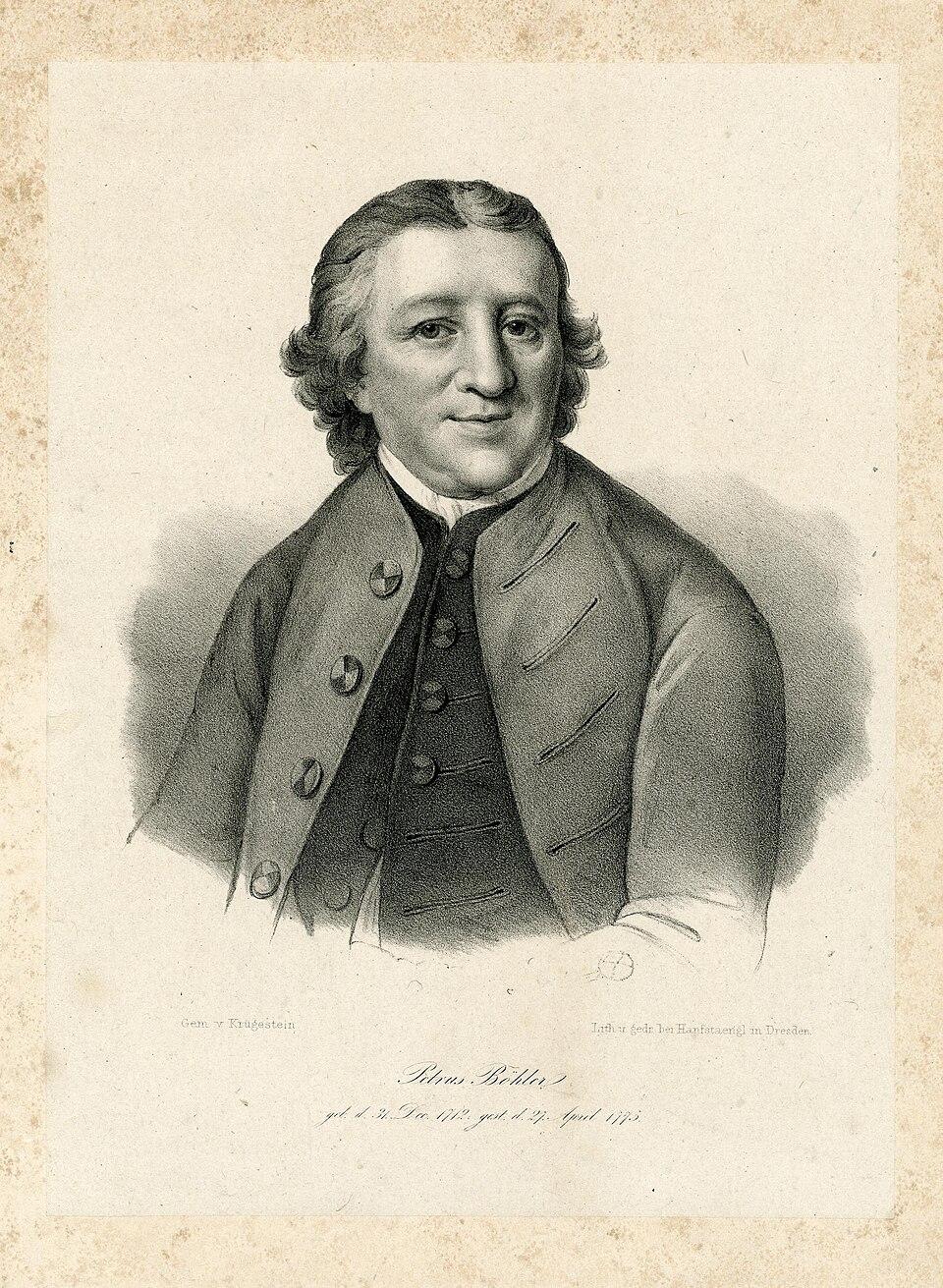
Friedrich Bils after Krügestein, Petrus Böhler, 1816 to 1853. Public domain.
1736 to 1740 · Subject · Featured Study
From the Moravians to Aldersgate
Wesley met the Moravians on a ship, took counsel from Peter Böhler in London, and went to Herrnhut after the night his heart was warmed.
Wesley wrote that the Germans on his ship sang through a storm. One told him their women and children were not afraid to die.
The Spirit Himself testifies with our spirit that we are God’s children.
The Spirit Himself testifies with our spirit that we are God’s children.
- Books
- Romans, James, 2 Peter, Habakkuk
- Hold in memory
- Romans 8:16, James 5:16
Summary
John Wesley met the Moravians six times in four places over two and a half years. Their questions and counsel shaped the faith he found on 24 May. Two years later he parted from them.
- The meetings ran from a ship in the Atlantic to Georgia, London and Saxony.
- Peter Böhler advised the rules of the society that later met in Fetter Lane.
- Wesley visited Herrnhut ten weeks after Aldersgate.
- Wesley left the London society in July 1740.
The Verses on the Road to Aldersgate
A question from Romans, a rule from James, two readings on one morning, and a hope from Habakkuk.
Each verse below stands where Wesley's Journal sets it, and the cards follow the order of his road from Georgia to Herrnhut.
Georgia and London
Therefore confess your sins to each other and pray for each other so that you may be healed. The prayer of a righteous man has great power to prevail.
The society Böhler advised met to obey this command, as its first rule says.
James 5:16BSB
Aldersgate and after
Through these He has given us His precious and magnificent promises, so that through them you may become partakers of the divine nature, now that you have escaped the corruption in the world caused by evil desires.
Wesley opened his Testament on these words at about five that morning.
2 Peter 1:4BSB
When Jesus saw that the man had answered wisely, He said, “You are not far from the kingdom of God.” And no one dared to question Him any further.
He opened it again on these words as he went out.
Mark 12:34BSB
For the earth will be filled with the knowledge of the glory of the LORD as the waters cover the sea.
Wesley echoed this verse as he left Herrnhut in August.
2 Peter 1:4, Mark 12:34, Habakkuk 2:14
Six Meetings in Four Places
The stops run from the Atlantic to Saxony.
Wesley met the Moravians at six stops in two and a half years, and each left its mark in his Journal.
- The Simmonds, at sea25 January 1736The calm of the Moravians in danger.17
- GeorgiaFebruary 1736A pastor's questions about assurance.18
- London7 February 1738A friendship with a young Moravian.61
- A society in London1 May 1738Weekly bands under written rules.66
- Aldersgate Street24 May 1738The night of assurance.74
- Herrnhut1 to 14 August 1738Two weeks in the settlement.82 to 86
A sequence of six stops, each with its date and the page of the Journal of 1831, volume III.
What Changed at Aldersgate
Hutton reports two readings of Wesley's state before that night, and Wesley's own note leaves the question open.
The Methodist and the High Church readings answer three questions about Wesley differently.
| The question | The Methodist reading | The High Church reading |
|---|---|---|
| Was Wesley a Christian before he met Böhler? | He had a legal religion and lacked saving faith | He was a Christian saint already |
| What did he receive at Aldersgate? | Trust in Christ alone and the assurance that his sins were taken away | A deepening of a faith he already had |
| What did the Moravians give him? | The teaching of faith and assurance that led him there | Counsel to a devout man who was troubled by doubts |
The Wesleyan and Pentecostal tradition reads that night as Wesley read it. It was the witness of the Spirit given to one who trusted Christ alone.
The Ship and the Colony
The Moravians on the Simmonds and their pastor in Georgia asked Wesley questions he could not answer.
Wesley sailed for Georgia in the Simmonds with a company of Moravian settlers. In the third storm the sea broke over the ship while the Germans were singing a psalm.
When Wesley asked one of them afterwards whether he had been afraid, he answered, “I thank God, no.”
In Georgia, Wesley asked August Gottlieb Spangenberg, a pastor of the Germans, for advice about his own conduct. Spangenberg first asked him, “Do you know Jesus Christ?”
Wesley answered that he knew Christ was the Saviour of the world, and wrote that he feared his further answers were vain words.
Böhler, the Society and Aldersgate Street
Back in England, Wesley met Peter Böhler and began a society on his advice, and in May he trusted Christ alone.
On his voyage home Wesley wrote on 1 February that he who went to America to convert others was never himself converted to God.
Six days later he met Peter Böhler and two other Moravians at a Dutch merchant's house in London. They had just landed from Germany, and he found them a lodging.
On 5 March Böhler convinced him of unbelief. Wesley asked whether he should stop preaching. Böhler told him, “Preach faith till you have it; and then, because you have it, you will preach faith.”
On 1 May a little society began, which afterwards met in Fetter Lane. Its rules were agreed on Böhler's advice. The first was to meet once a week to confess their sins to one another and pray for one another.
On 24 May, in a society in Aldersgate Street, one was reading Luther's preface to the Epistle to the Romans. At about a quarter before nine Wesley felt his heart strangely warmed and wrote, “I felt I did trust in Christ, Christ alone for salvation.”
On 1 August Wesley reached Herrnhut. He stayed among the Brethren for two weeks and heard Christian David and others tell how they had come to faith.
In Their Own Words
Charles Wesley (1707 to 1788)
The Journal of the Rev. Charles Wesley, M.A., volume I, Wednesday 17 May 1738
Charles Wesley found justification by faith in his own church's articles.
“Who would believe our Church had been founded on this important article of justification by faith alone?”
Methodist
About this saying1 paragraph
Charles Wesley wrote this in the eighteenth century, a week before his brother's evening in Aldersgate Street.
John Wesley (1703 to 1791)
Journal, 12 August 1738
Wesley would have stayed at Herrnhut.
“I would gladly have spent my life here; but my Master calling me to labour in another part of his vineyard, on Monday, 14, I was constrained to take my leave of this happy place; Martin Dober, and a few others of the brethren, walking with us about an hour. O when shall this Christianity cover the earth, as the ‘waters cover the sea?’”
Evangelical
About this saying1 paragraph
Wesley wrote this on the intercession day at Herrnhut in the eighteenth century, two days before he left.
August Gottlieb Spangenberg (1704 to 1792)
Diary, February 1736, in Adelaide L. Fries, The Moravians in Georgia, 1735-1740, page 123
Spangenberg judged that grace dwelt in Wesley.
“He told me how it was with him, and I saw that true Grace dwelt in and governed him.”
Moravian
About this saying1 paragraph
Spangenberg wrote this in his own diary in the eighteenth century about the young clergyman who came to him.
Where Wesley and the Brethren Parted
Wesley's own later note, and the quarrel that ended his time in the society, show how far the Moravian teaching held.
When Wesley published his Journal, he set beside his words of 1 February the note “(I am not sure of this.)”
Hutton, writing for the Moravians, judges that Wesley lacked the firm trust and assurance Böhler had, and that Böhler led him into rest.
From October 1739 Philip Henry Molther taught the society his teaching of stillness. A sinner should sit still and wait for Christ, he said, rather than read the Scriptures, pray or take the Sacrament. Wesley held that there were many means of grace, all leading the soul to Christ. The Sacrament was one of them, meant for all.
Hutton reports that on 20 July Wesley called those of his opinion to follow him. Eighteen did, and he did not return.
Books to Read Next
The Works of the Rev. John Wesley, volume III, his Journal
John Wesley · 1831
Wesley tells each of the six meetings in his own words.
Free scan of volume IIIA History of the Moravian Church
J. E. Hutton · 1909
Hutton tells the friendship and the quarrel from his church's side as a Moravian minister.
Free at Project GutenbergWhat Wesley Carried Away
Wesley parted from the Moravians but kept the teaching of faith and assurance he had learned from them. Hutton, their own historian, judges that Böhler's influence on him was enormous.
Sources
Scripture is the Berean Standard Bible.
- The Holy Bible, Berean Standard Bible (read 2026)
- John Wesley, Journal, January 1736 to August 1738, in The Works of the Rev. John Wesley (New York: J. Emory and B. Waugh, 1831), volume III, pages 17, 18, 56, 61, 62, 66 to 67, 74, 82 and 86.
- J. E. Hutton, A History of the Moravian Church, second edition, revised and enlarged (London: Moravian Publication Office, 1909), Book Two, chapter IX, Moravians and Methodists.
- August Gottlieb Spangenberg, diary, February 1736, in Adelaide L. Fries, The Moravians in Georgia, 1735-1740 (1905), page 123.
- Charles Wesley, Journal, volume I, 17 May 1738.
Keep Studying
People and groups3
Doctrines1
Go further1