
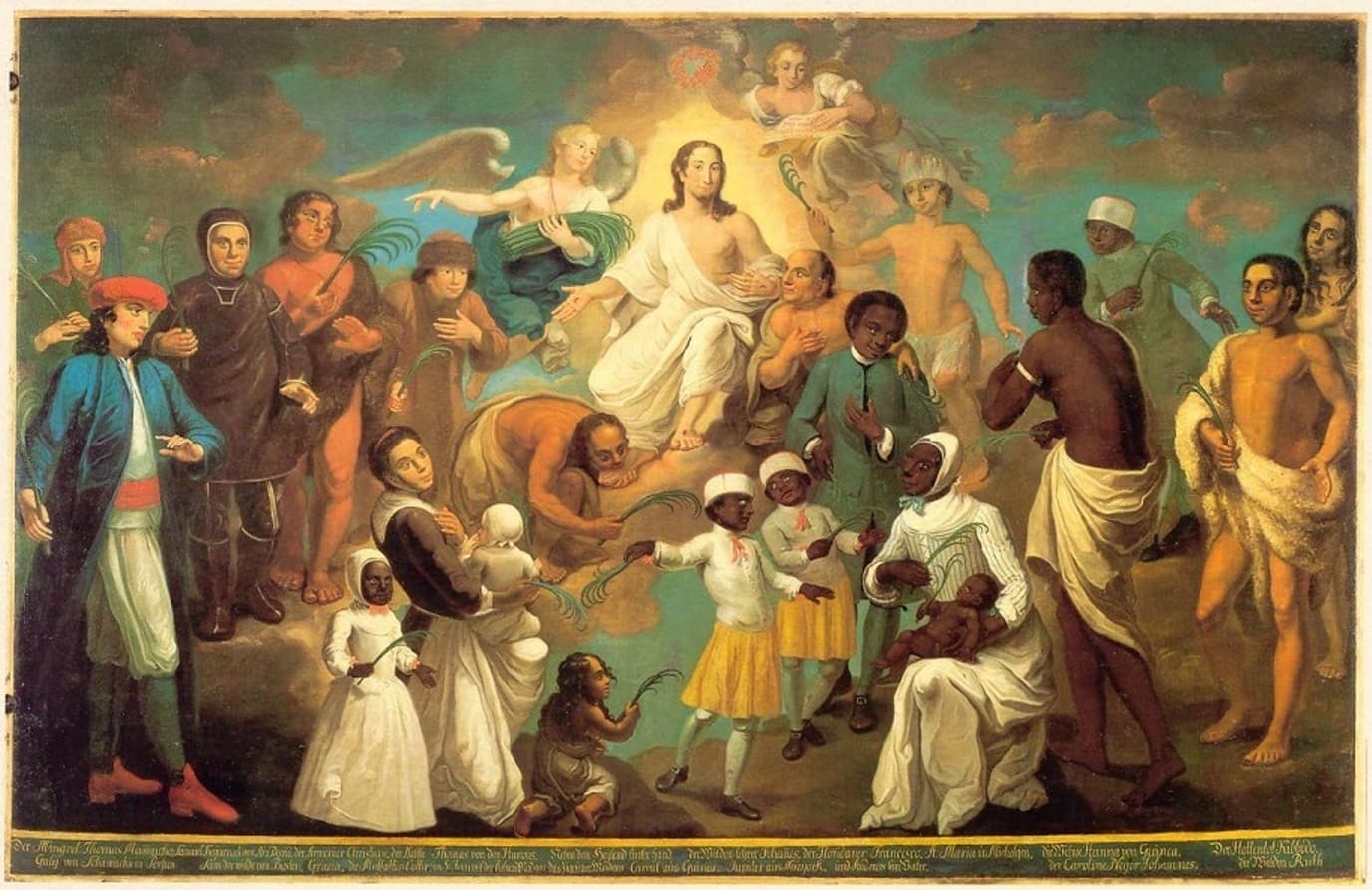
Johann Valentin Haidt, The First Fruits, 1747. Public domain.
AD 1747 · Story · Featured Study
The First Fruits Painting
Haidt's canvas of 1747 names converts of the Moravian missions from Greenland, Persia, Africa and the Americas.
- When
- March to May 1747
David Cranz, the church's own historian, wrote that the picture “has excited many beholders to praise and glorify God.”
These are the ones who have not been defiled with women, for they are virgins. They follow the Lamb wherever He goes. They have been redeemed from among men as firstfruits to God and to the Lamb.
Summary
The First Fruits is a painting of 1747 by Johann Valentin Haidt, made for the Moravian congregation at Herrnhaag. It gathers the dead converts of the Brethren's missions around Christ on His throne.
- Cranz writes that the first converts of the Tatars and of the Arawaks in Berbice, then still living, were left out of the picture.
- Levering wrote in 1903 that nearly all the oil portraits in the church archives at Bethlehem are Haidt's work.
- Hutton writes that the Moravian Church later rejected Zinzendorf's First Fruits Idea.
The Verse Written on the Picture
The name comes from the superscription.
Cranz writes that the figures stand under a superscription from the fourteenth chapter of Revelation.
The Names in the Picture
Each figure stands with the people Cranz gives him or her.
Cranz numbers sixteen entries, and two men born of Christian parents stand beside them.
| Cranz's number | Name | Who Cranz says he or she was |
|---|---|---|
| 1 | Sam | A native of New England |
| 2 | Samuel Kajarnak | The first Greenlander |
| 3 | Guly | A Persian woman |
| 4 | Thomas | A native of Canada |
| 5 | Catharine, with the girl Rebecca | A woman of mixed birth from St Jan, with a Black girl |
| 6 | Gratia | A Black woman |
| 7 | Catharine | A Romani girl given to the girls' house at Herrnhaag after her mother was shot |
| 8 | John | A Mahican, a teacher among his people |
| 9 | Andrew, with his son Michael and Anna Maria | A Black man, his son in the arms of a single Black woman |
| 10 | Carmel, later called Joshua | A boy of Guinea whom Leonhard Dober bought in St Thomas |
| 11 | Jupiter, called Joshua | A Black man of New York |
| 12 | Francesco | A native of Florida |
| 13 | Hannah | A widow of Guinea |
| 14 | John | A Black man of South Carolina |
| 15 | Kibbodo, called Jonas | A Khoikhoi man (Cranz's word is Hottentot) |
| 16 | Ruth | An Indian woman |
| Beside them | Christian Zedmann and Thomas Mammucha | An Armenian and a Mingrelian, born of Christian parents |
7, 8, 9, 10, 11, 12, 13, 14 and 3 more
The Story From John's Death to the Canvas at Zeist
John the Mahican's death in 1747 began the work, and Haidt copied it for the mission congregations.
News that John, the first convert and teacher of the Mahicans, had died reached the congregation at Herrnhaag on 15 March 1747, as the Moravian Archives at Bethlehem date it.
Cranz writes that his death gave occasion to reckon up all the first fruits of the missions who had died in the faith up to 1747, and to paint them in their natural colours and in the dress of their own country.
And they sang a new song: “Worthy are You to take the scroll and open its seals, because You were slain, and by Your blood You purchased for God those from every tribe and tongue and people and nation.This verse is MannaFest's choice for a company drawn from many peoples before the throne.
Haidt began the work that March, and by the beginning of May the life-size painting was finished and hung in the conference room beside the hall at Herrnhaag.
Zinzendorf had counted eighteen first fruits, and Haidt painted three more. Christ shows the wounds in His hands and feet, and John sits at His feet.
After this I looked and saw a multitude too large to count, from every nation and tribe and people and tongue, standing before the throne and before the Lamb. They were wearing white robes and holding palm branches in their hands.The Moravian Archives read the palms in the figures' hands from this verse.
Spangenberg reports that Zinzendorf once warned the brethren to beware of the idea of converting great multitudes.
Hutton calls this Zinzendorf's First Fruits Idea, and he writes that nothing throws a clearer light on Zinzendorf's missionary policy than the painting.
So he started out, and on his way he met an Ethiopian eunuch, a court official in charge of the entire treasury of Candace, queen of the Ethiopians. He had gone to Jerusalem to worship,Zinzendorf's rule of 1732 holds up the Ethiopian of this chapter as the seeker to look for.
Haidt painted versions for Neusalz, Herrnhut, Bethlehem and St Thomas, and the one for Bethlehem hangs in the Moravian Archives there.
But I ask, did they not hear? Indeed they did: “Their voice has gone out into all the earth, their words to the ends of the world.”This verse is MannaFest's choice, set beside the copies sent out to the mission congregations.
Acts 8:27, Romans 10:18
Where the Painted Converts Died
Hutton places nine of the deaths in German congregations.
Hutton's list says that Guly the Persian, Thomas Mammucha, Gratia, the Romani girl Catharine and Anna Maria died at Herrnhaag. Hannah died at Herrnhut, and the two babies Michael and Pocco, who was born in Berbice, at Marienborn.
Hutton has Carmel die at Herrnhut a year after his baptism. Sam was buried at New Herrnhut, and Francesco drowned in a river in Surinam.
Who Tells the Story
Two historians of the Moravian Church and its archive at Bethlehem tell it.
David Cranz wrote the church's own history in German in 1772, and Benjamin La Trobe put it into English in 1780. J. E. Hutton, also a historian of the Moravian Church, gave a second list in A History of Moravian Missions (1922).
The Moravian Archives at Bethlehem told the making of the painting in a paper of March 2007.
What the Record Leaves Unsaid
Some questions have no answer in the sources.
The sources give no account of the painting by Haidt himself, and none says who chose the three figures Haidt added. Cranz gives a year of death for Carmel alone, 1736.
The Picture Beside the Mission's Record on Slavery
Hutton, the church's own historian, records that its mission held slaves.
The painting sets Black converts and converts from the slave islands beside converts from Greenland and Persia.
Zinzendorf spoke to the enslaved converts at St Thomas on 15 February 1739. In Hutton's English he told them that “God punished the first negroes by making them slaves.”
Hutton adds that Zinzendorf had no sympathy with emancipation and thought it wrong to teach slaves to read and write.
When Frederick Martin bought a plantation with money sent from Herrnhut, Hutton writes, the Moravian Church became the owner of the slaves who worked on it. Hutton's history of 1909 says plainly that the Brethren never came forward as champions of liberty, since Zinzendorf himself was a firm believer in slavery.
There is neither Jew nor Greek, slave nor free, male nor female, for you are all one in Christ Jesus.This verse is MannaFest's choice for the claim the painting makes and the mission's practice did not keep.
In Their Own Words
Zinzendorf, a missionary and a Mahican convert speak of the missions in their own words, Zinzendorf twice.
Nicolaus Ludwig von Zinzendorf (1700 to 1760)
His words in his last days, in August Gottlieb Spangenberg, The Life of Nicholas Lewis Count Zinzendorf, page 502
Thousands of them
“Did you suppose, in the beginning, that the Saviour would do as much as we now really see, in the various Moravian settlements, amongst the children of God of other denominations, and amongst the heathen? I only entreated of Him a few first-fruits of the latter, but there are now thousands of them.”
Moravian
About this saying1 paragraph
In his last days Zinzendorf counted what the missions of the eighteenth century had grown to.
Nicolaus Ludwig von Zinzendorf
Letter of 12 April 1732, in J. E. Hutton, A History of Moravian Missions, pages 20 to 21
Seekers after the truth
“You are not to aim at the conversion of whole nations: you must simply look for seekers after the truth who, like the Ethiopian eunuch, seem ready to welcome the Gospel.”
Moravian
About this saying1 paragraph
Zinzendorf set his missionaries their rule in 1732.
Leonhard Dober (1706 to 1766)
Letter of 16 June 1732, in J. E. Hutton, A History of Moravian Missions, page 21
Ready to become a slave
“I know the grace of Christ myself, and I know that in St. Thomas there are slaves who cannot believe because they have not heard. If another Brother will go with me, I am ready to become a slave myself.”
Moravian
About this saying1 paragraph
Dober asked to be sent to the West Indies in 1732.
Tschoop
His account to the Brethren, in J. E. Hutton, A History of Moravian Missions, pages 86 to 87
Preach Christ
“I say, therefore, Brethren, preach Christ our Saviour, His sufferings and death, if you wish your words to gain entrance among the heathen.”
Moravian
About this saying1 paragraph
Tschoop, a Mahican convert of the eighteenth century, ended the story of his own conversion with this counsel.
Leonhard Dober, Tschoop
Where Historians Disagree
Cranz, Hutton and the Moravian Archives answer two questions differently.
How many figures does it show?2 paragraphs
Cranz's list of 1780 and the Moravian Archives at Bethlehem give twenty-one figures.
Against that count, Hutton's list of 1922 gives twenty-two names, one of them a baby whom Cranz does not name.
Which canvas is the original?2 paragraphs
The Moravian Archives at Bethlehem hold that the canvas of 1747 went to Zeist in 1753, and the Commons record follows them.
Against that reading, Hutton heads his list Original Painting at Herrnhut, and calls the canvas at Zeist a reproduction.
Books to Read Next
Three free books tell the story, the first of them the church's own history.
The Ancient and Modern History of the Brethren
David Cranz, translated by Benjamin La Trobe · 1780
It gives the occasion of the painting and Cranz's list of its names.
Read it free onlineA History of Moravian Missions
J. E. Hutton · 1922
It prints a second list of the figures with their places of death, and the mission's record on slavery.
Read it free onlineThe Life of Nicholas Lewis Count Zinzendorf
August Gottlieb Spangenberg, translated by Samuel Jackson · 1838
It tells Zinzendorf's rule of the first fruits in the words of his colleague.
Read it free onlineWhat the Picture Left
The First Fruits left the Brethren the faces and the names of their first converts, kept together in one picture.
Sources
Scripture is the Berean Standard Bible.
- The Holy Bible, Berean Standard Bible (read 2026)
- David Cranz, The Ancient and Modern History of the Brethren, translated by Benjamin La Trobe (London, 1780), section 140, pages 333 to 334, and page 186.
- David Cranz, Alte und Neue Brüder-Historie (Barby, 1772), section 140.
- J. E. Hutton, A History of Moravian Missions (London: Moravian Publication Office, 1922), pages 20 to 21, 39 to 45, 86 to 87, 183 to 198 and the appendix, pages 529 to 530.
- J. E. Hutton, A History of the Moravian Church (1909)
- August Gottlieb Spangenberg, The Life of Nicholas Lewis Count Zinzendorf, translated by Samuel Jackson (London: Samuel Holdsworth, 1838), pages 304 to 305, 367 and 502.
- Moravian Archives, Bethlehem, This Month in Moravian History, number 17 (March 2007), Haidt's Painting of the First Fruits, 1747.
- Joseph Mortimer Levering, A History of Bethlehem, Pennsylvania, 1741-1892 (Bethlehem: Times Publishing Company, 1903), pages 277 to 278 and 523.
Keep Studying
People and groups5